
Annual Plan 2026–27
Annual Plan 2026–27
The Victorian Auditor-General’s Annual Plan 2026–27 was prepared pursuant to the requirements of section 73 of the Audit Act 1994 and tabled in the Parliament of Victoria on 24 June 2026.
1. Introducing our annual plan
What we do
Our role
The Auditor-General is an independent officer of the Victorian Parliament who is supported by the Victorian Auditor General's Office (VAGO).
We provide assurance to Parliament and the Victorian community about how effectively and efficiently public sector agencies provide services and use public money.
Our work
Our vision is to support better lives for Victorians. We achieve this through an annual program of financial and performance audits and limited assurance reviews of public sector agencies. This work is guided by VAGO’s Strategic Plan 2025–29, which sets the direction and focus of our assurance role in support of a more open and accountable government and better public services. Our 3 key result areas are our audit services, systems and methods, and workforce.
Our work examines:
- how effective, efficient and economical government agencies, programs and services are
- how well government agencies manage their resources
- opportunities for government agencies to improve their management practices and systems
- if government agencies are fairly presenting their annual financial statements and performance statements
- if government agencies are complying with legislation and other requirements
- if there is wastage or a lack of probity in the way that public resources are being managed.
Our forward work program
Our annual plan
Under the Audit Act 1994, the Auditor-General must table in Parliament an annual plan describing their proposed work program by 30 June.
This annual plan describes our 3-year forward work program.
It includes detailed information on the 22 performance engagements, 2 financial results of audit reports and the Auditor-General's Report on the Annual Financial Report of the State of Victoria we plan to table in Parliament in 2026–27.
Our rolling planning cycle
We plan our work on a 3-year rolling cycle. Each year, we review our planned topics to ensure they are still relevant. We also make updates based on recent events, new government initiatives and in response to feedback from Parliament, government agencies and the community.
Our approach allows us the flexibility to add in important performance engagements that may emerge during the year.
Sometimes we may identify a topic that is sufficiently urgent to warrant replacing a topic already listed in a previously published annual plan. In these cases, we may defer a topic to a later year or cancel it altogether. We make these changes transparent by publishing a reconciliation of all previously published topics (Appendix C).
Who we audit
We audit more than 500 public sector organisations. This includes:
- public bodies, such as government departments, agencies and local councils
- state-owned companies
- entities that are not public bodies, but we agree to audit as a public-purpose arrangement under the Audit Act 1994.
These organisations cover a range of sectors. Each year, we list the entities we audited in the latest audit cycle in Appendix B of our Transparency Report.
We can also audit non-government organisations to see if they have used public money to deliver public services as intended.
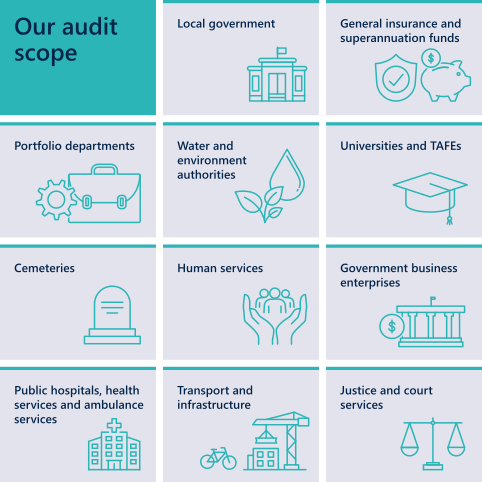
Figure 1: Sectors within scope of audits
How we share our work
We deliver reports to Parliament that summarise the results of our financial and performance engagements.
Our recurring financial audit reports are:
- the Auditor-General's report on the Annual Financial Report (AFR) of the State of Victoria
- results of audits on the financial outcomes and risks to financial sustainability of the:
- local government sector
- TAFE and university sectors.
We also publish reports on the findings and recommendations from our performance audits and reviews.
Sometimes we publish dashboards to accompany our reports. Dashboards visualise key financial data and make our findings more accessible to Parliament and the public.
Who we consult with
Consulting with the Public Accounts and Estimates Committee
The Audit Act 1994 requires us to submit a draft of our Annual Plan to the Public Accounts and Estimates Committee (PAEC) for its consideration. We value PAEC's input and suggestions.
The Audit Act 1994 requires us to note in our Annual Plan any PAEC suggestions that the Auditor-General has not adopted.
Consulting with public sector agencies
We also consult with the government departments and agencies that we propose to include in our engagements. We give them the opportunity to provide feedback throughout the planning process.
2. Our financial audit work program
Financial auditing
What we do
Our financial audit services help maintain accountability, transparency and effective financial administration within the Victorian public sector. Our audit opinions provide Parliament and the community with confidence that financial reports and performance statements are reliable for informed decision-making.
Our parliamentary reports and dashboards provide information, insights and recommended improvements to help decision-makers.
Financial report audits
Our audit of an entity’s financial report assesses if it presents financial results and information fairly, in accordance with relevant standards and legislation. We provide an independent opinion on the financial report, confirming the reliability of the published financial information.
Performance statement audits
We also audit the reliability and completeness of performance statements prepared in the local government, TAFE (Technical and Further Education) and water sectors and provide an independent audit opinion reflecting this.
Performance statements contain target and actual results against mandatory performance indicators established through Ministerial direction. Our assurance confirms the reliability of the published performance information.
Auditor-General’s Report on the Annual Financial Report of the State of Victoria
A significant piece of assurance we provide Parliament and the Victorian community is the Auditor-General’s audit opinion on the State of Victoria's AFR.
The AFR is a consolidation of the financial results of over 270 state-controlled entities. While we audit and provide opinions on the individual financial reports of these entities, we also audit and provide an opinion on the consolidated AFR.
Our opinion of the AFR provides assurance that the published financial outcomes of the State of Victoria, and within that the general government sector, are reliable. This means information can confidently be used to inform decisions.
This report is the only report to Parliament that we must make under section 57(1) of the Audit Act 1994. The act provides that we may comment on, and make recommendations about, more effective and efficient management of public resources and about proper accounts and records.
We use this report to provide our independent perspectives on the state of finances. We also prepare a dashboard as a companion product to our audit opinion on the AFR to Parliament. It brings together current and historical financial information for the Victorian general government sector reported in past state budgets and opinions on the AFR.
Review opinion on the state Budget
Each year, the government prepares estimated financial statements as part of its budget as required by the Financial Management Act 1994. This is often referred to as the state Budget.
The purpose of the estimated financial statements is to set out the projected financial results for the Victorian general government sector based on the government's stated and expected financial policies and assumptions.
The Audit Act 1994 requires the Auditor-General to conduct a review of the estimated financial statements to confirm they have been prepared consistent with stated accounting policies, targets specified in the current financial policy objectives, and strategies and assumptions outlined.
The Auditor-General’s report is included in Budget Paper 5: Statement of Finances, Chapter 1 – Estimated financial statements for the general government sector.
Grant acquittals
Where public sector entities are publicly funded, entities can also be given grants to provide specific services to the community. Entities must use these funds appropriately and per the terms and conditions of the grant agreement.
Part of our work is understanding and testing the use of grants to provide confidence that public funds are used as agreed.
Results of audits
Our results of audits reports analyse local government, TAFE and university sectors' financial outcomes and risks to financial sustainability. We highlight common internal control and financial reporting issues and make recommendations for improvement.
The reports provide entities within the relevant sector, and their stakeholders, with recommended areas of improvement to reliably manage resources. We aim to table these reports within 5 months of the relevant sector's financial year end.
As with other reports to Parliament, we produce a dashboard as a companion product to each report. These dashboards allow users to explore the individual financial outcomes of entities and gain an overall sector perspective.
Our outputs
Based on our audit profile for the latest audit cycle, we expect to deliver the following in 2026–27 (Figure 2).
Figure 2: Opinions to be delivered in 2026–27
| Audit opinions | Number |
|---|---|
| Opinions on entities' financial reports | 529+ |
| Opinions on entities' performance statements | 108 |
| Opinions on the AFR | 1 |
| Review opinions | |
| Estimate financial report review opinion | 1 |
| Grant acquittal certifications | |
| Grant acquittal certifications | 99+ |
How we deliver our work
Our financial auditors
Our financial audit division, in conjunction with external audit firms, deliver financial audit services to our clients in the public sector.
We are structured by sector:
- education
- environment
- health and integrity
- human services, hospitals and housing
- infrastructure and transport
- justice and community safety
- local government
- whole of government.
We operate under a hybrid working model, which matches work modes with situations and needs. We combine the best of office-based and virtual work, empowering our staff to decide what works for them.
Our audit service providers
As our work program is significant, we supplement our workforce with 8 empanelled external audit firms from across Victoria. These audit service providers undertake audit work on our behalf.
Our audit service providers are our agents and therefore must adhere to the same capability, ethical requirements and quality control systems we hold ourselves to. We undertake considerable oversight throughout an audit cycle to ensure their services are consistent with our requirements.
Our financial audit process
Our process
We use a risk-based methodology and conduct our financial audits in accordance with the Audit Act 1994 and the Australian Auditing Standards. As part of an audit, we:
- identify and assess the risks of material misstatement of a financial report (whether due to fraud or error), design and perform audit procedures responsive to those risks, and obtain audit evidence that is sufficient and appropriate to provide a basis for an opinion
- obtain an understanding of internal controls relevant to the audit to design audit procedures that are appropriate in the circumstances
- evaluate the appropriateness of accounting policies used and the reasonableness of accounting estimates and related disclosures
- conclude on the appropriateness of using the going-concern basis of accounting
- evaluate the overall presentation, structure and content of the financial report, including the disclosures, and whether the financial report represents the underlying transactions and events in a manner that achieves fair presentation.
Our methodology
To guide us in undertaking our financial audits, we have developed our audit methodology to support compliance with our standards and legislative requirements.
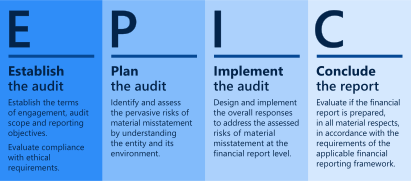
Our EPIC methodology integrates audit policy, guidance and procedures designed for the public sector to ensure we are testing the control systems of an entity's financial administration appropriately. We undertake 4 major processes.
Figure 3: Audit processes
How we communicate with our clients
We communicate throughout an audit to those charged with governance in each entity. While some of the key deliverables are required by legislation, others play a key role in effectively communicating our insights on the financial performance and position of an entity and its compliance with relevant reporting requirements.
| Key deliverable documents include our ... | which ... |
|---|---|
| engagement letter | sets out the terms on which we undertake our audit, and the respective roles and responsibilities of both the preparer and auditor. |
| audit strategy | demonstrates our understanding of the audit context, our assessment of financial reporting risks and our proposed response to these risks. |
| audit fee letter | provides management with an estimate of the reasonable audit costs based on our audit strategy. |
| management letters | describe significant control and financial reporting weaknesses found during the audit and provide recommendations to address those weaknesses. |
| closing report | details our audit findings and our conclusion on whether the financial report complies with the relevant reporting framework and is free from material misstatement. |
| audit report | includes our audit opinion – this is the statutory report we are required to provide, and it must be appended to the entity’s annual financial report. |
| independence declaration (where required under specific legislation) | declares that we comply with the independence requirements of the Accounting Professional & Ethical Standards Board. We are only required to declare our independence for audits of financial reports where certain legislation applies, such as the Corporations Act 2001 (Commonwealth). |
Timing of services
Most of our annual financial audits relate to entities with financial year-end dates of 30 June and, to a lesser extent, 31 December. This means there is a strong focus on delivering financial audits between July and September.
We work progressively across the entire calendar year to enable the efficient and effective use of our workforce and delivery of our services.
Audit fees
The audit work we provide to the Victorian public sector funds our financial audit division. Under section 29 of the Financial Management Act 1994, our audit fees must be determined based on reasonable cost recovery. This means our people and our work must be effective and efficient.
3. Our performance engagement work program
Performance engagements
What we do
Our performance engagements assess if government agencies are delivering their programs and services effectively, economically and efficiently, and complying with relevant laws.
Under the Audit Act 1994 we can do 2 types of performance engagements:
| Our ... | provide ... | This means we are ... |
|---|---|---|
| performance audits | reasonable assurance about an agency's performance. | highly confident in the accuracy of our conclusions. |
| performance reviews | limited assurance about an agency's performance. | moderately confident in the accuracy of our conclusions. |
Limited assurance reviews are often completed more quickly than audits because they rely on less evidence. They also typically have a narrow scope with a focus on waste, probity or compliance. We use reviews to:
- quickly respond to emerging issues
- examine less complex activities.
By contrast, our audits require extensive evidence-gathering and substantiation. They typically focus on system-level issues and examine people-centred, complex or costly activities.
Our reports
Once we complete a performance engagement we table a report in Parliament that describes our findings. We may also publish an online dashboard to share important data and help readers visualise key findings.
Our reports promote accountability and transparency in government and provide assurance to Parliament about how agencies deliver their work. Where relevant, our reports include recommendations that aim to help agencies improve their performance.
How we deliver our work
Our methodology
We have developed a risk-based methodology to guide our work and support compliance with the Audit Act 1994 and the Australian Auditing and Assurance Standards.
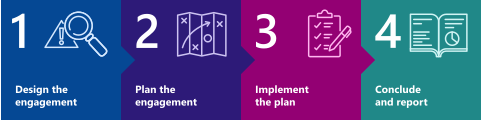
Our methodology is made up of manuals, guidance and procedures that outline the 4 phases of a performance engagement. Throughout all phases we test our findings with agencies to ensure we have a fair and balanced understanding of their work and performance.
Figure 4: Phases of a performance engagement
| In phase ... | we ... |
|---|---|
1
|
|
2
|
|
3
|
|
4
|
|
The 3 'Es'
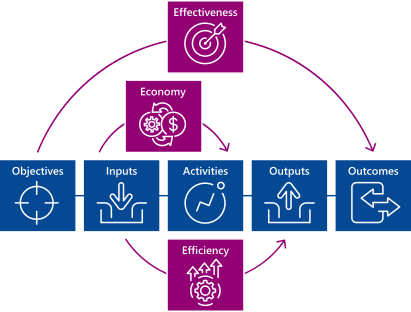
The concepts of economy, effectiveness and efficiency are central to how we assess agencies' performance during an engagement. The 3 Es are described in our legislation and the Australian Auditing and Assurance Standards.
We also focus on compliance and may examine if an agency follows all relevant laws. We can consider compliance alongside economy, effectiveness and efficiency, or as a standalone focus.
| We use ... | to examine if an agency has ... | An example is if the ... |
|---|---|---|
| economy | minimised the cost of delivering a service or program, within operational requirements. | auditee can demonstrate that it purchased its resources at fair market price. |
| auditee competitively sourced its resources (for example, people, advertising or a digital system) to administer the grant program. | ||
| effectiveness | achieved its objectives at the program or service level or as a whole entity. | Department of Jobs, Skills, Industry and Regions' travel voucher scheme increased Victorian tourism. |
| efficiency | minimised inputs to deliver their intended outputs or maximised outputs for a given level of input (in terms of quality, quantity and timing) | cost of delivery per travel voucher met a best practice benchmark for grant delivery. |
| cost of overall delivery using the automated digital service platform was less than the cost using the previous manual system. |
Relationship between the 3 Es
Taken together, these concepts help us design our performance engagements to assess how well government agencies are delivering their services and programs, and if they are using public money as intended.
Figure 5: Relationships between the 3 Es
Delivering our work program
Our planning process
We aim to design a work program that delivers reports that are credible, relevant, timely and informative for both Parliament and the community.
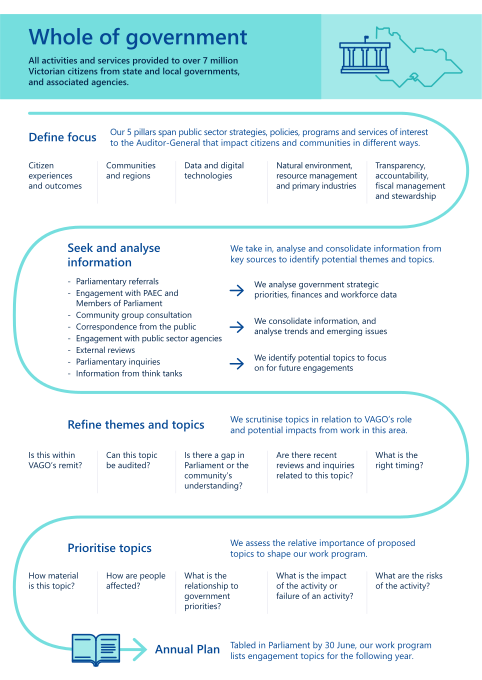
The range of issues and topics we could focus our performance engagements on is vast. We use our strategic planning framework to narrow our focus to the most significant issues facing Victorians. We also consider topics where our assessment can have the most impact and influence.
Our framework is detailed in Figure 6.
Figure 6: Our planning framework
How we identify potential topics
Each year we can deliver around 20 performance engagements. This depends on a range of factors, such as:
- available resources
- the complexity and breadth of each proposed engagement
- the availability and timeliness of the provision of data and information by auditees.
We use information from a range of sources to help develop potential topics. These include:
- referrals from Members of Parliament
- issues that citizens, community groups or advocacy groups have raised through correspondence to the Auditor-General or through our stakeholder consultation processes
- issues raised by government departments
- information we gather from external reports, data analysis, budget papers, annual reports and other sources.
We also use information from our financial audit work program to identify potential topics for performance engagements.
Refining themes and topics
We use our planning framework to refine our themes and topics. When deciding if we should focus on a topic we consider:
- the risk associated with a particular government service, program or project and the consequences of potential underperformance
- if there are clear performance standards against which the service, program or project can be measured
- if there is a reasonable expectation that a gap exists between an agency's performance and the standard we would expect to see
- if there is sufficient, reliable data available for us to measure an agency's performance outcomes.
Over the next 3 years our performance engagement program will focus on a broad range of services, programs and projects. This will help us to provide transparent information about agency performance to the Victorian Parliament and the community.
We continue to strengthen how we engage with First Nations people and communities in shaping our work program. Our Reconciliation Action Plan, endorsed by Reconciliation Australia, guides our approach to respectful engagement and dialogue. In line with this work, we will continue to build our understanding of issues that matter to First Nations communities and consider how our audits can meaningfully reflect these perspectives.
Creating a balanced program
After we consider the merits of each individual potential topic, we assess all proposed topics as a program.
This helps us make sure our program is balanced and relevant. Factors we consider include:
- the significance of each proposed engagement, including its relationship to government priorities
- the risks associated with a service area or program and the consequences of poor performance
- the overall balance of themes, issues and engagement types (audits and reviews)
- any resourcing and timing matters.
Our follow-up engagements and engagement series
When we develop our forward program, we always consider the relationship between our proposed engagements and past reports to decide if we should develop any follow-up engagements.
A follow-up engagement may focus on whether public sector entities have implemented recommendations from previous performance audits. This includes progress, accountability and whether public sector entities have addressed performance, efficiency and compliance gaps.
4. 2026–27 parliamentary reports
Overview
Our planned 2026–27 reports
In 2026–27, we plan to table in Parliament:
- 3 financial audit reports (see Section 2 for more detail):
- Auditor-General's Report on the Annual Financial Report of the State of Victoria: 2025–26
- Results of 2025–26 audits: local government
- Results of 2026 audits: TAFEs and universities
- 22 performance engagement reports. This includes 17 reports on performance audits and 5 on performance reviews.
Our 3-year performance engagement work program
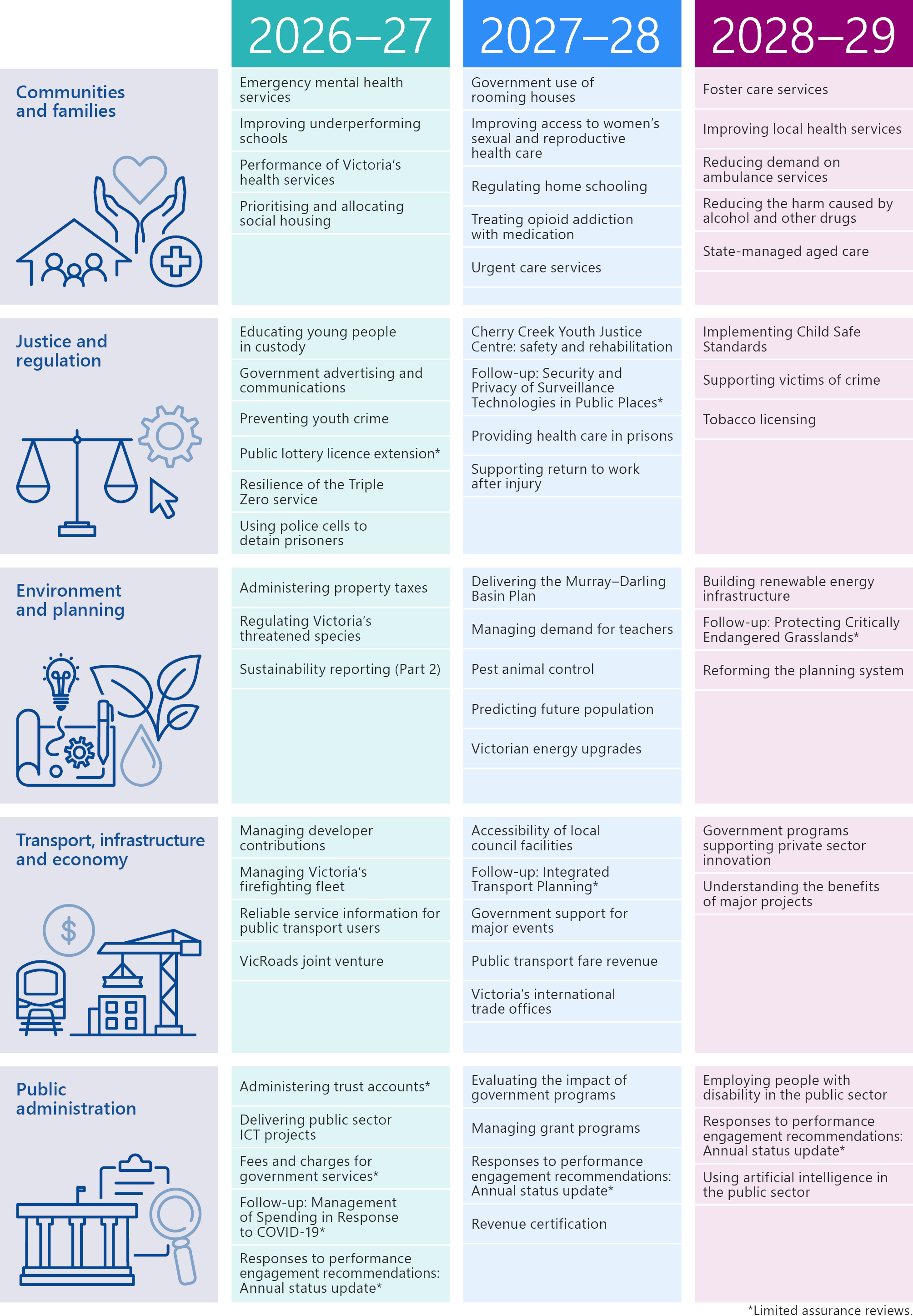
Proposed engagement topics for 2026–27
Administering property taxes
Why this is important
Property taxes are increasing as a share of government revenue. They are also identified as a key funding source for some major government infrastructure projects.
Property taxes have become more complex in recent years as the government has changed some taxes (such as land tax) and introduced new ones (such as the windfall gains tax).
When property taxes are calculated or collected incorrectly, or people are uncertain when they apply, there can be extra costs for taxpayers and businesses, and the community can lose confidence in the tax system.
This engagement will examine if the Valuer-General Victoria values property reliably and if the State Revenue Office calculates its assessments in line with relevant legislation and policies.
What we plan to examine
We plan to examine if property tax assessments are administered effectively and in accordance with relevant legislation and controls.
Who we plan to examine
Department of Transport and Planning
Department of Treasury and Finance
State Revenue Office
Valuer-General Victoria
Administering trust accounts (limited assurance review)
Why this is important
A trust account is used to manage money received, held and used for a specific purpose. Some trust accounts are hypothecated. This means that funds in these accounts can only be used for the purposes outlined in legislation. Victoria has hypothecated accounts that fund a wide range of activities, including preventing gambling harm, providing infrastructure in growing urban areas, and maintaining parks and gardens.
On 30 June 2025, Victoria had $19.2 billion in trust accounts. The major trust accounts include the Community Support Fund that receives a percentage of revenue generated from electronic gaming machines (which had a balance of $323.8 million) and the Sustainability Trust Fund (which had $545.7 million).
The Department of Treasury and Finance and other departments administer trust funds on behalf of the government according to their special purpose. This may include investing money in bank deposits and other financial investments.
There is no aggregated public reporting on the number and total value of Victoria's various trust accounts. Although departments report publicly on trust account balances, they do not always need to report on how they use money from trust accounts. This means the public has little insight into whether trust accounts are achieving their intended outcomes.
What we plan to examine
We plan to examine if departments administer trust accounts transparently and for their intended purposes.
Who we plan to examine
All departments
Delivering public sector ICT projects
Why this is important
Information and communication technology (ICT) is central to how governments deliver programs and services to the community. ICT projects often aim to increase productivity, improve information management or streamline administration.
The Department of Government Services reports on the progress of public sector ICT projects with budgets over $1 million. In June 2025, there were 243 active projects with a combined value of $3.3 billion. Over a third were facing issues, including timeline delays and budget concerns.
Over the last 20 years, our reports have identified a range of challenges public sector ICT projects face. These include weaknesses in governance and oversight, lack of technical capability and poor contract management.
In late 2025, the government's response to the Independent Review of the Victorian Public Service announced plans to improve the efficiency of service delivery by increasing digitisation, especially for back-office functions. It is important that agencies understand common weaknesses in past ICT project implementation to ensure new projects have the best chance of success.
What we plan to examine
We plan to examine if public sector ICT projects are being delivered on time, within budget and achieving their intended benefits.
Who we plan to examine
Department of Government Services
A selection of government agencies
Further information
This engagement builds on our reports:
The Victorian Government ICT Dashboard (2018)
Digital Dashboard: Status Review of ICT Projects and Initiatives – Phase 2 (2016)
Digital Dashboard: Status Review of ICT Projects and Initiatives (2015).
Educating young people in custody
Why this is important
Young people in detention are among the most disadvantaged in the state, often having experienced socioeconomic hardship, family instability and substance abuse. Many have also been affected by trauma, which can disrupt brain development and impair cognitive growth, leading to long‑term challenges.
Education plays a critical role in rehabilitation by contributing to better employment outcomes, improved literacy and numeracy and the development of important life skills.
The Department of Education is responsible for delivering education and training to young people in custody, including through Parkville College – a specialist government school that provides learning programs for students in custody.
Ensuring these young people receive the right educational and training support is essential to help them overcome barriers to learning and improve their future opportunities.
What we plan to examine
We plan to examine if Victoria's youth justice education and training meets the needs of young people in custody.
Who we plan to examine
Department of Education
Department of Jobs, Skills, Industry and Regions
Department of Justice and Community Safety
Emergency mental health services
Why this is important
Mental illness has a profound impact on the wellbeing, safety and social participation of many Victorians. One in 5 Victorians experience mental illness each year. In 2023–24, over 92,000 people accessed mental health services and there were over 110,000 emergency department presentations for mental health concerns.
Emergency mental health services should be accessible, effective and responsive to the needs of people in crisis, regardless of where they live. But the Department of Health reported that in the last quarter of 2024–25, only 40 per cent of inpatients in metropolitan emergency departments were able to access a mental health bed within 8 hours of their arrival, compared with 50 per cent of inpatients in rural hospitals.
Despite significant government investment and reforms following the Royal Commission into Victoria’s Mental Health System, the department consistently underperforms on key targets, such as timely transfer to mental health beds. These issues disproportionately affect groups experiencing disadvantage, including First Nations people and people in remote areas.
What we plan to examine
We plan to examine if the Department of Health's emergency mental health services are timely and accessible for all Victorians experiencing poor mental health. This includes how the Department of Health and health services plan and allocate resources and evaluate services.
Who we plan to examine
Department of Health
A selection of health and mental health service providers
Further information
This builds on our reports:
Access to Emergency Healthcare (2024)
Access to Mental Health Services (2019).
Fees and charges for government services (limited assurance review)
Why this is important
Government agencies charge and manage a range of regulatory fees and service user charges. These include fees for applications, registrations, licences, identity documents and permits to access or use natural resources.
In July 2020, the government released the Pricing for Value Guide to support agencies to set their fees and charges. It aims to support agencies to recover the full cost of regulating and delivering services.
However, agencies may set their fees below or above cost recovery – either in recognition that some people are less able pay, or to fund a more specialised or higher level of service.
Given that many fees and charges are for services or products where there is no market competition, it is important that agencies are transparent about how they are set.
What we plan to examine
We plan to examine if agencies set and report on service fees and charges fairly and transparently.
Who we plan to examine
A selection of departments and agencies
Follow-up: Management of Spending in Response to COVID-19 (limited assurance review)
Why this is important
During a crisis, departments need to respond rapidly to unexpected events. However, departments still need to be transparent and accountable for how they spend public money.
Our 2021 report Management of Spending in Response to COVID-19 found that not all departments effectively managed their spending during the pandemic. There were gaps in some procurement processes and grant management. Departments were also not tracking and reporting their COVID-19 related spending in transparent ways.
Our 2023 Auditor-General’s Report on the Annual Financial Report of the State of Victoria: 2022–23 also looked at COVID-19 business support grants. It found that the former Department of Jobs, Precincts and Regions did not have effective controls in place to minimise the likelihood of fraud and error, and recommended that it evaluate its grants programs.
Since 2021, some departments have reported on the continued financial impact of COVID-19. This includes disclosing reductions in the value of personal protective equipment bought during the pandemic and acknowledging that they paid some COVID-19 business support grants in error.
However, because departments report this information individually, there is still limited transparency around the ongoing impact of pandemic-related spending across the government. This engagement will improve transparency and assess departments' progress implementing our recommendations.
What we plan to examine
We plan to examine if departments implemented our recommendations from Management of Spending in Response to COVID-19 (2021) and the Auditor-General’s Report on the Annual Financial Report of the State of Victoria: 2022–23, with a focus on how agencies are reporting the ongoing financial impact of their COVID-19 related expenditure.
Who we plan to examine
All departments
Further information
This builds on our reports:
Management of Spending in Response to COVID-19 (2021)
Auditor-General’s Report on the Annual Financial Report of the State of Victoria: 2022–23 (2023).
Government advertising and communications
Why this is important
Government agencies regularly communicate with the public about important issues, such as services, changes to the law, and health and safety. Government advertising and communications appear in a range of formats, including print, radio, television, outdoor displays and online or other digital platforms.
Agencies need to comply with a range of laws to ensure government advertising and communication is apolitical and in the public interest. This includes the Public Administration Act 2004 and Privacy and Data Protection Act 2014.
Our 2022 report Government Advertising examined 2 advertising campaigns in detail and found that they were not apolitical. We also found that agencies did not always evaluate their campaigns and that their reporting on advertising costs was incomplete.
Since 2022, agencies have increased their use of social media advertising. It is important that agencies are supporting their staff to share apolitical content and manage privacy risks regardless of whether they are delivering messages online or through more traditional formats.
What we plan to examine
We plan to examine if government advertising and communications comply with required standards and are cost-effective.
Who we plan to examine
Department of Education
Department of Energy, Environment and Climate Action
Department of Families, Fairness and Housing
Department of Government Services
Department of Health
Department of Jobs, Skills, Industry and Regions
Department of Justice and Community Safety
Department of Premier and Cabinet
Department of Transport and Planning
Department of Treasury and Finance
Suburban Rail Loop Authority
Victoria Police
Further information
This builds on our report Government Advertising (2022).
Improving underperforming schools
Why this is important
A well-managed school supports students to learn and thrive, and allocates resources appropriately.
Victoria's devolved education system means government schools have a lot of choice about how they implement the curriculum, undertake assessments and allocate the available resources to administer the school.
The Department of Education's Framework for Improving School Outcomes intends to help schools improve in areas that have the greatest impact on student outcomes.
As part of the 'improvement cycle', every 4 years each school goes through an independent review, which the department oversees. The review examines the school's performance and target areas it can improve. To do this well, the department must be able to identify and address areas of poor performance in schools.
If the department does not detect and address underperformance, these schools may fall through the cracks and students’ access to quality education may be at risk.
What we plan to examine
We plan to examine the Department of Education's approach to identifying performance issues within schools, and if this improves school performance over time.
Who we plan to examine
Department of Education
Managing developer contributions
Why this is important
Development contributions are payments or in-kind land and works contributions that housing developers provide to help build the infrastructure growing communities need. They aim to fund infrastructure upfront to avoid lags between people moving in and services and facilities coming years later.
As of 30 June 2024, the government and local councils had collected more than $5.1 billion in development contributions. This excludes levies collected by local councils from 1995 to 2015 when there was no aggregate reporting. There is little transparency around how contributions are prioritised and spent, especially by local councils.
But our 2020 report Managing Development Contributions found that development contributions are not delivering the infrastructure needed by growing communities to support their quality of life, and that there is no overarching strategy, goals or plan for these contributions.
What we plan to examine
We plan to examine:
- if the Department of Transport and Planning and State Revenue Office have implemented the actions they proposed in response to the recommendations in our 2020 report Managing Development Contributions
- if development contributions are delivering the infrastructure and services growing communities need.
Who we plan to examine
Department of Transport and Planning
State Revenue Office
A selection of local councils
Further information
This builds on our report Managing Development Contributions (2020).
Managing Victoria's firefighting fleet
Why this is important
Victoria's fire authorities need a fit-for-purpose and well-maintained firefighting fleet to protect citizens, staff, property and the environment from fires, and to respond to emergencies.
Under the Victorian Occupational Health and Safety Act 2004, fire authorities have a duty of care, as far as is reasonably practicable, to:
- provide and maintain a working environment that is safe and without risks to health (this includes providing and maintaining safe systems of work and equipment)
- not expose members of the public, contractors or volunteers to health and safety risks.
To achieve this, authorities must:
- plan to ensure the fleet has the functionality to meet current and future firefighting needs
- adequately maintain and equip the fleet
- replace vehicles when they are no longer safe, functional or cost-effective to operate.
Victoria's firefighting fleet is ageing. Several recent malfunctions rendered some vehicles unable to effectively help suppress fire.
It is important there is transparency about whether fire authorities are meeting their responsibilities to ensure that Victoria's firefighting fleet is fit-for-purpose.
What we plan to examine
We plan to examine if fire authorities are planning and maintaining the firefighting fleet to meet Victoria's current and future needs.
Who we plan to examine
Country Fire Authority
Department of Energy, Environment and Climate Action
Department of Justice and Community Safety
Fire Rescue Victoria
Further information
This is one of several engagements that look at the maintenance of critical emergency management functions.
Performance of Victoria's health services
Why this is important
The government funds Victorian health services to provide safe, high-quality, accessible and sustainable health care for Victorian patients and communities. There are more than 70 health services in Victoria.
Each year, the Minister for Health sets out performance expectations, targets and funding for each health service in a statement of priorities. This includes 4 performance priorities:
- high-quality and safe care
- strong governance, leadership and culture
- timely access to care
- effective financial management.
Health services publicly report how they have performed against their statement of priorities in their annual report. However, it can be difficult for the public to access, understand and compare this information across services.
What we plan to examine
We plan to examine the statewide performance of the health system by analysing if health services have met their performance targets.
Who we plan to examine
Department of Health
Preventing youth crime
Why this is important
Youth crime increased in Victoria in 2025, prompting the government to increase bail restrictions and impose adult sentencing on children who commit violent crimes.
Human rights groups have expressed concern that the changes will send more children to prison. Each person in youth custody costs Victoria $7,775 per day, placing further strain on the state Budget. It is critical to prevent children and young people from entering a cycle of crime and incarceration.
The Youth Crime Prevention Program targets 14 areas of outer Melbourne and regional Victoria with higher levels of youth crime and socioeconomic disadvantage. Since 2016, the government has invested more than $40 million in the program, which it delivers in partnership with local community organisations.
It is important to understand whether these community-based grants are effectively addressing the causes of youth crime and helping to make Victorian communities safer.
What we plan to examine
We plan to examine if the Youth Crime Prevention Program reduces children and young people's risk of (re)offending and improves community safety.
Who we plan to examine
Department of Justice and Community Safety
Community organisations funded under the Youth Crime Prevention Program
Victoria Police
Further information
The Youth Crime Prevention Program falls within our 'follow the dollar' powers, which allow us to audit private entities receiving government funding.
Prioritising and allocating social housing
Why this is important
There are more people in Victoria who need social housing than there are social housing places. Over 56,000 people are on the Victorian Housing Register, which means they have applied for social housing and meet the eligibility criteria. In 2024–25, Homes Victoria and community housing organisations allocated social housing to 5,110 applicants.
The Victorian Housing Register, which Homes Victoria administers, aims to provide a single, consistent application process for people seeking to access social housing. Once applicants are assessed as eligible for social housing, placements are prioritised based on need.
Transparency about how applications are prioritised on the Victorian Housing Register, and how Homes Victoria and community housing organisations subsequently allocate social housing, is important, particularly as people can be on the housing register for several years before being allocated a home.
What we plan to examine
We plan to examine if the prioritisation and allocation of social housing by Homes Victoria and selected community housing organisations is consistent, equitable and streamlined.
Who we plan to examine
Department of Families, Fairness and Housing (Homes Victoria)
A selection of community housing organisations
Victorian Housing Registrar
Public lottery licence extension (limited assurance review)
Why this is important
In May 2026, the government announced that it had reached agreement with The Lottery Corporation on a 40-year extension of the Victorian public lottery licence.
The existing 10-year agreement with The Lottery Corporation was set to expire on 30 June 2028. As part of the extension, The Lottery Corporation will pay the government $1.145 billion upfront. The extension was awarded following a period of exclusive, bilateral negotiations between the government and The Lottery Corporation.
This engagement examines a major long term commercial transaction that was not subject to a competitive process. So it is important that the adopted process was supported by robust analysis and advice, and that a credible threat of competition was maintained during negotiations to help optimise value.
What we plan to examine
We plan to examine if the public lottery licence extension optimised value.
Who we plan to examine
Department of Treasury and Finance
Department of Premier and Cabinet
Department of Justice and Community Safety
Victorian Gambling and Casino Control Commission
Regulating Victoria's threatened species
Why this is important
Habitat loss and degradation have had significant impacts on Victoria’s plants and animals. More than 1,000 terrestrial plant and animal species are currently endangered. The latest State of the Environment report rated 26 of 42 biodiversity indicators as poor, with 20 deteriorating since 2020.
Victoria protects threatened species through a mix of regulation, strategic planning, community engagement and targeted conservation actions. The Conservation Regulator, Parks Victoria and local councils are responsible for enforcing laws that protect native habitat and species. To be effective, their regulatory activities require:
- timely intelligence gathering and information sharing
- a risk-based approach to regulatory decision-making
- effective monitoring, compliance and enforcement
- enough trained staff to monitor and enforce non-compliance.
There should be transparency around how effectively these agencies are performing these regulatory activities. Identifying gaps in how well they are performing, according to regulatory frameworks and policies, may also help strengthen regulatory frameworks to protect threatened species.
What we plan to examine
We plan to examine if the Conservation Regulator, Parks Victoria and local councils are protecting Victoria's threatened species and enforcing compliance with relevant laws and regulations.
Who we plan to examine
Department of Energy, Environment and Climate Action
Parks Victoria
A selection of local councils
Reliable service information for public transport users
Why this is important
Passengers made around 500 million public transport journeys in Victoria in 2024–25. Reliable service information lets passengers make informed choices about the time, route and mode of their travel. It also helps them adjust their plans if there are disruptions or circumstances change. Reliable public transport service information also makes the transport network more efficient.
Passengers can access public transport service information in a range of ways. They increasingly rely on digital channels, including the Public Transport Victoria app, and other platforms that public transport service operators and third-party providers manage.
The reliability and timeliness of information provided to passengers relies on the effective integration and publication of information from public transport service operators. It is important that the Department of Transport and Planning has an effective framework in place to ensure that this happens.
What we plan to examine
We plan to examine if public transport service information is accurate, timely and accessible.
Who we plan to examine
Department of Transport and Planning
A selection of public transport operators
Further information
We looked at issues related to customer notifications and service disruptions in our report Managing Disruptions Affecting Victoria's Public Transport Network (2025).
Resilience of the Triple Zero service
Why this is important
Triple Zero Victoria (Triple Zero) provides a vital link between the state’s emergency services and the community. If callers cannot connect to Triple Zero, they may not be able to reach emergency help in life-threatening situations.
In 2024–25, Triple Zero handled 3.1 million emergency calls, averaging one call every 10 seconds. While available performance data shows that Triple Zero met most of its performance benchmarks, recent system outages have affected service continuity. Reports highlighted that call takers used pen and paper to coordinate responses during these outages, which led to delays connecting with and dispatching emergency services.
The outages have raised concerns about the call-taking and dispatch system’s resilience under stress or potential overload, and how long it takes to respond to callers when the system is out. Although Triple Zero provides annual service performance data, it does not report this in real time or report its response times when the system has failed or been disrupted.
Many people's lives depend on Triple Zero working as it should and calls to the service are increasing every year. The resilience and reliability of the Triple Zero service, especially during disruptions and other emergencies, should be closely examined.
What we plan to examine
We plan to examine if Triple Zero has robust systems and processes to maintain call taking and dispatch service continuity that meet performance standards during disruptions or emergencies.
Who we plan to examine
Triple Zero Victoria
Responses to performance engagement recommendations: Annual status update (limited assurance review)
Why this is important
Our performance engagements identify opportunities for public agencies to improve how they work. We do this by uncovering risks, weaknesses and poor performance, as well as by sharing examples of better practice. We then make recommendations to agencies to address areas where they can improve.
Audited agencies do not have to accept, complete or publicly report on our recommendations. We conduct this review each year to monitor how agencies address our findings.
What we plan to examine
We plan to examine if agencies implement our recommendations in a timely manner. For unresolved recommendations we will seek updates from agencies on:
- when they plan to address them
- their current implementation status
- actions taken to address them.
Who we plan to examine
All departments and agencies with unresolved recommendations from our reports that were tabled before 30 June of the previous year.
Sustainability reporting (Part 2)
Why this is important
The government has a long-term target for the state to reduce greenhouse gas emissions to zero by 2045. This includes reducing greenhouse gas emissions to 75–80 per cent below 2005 levels by 2035. The Climate Action Act 2017 also requires the government to consider the impacts arising from climate change when it makes decisions or takes actions.
Since July 2022, the Department of Treasury and Finance has required public entities to disclose information about their energy and resource consumption and environmental performance in their annual reports. Each entity must also disclose:
- its approach to understanding and managing climate-related risks and opportunities and (where possible) a description of its planned responses
- a description of its environmental management system, how it conforms with the standards and when it was last audited
- any relevant targets the entity has set for its own operations.
Reliable disclosure reporting is essential for the government to meet its emissions reduction targets and to understand the exposure and vulnerability of government assets and operations to climate risks.
Assessing the completeness and reliability of both agency and whole of government emissions reporting and climate risk assessments will provide insight into the maturity of their environmental management systems and how prepared they are to manage the impacts of climate change.
What we plan to examine
We plan to examine if Victorian Government departments' climate-related disclosure reporting is complete and reliable.
Who we plan to examine
Department of Energy, Environment and Climate Action
Department of Treasury and Finance
A selection of departments and agencies
Further information
This builds on our report Sustainability Reporting by Water Corporations (2026).
Using police cells to detain prisoners
Why this is important
Police cells are designed to hold people for short periods, such as after arrest and for bail hearings. However, in 2025 there were media reports of police holding prisoners in police cells beyond the recommended 14-day limit.
When cells at one station are full, police may transport individuals to other stations. In some reported cases, police have transported individuals hundreds of kilometres away. This can mean that prisoners miss their court appearances and do not have easy access to their lawyers and health services. This undermines both prisoners' human rights and the proper functioning of the justice system.
With Victoria's recent bail reforms likely to continue to increase pressure on prison bed and staff capacity during 2026 and beyond, it is timely to examine the use of police cells for prisoner detention.
What we plan to examine
We plan to examine if Victoria Police and the Department of Justice and Community Safety manage prison and police cell capacity to support human rights and the efficient functioning of the justice system.
Who we plan to examine
Department of Justice and Community Safety
Victoria Police
Court Services Victoria
VicRoads joint venture
Why this is important
Most adults in Victoria interact with VicRoads at least once a year for services such as registering vehicles and renewing licences.
In 2022, a consortium paid $7.9 billion to enter a 40-year joint venture with the government to provide registration and licensing services. As part of the agreement, the consortium can access government systems and data to develop other products and services.
The joint venture was intended to make registration and licensing processes easier. But service targets for user satisfaction performance and timely customer service measures were reduced for the first years of the agreement and actual performance has been mixed.
It is important to understand if the joint venture is meeting its contractual targets and achieving the government's objectives, and how it is managing Victorians' personal data.
What we plan to examine
We plan to examine if the VicRoads registration and licensing joint venture is achieving its intended benefits.
Who we plan to examine
CP Services Victoria Pty Ltd as trustee for the Victorian CP Services Trust (custom plates operator)
Department of Transport and Planning
Department of Treasury and Finance
R&L Services Victoria Pty Ltd as trustee for the Victorian R&L Services Trust (registration and licensing operator) known as VicRoads
5. 2027–29 parliamentary reports
Overview
Our planned 2027–28 and 2028–29 reports
This section describes the key focus areas that we plan to develop further into performance engagements for 2027–28 and 2028–29.
Each year, as part of our annual planning process, we will consider the continued relevance and appropriateness of these proposed topics. We will publish any changes we make in our future annual plans.
Proposed engagement topics for 2027–28
Accessibility of local council facilities
Why this is important
Local councils own and maintain a range of facilities and infrastructure in their communities. These include administration offices, town halls, libraries, community centres, parks, footpaths, pools and sports grounds. Residents need to be able to access these facilities to use and benefit from them, and be socially included in their communities.
Councils have legal obligations to ensure their facilities are accessible under the Local Government Act 2020 (Victoria) and the Disability Discrimination Act 1992 (Commonwealth). This includes making reasonable adjustments to public buildings to reduce physical barriers for people with disability.
The Disability Act 2006 (Victoria) also requires local councils to prepare disability action plans that outline how they will reduce barriers to inclusion for people with disability, including physical access to facilities.
Despite these obligations, there is limited public information about the current accessibility of local council facilities and if councils are taking steps to improve it.
What we plan to examine
We plan to examine if council-owned buildings and recreation facilities are accessible for people with disability.
Who we plan to examine
Local Government Victoria (Department of Government Services)
Department of Families, Fairness and Housing
A selection of local councils
Cherry Creek Youth Justice Centre: safety and rehabilitation
Why this is important
Rehabilitating children in custody reduces the chance that they will reoffend after they are released back into the community. Successful rehabilitation is essential to lowering Victoria's youth crime rate.
Youth custodial centres are complex to run, because of potential harm to children and staff. It is also expensive, with each child in custody costing Victoria $7,775 per day.
Cherry Creek Youth Justice Centre opened in mid-2023. It uses a new 'communities in custody' approach where teenage boys live in small units with living and outdoor areas. The design was based on a 2017 youth justice review's recommendation that centres with smaller, more normalised environments are safer and more effective.
Following the 2025 tightening of Victoria's bail laws and introduction of adult sentencing for children who commit violent crimes, the number of young people in custody is increasing. It is timely to test if Cherry Creek's new approach to youth justice is delivering on its vision of improving safety and rehabilitation.
What we plan to examine
We plan to examine if Cherry Creek Youth Justice Centre promotes safety and rehabilitation.
Who we plan to examine
Department of Justice and Community Safety
Delivering the Murray–Darling Basin Plan
Why this is important
The health of the Murray–Darling Basin is important for Victoria's environment, industries and communities. Under the Murray–Darling Basin Plan (the Basin Plan), the Victorian Government agreed to recover 1,075 gigalitres of water per year and implement long-term environmental watering plans to restore ecosystems dependent on water in the Murray–Darling Basin.
The Victorian Government agreed to offset 266 gigalitres of its water recovery target by delivering 9 water-offsetting infrastructure projects under the Sustainable Diversion Limit Adjustment Mechanism, which improve environmental outcomes.
As of June 2024, when the Basin Plan was due to finish, Victoria had not met its water recovery target, mostly because it has not delivered the 9 offset projects. An independent review estimated that Victoria will fail to deliver most of these projects by the Australian Government's extended target of December 2026. This means that Victoria is at risk of not meeting its obligations by the Basin Plan's revised end date of December 2026.
What we plan to examine
We plan to examine if Victoria is meeting its water recovery targets and environmental obligations under the Murray–Darling Basin Plan.
Who we plan to examine
Department of Energy, Environment and Climate Action
Goulburn–Murray Water
Lower Murray Water
Victorian Environmental Water Holder
Relevant catchment management authorities (North Central, Goulburn Broken, North East, Mallee and Wimmera)
Evaluating the impact of government programs
Why this is important
An evaluation is an objective and systematic way to assess the design, implementation and results of a government program or activity.
Evaluation is a key part of the Resource Management Framework, the Department of Treasury and Finance's guidance to agencies on how they need to plan and use their funding. Each year, as part of the Budget cycle, agencies need to evaluate programs that are 'lapsing' to help determine if their funding will continue. Agencies also need to regularly review their 'base' funding to ensure their core services are meeting their intended objectives.
As the public sector continues to face significant financial pressures, it is important that agencies consider if their programs are improving outcomes for Victorians. Evaluations can help government budgeting and decision-making by building an evidence base about which programs work.
What we plan to examine
We plan to examine if agencies evaluate their programs and services to ensure they are meeting their intended objectives.
Who we plan to examine
Department of Treasury and Finance
A selection of government agencies
Follow-up: Integrated Transport Planning (limited assurance review)
Why this is important
Under the Transport Integration Act 2010, the Department of Transport and Planning must prepare and periodically revise Victoria's transport plan.
However, our 2021 report Integrated Transport Planning found the department had not demonstrably integrated transport planning and/or met the Transport Integration Act 2010 requirements for the transport plan. Not having a transport plan creates risks of missed opportunities to sequence and optimise the benefits of transport investments to best meet Victoria's needs.
What we plan to examine
We plan to examine how the Department of Transport and Planning has responded to the recommendations in our 2021 report Integrated Transport Planning, and if it can demonstrate that transport planning is integrated to optimise outcomes.
Who we plan to examine
Department of Transport and Planning
Further information
This is a follow-up to our report Integrated Transport Planning (2021).
Follow-up: Security and Privacy of Surveillance Technologies in Public Places (limited assurance review)
Why this is important
Surveillance technologies are tools and systems that monitor people, places or objects. They include both physical and digital technologies, including CCTV (closed-circuit television) cameras, drones and phone and GPS (global positioning system) tracking systems.
CCTV cameras are used in public spaces, such as streets, shopping centres, shops, banks, public transport and carparks, as a measure to prevent crime and a tool to detect and identify offenders. Many local councils manage CCTV surveillance systems in public spaces or around council-owned facilities for Victoria Police to use.
Our 2018 report Security and Privacy of Surveillance Technologies in Public Places looked at whether councils keep secure the information they collect from these CCTV surveillance systems and whether they protect the privacy of individuals.
We found the councils we examined could not show that they are consistently meeting their commitments to the community to ensure they are protecting private information they collect through CCTV systems. Given recent advances in surveillance technology, including rising use of AI-enabled tools, it is important to understand how councils are managing the security and privacy of people in their community.
What we plan to examine
We plan to examine how selected councils implemented our recommendations from Security and Privacy of Surveillance Technologies in Public Places (2018).
Who we plan to examine
City of Melbourne
East Gippsland Shire Council
Horsham Rural City Council
Hume City Council
Whitehorse City Council
Further information
This is a follow-up to our report Security and Privacy of Surveillance Technologies in Public Places (2018).
Government support for major events
Why this is important
The government invests in major events to generate economic and other benefits.
The Visit Victoria 2030 strategy identifies sporting, cultural, regional and business events and exhibitions as a cornerstone of further growth in the visitor economy by 2030.
Given the significant government investment and the importance of major events to achieving the government's visitor economy goals, it is important for the public to know if:
- funding decisions are based on sound justification and advice
- agencies are managing and coordinating events to maximise value
- the government can demonstrate the benefits of its investment in major events.
What we plan to examine
We plan to examine how well government funding for major events is being managed, and if agencies can demonstrate benefits from public funds invested.
Who we plan to examine
Department of Jobs, Skills, Industry and Regions
Visit Victoria
A selection of major events entities
Further information
We looked at government funding of major events in our report State Investment in Major Events (2007).
Government use of rooming houses
Why this is important
Rooming houses are privately owned accommodation where residents have an individual agreement with the rooming house operator. The government often uses rooming houses to accommodate people experiencing disadvantage, while delivering other support services they need.
This includes those at risk of homelessness, people leaving hospitals or prisons, and people escaping family violence.
This transitional accommodation can be expensive, poorly maintained and unsafe. This potentially undermines the outcomes the government is hoping to achieve.
What we plan to examine
We plan to examine if rooming houses used in the delivery of government services are safe, legally compliant and provide value for money. We are also interested in whether rooming houses support the government to achieve improved outcomes for people experiencing disadvantage.
Who we plan to examine
Department of Families, Fairness and Housing
Department of Government Services
Department of Health
Department of Justice and Community Safety
A selection of community service providers
Improving access to women's sexual and reproductive health care
Why this is important
The Victorian Health Services Act 1988 says that all Victorians should have equitable access to essential health services. In 2022, the government released the Victorian Women’s Sexual and Reproductive Health Plan 2022–30. The plan aims to improve the sexual and reproductive health of Victorian women, girls and gender diverse people.
Women's specialist health services cater to the specific needs of women, girls and gender diverse people. The availability of these health services impacts over half of Victoria's population.
The Victorian Women’s Sexual and Reproductive Health Plan 2022–30 reports that some people face more barriers than others when trying to access services and support, and that these barriers can worsen their sexual and reproductive health outcomes. This includes women, girls and gender diverse people.
Medical gender bias can also impact the way institutions provide health care. Women in all parts of the world experience this bias, particularly in relation to recognition and treatment of chronic pain.
What we plan to examine
We plan to examine if Victorians have equitable access to women's specialist health services.
Who we plan to examine
Department of Health
A selection of health services or women’s health hubs
Further information
We looked at women's access to sexual and reproductive health information and services in our report Supporting Sexual and Reproductive Health (2023).
Managing demand for teachers
Why this is important
One of the objectives of the Department of Education is to provide equitable and inclusive schooling to all Victorian students.
To achieve this, the department needs access to a skilled teaching workforce and the ability to understand and plan for teacher demand across over 1,500 government schools.
Different factors influence demand for different kinds of teachers, including population growth, school need and subject demand.
The department needs to be able to accurately model future teacher demand to support learning outcomes, plan workforces sustainably and secure appropriate budget funding.
What we plan to examine
We plan to examine if the Department of Education can reliably estimate and manage demand for teachers.
Who we plan to examine
Department of Education
Managing grant programs
Why this is important
Grants are one tool the government can use to deliver its policy goals. Grants give targeted financial support to individuals or organisations for issues including essential human needs, disaster recovery, industry development or transition, and to fund arts, sport, education and housing.
Sound governance procedures and keeping administrative costs as low as possible maximise the benefits of grants. Grant programs are often more effective when their processes give applicants and recipients a good experience that minimises the costs to access grants and provides transparency.
Most government departments and many agencies use grants to help them meet their objectives.
What we plan to examine
We plan to examine if government agencies manage grant programs efficiently.
Who we plan to examine
A selection of departments and agencies
Pest animal control
Why this is important
Pest animals can severely impact biodiversity, threaten species and undermine biosecurity measures. They damage native ecosystems, compete with native species, spread disease and harm agricultural production. This production loss and the measures necessary to control these consequences cost Victorians a lot of money.
Victoria's biodiversity strategy, Biodiversity 2037, identifies controlling pest animals in priority locations as a key action to reduce biodiversity threats, and sets annual targets for land under control.
The strategy commits the government to reporting on its implementation of the strategy and progress towards the targets each year. However, the most recent published progress report is from 2022. This showed that while the target area for pest predators was under control, less than half the target area for pest herbivores was under control.
Pest herbivores such as deer, goats and pigs cause extensive damage to vegetation and farmland through grazing, trampling and digging. Given their impact on biodiversity and agriculture, it is important to assess whether agencies are meeting obligations to reduce these threats.
What we plan to examine
We plan to examine if responsible agencies are managing the distribution and population of pest herbivores to reduce their impacts.
Who we plan to examine
Department of Energy, Environment and Climate Action
Parks Victoria
Further information
This engagement builds on our reports:
Protecting Victoria's Biodiversity (2021)
Protecting the Biosecurity of Agricultural Plant Species (2024).
Predicting future population
Why this is important
Victoria in Future (VIF) is the official population projection model the government uses to guide planning and infrastructure.
The Planning and Environment Act 1987 and the Victorian Planning Provisions require that planning for land use, infrastructure and service delivery considers government population projections, which the VIF provides. This means all state and local government entities should use VIF as their standard demographic evidence base to ensure planning and investment decisions are consistent and have integrity.
Inaccurate VIF projections can lead to a broad range of issues including misplaced, inadequate or over-scoped infrastructure and services. This could mean that services and essential infrastructure are not available where and when people need them. As such, the reliability of the VIF and how agencies use the projections warrants close examination.
What we plan to examine
We plan to examine how accurate the VIF projections are across time and geographic scales and how departments have used them to inform service and infrastructure planning.
Who we plan to examine
Department of Education
Department of Health
Department of Transport and Planning
Providing health care in prisons
Why this is important
People in prison fully depend on the government for access to health care. People in prison often have poorer health than the general population and are more likely to experience chronic and infectious disease, intellectual disability, substance use disorder and mental illness.
Aboriginal and Torres Strait Islander people are over-represented in the Victorian justice system. There is also a growing cohort of ageing prisoners in Victoria. The government's recent bail reforms are likely to increase the size of the prison population and add to pressure on health services.
If prisoners receive substandard care, there is a risk of worsening physical and mental health, missed opportunities for rehabilitation and even deaths in custody.
What we plan to examine
We plan to examine if prisoners receive timely and appropriate health care.
Who we plan to examine
Department of Justice and Community Safety
Further information
Private and not-for-profit health care providers operating in prisons fall within our 'follow the dollar' powers, which allow us to audit private entities receiving government funding.
Public transport fare revenue
Why this is important
The fares public transport users pay help cover the costs of operating and maintaining Victoria’s public transport system.
When the fare system is managed effectively, including charging and collecting fares correctly, revenue is maximised in line with the government's fare policy. It also helps to ensure public transport users have confidence that they are paying the right fares.
Recent changes to the government's fare policy include the Youth myki and the regional fare cap.
It is important that appropriate systems are in place to protect the integrity of revenue collected from public transport users and that this takes recent fare changes into account.
What we plan to examine
We plan to examine if Victoria's public transport fare revenue is being managed in line with all relevant controls and delivering the intended outcomes.
Who we plan to examine
Department of Transport and Planning
Department of Treasury and Finance
Public transport service operators
Regulating home schooling
Why this is important
Since 2020, the number of children registered for home schooling in Victoria has grown rapidly, increasing by 83 per cent in 2025 to 11,691.
The learning outcomes of home-schooled children strongly depend on their at-home learning environment and the quality of instruction they receive.
Without a responsive regulatory regime, there is a risk that a growing number of Victorian children may not receive the education they are entitled to. This could limit their ability to engage in future training, study and employment, and impact their quality of life.
With home schooling on the rise in Victoria, it is timely to examine whether government regulation is performing effectively.
What we plan to examine
We plan to examine if the Victorian Registration and Qualifications Authority's regulation of home schooling enables high-quality education outcomes.
Who we plan to examine
Department of Education
Victorian Registration and Qualifications Authority
Revenue certification
Why this is important
Revenue certification is the process the government uses to assess how much it should 'pay' departments for delivering goods, services and assets – known as 'outputs' – to the community.
Twice each year, departments submit an invoice to the Treasurer requesting access to parliamentary appropriations or 'payment'. The Department of Treasury and Finance (DTF) assesses each invoice to confirm if that department has delivered the outputs they intended to. At the end of the financial year DTF advises the Treasurer to release part or all of the department's payment.
Revenue certification aims to ensure that departments are using public money to achieve agreed outcomes. Despite this, the public sees little of this process and the fundamental role it plays in making sure government departments deliver the services and infrastructure they plan to.
It is important to understand if DTF is managing the revenue certification process in an evidence-based and impartial way.
What we plan to examine
We plan to examine if the Department of Treasury and Finance manages the revenue certification process to ensure that departments are using public money to achieve their agreed outcomes.
Who we plan to examine
Department of Treasury and Finance
Supporting return to work after injury
Why this is important
After a worker has been injured in a workplace, their return to work needs to be managed appropriately to support their long-term recovery.
Employers must help their workers return to work after an accident, injury or illness, or to stay at home while they recover. WorkCover is a compulsory insurance scheme that provides financial support and rehabilitation services for injured workers. WorkSafe Victoria regulates WorkCover.
Return to work success rates in Victoria have been mixed.
In 2024, the government made several changes to WorkCover and established Return to Work Victoria (as part of WorkSafe Victoria) to support people to return to work and prevent accidents. WorkSafe Victoria has set a target to improve the rate of people returning to work after injuries by 10 per cent.
Return to work programs need to be effective to best support Victorians who have been in workplace accidents, their families and the broader economy.
What we plan to examine
We plan to examine if return to work programs are meeting targets and improving outcomes for workers injured in workplace accidents.
Who we plan to examine
WorkSafe Victoria and its commercial agents (associated entities)
Treating opioid addiction with medication
Why this is important
Using medicine (such as methadone) to help treat opioid addiction is called pharmacotherapy. Effective pharmacotherapy services can significantly reduce the health, social and economic harms of opioid addiction.
Around 15,000 Victorians rely on pharmacotherapy daily. Opioid addiction disproportionately affects people experiencing disadvantage.
In 2024 the government introduced the Community Health Pharmacotherapy Grants program to improve access to pharmacotherapy services. It has since provided more funding for pharmacotherapy through the Statewide Action Plan to reduce drug harms.
Despite this, there are ongoing concerns about unmet demand, workforce shortages and equitable access to services across the state. There is not much public reporting on the outcomes of the program, so it is not clear how effective it is at reaching the people who need it most.
It is important that government initiatives to reduce drug harms are achieving their objectives and ensuring that disadvantaged Victorians can access essential treatment when and where they need it.
What we plan to examine
We plan to examine if the Community Health Pharmacotherapy Grants program is meeting its program objective and expanding access to pharmacotherapy services, and how effectively these grants have been allocated and applied, including if grants have been applied in areas of greatest need.
Who we plan to examine
Department of Health
A selection of grant recipients (community health services)
Further information
We looked at pharmacotherapy and other alcohol and other drug treatments in our reports Managing Drug and Alcohol Prevention and Treatment Services (2011) and Victoria's Alcohol and Other Drug Treatment Data (2022).
This complements our planned engagement 'Reducing the harm caused by alcohol and other drugs', which looks at the timeliness and accessibility of alcohol and other drug programs.
Urgent care services
Why this is important
Urgent care services aim to reduce demand for emergency services by diverting patients with non life-threatening conditions from ambulance services and hospital emergency departments.
Through this, urgent care services intend to improve statewide health outcomes by ensuring that Victorians receive the right level of support, when and where they need it.
Urgent care services include Virtual Emergency Care which is delivered through the Victorian Virtual Emergency Department. Run by Northern Health, this service connects patients to a doctor or nurse via computer or phone, 24/7. The 2025–26 Budget included $437 million to triple the Victorian Virtual Emergency Department's capacity, enabling it to handle 1,750 calls per day by 2028–29.
Timely, high‑quality urgent care improves patient safety and health outcomes. It is important that services are working as intended to provide urgent health care when people need it and make the health system operate more efficiently.
What we plan to examine
We plan to examine if urgent care services are working as intended to reduce demand on ambulance services and hospital emergency departments.
Who we plan to examine
Department of Health
Northern Health
Further information
This complements our planned engagement 'Reducing demand on ambulance services' that also looks at initiatives designed to reduce demand on ambulance services and hospital emergency departments.
We looked at the Nurse-on-Call service in our report Delivery of NURSE-ON-CALL (2010).
Victorian energy upgrades
Why this is important
The Victorian Energy Upgrades program aims to increase the uptake of energy-efficient appliances and building upgrades to reduce energy demand, household energy costs and greenhouse gas emissions.
When approved businesses complete energy-saving projects, such as installing efficient appliances and upgrading buildings, they create Victorian Energy Efficiency Certificates. Each certificate represents one tonne of greenhouse gas emissions reduction. Energy retailers must buy these certificates from the approved businesses to meet their government mandated efficiency targets. Energy retailers pass the cost of buying certificates on to consumers through electricity bills.
Since 2023, the program has also supported households and businesses to move away from gas appliances. This works towards the government’s Gas Substitution Roadmap and energy transition objectives. However, energy savings under the programs have declined and the program may have impacted electricity prices. There have also been compliance issues including fraudulent certificates.
It is timely to improve transparency over the management and outcomes of this important, but under-reported component of the government’s greenhouse gas and energy transition agenda.
What we plan to examine
We plan to examine if the Victorian Energy Upgrades program has reduced energy demand and greenhouse gas emissions, and if it complies with the Victorian Energy Efficiency Target Act 2007 and its subordinate instruments.
Who we plan to examine
Department of Energy, Environment and Climate Action
Essential Services Commission
Further information
This is one of several engagements that look at Victoria's transition to renewable energy.
Victoria's international trade offices
Why this is important
The government runs a network of trade and investment offices around the world. These offices aim to support key government objectives, including by:
- building the skills and knowledge of Victorians and their businesses to help them achieve their global ambitions
- connecting Victorian businesses to global networks and markets
- championing the interests of Victorian exporters on a global stage
- promoting Victorian businesses in a global setting.
However, there is little publicly available information on how much the offices contribute to the government's trade and investment goals.
It is important that the government effectively tracks and reports on the benefits of these offices, and that the Department of Jobs, Skills, Industry and Regions manages governance risks.
What we plan to examine
We plan to examine if Victoria's international trade and investment offices are achieving their intended outcomes, and if they are being governed in line with relevant probity and administrative requirements.
Who we plan to examine
Department of Jobs, Skills, Industry and Regions
Proposed engagement topics for 2028–29
Building renewable energy transmission infrastructure
Why this is important
Transmission projects need to be delivered effectively and economically for Victoria to meet its renewable energy targets and energy objectives.
Transmission infrastructure is critical because it enables new renewable generation to connect to the grid and deliver electricity where it is needed. Without timely investment and delivery of new transmission infrastructure, Victoria risks a disorderly transition to renewable energy as coal-fired power stations close.
VicGrid is now fully responsible for planning and delivering Victoria’s renewable energy transmission network. By 2028–29, Western Renewables Link and the first 2 projects to be fast tracked under the Victorian Transmission Plan should be nearly completed.
Our 2025 audit of Victoria's transition to renewable energy highlighted considerable delays and higher than expected costs delivering key transmission projects. Given these significant delivery risks, it is important that Victorians have assurance about the government’s progress in implementing the Victorian Transmission Plan.
What we plan to examine
We plan to examine if the planning and delivery of Victoria’s renewable energy transmission network is meeting Victoria’s needs.
Who we plan to examine
Department of Energy, Environment and Climate Action
VicGrid
Further information
This is one of several engagements that look at Victoria's transition to renewable energy.
Employing people with disability in the public sector
Why this is important
Around 1.1 million Victorians have disability, but they are much less likely to be employed than people without disability.
People with disability can face a range of barriers to employment and may experience discrimination in the workplace, which can impact on their health and wellbeing. In Australia, it is illegal for employers to discriminate against someone because of their disability.
The Victorian public sector is the largest employer in Victoria. The Victorian Public Sector Commission’s 'Getting to Work' action plan aimed to increase the employment of people with disability in the public sector and ensure that the public sector is providing safe and inclusive workplaces.
This engagement aims to measure whether public sector workplaces are becoming more inclusive and supporting better outcomes for people with disability.
What we plan to examine
We plan to examine if government departments and the Victorian Public Sector Commission are increasing and reporting on the meaningful employment of people with disability across the Victorian public sector.
Who we plan to examine
Victorian Public Sector Commission
All departments
Follow-up: Protecting Critically Endangered Grasslands (limited assurance review)
Why this is important
Natural Temperate Grasslands and Grassy Eucalypt Woodlands on the Victorian Volcanic Plain have been heavily degraded by land disturbance and agriculture, leaving them vulnerable to weeds.
In 2010, the Australian Government endorsed the Melbourne Strategic Assessment program under the Environment Protection and Biodiversity Conservation Act 1999. This committed the Victorian Government to offset native vegetation loss from Melbourne’s growth areas, by creating a 15,000 hectare Western Grassland Reserve and a 1,200-hectare Grassy Eucalypt Woodlands Reserve by 2020.
Our 2020 report Protecting Critically Endangered Grasslands found that the government's acquisition of grassland was far behind schedule, reducing the ecological value of that land and increasing the cost of restoring it. The report provided 7 recommendations to improve the delivery of the Melbourne Strategic Assessment.
As of 2025, only 26 per cent of land for the Western Grassland Reserve had been acquired, and there was still no progress establishing the Grassy Eucalypt Woodlands Reserve, so it is timely to review this issue.
What we plan to examine
We plan to examine if the Department of Energy, Environment and Climate Action has implemented:
- the actions it proposed in response to the recommendations in our 2020 report Protecting Critically Endangered Grasslands
- a strategy that can deliver the Melbourne Strategic Assessment's intended ecological offsets.
Who we plan to examine
Department of Energy, Environment and Climate Action
Further information
This is a follow-up to our report Protecting Critically Endangered Grasslands (2020).
Foster care services
Why this is important
Foster care plays a vital role in supporting some of the most vulnerable children in our community – those who cannot live with their birth families, often due to trauma or challenging circumstances. These children come from diverse backgrounds and require protection, stability and respect for their individual wishes. Since they are usually young and unable to advocate for themselves or raise concerns about the quality of their care, it is essential to ensure their welfare is prioritised.
More than 1,300 children are currently in foster care in Victoria. Aboriginal and Torres Strait Islander children are significantly over-represented. It is therefore crucial that the government delivers culturally safe and consistent foster care support.
The substantial government investment in child protection and family services – $2.2 billion in 2025–26 – underscores the need for accountability and effective use of resources. It is important that children receive the best possible care and carers have the support they need.
What we plan to examine
We plan to examine if the Department of Families, Fairness and Housing provides children safe, stable foster care and delivers adequate support for foster carers.
Who we plan to examine
Department of Families, Fairness and Housing
A selection of foster care agencies
Government programs supporting private sector innovation
Why this is important
Innovation can improve productivity, leading to higher economic growth and incomes.
In recent years the government has committed to supporting innovation through its Innovation Statement (2021) and Economic Growth Statement (2024).
There are several programs that aim to support innovation by private businesses. This includes through seed capital, direct investment as well as grants.
Innovation carries risks and it can take some time for innovation to deliver benefits. It is important that government funding decisions are informed by sound decision-making frameworks and can demonstrate that the use of public funds achieves value.
What we plan to examine
We plan to examine if government programs supporting business innovation, including grants and equity investments, are informed by sound decision-making frameworks and are achieving their intended outcomes.
Who we plan to examine
Department of Jobs, Skills, Industry and Regions
Other government-owned entities delivering innovation support
Implementing Child Safe Standards
Why this is important
The Victorian Child Safe Standards provide a framework to safeguard children and young people from harm and abuse across organisations that work with them. The standards were developed in response to the Royal Commission into Institutional Responses to Child Sexual Abuse. They require organisations to:
- embed child safety in policies and culture to help prevent abuse
- ensure they act on allegations
- respond to concerns in a timely manner.
There are around 1.5 million children and young people in Victoria, including Aboriginal and Torres Strait Islander children, those with disability, those in out-of-home care, and those from diverse backgrounds. The standards are vital for strengthening community trust and keeping children’s rights and wellbeing central to services.
Five regulators oversee compliance with the standards. The Social Services Regulator recently took on responsibility for regulating organisations previously covered by the Commission for Children and Young People. The newly established Victorian Early Childhood Regulatory Authority has also recently taken over the regulation of early childhood education and care services from the Department of Education.
What we plan to examine
We plan to examine how regulators are working together to implement Victoria's Child Safe Standards to protect children and young people from harm and abuse.
Who we plan to examine
Department of Education
Department of Health
Social Services Regulator
Victorian Early Childhood Regulatory Authority
Victorian Registration and Qualifications Authority
Workforce Inspectorate Victoria
Further information
This builds on our report School Compliance with Victoria's Child Safe Standards (2019).
Improving local health services
Why this is important
All Victorians use health care. But accessing health care can be challenging for some people because doctors, specialists, hospitals and other health services are not fully coordinated and integrated in many areas of Victoria. This means that Victorians do not always receive the care they need, when or where they need it.
Local Health Service Networks have been in place since 1 July 2025. They bring together local health services, tertiary hospitals, women’s hospitals and children’s hospitals through formal partnership arrangements. Networks are responsible for planning and managing care across a region. The networks are intended to:
- increase collaboration between independent health services to make care more equitable and consistent for patients
- foster a consistent and coordinated approach to optimising workforce planning and management
- better use health resources to deliver value for Victorians.
Networks are a key part of the government's plan to improve health services in Victoria to better equip them to meet growing demand and provide safe and accessible health care to all Victorians where they live.
What we plan to examine
We plan to examine if networks are meeting the health care needs of Victorians as close to home as possible.
Who we plan to examine
Department of Health
A selection of local health services networks
Reducing demand on ambulance services
Why this is important
Around one in 5 calls to Triple Zero do not require an emergency response.
Ambulance Victoria's Secondary Triage and Medium Acuity Transport services aim to reserve emergency resources for the most urgent patients to increase access to emergency health care for all Victorians.
Paramedics and nurses operate the Secondary Triage service. It connects patients who do not need emergency responses with appropriate care in the community.
Medium Acuity Transport services pair new graduates with pre-retirement paramedics to meet the needs of less urgent patients, freeing up ambulances to respond to emergencies.
Ambulance Victoria has not met its response time targets since 2018–19. It is important that services designed to divert less urgent patients from emergency resources are working as intended.
What we plan to examine
We plan to examine if Ambulance Victoria's Secondary Triage and Medium Acuity Transport services are reducing demand on ambulance services and hospital emergency departments.
Who we plan to examine
Ambulance Victoria
Further information
This complements our planned engagement 'Urgent care services', which looks at initiatives designed to reduce demand on ambulance services and hospital emergency departments.
Reducing the harm caused by alcohol and other drugs
Why this is important
Each year, around 40,000 Victorians use alcohol and other drug services. These services are disproportionately accessed by people experiencing other forms of disadvantage.
The government has worked to reduce drug harms, including through its Statewide Action Plan which it launched in 2024. The government invested $95.1 million through the plan, which focuses on reducing the harms of drug use and providing appropriate care.
Demand for government-funded alcohol and other drug services is increasing, and client needs are becoming more complex. There are concerns about the financial sustainability, transparency, effectiveness and oversight of these services.
It is important the Department of Health is accountable for these services and aware of areas for improvement to support better outcomes for Victorians who experience disadvantage.
What we plan to examine
We plan to examine if the Department of Health's alcohol and other drug programs are timely, accessible and meet the needs of clients. This will include how the department strategically plans and allocates resources, monitors and evaluates demand for services, and the oversight mechanisms that are in place.
Who we plan to examine
Department of Health
A selection of alcohol and other drug service providers
Further information
This builds on our report Victoria's Alcohol and Other Drug Treatment Data (2022).
Reforming the planning system
Why this is important
Under Victoria’s Housing Statement, the government has set a target to deliver 800,000 net new homes between 2024 and 2034, and 2.24 million by 2051. Plan for Victoria sets out how the state will grow over time, including where new housing will be. At least 70 per cent will be built in established areas and up to 30 per cent in areas that have not yet been developed.
To support housing delivery in established areas, the government is introducing planning system reforms that aim to boost supply by:
- streamlining and fast-tracking planning permit approvals for single dwellings and multi-unit housing
- reducing council backlogs of residential planning applications
- providing greater certainty to home builders and developers on approval times and the pathway to resolve delayed applications
- enabling more dense development in established areas.
The government proposes to embed these reforms in the Planning and Environment Act 1987 through the Planning Amendment (Better Decisions Made Faster) Bill 2025.
Victoria is not currently meeting its annual target of 80,000 net new homes each year and is not meeting statutory targets for the time it takes to approve planning permits.
Given the importance of planning reform to achieving housing targets in established areas, the extent to which these reforms are delivering their objectives and contributing to increased housing supply warrants close examination.
What we plan to examine
We plan to examine how planning authorities are implementing Victoria's planning reforms and if the reforms are boosting supply and reducing approval times for eligible types of homes.
Who we plan to examine
Department of Transport and Planning
A selection of local councils
Further information
This builds on our engagement Planning and Managing Drainage Schemes in Melbourne's Growth Areas (2026).
State-managed aged care
Why this is important
State-managed aged care services play a vital role in supporting some of Victoria’s most vulnerable older citizens.
This is especially relevant in regional and rural communities, where public sector residential aged care services (PSRACS) are often the sole provider of care. These facilities care for individuals with complex needs who private providers may not accept.
The Victorian Department of Health is the largest provider of public sector residential aged care in Australia. Its budget in 2025–26 was 32.4 per cent more than it was in 2024–25, which reflects the growing cost of delivering services for aged and home care.
In the 2025–26 Budget the government allocated $34.6 million to improve PSRACS and an additional $7.6 million over 4 years to improve medication practices in residential aged care settings. This built on funding provided in previous budgets.
Despite significant government investment and ongoing reforms, including the new Aged Care Act 2024, there are performance gaps around service availability, workforce shortages and equitable access.
It is important that PSRACS meet the needs of regional and rural Victorians, provide value for public resources, and are transparent and accountable in their delivery of aged care.
What we plan to examine
We plan to assess if Victorian PSRACS provide efficient aged care services.
Who we plan to examine
Department of Health
A selection of PSRACS facilities in regional and rural areas
Further information
We looked at residential aged care services and the condition of their facilities in our reports:
Conditions of Public Sector Residential Aged Care Facilities (2006)
Aged Care (1993).
Supporting victims of crime
Why this important
Victims of violent crime often need counselling and medical assistance to support their recovery. The Financial Assistance Scheme aims to improve victims' access to these vital services and make up for any loss of income due to mental or physical injuries. The scheme started work in 2024, replacing the previous approach, which required victims to attend a tribunal to access assistance.
Each year, tens of thousands of Victorians are victims of crime and the government spends $70 million to assist them. Primary victims, secondary victims and related victims of crime are eligible for different support under the scheme.
In 2027–28, the scheme will have been running for 3 years. It will be timely to examine whether it supports victims to access the help they need, when they need it.
What we plan to examine
We plan to examine if the Financial Assistance Scheme ensures that victims of crime receive prompt assistance that supports their recovery.
Who we plan to examine
Department of Justice and Community Safety
Tobacco licensing
Why this is important
Tobacco smoking is one of the leading preventable causes of death and disease in Australia. The sale of illicit tobacco, such as products grown or produced illegally in Australia or imported without paying duties, has also been linked to organised crime.
The Tobacco Amendment (Tobacco Retailer and Wholesaler Licensing Scheme) Act 2024 set up a new licensing scheme for tobacco sales in Victoria. From 1 July 2025, tobacco retailers and wholesalers must apply for a licence to sell tobacco products. There are also new offences and penalties for unlicensed or illicit tobacco activities.
Tobacco Licensing Victoria, part of the Department of Justice and Community Safety, was set up to regulate the new scheme. It started enforcement and compliance activities on 1 February 2026.
There are an estimated 8,000 tobacco retailers operating in Victoria. Given this scale, it is important that Tobacco Licensing Victoria effectively implements the new licensing scheme to achieve its intended public health and law enforcement goals.
What we plan to examine
We plan to examine if Tobacco Licensing Victoria is enforcing compliance with the new tobacco licensing scheme.
Who we plan to examine
Tobacco Licensing Victoria (Department of Justice and Community Safety)
Understanding the benefits of major projects
Why this is important
Governments need to measure and report on the benefits of large, publicly funded projects to be transparent about the value they deliver.
Victoria's capital investment lifecycle includes benefits management principles. But in practice, departments apply these principles inconsistently. This means there is a risk that the government does not know what benefits major projects have delivered and how they compare to those it expected.
It is important that the government robustly identifies and tracks the benefits of capital projects, because they make up a large share of government spending that could otherwise be used to deliver services.
This engagement will report on the value delivered by recent investments in large capital projects and identify approaches that may be used for wider learning within the government.
What we plan to examine
We plan to examine if government entities responsible for a selection of major asset investments have effectively defined and measured project benefits.
Who we plan to examine
A selection of departments, agencies and associated entities
Using artificial intelligence in the public sector
Why this is important
Artificial intelligence (AI) refers to the ability of computer systems to perform tasks that typically require human intelligence. A range of AI tools are available to help users automate tasks, create content and analyse data. These include AI ‘assistants’ such as ChatGPT and Copilot.
AI tools have the potential to help employees in the Victorian public sector. In 2024, the Department of Premier and Cabinet and the Department of Government Services released guidance to support responsible AI use. The government's response to the Independent Review of the Victorian Public Service in late 2025 announced plans to increase the use of AI across agencies and the creation of an AI Centre of Excellence to uplift skills.
Although AI tools have the potential to save time and streamline work, they also create risks around the misuse of personal or sensitive information and potential lack of transparency around decision-making. As AI tools continue to evolve, the government must ensure that staff are maximising the benefits of AI while managing ethical risks in line with public sector values and community expectations.
What we plan to examine
We plan to examine if agencies are supporting public sector staff to use AI responsibly.
Who we plan to examine
Department of Government Services
Department of Premier and Cabinet
A selection of government agencies
Appendix A: Submissions and comments
Download a PDF copy of Appendix A: Submissions and comments.

Appendix B: Abbreviations and acronyms
Download a PDF copy of Appendix B: Abbreviations and acronyms.
Appendix C: Reconciliation of previously published topics from the 2025–26 and 2024–25 plans
Download a PDF copy of Appendix C: Reconciliation of previously published topics from the 2025–26 and 2024–25 plans.
Appendix D: VAGO budget information
Download a PDF copy of Appendix D: VAGO budget information.