
Follow-up: Management of Spending in Response to COVID-19
Review snapshot
Have departments implemented recommendations from our past reports relating to COVID-19 expenditure, while continuing to report on the pandemic's ongoing financial impact?
Why we did this review
During a crisis, departments need to respond rapidly to unexpected events. However, departments still need to be transparent and accountable for how they spend public money.
Our 2021 report Management of Spending in Response to COVID-19 found that not all departments effectively managed their spending during the pandemic, leading to waste in some instances.
We did this review to see if departments have implemented the actions they committed to in response to our recommendations about managing and reporting COVID-19 related spending.
Key background information

Source: VAGO.
What we concluded
Departments have made progress in responding to the recommendations in our 2021 report. However, gaps remain in the ways they report COVID-19 spending, manage grants and procure professional services.
The Victorian Government has spent at least $39.8 billion on COVID-19. But there is still no accessible, whole-of-government picture of pandemic-related costs. This is because the Department of Treasury and Finance only published consolidated data for all departments until 2021–22, even though departments continued to experience financial impacts of the pandemic. These include legal costs, managing fraudulent or ineligible grant payments, and writing off expired personal protective equipment (PPE).
The Department of Jobs, Skills, Industry and Regions (DJSIR) managed $11.1 billion in COVID-19 grants. By 30 June 2025, DJSIR had written off $72.5 million it paid incorrectly to ineligible grant applicants as unrecoverable. This likely reflects a minimum amount lost to fraud and error. In making its recommendation to the minister not to pursue further recovery, DJSIR advised the period it could review the grants was coming to an end, the costs of further recovery would exceed any amounts recovered, and there was potential risk of damaging the government's reputation with low likelihood of improved recovery rates.
Most departments have improved their grants management frameworks since the pandemic.
Departments have improved their guidance on emergency procurement and hiring professional services. But their definitions of consultants, contractors and secondees remain inconsistent. There is a risk that current reporting requirements may limit transparency and some reporting of expenditure on consultants may be incomplete.
The Victorian Government has now developed a clear, whole-of-government process to procure and manage PPE. This means there is a reduced risk that the poor coordination and competition over scarce PPE, which we found in our 2021 report, will recur in future.
1. Our key findings
What we examined
Our review followed 3 lines of inquiry:
1. Have departments implemented their action plans from our 2021 report Management of Spending in Response to COVID-19?
2. Has the Department of Jobs, Skills, Industry and Regions (DJSIR) addressed recommendation 7 from our Auditor-General's Report on the Annual Financial Report of the State of Victoria: 2022–23 report, related to its management of grants?
3. Are departments transparently reporting the ongoing financial impact of COVID-19?
To answer these questions, we examined all 10 departments and the Victorian Managed Insurance Authority (VMIA).
| We examined the Department of … | or ... | which, at the time of our 2021 report, was the Department of … |
|---|---|---|
| Education | DE | Education and Training. |
| Energy, Environment and Climate Action | DEECA | Environment, Land, Water and Planning. |
| Families, Fairness and Housing* | DFFH | Health and Human Services. |
| Government Services** | DGS | |
| Health* | DH | Health and Human Services. |
| Justice and Community Safety | DJCS | |
| Jobs, Skills, Industry and Regions | DJSIR | Jobs, Precincts and Regions. |
| Premier and Cabinet | DPC | |
| Treasury and Finance | DTF | |
| Transport and Planning | DTP | Transport. |
*The Department of Health and Human Services was separated into DFFH and DH on 1 February 2021.
**DGS was established on 1 January 2023 and did not have any recommendations directed to it.
The VMIA was not part of our 2021 audit. However, we included it in this review because it is the government's insurer and risk adviser. It manages and resolves insurance claims made by government departments, agencies and organisations, which include COVID-19 related claims.
In this review we focused on addressing the key themes underpinning our 3 lines of inquiry, particularly:
- financial reporting
- grants management
- procurement.
We looked at how departments have implemented the action plans they agreed to in response to our earlier audits.
We did not report on each individual department's action plan items, which you can find in Appendix E.
Background information
After our 2021 report, DTF started publishing departments’ actual spending on COVID-19 related initiatives. However, the department's last update was in 2021–22.
Although most direct costs related to COVID-19 would have been incurred by this time, some departments have had further spending, including on legal fees related to legal challenges to COVID-19 lockdowns.
COVID-19 spending
In March 2020, Victoria’s government declared a state of emergency in response to the COVID-19 pandemic. Departments needed to act to buy essential medical supplies and set up support programs. The government’s funding initiatives included extra funding for the health system, recovery efforts and grants to support businesses. In October 2022, the government ended its pandemic declaration. Although COVID-19 is still an active disease, in this report, ‘COVID-19 spending’ refers specifically to the direct costs linked to the pandemic response and excludes the ongoing costs to the regular health system of endemic COVID-19.
Pandemic impacts on financial positions
The pandemic has also continued to impact on departments' financial positions. This includes departments revaluing or writing off their personal protective equipment (PPE), recording some fraudulent/ineligible COVID-19 grant payments as ex gratia payments, and legal fees.
Ex gratia payment
An ex gratia payment is money or another benefit given voluntarily when there is no obligation to do so. For example, a department choosing to write off a debt because of special circumstances is an ex gratia payment.
Departments have disclosed some of this information in their annual reports. For example, DH's annual reports have reported write-downs of its PPE inventory of:
- $113.5 million in 2025
- $135.3 million in 2024
- $522.4 million in 2023.
DJSIR's 2024–25 annual report noted $75.4 million in ex gratia payments – made up of COVID-19 and flood grants that were paid in error.
Our Auditor-General's Report on the Annual Financial Report of the State of Victoria: 2024–25 noted that DJSIR has recognised a total of $72.5 million in COVID-19 grants as ex gratia payments from 2020–21 to 2024–25.
However, there is no publicly accessible way of identifying and aggregating this information to get a clear picture of the ongoing financial impact of the pandemic on government finances.
Responses to our 2021 recommendations
Departments accepted all recommendations from our 2021 report in full, in part or in principle.
Our review Responses to Performance Engagement Recommendations: Annual Status Update 2025 notes that DJCS no longer accepts our recommendations to:
- set up a working party to manage surplus PPE (recommendation 8)
- review its COVID-19 grants programs (recommendation 11).
All other departments told us they had fully implemented their action plans by December 2023.
What we found
This section focuses on our key findings, which fall into 3 areas:
1. Departments have spent at least $39.8 billion on COVID-19 related initiatives, but there is no transparent, easily accessible reporting on pandemic spending across the whole government.
2. DJSIR has lost at least $72.5 million in COVID-19 grants it paid incorrectly because of poor grants design and management, though it and other departments have improved their grants processes since.
3. Departments have improved their processes for procurement during an emergency, but their definitions of consultants, contractors and secondees remain inconsistent and current reporting obligations may limit transparency.
The full list of recommendations from our 2021 report, including action plans, is available in Appendix D.
Consultation with agencies
When reaching our conclusions, we consulted with the reviewed agencies and considered their views.
You can read their full responses in Appendix A.
Key finding 1: Departments have spent at least $39.8 billion on COVID-19 related initiatives, but there is no transparent, easily accessible reporting on pandemic spending across the whole government
The government has spent at least $39.8 billion on costs related to COVID-19. But this information is not easily accessible because there is no consolidated, whole-of-government reporting of COVID-19 spending.
Our 2021 report recommended that DTF track and publish cross-departmental pandemic initiatives. However, DTF only published consolidated government reporting on pandemic spending from 2019–20 to 2021–22.
This was contrary to the intent of our original recommendation in the 2021 report to collect and publish ongoing whole-of-government pandemic spending. DTF has not collected and published this information since 2021–22.
DTF told us that pandemic spending had reduced significantly after 2021–22 and after this point, COVID-19 expenditure did not require specific public reporting. DTF also told us the public reporting came with an administrative cost, and it decided that departments would only report COVID-19 spending as part of their business-as-usual arrangements.
We found that departments have spent at least $39.8 billion on COVID-19 related initiatives, including:
- at least $12.1 billion on COVID-19 grants
- at least $252.2 million on COVID-19 related legal expenses.
We also found departments have not reported the full extent and value of obsolescent and written off COVID-19 inventory.
Key finding 2: DJSIR has lost at least $72.5 million in COVID-19 grants it paid incorrectly because of poor grants design and management, though it and other departments have improved their grants processes since
DJSIR (then the Department of Jobs, Precincts and Regions) managed most of the government's $12.1 billion COVID-19 grants programs. Our 2021 report found control weaknesses in DJSIR's implementation of large grant programs. We noted that DJSIR had to manage grants at speed, at a time when it did not have an overarching grants management framework in place for large-scale grant programs.
In 2024, DJSIR estimated that $397.0 million of the $6.2 billion paid under its 3 main grant programs were made to high-risk and potentially ineligible recipients. This included:
- $184.0 million that DJSIR investigated and concluded that $64.9 million of these grants were paid to ineligible recipients
- $213.0 million that DJSIR told the government it would not further investigate because it would require a caseby-case audit to establish eligibility. DJSIR advised that there was no clear evidence these recipients were ineligible. Given the high administration costs, likely low rates of returned grant funds, strict time limits and policy complexities, further investigation was not recommended.
In 2025, DJSIR changed its position and advised the government that it now believed the second group of high-risk grants, which had grown to about $249.0 million, had a high probability of being eligible. DJSIR based this on its own reviews and by corroborating data with other agencies. But we found that its audit sample sizes were small and potentially biased. DJSIR reiterated that the high administrative cost of a case-by-case audit would unlikely be matched by recovered grant funds.
DJSIR's business support grants had vague and poorly set out eligibility requirements, especially for direct costs for sole traders, which created challenges when it determined whether to pursue recovery.
DJSIR later established an overarching grants management framework for large-scale grants management. By 30 June 2025, DJSIR had written off $72.5 million of the paid grants as unrecoverable and recognised them as ex gratia payments.
We found that:
- DJSIR has not fully resolved the financial impact of ineligible COVID-19 grant payments across its grant programs
- departments have updated their grants management guidance.
In October 2026, the Independent Broad-based Anti-corruption Commission (IBAC) tabled its report on Operation Harmonia. IBAC’s report related to the conduct of senior officials at DJPR (now DJSIR) managing COVID-19 business support programs. Section 3 of this report also covers DJSIR’s management of COVID-19 grants, in line with the scope set out in Appendix C.
See the IBAC and Parliament of Victoria websites for the Operation Harmonia report.
Key finding 3: Departments have improved their processes for procurement during an emergency, but their definitions of consultants, contractors and secondees remain inconsistent and current reporting obligations may limit transparency
Departments have now set clear roles and responsibilities for PPE procurement in preparation for future emergencies. A 2024 whole-of-government PPE procurement operating guide directs that, in emergency response situations, HealthShare Victoria will manage PPE procurement and inventory for all departments. It also outlines roles and responsibilities for health and non-health agencies in business-as-usual circumstances. This reduces the risk that departments may compete for stock in a future crisis.
We also found that DPC and DTF have updated whole-of-government guidance around procuring professional services in emergency situations. But lack of clarity in the definitions of contractors, consultants and secondees means there is a risk that some departments' reporting of expenditure on consultants may be incomplete under current reporting requirements.
We found that:
- departments' roles and responsibilities for procurement in a new crisis are now clearly defined
- departments have improved guidance for procuring contractors, but reporting on costs is still not fully transparent.
2. The total cost of COVID-19
Since the start of the pandemic, departments have spent at least $39.8 billion on COVID-19 related initiatives. But Parliament and the public cannot easily get a full picture of the ongoing costs because consolidated whole-of-government reporting stopped after 2021–22.
COVID-19 has continued to affect departments financially. This includes losses incurred from grants paid to ineligible recipients, legal costs, and the value of PPE and cleaning supplies that expired, became obsolete or were written off. Although departments record some of these costs in their internal and annual reporting, this does not give a complete or accessible picture of the pandemic's ongoing financial impact.
Covered in this section:
- There is no easily accessible information on whole-of-government pandemic spending because DTF has stopped reporting on it
- Departments have spent at least $39.8 billion on pandemic related initiatives
- Departments provided $12.1 billion in COVID-19 grants, up to $397.0 million of which were paid to high-risk and potentially ineligible recipients
- Departments have not reported the full extent and value of obsolete and written off COVID-19 inventory
There is no easily accessible information on whole-of-government pandemic spending because DTF has stopped reporting on it
Our 2021 audit findings about COVID-19 spend reporting
Our 2021 audit found that while departments recorded and tracked COVID-19 related spending, there was no central oversight or reporting of cross-department COVID-19 initiatives. As a result, pandemic spending for the whole government was not visible or easy to access.
We recommended that DTF publicly report on the costs directly attributable to the COVID-19 pandemic for 2021–22 and for any future years that may apply. DTF accepted this recommendation.
Whole-of-government reporting stopped after 2021–22
In line with our recommendation, DTF collected and published consolidated reporting on government COVID-19 spending from 2019–20 to 2021–22.
However, DTF stopped doing this after its 2021–22 report. Internal DTF correspondence shows that the department interpreted our recommendation as only requiring it to collect and publish COVID-19 reporting until 2021–22. DTF reported cumulative COVID-19 spending of $36.8 billion between 2019–20 and 2021–22 before it stopped publishing these reports. We estimate departments spent a further $3.0 billion by the end of 2025–26, bringing total COVID-19 spending to $39.8 billion.
DTF told us that it stopped the whole-of-government reporting after 2021–22 because:
- COVID-19 spending had fallen significantly and DTF did not consider it material enough to warrant specific public reporting
- the public reporting came with an administrative cost.
DTF decided that departments would only report COVID-19 spending as part of their business-as-usual arrangements.
Current lack of transparency
DTF's interpretation of our recommendation was inconsistent with its intent. Our report said that reporting should continue for any future years that may apply. In its action plan, DTF committed to reviewing the relevance of reporting for future years as conditions evolved.
DTF reported pandemic expenditure only up to 2021–22, even though the Victorian Government’s COVID-19 pandemic declaration continued into 2022–23. At a minimum, DTF should have extended its reporting to include the 2022–23 financial year.
By only reporting direct COVID-19 spending up to 2021–22, DTF has limited Parliament and the public’s ability to access information on the ongoing financial impacts of COVID-19 in an easy and transparent manner.
Departments have spent at least $39.8 billion on pandemic related initiatives
Our approach to understanding COVID-19 spend
During this review, we have sought information from departments about how much they spent in total on pandemic initiatives from 2019–20 to 2025–26.
Because this is a limited assurance review, we have relied on departments' evidence and assertions instead of trying to verify all the information we received. This means we may not have a complete figure for departments’ total COVID-19 spend.
However, this approach does allow us to identify an approximate total cost, which we consider likely to be on the lower limit of COVID-19 related spending.
Total spend on COVID-19 related initiatives
We found that from 2019–20 to May 2026, departments have spent at least $39.8 billion on COVID-19 related initiatives, as Figure 1 shows.
Figure 1: COVID-19 expenditure from 2019–20 to 2025–26
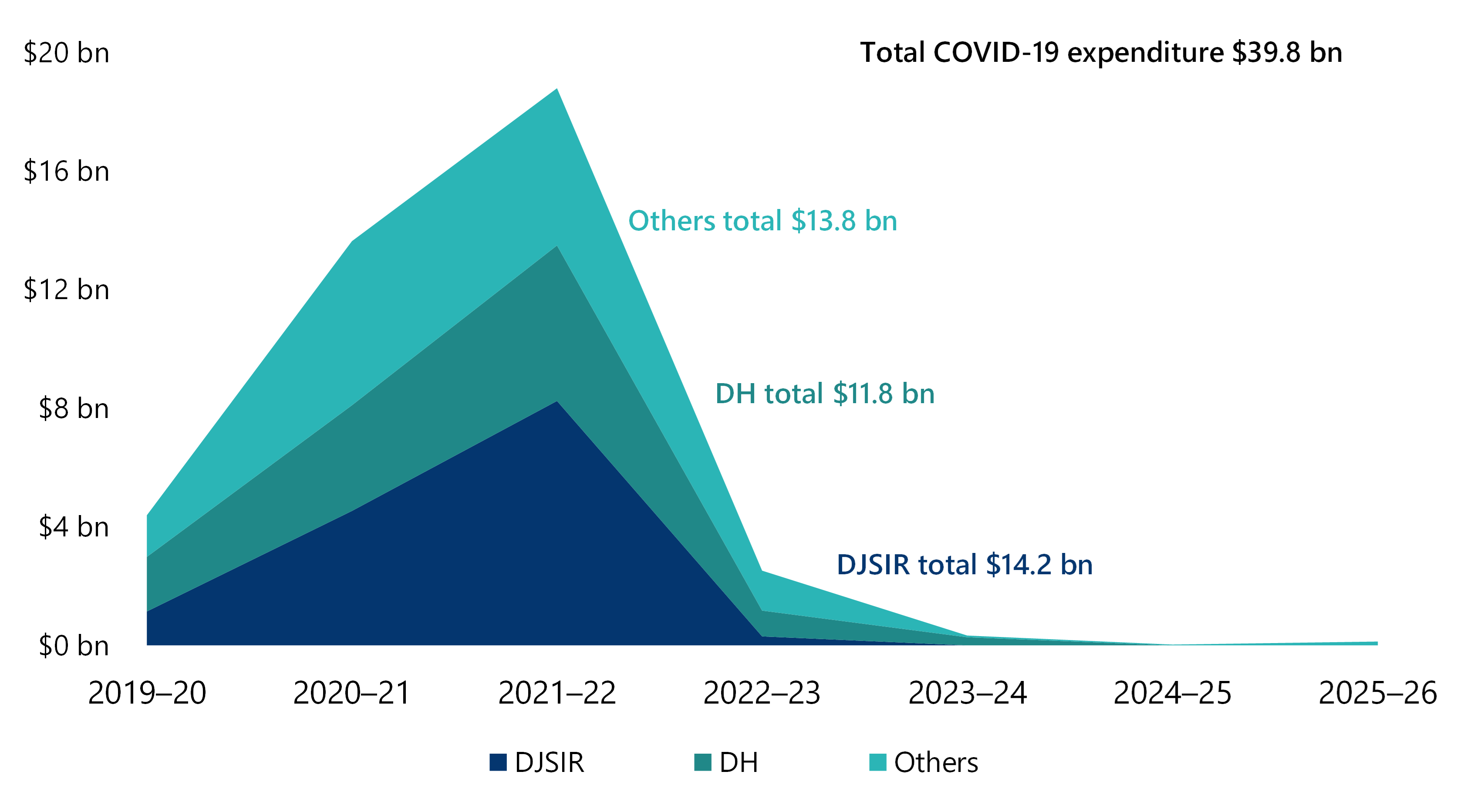
Note: The data in this graph may not be complete as we have relied on evidence provided by departments.
Source: VAGO, based on department reports.
In 2023–24 and 2024–25, the government raised $4.3 billion as COVID-19 specific revenue from COVID-19 payroll and landholdings levies. The government planned to use these amounts to offset the cost of servicing its pandemic-related debt.
COVID-19 related legal costs
Victorian government departments and VMIA have spent at least $252.2 million on COVID-19 related legal costs and insurance claims.
Legal costs incurred by departments span a variety of issues, including:
- the Hotel Quarantine Inquiry
- class action lawsuits
- settlements
- legal advice.
All departments are tracking COVID-19 related costs as part of their usual processing. But no departments publicly report on legal costs that specifically relate to COVID-19.
Figure 2: Legal costs, settlements and insurance claims
| Agency | Total cost ($ million) |
|---|---|
| VMIA – legal costs | 71.4 |
| VMIA – other COVID-19 related insurance claims | 13.6 |
| DE | 0.1 |
| DEECA | 0.0 |
| DFFH | 1.9 |
| DH | 27.4 |
| DJCS | 134.4 |
| DJSIR | 1.6 |
| DPC | 1.1 |
| DTF | 0.0 |
| DTP | 0.7 |
| Total | 252.2 |
Note: This data may not be complete. VMIA insurance costs do not include medical indemnity insurance claims.
Source: VAGO, based on department and VMIA reports.
Departments provided $12.1 billion in COVID-19 grants, up to $397.0 million of which went to high-risk and potentially ineligible recipients
COVID-19 grants
Between 2019–20 and 2025–26, departments gave out $12.1 billion in COVID-19 grants. DJSIR managed most ($11.1 billion) of these grants.
Departments individually reported their total grant spend in their annual reports, as required by government's FRD 22 Standard disclosures in the Report of Operations. But this reporting is not detailed enough to highlight COVID-19 grants specifically.
The government does not publish consolidated whole-of-government reporting on COVID-19 grants paid.
Figure 3 shows the cumulative COVID-19 grant spend by departments since 2019–20.
Figure 3: COVID-19 grant expenditure from 2019–20 to 2024–25
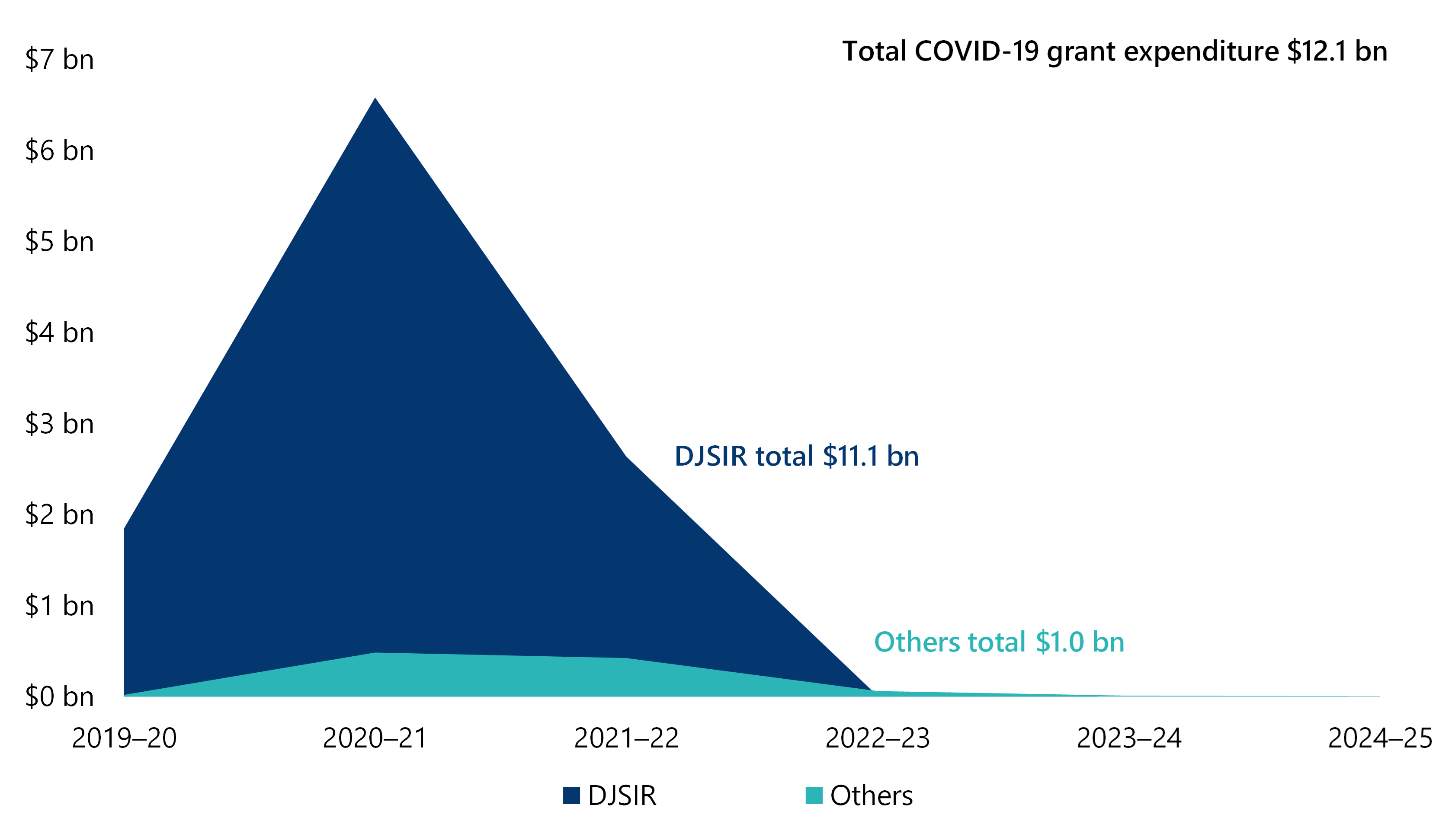
Note: The data in this graph may not be complete.
Source: VAGO, based on department reports.
Fraud and error in COVID-19 grants
In 2024, DJSIR estimated that it may have paid about $397.0 million in COVID-19 grants to high-risk grant recipients. This was out of $6.2 billion paid under its 3 main COVID-19 business support grant programs. DJSIR has since revised down what it believes to be ineligible payments. By 30 June 2025 it had written off $72.5 million of grants as ex gratia payments, which included $64.9 million paid to ineligible grant recipients.
We discuss grant management further in the next section.
Departments have not reported the full extent and value of obsolete and written off COVID-19 materials
Inventory and supplies
Under the accounting standards, departments count and report on the materials they use in different ways.
‘Inventories’ are assets that an entity plans to sell, or that they use in delivering services.
‘Supplies’ are materials for daily operations that are not planned for sale or used in a production process.
These definitions are important because they direct how to record and account for these materials in financial records.
Accounting for COVID-19 supplies
Since the pandemic started, departments acquired, held and used large numbers of COVID-19 materials, including:
- PPE
- sanitisers
- rapid antigen test kits.
Eight of the 10 government departments did not recognise these materials as an inventory asset but accounted for them as regular supplies that were likely to be used up in the year they were purchased. The departments therefore did not record if these supplies were used, damaged, expired or discarded because they were obsolete.
It is acceptable for departments to do this under the accounting standards because the COVID-19 materials were not meant for sale or consumption in production or directly in the delivery of services.
But this means that it is impossible to identify and report on the cost or extent to which COVID-19 supplies were used or discarded after expiry, damage or obsolescence.
Departments that adopted this approach were DEECA, DFFH, DGS, DJCS, DJSIR, DTP, DPC and DTF.
DH and DE adopted a different accounting treatment as they held COVID-19 inventories to use in the ordinary course of providing their services.
COVID-19 inventory write-offs
DH held large stockpiles of COVID-19 inventories to use in public health agencies and distribute to other departments and not-for-profit organisations across Victoria.
Write-down
A ‘write-down’ is when an organisation reduces the value of an asset in its financial records because the asset is worth less. The loss of value could be due to damage or obsolescence.
Write-offs
A ‘write-off’ is when an organisation removes an asset from its financial records because the asset has lost all value.
Between 2020–21 and 2025–26, DH has written down $777.2 million worth of COVID-19 inventories, as Figure 4 shows.
Figure 4: DH inventory write-downs
| Department | 2020–21 | 2021–22 | 2022–23 | 2023–24 | 2024–25 | 2025–26 | Total |
|---|---|---|---|---|---|---|---|
| DH | - | $5.7m | $522.4m | $135.3m | $113.5m | $0.3m | $777.2m |
Source: VAGO, based on DH's annual reports.
DH has reported these write-downs in its annual reports as an expense, in line with the
requirements of AASB 102 Inventories.
DH attributed the write-downs to loss of value due to expiration, obsolescence, no longer matching existing technologies, and losing the ability to be used or no longer functioning the same way as when it was first acquired.
DE has also told us it wrote off $370,000 worth of COVID-19 inventories that had expired.
In total, between 2021–22 and 2025–26, DH and DE wrote down or wrote off $777.6 million worth of COVID-19 inventories.
Inventories distributed free of charge
Between 2020 and 2025, DH also provided $1.4 billion of COVID-19 inventories, such as PPE and rapid antigen tests, free of charge to other departments, government agencies including health services and other non-profit organisations to use, as Figure 5 shows.
The departments that received these materials did not record them as inventory and would not have recorded subsequent write-downs of unused and impaired material.
It is not clear how departments subsequently managed COVID-19 inventory due to the accounting treatment they adopted. It is impossible to tell how much of those stocks later expired, became obsolete or unfit for use.
Figure 5: COVID-19 inventory distributed free of charge by DH
| Description | 2020–21 | 2021–22 | 2022–23 | 2023–24 | 2024–25 | 2025–26 | Total |
|---|---|---|---|---|---|---|---|
| Value | $294.6m | $705.5m | $305.9m | $35.8m | $15.0m | $7.5m | $1,364.3m |
Source: VAGO, based on DH's annual reports.
3. Managing grants
DJSIR managed most COVID-19 related grants. It informed the government that, of the $6.2 billion paid for its 3 main grant programs, up to $397.0 million was paid to high-risk, and potentially ineligible recipients.
By 30 June 2025, DJSIR had written off $72.5 million of grant payments it made incorrectly and deemed as unrecoverable. Additional payments, approximately $6.4 million, may also be written off in future years.
In 2024 DJSIR briefed the government on an estimated $213.0 million of the high-risk grant payments. It now believes most of these recipients could demonstrate some form of eligibility and will not seek to recover these funds. DJSIR decided not to confirm eligibility for these grants on a case-by-case because it judged the audit process would be too time-consuming, costly and there was a low likelihood of recovery.
DJSIR has reviewed its other COVID-19 programs and improved its grants management framework since the pandemic. But it has not tried to recover all ineligible payments.
All departments have improved their grants management frameworks since the pandemic.
Covered in this section:
- DJSIR has not fully resolved the financial impact of ineligible COVID-19 grant payments across its grant programs
- Departments have improved grants management guidance
DJSIR has not fully resolved the financial impact of ineligible COVID-19 grant payments across its grant programs
Our 2021 audit findings about grant process risks
Our 2021 audit found that not all departments identified and managed the risks of the COVID-19 grant programs or had effective controls to prevent fraud. Some departments did not have processes in place to manage conflicts of interest in grants administration.
To address these risks, we recommended all departments:
- review and revise internal grants guidance material to align with Better Grants by Design: A guide to best practice grant program investment, design, management and administration for the Victorian public sector (Better Grants by Design)
- review their COVID-19 grants programs and identify gaps in their controls that lead to risks of fraud, corruption or waste.
The 2021 audit also highlighted key control weaknesses in how DJSIR implemented large grant programs. This included DJSIR having no governance framework that clearly defined assessments and payment processes. We recommended DJSIR develop a governance framework for administering large grant programs, including guidance on implementing effective fraud controls.
Grant risks to DJSIR
In our Auditor-General's Report on the Annual Financial Report of the State of Victoria: 2022–23 we highlighted that 2 COVID-19 business support grant programs had risk of significant fraud and error:
- the Business Costs Assistance Program
- the Licensed Hospitality Venue Fund.
The then Department of Jobs, Precincts and Regions reported suspected fraud and losses to the Minister for Industry Support and Recovery, as required by the Standing Directions 2018 under the Financial Management Act 1994.
To address this, we recommended DJSIR appoint an independent evaluator to assess and report on the effectiveness of these 2 grant programs and whether they achieved value for money.
Grant eligibility requirements
DJSIR’s grant eligibility requirements for these business support grant programs were vague and poorly structured. Under the guidelines, applicants had low thresholds to eligibility. This meant that recipients who were a Victorian registered business (or sole trader), in an eligible industry, registered for GST and could demonstrate some direct costs resulting from COVID-19 restrictions, were considered eligible. This applied to some businesses that backdated their GST registrations just to meet grant requirements.
The vague eligibility requirements created challenges for DJSIR as it determined whether to pursue recovery. It also made it difficult to attempt to clarify requirements retrospectively, undertake case-by-case reviews or try grant recovery as there was a high risk of disputes.
Independent grants evaluations
DJSIR engaged 2 external consultants to:
- report on the effectiveness and value for money of the 2 grant programs
- analyse grant eligibility and acquittals over a sample of grant recipients
- provide recommendations for future programs.
DJSIR has actioned the 3 recommendations that arose from one of the independent evaluations. It updated its grant management framework for both business-as-usual and emergency management grants.
DJSIR’s initial quantification of loss due to fraud and error
DJSIR's external consultants and its own reviews confirmed that some COVID-19 grants were paid to ineligible recipients.
In September 2024, DJSIR briefed the Minister for Jobs and Industry that, of the $6.2 billion in grants paid under its 3 main grant programs, it estimated that $397 million may have been paid to high-risk and ineligible recipients. It recommended the government to commence the first recovery campaign and not conduct a case-by-case audit of an estimated 6,000 recipients due to high administration costs, potential low rate of recovery, strict time limits and policy complexities.
| DJSIR's initial analysis estimated that it had paid grants to ... | This meant … | and it … |
|---|---|---|
| 6,216 recipients that did not meet eligibility criteria. | $184.0 million was inappropriately paid | initiated a review and recovery campaign, which found that $64.9 million had definitely been paid to ineligible recipients. |
| 6,000 recipients that had heightened risk, with no clear evidence they were ineligible, and would require a case-bycase review to establish their eligibility. | $213.0 million was at high risk of having been inappropriately paid | elected not to undertake further review due to high administration costs, potential low recovery rates, time limits and policy complexities. We discuss this group below. |
DJSIR decision of grants needing case-by-case review
Since this advice in September 2024, DJSIR has changed its position. In February 2025, DJSIR briefed the Minister for Industry and Advanced Manufacturing that it believed this group – which had increased to 9,105 recipients and a value of at least $320.0 million – had a high probability of demonstrating eligibility for the grants and it would not pursue recovery efforts.
DJSIR's evidence to refine its advice to government
DJSIR has told us it used the following evidence to refine its advice to government:
- results of a sample audit of high-risk grant categories to inform design of recovery campaigns
- analysis of high-risk recipients’ eligibility against requirements using data obtained from other government agencies
- eligibility information obtained through an initial recovery campaign as well as learnings on applicant response and engagement.
DJSIR used the small sample audit to inform future steps, including the design of fund recovery campaigns. DJSIR contacted only 2 per cent of 11,621 grants recipients from 3 of its programs, including those who were deemed high-risk. Most recipients contacted did not respond. DJSIR then selected 51 of those responses to complete further testing on eligibility.
During the initial recovery campaign DJSIR gathered information from a subgroup of 521 out of 1,987 recipients who responded to its recovery enquiries. It used this information to inform actions for a larger group of 6,774. The 26 per cent response rate was low in the context of the larger group.
| DJSIR’s updated analysis found that it had paid grants to … | This meant ... | which … |
|---|---|---|
| 4,894 recipients that did not meet eligibility criteria. | $144.0 million was inappropriately paid | reduced by $40.0 million since the initial analysis. |
| 7,058 recipients that had heightened risk and would require a case-by-case review to establish their eligibility. | $253.0 million was at high risk of having been inappropriately paid | increased by $40.0 million since the initial analysis. |
DJSIR’s rationale for not pursuing further recovery
In May 2025, DJSIR told the Minister for Industry and Advanced Manufacturing that ‘the cost to undertake a case-by-case audit is very high with considerable uncertainty of the amount of grant funds that would be recouped to offset the high administration costs’ – given that the probability of recipients demonstrating eligibility was high.
DJSIR’s briefs to the minister also highlighted that:
- it did not have sufficient time to undertake case-by-case audits as the period in which it could review the grants was coming to an end
- there was potential risk of damaging the government’s reputation with low likelihood of improving recovery rates
- the recovery would be disproportionately costly and resource-intensive, as the likelihood of recovering additional payments was low.
Attempts to recover lost grant funds
Since 2020–21, DJSIR has:
- written off $72.5 million (as at 30 June 2025) as ex gratia payments across its entire grants program, and an additional $6.4 million may also be written off in future years
- recovered $8.3 million in repayments
- agreed to payment plans to recover $5.3 million.
DJSIR is not planning additional campaigns to recover other money it paid to ineligible recipients. It continues to seek repayment where ineligible recipients have entered payment plans.
Departments have improved grants management guidance
Updates to grants management guidance
Our 2021 audit recommended that departments conduct reviews of their COVID-19 grants programs to identify any gaps in their controls or administrative processes that lead to risks of fraud, corruption or waste. Departments have completed their individual action plans in response to our 2021 recommendations.
Each department has created or updated their grants management guidance since the 2021 audit. All departments updated their documentation between 2024 and 2025, which demonstrates ongoing review of these processes. This included DJSIR, which created an overarching grants compliance framework in 2024 to support other existing policies.
Seven out of 9 departments provided evidence of internal reviews. This, coupled with their updated policies and frameworks, demonstrates improvement in the controls surrounding grants management. DPC and DTF attested that they have reviewed COVID-19 grants programs.
DJSIR's program reviews covered a suite of its COVID-19 grants. From 2021, DJSIR embedded its Integrity team in program governance to review suspicious claims. As part of its controls, DJSIR also used eligibility information obtained in other grant programs to assist in determining claims in later programs.
We note that DTF did not include this recommendation in its action plan, although it accepted the recommendation in our initial 2021 report. DTF told us it was not directly responsible for grant management, with only one grant managed under its portfolio, administered and later reviewed by the State Revenue Office Victoria.
4. Procurement
Since our 2021 report, departments have improved guidance for emergency procurement.
Victoria has now put in place a clear, whole-of-government policy for procuring and managing PPE. This reduces the risk that the issues we identified in our 2021 report – such as poor coordination, elevated prices and departments competing for scarce stock – will reoccur in future.
Departments have also improved guidance for engaging professional services. However, their definitions of consultants, contractors and secondees remain inconsistent and current reporting requirements may limit the transparency of their professional services spending.
Covered in this section:
- Departments have defined roles and responsibilities for procurement in a new crisis
- Departments have improved guidance for procuring contractors, but reporting on cost is still not fully transparent
Departments have defined roles and responsibilities for procurement in a new crisis
Our 2021 audit findings about procuring PPE
Our 2021 audit found that departments had to rely on unfamiliar suppliers and pay high prices to meet the need for PPE during the COVID-19 pandemic. We noted that Victoria did not have a PPE stockpile because the public health system had a devolved governance model that required individual health services to manage their own equipment supplies.
Non-health agencies were not very familiar with PPE products and had little access to pre-vetted suppliers. Without a central stockpile or a state procurement contract specific to PPE, departments competed for stock.
What we recommended about PPE in 2021
To address these risks, we recommended departments implement recommendations from the Whole of Victorian Government Personal Protective Equipment Review (the McCann review).
This included for:
- DPC to work with all departments to define each agency’s roles and responsibilities for purchasing and distributing PPE
- DTF to set up a state procurement contract for PPE
- DPC, DJCS and DJSIR to set up a working party to address surplus stock of PPE.
DJCS did not complete the working party action because the government did not accept the relevant recommendation in the McCann review.
Procurement roles and responsibilities
In 2023, the government approved a solution for PPE procurement for the whole public sector. Departments have created a standard operating guide for procuring PPE during normal operations and in times of crisis.
Under the 2024 Whole of Victorian Government Personal Protective Equipment Procurement standard operating guide, HealthShare Victoria manages PPE procurement and inventory for health agencies during normal, business-as-usual operations. Non-health agencies manage their own PPE procurement and have the option to buy PPE through the Stationery and Workplace Consumables Contract.
In emergency response situations HealthShare Victoria is responsible for managing PPE procurement and inventory for all departments. The operating guide also says that in times of crisis DH and DGS will establish an Interdepartmental Governance Group to provide oversight for surge response preparations. DPC has told us that this arrangement will reduce the risk of competition between departments in procuring PPE in emergency situations.
Departments have improved guidance for procuring contractors, but reporting on cost is still not fully transparent
Our 2021 audit findings about hiring professional services
Our 2021 audit noted that all departments hired professional services firms to prepare advice, deliver projects or provide surge staffing to respond to the pandemic.
Departments had to follow several policies when hiring goods and services, including the:
- DPC guidelines (Administrative Guidelines on Engaging Professional Services in the Victorian Public Sector)
- Victorian Government Purchasing Board policy (Market approach: Goods and services policy).
However, our 2021 audit found there was no guidance from DPC or the purchasing board clarifying the relationship between these documents.
Under the DPC guidelines, during critical incidents, departments no longer needed secretary approval to hire professional services. However, DPC did not say if departments still need to complete an exemption form in these circumstances, which meant departments were unsure of their obligations.
DFFH and DH also did not report the full cost of using professional services because they hired some through secondment agreements. We have not analysed DH and DFFH spending on professional services through secondment agreements against total reported spending on consultants because this is outside the scope of this review.
What we recommended in 2021
To address these issues, we recommended that all departments review and amend their procurement policies, forms and oversight to ensure they:
- support transparency in emergency procurement processes
- encourage staff to consider value for money and probity
- manage risk of fraud
- clarify definitions of consultant, contractor and secondee.
Our 2023 report Contractors and Consultants in the Victorian Public Service: Spending and 2025 report Contractors and Consultants: Management also recommended that:
- departments strengthen their review and documentation processes to demonstrate value for money
- DTF update its guidance to departments to clarify definitions of contractors and consultants to enable transparent and consistent reporting across the public sector.
Whole-of-government policy and guidelines
DPC and DTF have now updated policy and guidelines to give departments more clarity about their obligations when they procure professional services in an emergency.
DTF updated the Governance: Goods and services policy, which covers emergency procurement. The policy now says that when organisations complete emergency procurement plans they must explain how they will apply the DPC guidelines.
DPC also updated its guidelines to more clearly set out situations when departments can hire professional services (‘valid engagement circumstances’) and the approval process they need to follow when they do.
| If a valid engagement circumstance ... | then the department ... | and must record … |
|---|---|---|
| applies | can use its standard approval process | decisions and the main valid engagement circumstance. |
| does not apply | needs Secretary approval | approvals and key details. |
Definition and treatment of secondees
Not all departments clearly define consultant, contractor and secondee. Without clear definitions, departments may not be fully transparent about how much they use consultants and how much they cost. Only 4 departments (DE, DFFH, DH, and DTP) have definitions for all 3 terms.
DJCS says it follows the definition of internal and external secondment in the Victorian Public Service's Secondments and Temporary Assignments policy.
DFFH and DH also define 3 types of secondees and their engagement processes. This example of good practice enables staff to correctly categorise transactions and report on required spending.
| They define a … | as a person seconded … |
|---|---|
| Victorian Public Service secondee | within the Victorian Public Service. |
| professional services secondee | from outside the Victorian Public Service through a specific secondee agreement. This also includes the Professional Advisory Services agreement. |
| broader public sector secondee or external staff secondee | from the broader public sector, such as a public entity or health service. |
Consultant cost reporting may be incomplete
There is no clear whole-of-government guidance on reporting the use of professional services seconded through specific agreements, rather than engaged through a contract.
Under the government's FRD 22 Standard disclosures in the Report of Operations, government entities must disclose details of consultants they hire for more than $10,000 (excluding GST). However, the guidelines do not require departments to report spending on all contractors or professional services engaged as secondees.
Based on the secondee definitions above, departments can procure consultants and contractors as secondees through specific agreements, which are not required to be publicly reported. This means that under current guideline requirements, departments’ reporting may not fully capture total spending on professional services.
Appendix A: Submissions and comments
Download a PDF copy of Appendix A: Submissions and comments.

Download Appendix A: Submissions and comments
Appendix B: Abbreviations, acronyms and glossary
Download a PDF copy of Appendix B: Abbreviations, acronyms and glossary.
Download Appendix B: Abbreviations, acronyms and glossary
Appendix C: Review scope and method
Download a PDF copy of Appendix C: Review scope and method.
Download Appendix C: Review scope and method
Appendix D: Recommendations made in our 2021 audit
Download a PDF copy of Appendix D: Recommendations made in our 2021 audit.
Download Appendix D: Recommendations made in our 2021 audit
Appendix E: Department action plans in response to our 2021 audit
Download a PDF copy of Appendix E: Department action plans in response to our 2021 audit.
Download Appendix E: Department action plans in response to our 2021 audit