
Follow-up: Reducing Bushfire Risks
Review snapshot
Did the Department of Energy, Environment and Climate Action and the Country Fire Authority complete their actions in response to our 2020 report, and did they adequately reduce bushfire risk near Grampians National Park leading up to the 2024 bushfires?
Why we did this review
Hotter, drier and longer fire seasons driven by climate change are increasing bushfire risk in Victoria.
In our 2020 audit Reducing Bushfire Risks we looked at whether the then Department of Environment, Land, Water and Planning (now the Department of Energy, Environment and Climate Action, or the department) and the Country Fire Authority (CFA) were effectively working together to reduce Victoria's bushfire risk. We made recommendations about how they measure, plan and deliver actions to reduce bushfire fuel.
We did this review to follow up on their progress. We also examined whether the department and CFA met their obligations to reduce bushfire risk in and around Grampians National Park before the 2024 Grampians bushfires.
Key background information
Source: VAGO.
What we concluded
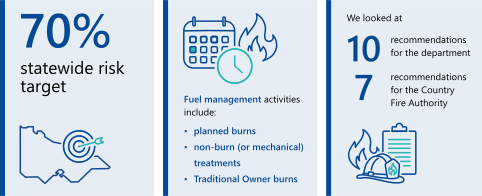
The department completed 21 of its 29 actions, partially completed 7 and did not complete one. CFA completed 13 of its 16 actions and partially completed 3.
Both agencies have made improvements since our 2020 audit. They improved their risk-modelling tools, datasets and statewide bushfire management planning. They also work more closely with Traditional Owners. These steps have helped keep statewide bushfire risk below the 70 per cent target.
But the department and CFA still need to improve how they measure the effectiveness of different fuel reduction methods, manage bushfire risk on private land and assess fuel hazards. They do not fully know how effectively their planning and actions protect people and property.
Before the 2024 Grampians bushfires, the department and CFA kept the Wimmera district's risk level below the target through effective planning and reducing fuel loads. But the department could not show us how it prioritised strategic fuel breaks. While this did not limit firefighters' access during the 2024 bushfires, it could affect fires at other locations in the future.
1. Our key findings
What we examined
Our review followed 2 lines of inquiry:
1. Did the department and CFA's actions respond to the issues our 2020 audit recommendations sought to address?
2. Did the department and CFA deliver fuel management activities as much as possible in the vicinity of Grampians National Park prior to the 2024 bushfires?
We discuss the department and CFA's actions throughout this report. You can find their actions status in full in Appendix D.
Department of Energy, Environment and Climate Action (the department)
In this report we refer to ‘the department’ for simplicity when discussing the recommendations and actions.
In January 2023, the department replaced part of the Department of Environment, Land, Water and Planning (DELWP). This transferred responsibility for managing bushfire risk on public land to the department. It also transferred responsibility for implementing any outstanding actions DELWP committed to in response to our 2020 audit.
Identifying what is working well
In our engagements we look for what is working well – not only areas for improvement.
Sharing positive outcomes allows other public agencies to learn from and adopt good practices. This is an important part of our commitment to better public services for Victorians.
Background information
Our 2020 audit
Our 2020 audit Reducing Bushfire Risks assessed if the department, CFA and local councils were effectively working together to reduce bushfire risk.
| In 2020 we found that ... | which was ... |
|---|---|
| the department and CFA were effectively collaborating to reduce the risks that bushfires pose to life and property | ensuring a strong commitment to keeping statewide residual bushfire risk below the 70 per cent target. |
| Phoenix RapidFire had limitations incorporating non-burn, small scale and private land-based risk reduction activities into modelling | limiting the ability to make informed investment and planning decisions around the best and most efficient mix of fuel treatments. |
| CFA and councils did not have the tools or capacity to assess and address bushfire risk on private land | limiting risk reduction across the state. |
We made 17 recommendations to the department and CFA. They accepted all of them.
For our report Responses to Performance Engagement Recommendations: Annual Status Update 2025, the department and CFA told us that by June 2025 they had implemented 14 of the 17 recommendations.
Victoria's Bushfire Management Strategy
Victoria’s Bushfire Management Strategy is the government's 10-year plan to reduce bushfire risk and improve resilience across the state in the face of increasing threats from climate change and shifts in population. The strategy outlines how Victorians can work together to plan, mitigate, prepare for, respond to and recover from bushfires across all land tenures, whether public or private.
Under Victoria’s Bushfire Management Strategy, the government has a target to maintain statewide residual bushfire risk at or below 70 per cent of the state's potential maximum risk level.
The Code of Practice for Bushfire Management on Public Land specifies the legislative obligations, standards and procedures relevant to managing fire on public land in Victoria. The code aligns with and supports a range of policy and operational frameworks including Victoria's Bushfire Management Strategy.
Residual bushfire risk
Residual bushfire risk is a metric calculated by computer models. It shows what percentage of risk to human life and property remains after actions like planned burning, slashing, mulching or bushfires have lowered the amount of available fuel, when compared to the maximum possible risk level.
Forest Fire Danger Index (FFDI)
This is a numerical scale used to measure the potential danger of a bushfire on any given day. It considers temperature, relative humidity, wind speed and drought.
The index typically ranges from zero to 100, with 100 based on the conditions of the 1939 Black Friday bushfires. But the index can go above 100 for catastrophic conditions like the 1983 Ash Wednesday (FFDI 120) or 2009 Black Saturday (FFDI 180) bushfires.
Phoenix RapidFire
This is computer software that predicts where a bushfire will go and how many houses it will destroy. It works by starting thousands of bushfires virtually across the state to see what could happen considering:
- the landscape
- wind speed, temperature and humidity
- how thick and dry vegetation is in specific areas.
The joint fuel management program
The joint fuel management program is a 3-year rolling, statewide program of fuel management activities on public and private land. It aims to reduce the risk and severity of bushfires.
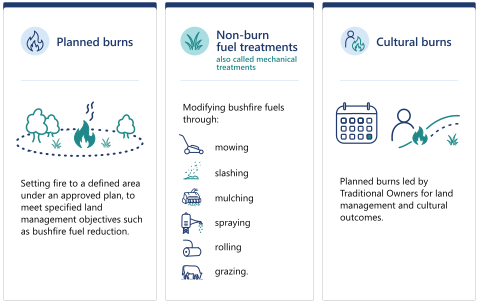
The joint fuel management program prioritises locations where bushfires are likely to start or spread based on Phoenix RapidFire modelling. Each 3-year program outlines a proposed number of different fuel treatments (see Figure 1) the department and CFA will deliver and the number of hectares they will treat.
Figure 1: Fuel treatments in the joint fuel management program
Source: VAGO, based on the joint fuel management programs 2021–22 to 2024–25.
The department and CFA update the joint fuel management program annually to add or remove fuel treatments planned in previous years, with the focus on delivering Year 1 of the program.
Strategic fuel breaks
Strategic fuel breaks are areas where vegetation is reduced to help protect communities and critical infrastructure. They aim to:
- give firefighters safer and faster access to conduct backburning to suppress fires, and complete planned burns
- reduce the intensity and spread of fires by reducing fuel loads.
There are 2 kinds of strategic fuel breaks:
- landscape protection breaks
- divide forest areas into smaller units that help to reduce a bushfire's size
- provide a platform for planned burns and fighting fires in the forest.
- asset protection breaks
- protect townships and assets from direct fire impact.
As part of its response to the Inspector-General for Emergency Management’s inquiry into the 2019–20 fire season and our 2020 audit, the government established the Strategic Bushfire Risk Program. It aimed to construct 1,447 kilometres of strategic fuel breaks across Victoria by July 2023.
The program exceeded its target by establishing 1,489 kilometres of breaks by July 2023.
What we found
This section focuses on our key findings, which fall into 3 areas:
1. The department and CFA have strengthened how they reduce bushfire risk but have not completed all the actions they committed to.
2. The department still has work to do to ensure its simulations and fuel hazard assessments are accurate.
3. The department kept bushfire risk below the target but did not deliver all strategic fuel breaks in and around Grampians National Park.
The full list of our recommendations, including agency responses, is at the end of this section.
Consultation with agencies
When reaching our conclusions, we consulted with the reviewed agencies and considered their views.
You can read their full responses in Appendix A.
Key finding 1: The department and CFA have improved how they reduce bushfire risk but have not completed all the actions they committed to
Completed actions
The department completed 21 of its 29 actions we looked at, partially completed 7, and did not complete one. CFA completed 13 of its 16 actions we looked at and partially completed 3 (see Figure 2).
Figure 2: Status of agency actions by the recommendations examined
| Rec. | Theme | Were the actions completed? | Status reported to VAGO in 2025 | ||
|---|---|---|---|---|---|
| CFA | The department | CFA | The department | ||
| 1 | Performance metrics | Partially | Partially | N/A | In progress |
| 2 | Bushfire risk modelling | Yes | Yes | N/A | Complete |
| 3 | Bushfire management planning | N/A | Partially | N/A | Complete |
| 4 | Regional planning approaches | N/A | Partially | N/A | Complete |
| 6 | Collaboration with Traditional Owners | N/A | Yes | N/A | In progress |
| 7 | Planning on private land | Yes | N/A | Complete | N/A |
| 9 | Cancelling planned burns | Partially | Yes | Complete | Complete |
| 10 | Financial monitoring and forecasting | Yes | Yes | Complete | Complete |
| 11 | Fuel hazard assessment target | N/A | Partially | N/A | Complete |
| 13 | Effectiveness of fuel management treatments | Yes | Yes | Complete | Complete |
| 14 | Reducing risk on private land resourcing | Yes | Yes | Complete | Complete |
Note: ‘N/A’ means the recommendation was not directed at the agency. Status as reported in our report Responses to Performance Engagement Recommendations: Annual Status Update 2025.
Source: VAGO.
Key issue: The department and CFA did not report completed actions accurately
The department and CFA reported in our annual Responses to Performance Engagement Recommendations: Annual Status Update 2025 that they had completed some recommendations from our 2020 engagement that were not complete.
The department reported it had completed 8 of the recommendations we examined, and CFA reported 5. But based on the evidence the department gave us it only completed 6 recommendations.
Although CFA reported completing 5 recommendations, it did not report against all the actions it committed to. It has only completed 4 of the 5 recommendations it reported completing.
Assessing risk and planning fuel management activities
The department has improved bushfire fuel management planning by broadening fuel treatment options and adopting regional innovations into statewide frameworks and procedures. It also incorporated cultural burns into its fuel treatment program.
CFA sought funding for fuel treatment activities and employed staff to boost regional planning capability. But it still has work to do to implement fuel treatment planning consistently across the state.
Bushfire fuel
Bushfire fuel is any dead or alive vegetation that can catch fire and burn. Fuel treatments such as planned burns, Traditional Owner burns, mulching or slashing reduce the amount of bushfire fuel.
Completing planned burns and expanding the mix of approaches
Since our 2020 audit, the department is completing more planned burns but has cancelled or deferred 35 per cent, mostly due to unsuitable weather.
The department has not increased how many mechanical fuel treatments it undertakes since our audit.
Our 2020 audit found the department did not systematically assess the effectiveness of non-burn treatments. Phoenix RapidFire’s limitations also mean the department cannot incorporate small scale treatments into risk modelling.
While Phoenix RapidFire can now incorporate mechanical fuel treatments, the department has not developed the metrics to assess their impact on bushfire risk.
As a result, the department's risk modelling may underestimate the potential impact of all fuel treatments on bushfire risk and limit its ability to plan a cost-effective fuel treatment program.
Addressing this finding
To address this finding, we made one recommendation to the department and CFA about:
- strengthening assurance processes for completing actions in response to our recommendations.
We also made one recommendation to the department about:
- developing performance metrics and methods to assess the impacts of different fuel treatments.
Key finding 2: The department still has work to do to ensure its simulations and fuel hazard assessments are accurate
Updating and improving fuel accumulation curves
Fuel accumulation curves are a key input to Phoenix RapidFire's simulations. They must be accurate to assess bushfire risk and plan fuel treatment.
Our 2020 audit found that the department had not confirmed most fuel accumulation curves and that some did not match historical fuel hazard data the department had collected. We recommended the department check and update fuel accumulation curves to improve fire simulations’ accuracy.
Since our audit, the department has updated and validated fuel accumulation curves for some vegetation types. But there are 180 fuel accumulation curves across 60 different vegetation types. The department has only verified curves for 4 vegetation types since 2020, although it did establish a working group to help prioritise which curves to verify.
Key issue: Bushfire risk estimates could be inaccurate
The reported fuel-driven bushfire risk level has consistently been at or close to the target in several districts. This includes some affected by recent fires.
But because the department has only validated fuel accumulation curves for 4 vegetation types, it cannot assure the accuracy of Phoenix RapidFire's simulations. This means that it also cannot assure that its reporting of district-level bushfire risk and the impact of fuel management activities are accurate.
Improving fuel hazard assessments
Fuel hazard assessments help determine the structure of different vegetation types and how they change after treatment. This helps the department prioritise locations for fuel treatments and to assess their effectiveness.
Our 2020 audit found that the department's target to conduct fuel hazard assessments for 20 per cent of planned burns may not be enough to extrapolate the impact of its statewide planned burn program. We also found that the way the department conducted fuel hazard assessments was not accurate enough for verifying fuel accumulation curves.
In this review, we found that the department has still not verified or updated its monitoring target and that its assessors still rely on subjective visual assessments, without a consistent approach across regions.
This means the limitations we identified in 2020 still exist, preventing the department from using fuel hazard assessments to help validate fuel accumulation curves. This is a missed opportunity given the large number of fuel accumulation curves that still need verifying and the large volume of fuel hazard data collected.
The department is developing more objective visual and remote sensing‑based techniques to improve fuel assessments accuracy and consistency.
Addressing this finding
To address this finding, we made one recommendation to the department about improving fuel hazard assessments and exploring how assessments can help verify fuel accumulation curves.
Key finding 3: The department kept bushfire risk below the target but did not deliver all strategic fuel breaks in and around Grampians National Park
Prioritising and planning fuel management
The department and CFA have risk-based frameworks for planning and prioritising fuel management. But only the department, and not CFA, could show how it applied its process in and around Grampians National Park before the 2024 bushfires.
The department modelled fuel hazard levels, identified high bushfire risk areas, and selected treatment sites according to regional bushfire management strategies and treatability, access and available resources. It used Phoenix RapidFire to test the impact and prioritise each planned burn by their potential to reduce the residual bushfire risk level.
Delivering fuel treatments
The department had 100 per cent of planned burns near the fire-impacted localities ready for delivery in 2021–22 and 2022–23 and had 92 per cent ready in 2023–24. But it only completed 74 per cent of burns that were ready.
The department completed 90 per cent of its planned mechanical treatments across 2020–21 to 2023–24 but only treated between 68 and 79 per cent of the target area annually.
CFA could not show the extent it delivered planned fuel treatments near all localities impacted by the fires, although it did not always meet regional targets in the preceding years.
Working well: Residual risk in the Wimmera district was well below target before the 2024 Grampians bushfires
Despite not completing all planned fuel treatments, the department's prioritisation kept the residual bushfire risk in the Wimmera district at about 40 per cent between 2020–21 and 2023–24. This was well below the 70 per cent target.
Limitations in Phoenix RapidFire meant that risk modelling and analysis did not include mechanical, small scale and linear treatments, which are mostly CFA's fuel treatment activities. This means the department's modelling may have underestimated the potential impact of all fuel treatments on bushfire risk.
Strategic fuel breaks
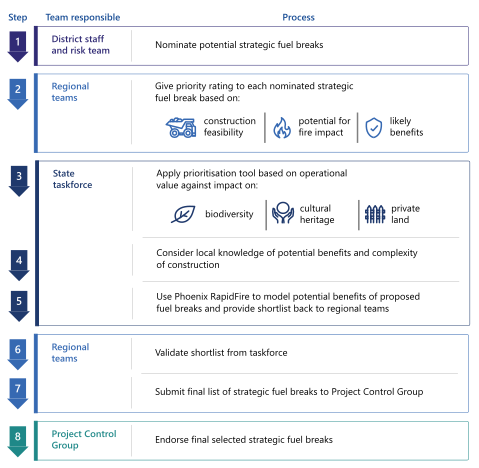
The department nominated and prioritised fuel breaks for inclusion in the strategic fuel break program based on the likelihood of direct impact on fires, operational benefit and the feasibility of construction.
Staff in the Wimmera district nominated 16 fuel breaks for construction or renewal as part of the program.
The department selected 5 for inclusion but only 2 were from the nominations by Wimmera district staff. The department could not show how it applied its prioritisation process across the nominations and whether all 5 selected had the highest potential benefit.
Key issue: The department did not deliver all planned strategic fuel breaks in and around Grampians National Park
The department planned to have all 5 breaks completed by August 2022. But it only constructed 2, while another was already in place and in use. The department did not establish the remaining 2 strategic fuel breaks.
Although the 2 uncompleted strategic fuel breaks are outside the 2024 Grampians bushfires’ boundaries, more properties could be at risk in future bushfires if they are not established.
Addressing this finding
To address this finding, we made one recommendation to the department about reassessing and establishing strategic fuel breaks with high operational value across the state.
2. Our recommendations
We made 4 recommendations to address our findings. The relevant agencies have accepted the recommendations in full or in part.
| Agency responses | ||||
|---|---|---|---|---|
| Finding: The department and CFA have strengthened how they reduce bushfire risk but have not completed all the actions they committed to | ||||
Department of Energy, Environment and Climate Action Country Fire Authority | 1
| Strengthen assurance processes for completing actions in response to our recommendations from all engagements to ensure progress attestations are reliable. This includes strengthening their Risk and Audit Committee’s role in monitoring delivery. (See Section 3 and Appendix D.) | Accepted
| |
Department of Energy, Environment and Climate Action
| 2
| In collaboration with the Country Fire Authority, develop performance metrics and methodologies to quantify mechanical, small scale and linear fuel treatments’ impacts (see Section 4).
| Accepted
| |
| Finding: The department still has work to do to ensure its simulations and fuel hazard assessments are accurate | ||||
Department of Energy, Environment and Climate Action
| 3
|
| Accepted in part
| |
| Finding: The department kept bushfire risk below the target but did not deliver all strategic fuel breaks in and around Grampians National Park | ||||
Department of Energy, Environment and Climate Action
| 4
|
| Accepted in part
| |
3. Status of our 2020 recommendations
The department has completed 21 of 29 actions we examined, partially completed 7 and did not complete one. This means it has only completed 6 recommendations in full, despite reporting it completed 8 in our report Responses to Performance Engagement Recommendations: Annual Status Update 2025.
CFA has completed 13 of 16 actions examined and partially completed 3. This means it has only completed 4 recommendations in full, despite telling us it completed 5.
The department's and CFA's actions have addressed some but not all the issues we raised in our 2020 audit.
Covered in this section:
The department and CFA have made some progress on actions from our 2020 audit
Department's actions status
The department completed 21 of the 29 actions we looked at and partially completed 7. It completed 14 actions on time.
This means the department has only completed 6 of the 10 recommendations we looked at despite reporting that it had completed 8 in our Responses to Performance Engagement Recommendations: Annual Status Update 2025.
The department has expanded the strategic planning frameworks for bushfire management to incorporate a mix of risk treatments. It also enhanced its bushfire risk modelling capability and collaborated with Traditional Owners to embed cultural burning practices in strategic frameworks and operational planning processes.
But the department has more work to do developing performance metrics and targets to measure fuel management and further enhance bushfire modelling capability impacts for the sector.
See Appendix D for more detail about the department's progress implementing each of its actions.
CFA's actions status
CFA completed 13 of the 16 actions we looked at in full and partially completed 3. It completed 6 actions by the agreed deadline.
This means CFA has completed 5 of the 7 recommendations we looked at.
Although CFA reported that it has completed 5 recommendations in our Responses to Performance Engagement Recommendations: Annual Status Update 2025, it did not report on 2 recommendations. Of the 5 recommendations it reported completing, CFA has only completed 4.
CFA has worked collaboratively with the department across a range of areas, including performance metrics, data reporting, bushfire modelling tools and strategic planning framework development.
It is still improving planning on private land to ensure consistent risk assessment and planning across all public and private land.
See Appendix D for more detail about CFA's progress implementing each of its actions.
2020 issues' status
The department's and CFA's actions only fully addressed the issues for 2 of the 11 recommendations we examined. For 6 recommendations, their actions acquitted some areas of concern, but their actions did not always target the underlying cause or issue of concern (see Figure 3).
This means that gaps in bushfire fuel risk assessment, modelling and measurement, and fuel treatment planning and delivery still exist.
Figure 3: Status of the issues that led to our 2020 recommendations
| Recommendation | Issue | Status and comments |
|---|---|---|
1
| Performance measures
| Partially addressed The department is yet to finalise new performance metrics or incorporate the impact of mechanical fuel treatments on risk reduction. The department has also not communicated its fuel management program's cost-effectiveness |
2
| Modelling inputs
| Partially addressed The department has not yet deployed remote sensing data statewide to address regional inconsistencies in fire history data. It developed a process to update fuel data to make sure modelling inputs are accurate. |
3
| Practical limitations of planned burning
| Partially addressed The department is still developing metrics to assess the impact of mechanical and small-scale fuel treatments. But it does not have enough evidence to adopt a broader mix of fuel treatments into strategic planning frameworks. |
4
| Adopting regional innovations
| Addressed The department identified 33 regional innovations in fuel management planning and delivery and adopted 15 to strengthen statewide planning. |
6
| Collaboration with Traditional Owners
| Addressed The department updated policies and processes to embed Traditional Owner land management practices. They increased the number of Traditional Owner led burns from 2022–23. |
7
| Planning on private land
| Not addressed CFA is still improving its planning processes but is yet to finalise bushfire risk calculation and modelling tools fit for their operational scale. |
9
| Cancelling planned burns
| Partially addressed The department began recording factors that influence planned burn delivery. But a substantial proportion of planned burns still do not go ahead. |
10
| Financial monitoring and forecasting
| Not addressed The department has not demonstrated an increase in efficiency or cost effectiveness after embedding fuel treatment costing in its fuel management planning. |
11
| Fuel hazard assessments
| Not addressed The department has not applied a consistent or reliable fuel hazard data collection method to improve data quality. |
13
| Measuring effectiveness
| Partially addressed The department has developed a process to assess the effectiveness of planned burns. To support effective program planning it should also consider non-burn treatments. |
14
| Reducing fuel on private land
| Partially addressed The department and CFA developed an options paper on legislative frameworks to improve coordinated cross-tenure bushfire risk management. The department has not demonstrated how approved funding assisted in improving planning and risk assessment on private land. |
Source: VAGO, based on our analysis of departmental and CFA information.
4. Improvements and ongoing issues
The department and CFA have improved aspects of the way they plan and deliver bushfire fuel treatments. But they still have work to do to understand and manage bushfire risk on private land.
The department also still needs to strengthen metrics to track how different fuel treatments protect communities and environmental values and ensure the datasets underpinning bushfire risk modelling are accurate.
These outstanding issues limit how effectively and efficiently the department and CFA can plan fuel treatment programs and create uncertainty around the extent they are reducing bushfire risk.
Covered in this section:
- The department can improve how it measures fuel management activities’ impact
- The department and CFA have strengthened fuel management planning but not on private land
- Not every district consistently achieves bushfire risk reduction targets
The department can improve how it measures fuel management activities' impact
Measuring different fuel treatments' impact
Understanding which fuel-reduction activities are most effective is important for making informed decisions about how to allocate resources to reduce bushfire risk.
In our 2020 audit, we found that the department and CFA did not have enough information to understand the effectiveness of all fuel treatment activities. Based on the information we assessed during this review, this issue persists.
While the department measures the impact of planned burns, it has not fully developed its capability to measure how non-burn and small-scale fuel treatments contribute to reducing bushfire risk.
Technical limitations in the department's risk modelling prevent residual risk calculations from including many of CFA's planned burns and mechanical treatments, which are often small scale or linear along roadsides and rail corridors.
Because of these limitations, the department and CFA still cannot measure the impact of all fuel treatment activities. This could mean that statewide and regional bushfire risk modelling and reporting may not accurately estimate the true reduction in bushfire risk from fuel management activities. It also limits their ability to plan a fuel treatment program that maximises risk reduction and environmental values, while minimising delivery costs.
Fuel accumulation curves
Fuel accumulation curves are a key input into Phoenix RapidFire modelling. They estimate how dangerous fuels are likely to be based on vegetation type and years since the last fire.
This contributes to modelling bushfire spread and planned burn benefit. Unreliable curves undermine the accuracy of fuel-driven bushfire risk assessments.
In our 2020 audit, we found that the department had not verified most fuel accumulation curves and as a result, did not know how accurate they were. We also cited research commissioned by the department that found historical fuel hazard data did not match the modelled fuel accumulation curves in Phoenix RapidFire.
Since then, the department has verified or updated accumulation curves for 4 fuel types to reflect observed fire behaviour as part of overall bushfire risk modelling improvements (see Figure 4).
Figure 4: Data that has been checked and updated since 2020
| Year | Data |
|---|---|
| 2021 | Updated maximum fuel hazard levels and assessment data for forest with shrub fuel type curves. |
| 2021 | Developed new accumulation curves for the box ironbark fuel type based on data already collected and a range of reports. |
| 2023 | Verified fuel accumulation curves for the alpine forest with shrub fuel type. |
| 2023 | Updated fuel attributes, including maximum surface hazard and near surface fuel hazard, for the woodland heath fuel type. |
| 2024 | Updated the wind reduction factor for the woodland heath fuel type. |
Source: VAGO, based on department information.
But the department uses fuel accumulation curves for 60 fuel types. Each fuel type has 3 accumulation curves (surface, elevated and bark strata).
This means that the department still has fuel accumulation curves for up to 56 fuel types to check and potentially update.
In 2024 the department and CFA established a working group to:
- maintain and update datasets used in fuel modelling and mapping
- develop and improve fuel mapping and modelling processes to ensure timely updates
- log fuel attributes that need reviewing.
This includes prioritising which fuel accumulation curves to verify over the coming year.
All fuel accumulation curves require verification over time to ensure they provide accurate input into bushfire risk modelling. While the department is progressing this, the slow pace due to the considerable work involved means uncertainty around bushfire risk modelling remains.
Fuel hazard assessments
Fuel hazard assessments help determine the structure of different vegetation types and how it changes after treatment. The department uses these to prioritise locations for fuel treatments and to understand whether individual treatments are effective.
Assessors visually assess fuel hazards, relying on each assessor's judgement and expertise. This approach can cause inconsistency across assessors and different regions. It does not reliably assess the amount of fuel present. We looked at research in our 2020 audit that found this approach is unreliable for validating fuel accumulation curves.
Our audit also found that the department's target to assess pre- and post-burn fuel hazards for 20 per cent of planned burns to estimate the statewide impacts of the planned burn program was not scientifically determined. We also found that regional staff interpreted and applied the target differently.
Together these limitations make fuel hazard assessments unreliable for both operational planning and assessing the effectiveness of both individual fuel treatments and the overall fuel treatment program. The limitations also mean that the department cannot use fuel hazard assessments to improve the underlying datasets its uses for Phoenix RapidFire modelling.
The department has undertaken projects to improve the accuracy and consistency of fuel hazard assessments.
| The department ... | This will ... |
| is piloting terrestrial laser scanning to objectively analyse fuel levels and the interaction between fuel treatments and bushfires. | enhance fuel treatment planning by providing a visual map of fuel conditions to assist with prioritising treatments. |
| has secured funding through the Australian Government's Disaster Ready Fund for its Fuelling the Fire Behaviour Models of the Future project. The project is due for completion in 2028. | integrate findings on the use of terrestrial laser scanning to develop new visual and remote sensing-based techniques for fuel hazard assessment and deliver fuel assessment guides, with outputs that can also be used to support the verification of fuel accumulation curves. |
| has commissioned research to develop a method to map fire severity using satellite data. The project is due for completion in June 2026. | generate data to help interpret fuel hazard assessments and understand the effectiveness of fuel treatment. |
The successful delivery of these projects should help the department better plan and assess the effectiveness of its fuel treatment program. Importantly, the adoption of objective fuel assessment methods, such as terrestrial laser scanning, could help the department verify a greater number of fuel accumulation curves. This would improve the accuracy of bushfire risk assessments.
The department and CFA have strengthened fuel management planning but not on private land
Delivering planned burns
Our 2020 audit identified that the department cancelled a significant number of planned burns each season but there was a lack of reporting about the reasons.
The department created the Burn Opportunity Reporting Tool for staff to record the reasons for rescheduling or delaying fuel treatments. The main reasons between 2020–21 and 2023–24 relate to unsuitable weather or fuel conditions (see Figure 5).
The proportion of planned burns influenced by unsuitable fuel conditions has declined, although this could reflect staff selecting a different weather-related reason instead now that they have more options to choose from.
Figure 5: Factors influencing planned burns delivery, 2020–21 to 2023–24
| Factors influencing delivery | 2020–21 | 2021–22 | 2022–23 | 2023–24 |
|---|---|---|---|---|
| Unsuitable weather | 44% | 52.7% | 64.0% | 57.5% |
| Unsuitable fuel conditions | 40.6% | 18.8% | 6.0% | 8.0% |
| Burn planning or preparation not completed on time | N/A | 26.2% | N/A | N/A |
| Weather prescription window occurred prior to completion of burn planning or preparation | N/A | N/A | 24.0% | 14.3% |
| Resource availability and financial consideration | 11.1% | 1% | 0.2% | 0.2% |
| Possible missed opportunity | N/A | N/A | 5.4% | 8.5% |
| Operation risk too high | N/A | N/A | 0.3% | 2.7% |
| Environment, community or stakeholder related | 1.9% | 0.6% | N/A | N/A |
| Reprioritised | 1.4% | N/A | N/A | N/A |
| Bushfires and other emergencies | N/A | N/A | – | 0.8% |
Note: For 2020–21 factors listed that delayed planned burns were collected before using the Burn Opportunity Reporting Tool. Categories that staff can select as factors affecting delivery have changed between reporting years. N/A refers to categories that could not be selected during that period.
Source: Managing Victoria’s Bushfire Risk: Fuel management report 2020–21, Victoria's Bushfire Risk Management Report 2023–24.
Although weather-related reasons continue to be the main reason to cancel planned burns, the department has completed a higher percentage since our 2020 audit. This suggests improved planning given the number planned has been comparable each year. But despite this improvement, a significant percentage still do not go ahead (see Figure 6).
Figure 6: Planned burns delivered by the department and CFA, 2019–20 to 2024–25
| Year | 2019–20 | 2020–21 | 2021–22 | 2022–23 | 2023–24 | 2024–25 |
|---|---|---|---|---|---|---|
| Burns planned | 466 | 561 | 505 | 381 | 445 | 468 |
| Burns completed | 158 | 470 | 207 | 234 | 345 | 270 |
| Completion rate | 34% | 84% | 41% | 61% | 78% | 58% |
Source: VAGO, based on department information.
The department advised that it plans more burns than it expects to deliver each year to account for weather or operational constraints. But it has not advised how it determines the threshold number that need to go ahead to maintain statewide residual bushfire risk below the 70 per cent target.
Mechanical fuel treatments
While the department and CFA are completing more planned burns, unsuitable weather’s influence reinforces the need to consider mechanical treatments when planning fuel management programs.
The department has incorporated a variety of fuel treatment approaches in strategic planning documents and procedures. Despite this, it has not increased mechanical treatments since our 2020 audit (see Figure 7).
Figure 7: Statewide non-burn fuel management activity, 2017–18 to 2024–25
| 2017–18 | 2018–19 | 2019–20 | 2020–21 | 2021–22 | 2022–23 | 2023–24 | 2024–25 | |
|---|---|---|---|---|---|---|---|---|
| Area treated by non-burn fuel treatments | 9,790 | 12,034 | 17,635 | 18,888 | 15,667 | 16,757 | 16,163 | 17,465 |
| Number of non-burn fuel treatments | Not reported | Not reported | 1,519 | 1,963 | 1,785 | 1,602 | 1,610 | 951 |
Note: Victoria's Bushfire Risk Management Report 2024–25 snapshot does not have the same amount of publicly available information as previous years.
Source: VAGO, based on analysis of department data.
Cost and cost effectiveness
Our 2020 audit found the department and CFA did not monitor or estimate future costs when making operational planning decisions, nor did they evaluate the cost effectiveness of their fuel management activities.
The department and CFA invest significant resources in fuel management. To optimise this investment, they need a clear understanding of the cost effectiveness of each treatment.
While the department and CFA have developed tools to monitor the costs of fuel treatments, only the department uses these tools to estimate and forecast future treatment costs and prioritise burns.
Despite the department now monitoring fuel treatment costs, there is no evidence that this has led to a more efficient or cost-effective fuel treatment program. Total investment in statewide fuel management has been consistent since 2020. But the number of planned burns and mechanical treatments has not increased, and statewide fuel-driven bushfire risk has not decreased (see Figure 8).
Figure 8: The department's fuel management costs and outcomes
| $ million invested (2024–25 adjusted) | Planned burns completed | Mechanical treatments completed | Statewide fuel-driven bushfire risk | |
|---|---|---|---|---|
| 2019–20 | 132.4 | 257 | 1,519 | 64% |
| 2020–21 | 185.9 | 470 | 1,963 | 63% |
| 2021–22 | 172.5 | 277 | 1,785 | 62% |
| 2022–23 | 150.6 | 234 | 1,602 | 65% |
| 2023–24 | 163.4 | 345 | 1,610 | 64% |
| 2024–25 | 159.8 | 270 | 951 | 66% |
Note: Victoria's Bushfire Risk Management Report 2023–24 snapshot did not provide planned burns’ contribution to risk reduction.
Source: VAGO, based on department data.
Until the department develops performance metrics and approaches to measure the effectiveness of different fuel treatments, it will not be able to compare their cost effectiveness, which will continue to limit fuel treatment planning.
Private land
Although most bushfire risk exists on public land, private land makes up 60 per cent of the state. Reducing risk effectively also means managing fuel on private land.
CFA has taken steps to improve how it assesses bushfire risk and plans fuel treatments on private land.
| CFA ... | This will improve fuel treatment planning by ... |
| is developing a fit-for-purpose product to replace the Victorian Fire Risk Register and current fire prediction models. | focusing on small, linear and asset-focused treatments that make up much of CFA's activities and better reflect its operational environment. |
| has hired new vegetation management planning staff. | improving understanding of private land vegetation data and factors that affect how fires behave. |
| has developed a draft quality assurance framework for planned burning. | embedding structured review, oversight and continuous improvement to the planned burning program and improving the justification of planning decisions. |
These steps indicate progress, but CFA still has work to do to implement a consistent statewide fuel treatment planning process, particularly on private land.
Not every district consistently achieves bushfire risk reduction targets
Residual bushfire risk
[Despite the department and CFA improving aspects of the way they plan and deliver fuel management activities, they have not consistently meet risk reduction targets in several districts (see Figure 9).
This confirms that the department and CFA still have work to do around measuring and modelling the effectiveness of different treatments and then planning and delivering a fuel management program that meets targets in every district.
Figure 9: Residual bushfire risk in each district against respective targets
| District | Target | 2019–20 | 2020–21 | 2021–22 | 2022–23 | 2023–24 |
|---|---|---|---|---|---|---|
| Barwon South West region | ||||||
| Far South West | 55% | 53% | 51% | 49% | 50% | 49% |
| Otway | 60% | 68% | 63% | 59% | 61% | 58% |
| Gippsland region | ||||||
| Latrobe | 80% | 82% | 85% | 82% | 84% | 86% |
| Macalister | 65% | 47% | 50% | 57% | 58% | 61% |
| Snowy | 65% | 3% | 4% | 5% | 8% | 14% |
| Tambo | 65% | 25% | 25% | 28% | 33% | 35% |
| Grampians region | ||||||
| Midlands | 70% | 75% | 78% | 77% | 79% | 77% |
| Wimmera | 70% | 41% | 43% | 48% | 40% | 38% |
| Hume region | ||||||
| Goulburn | 75% | 74% | 76% | 68% | 72% | 68% |
| Murrindindi | 80% | 80% | 81% | 76% | 80% | 75% |
| Ovens | 55% | 55% | 53% | 59% | 66% | 66% |
| Upper Murray District | 60% | 42% | 40% | 44% | 42% | 50% |
| Loddon Mallee region | ||||||
| Mallee | 90% | 79% | 79% | 82% | 82% | 79% |
| Murray Goldfields | 75% | 72% | 72% | 68% | 74% | 74% |
| Port Phillip region | ||||||
| Metropolitan | 85% | 91% | 85% | 90% | 95% | 92% |
| Yarra | 85% | 84% | 84% | 83% | 88% | 86% |
| Statewide | 70% | 64% | 63% | 62% | 65% | 64% |
Note: Figures in bold show regional targets were not met for that district. The department has not released residual bushfire risk data at a district level for 2024–25. The provisional statewide figure for 2024–25 is 66 per cent.
Source: The department, Victoria's Bushfire Risk Management Report 2023–24.
The above figures also show that the reported fuel-driven bushfire risk has consistently been at or close to the target in several districts. This includes some affected by recent fires such as the Murrindindi, Murray Goldfields and Otway districts.
Given the known limitations of modelling fuel-driven bushfire risk, actual risk may be higher or lower than reported in some districts. This increases the risk of over- or under-prioritising fuel treatments. This could lead to insufficient risk reduction, excessive ecological impacts and inefficient use of fuel management resources.
The department acknowledges that there is uncertainty in the inputs and models used for calculating fuel-driven bushfire risk, including outputs from Phoenix RapidFire. But it does not report margins of error for its bushfire risk modelling, nor does it disclose how it accounts for this uncertainty in the joint fuel management program.
5. Reducing risk around Grampians National Park
Before the 2024 Grampians bushfires, the department applied a risk-based framework to plan and prioritise fuel management in and around Grampians National Park. CFA had a process in place but could not show how it applied it.
Although the department and CFA did not complete all planned burns due to weather and operational constraints, the Wimmera district’s residual bushfire risk remained well below the 70 per cent target.
However, the department only established 3 of the 5 planned strategic fuel breaks in and around the national park and cannot show that it prioritised them based on operational value. Although the 2 unestablished fuel breaks are outside the area affected by both fires, more property could be at risk in future fires if they are not established.
Covered in this section:
- The department and CFA delivered most priority fuel treatments in and around Grampians National Park
- The residual bushfire risk was well below the target for the Wimmera district
- The department did not establish all the strategic fuel breaks it planned
The department and CFA delivered most priority fuel treatments in and around Grampians National Park
The 2024 Grampians bushfires
Bushfires across 2 consecutive fire seasons affected the Grampians region. In February 2024, bushfires happened around Grampians National Park, at Pomonal and Dadswells Bridge. These fires spread across 6,386 hectares and destroyed 47 properties.
In December 2024, dry lightning started a bushfire in Grampians National Park. It spread over 76,000 hectares and destroyed 4 properties. It burnt across farmland and pasture, with more than 700 livestock lost.
Planning fuel treatments
The department prioritises fuel treatments (such as planned burns, mulching, slashing or spraying) based on a range of variables, including modelled fuel hazard levels and operational factors such as treatability, site access and resourcing.
Regional fuel management teams nominate treatments for inclusion in the joint fuel management program based on available risk data and regional bushfire management strategies. The department then uses Phoenix RapidFire to prioritise proposed burns by their potential to reduce the residual bushfire risk.
Grampians National Park sits within the department's Wimmera district.
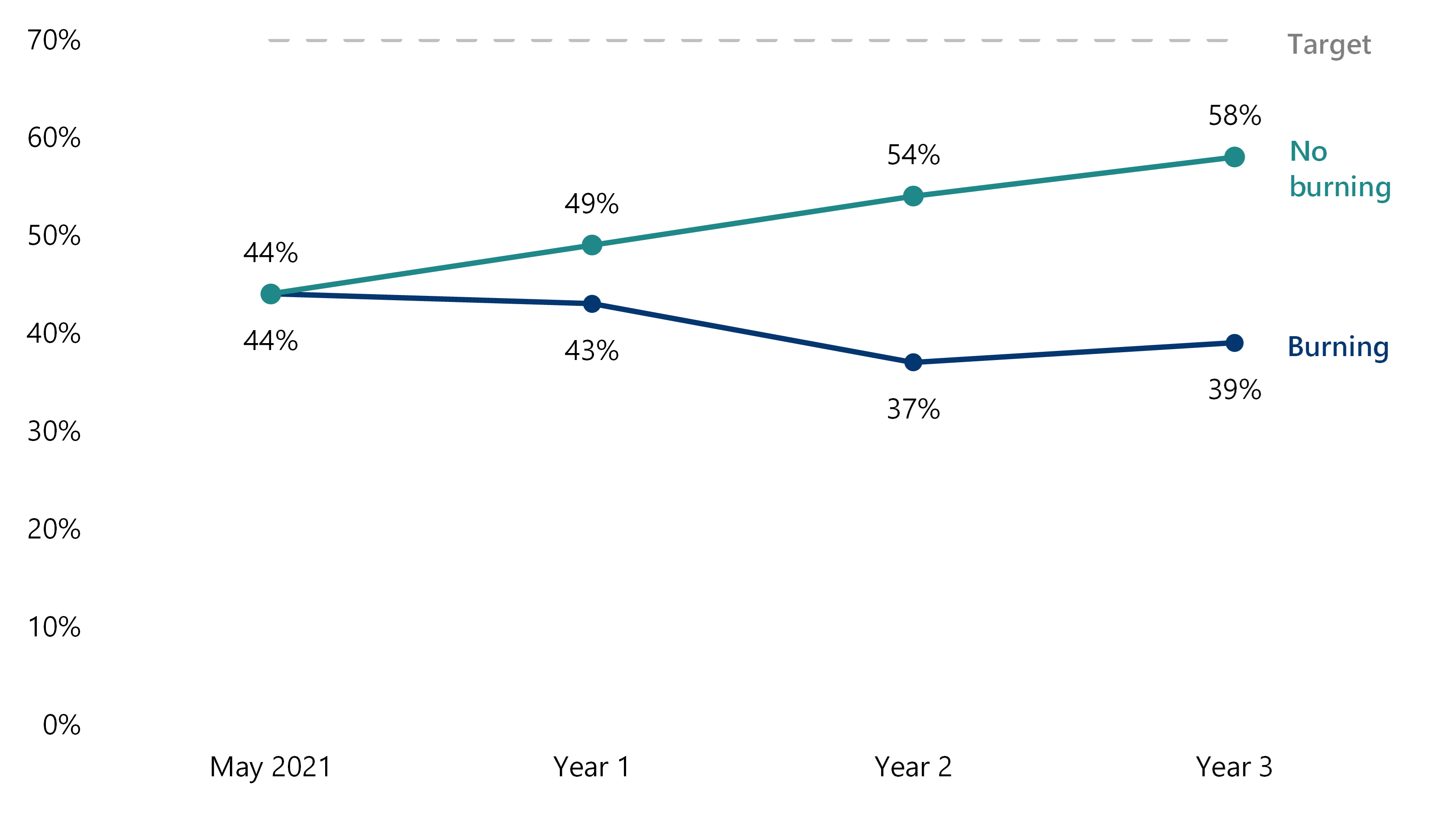
The department’s modelling estimated that the 2021–22 to 2023–24 joint fuel management program would keep residual bushfire risk at approximately 40 per cent in the Wimmera district. Although there is uncertainty around the department's risk estimates because it does not know how accurate its fuel accumulation curves are, this is well below the 70 per cent district target.
The modelling showed that without these burns, the risk would steadily rise to 58 per cent (see Figure 10). While still below the target, it highlights the importance of an annual fuel treatment program to prevent risk increasing.
Figure 10: Modelled impact of the 2021–22 to 2023–24 joint fuel management program on the Wimmera district's residual bushfire risk
Source: VAGO, based on the department's risk analysis of the Grampians region joint fuel management program.
Phoenix RapidFire cannot accurately model most of the CFA's fuel treatments. Therefore, CFA collaborates with stakeholders and land managers to nominate its fuel management treatments for the joint fuel management program.
It assesses nominations using a prioritisation matrix that considers direct risk reduction, ecological value, community impact and cultural heritage. The process also draws on the Victorian Fire Risk Register to identify community assets most at risk from a bushfire.
CFA then enters the proposed burns into the department's fuel management system to obtain a regional criticality ranking before finalising its planned fuel treatments.
But CFA could not show that it applied this process in the districts impacted by the 2024 Grampians bushfires in the preceding years. This means that it cannot show the extent its planning protected the fire-impacted communities.
The department's fuel treatment delivery
The department's performance targets for the joint fuel management program are:
- 100 per cent of Year 1 equivalent hectares of ecological and fuel reduction burns are at a 'ready' status by 28 February
- 100 per cent of Year 1 equivalent hectares of non-burn fuel treatments completed by 30 June.
The department does not set a performance target for completing planned burns.
Between 2020–21 and 2022–23, the department had 100 per cent of Year 1 equivalent hectares of ecological and fuel reduction burns around Grampians National Park ready for when an ignition window became available. In 2023–24 it had 92 per cent ready on time.
Despite the department having most of its planned burns in the years before the 2024 Grampians bushfires ready to go ahead, it only completed 74 per cent (see Figure 11).
Figure 11: The department's Year 1 planned burns near Grampians National Park, July 2020 to June 2024
| Burn preparation status | 2020–21 | 2021–22 | 2022–23 | 2023–24 |
|---|---|---|---|---|
| Planned | 23 | 15 | 25 | 22 |
| Ready | 23 | 15 | 25 | 18 |
| Completed | 18 | 9 | 22 | 11 |
| Percentage of target area with burn treatments at a 'ready' status | 100% | 100% | 100% | 92% |
Note: We did not include planned burns that were no longer needed or overrun by bushfires in our analysis. The percentage figure is based on the total area to be treated by year.
Source: VAGO, based on the department's documents.
The department completed 90 per cent of its planned mechanical fuel treatments near Grampians National Park in the years leading up to the bushfires, although it treated a smaller area than planned (see Figure 12).
Figure 12: The department's Year 1 mechanical treatments near Grampians National Park, July 2020 to June 2024
| Mechanical treatment status | 2020–21 | 2021–22 | 2022–23 | 2023–24 |
|---|---|---|---|---|
| Completed | 41 | 50 | 24 | 22 |
| Not completed | 4 | 4 | 5 | 3 |
| Total | 45 | 54 | 29 | 25 |
| Percentage of target area treatment was complete | 72% | 78% | 68% | 79% |
Note: Non-burn treatments that were not in the joint fuel management program were excluded. The department advised the treatments list was limited to the geographic area in and around Grampians National Park.
Source: VAGO, based on analysis of the department's information.
Together this shows that the department did not fully deliver its fuel management commitments in the Wimmera district leading up to the 2024 Grampians bushfires.
CFA's fuel treatment delivery
CFA aims to deliver all planned burns in Year 1 of the joint fuel management program. It focuses on protecting individual buildings and structures.
The areas affected by the 2024 Grampians bushfires are in CFA's West and South West regions.
In its West region, CFA only delivered 41 per cent of its planned fuel treatments in 2021–22 and 2022–23. But in 2023–24, it delivered more treatments than it planned (see Figure 13). These included treatments deferred from previous years. However, it could not show the extent it completed planned fuel treatments in West region localities impacted by the fires.
Figure 13: CFA Year 1 joint fuel management program treatments in the West region, 2021–22 to 2023–24
| Treatment type | 2021–22 | 2022–23 | 2023–24 |
|---|---|---|---|
| Burns planned | 164 | 97 | 56 |
| Burns completed | Not available | 24 | 63 |
| Mechanical treatments planned | 12 | 3 | 14 |
| Mechanical treatments completed | Not available | 17 | 25 |
| Total fuel treatments planned | 176 | 100 | 70 |
| Total fuel treatments delivered | 73 (41.5%) | 41 (41.0%) | 88 (125.7%) |
Note: In Victoria's Bushfire Risk Management Report 2021–22, CFA did not specify the number of fuel treatments completed by treatment type across each region. This data encompasses the entire West region (i.e. districts 15–17) and is not limited to around Grampians National Park.
Source: VAGO, based on analysis of Grampians Joint Fuel Management Program 2025–26 and Victoria's bushfire risk management reports.
CFA could narrow down planned burn reporting for its South West region to fire-impacted localities. It could also provide reporting for 2024–25. But it could not provide data about mechanical fuel treatments, even at a district level.
CFA planned few burns near these South West region localities in some years, especially 2022–23 and 2023–24, but delivered 24 of 30 planned burns in 2024–25 (see Figure 14). But it could not provide the date of each burn. This means it cannot show how many burns it completed in the months preceding the December 2024 fires.
Figure 14: CFA Year 1 planned burns in the joint fuel management program in the South West region near Grampians National Park
| Year | 2020–21 | 2021–22 | 2022–23 | 2023–24 | 2024–25 |
|---|---|---|---|---|---|
| Proposed | 11 | 8 | 1 | 0 | 6 |
| Completed | 12 | 5 | 3 | 1 | 24 |
| Total | 23 | 13 | 4 | 1 | 30 |
Note: CFA limited South West data to planned and complete burns in and around Grampians National Park.
Source: VAGO, based on our analysis of CFA dataset on South West region planned burns.
Limitations in CFA's West and South West regions recordkeeping mean it cannot show how much it protected impacted communities leading up to the 2024 Grampians bushfires.
The residual bushfire risk was well below the target for the Wimmera district
The Wimmera district's residual bushfire risk
Despite not completing all planned fuel treatments between 2020–21 and 2023–24, fuel-driven bushfire risk in the Wimmera district remained below 50 per cent (see Figure 15).
Figure 15: Fuel-driven bushfire risk in the Wimmera district 2020–21 to 2023–24
| Year | 2020–21 | 2021–22 | 2022–23 | 2023–24 |
|---|---|---|---|---|
| Wimmera district (target 70%) | 43% | 48% | 40% | 38% |
Source: Victoria's Bushfire Risk Management Report 2023–24.
This shows that the department's prioritisation of planned burns kept the residual risk in line with what it planned and well below the district target of 70 per cent.
As CFA's activities do not contribute to residual risk calculations, actual risk levels were likely lower than reported.
The department did not establish all the strategic fuel breaks it planned
Prioritising strategic fuel breaks
Strategic fuel breaks play a vital role in bushfire management by enabling firefighters to backburn to contain the spread of fires and by dividing the landscape to help reduce a fire's size.
The department had a prioritisation process for selecting strategic fuel breaks for the strategic fuel breaks program (see Figure 16).
Figure 16: Strategic fuel breaks program prioritisation process
Source: VAGO, based on the department’s documents.
Wimmera district staff nominated 16 strategic fuel breaks for construction or renewal near Grampians National Park.
After the prioritisation process, the department selected 5 to proceed (see Figure 17). But the department did not consistently apply its prioritisation process. Wimmera district staff only nominated 2 of the 5 selected fuel breaks. The state taskforce nominated the other 3.
The department had also partially or previously constructed 3 of the 5. It advised that the 3-year timeframe of the program and landholder considerations made it challenging to establish new fire breaks within required timeframes. As a result, the department prioritised fuel breaks already in use or only requiring renewal.
Figure 17: Strategic fuel breaks in the Wimmera district included in the Grampians master plan 2021–22
| Strategic fuel break | Type of break | Nominated by | |
|---|---|---|---|
| 1 | Ararat – Main Divide Road | Asset protection | Wimmera district |
| 2 | Grampians National Park – Smiths Road (Stage 1) | Asset protection | Wimmera district |
| 3 | Grampians National Park – Smiths Road (Stage 2) | Asset protection | State taskforce |
| 4 | Grampians Pomonal Firebreak | Asset protection | State taskforce |
| 5 | Grampians National Park – Harrops Track | Landscape protection | State taskforce |
Source: VAGO, based on the department’s documents.
During prioritisation, the department assigned proposed strategic fuel breaks a prioritisation score based on operational benefit and impacts on biodiversity, cultural heritage and land tenure. Scores range between minus one and one. Breaks with scores closer to one have higher operational benefit with less planning complexity.
The department provided priority scores for 4 of the 5 selected strategic fuel breaks and 7 of the 14 Wimmera district nominations not selected.
Of the strategic fuel breaks with available priority scores, only 3 of the 5 selected ranked in the top 5 based on their scores (see Figure 18).
Figure 18: Scores assigned to strategic fuel breaks nominated by Wimmera district staff
| Strategic fuel break | Priority score | Nominated by | Selected | Ranking |
|---|---|---|---|---|
| Ararat – Main Divide Road | 0.613 | Wimmera district | Yes | 1 |
| Bellfield – Grampians Road | 0.016 | Wimmera district | No | 2 |
| Grampians National Park –Smiths Road (Stage 1) | –0.061 | Wimmera district | Yes | 3 |
| Grampians National Park –Smiths Road (Stage 2) | –0.061 | State taskforce | Yes | 3 |
| Cherrypool – Blackrange Road | –0.220 | Wimmera district | No | 5 |
| Wirrantwa – Glenelg River Road (South) | –0.277 | Wimmera district | No | 6 |
| Grampians National Park – Harrops Track | –0.288 | State taskforce | Yes | 7 |
| Cherrypool – Muirfoot Track | –0.292 | Wimmera district | No | 8 |
| Halls Gap – Mount Zero Road | –0.334 | Wimmera district | No | 9 |
| Cherrypool – Lodge Road | –0.338 | Wimmera district | No | 10 |
| Moyston – Redman Road | –0.357 | Wimmera district | No | 11 |
| Grampians Pomonal Firebreak | Not provided | State taskforce | Yes | – |
Note: Bold indicates a selected fuel break.
Source: VAGO, based on the department’s documents.
The department not following its prioritisation process and its ranking scores means that it cannot confirm that the 5 selected strategic fuel breaks maximised risk reduction for Wimmera communities.
Wimmera district strategic fuel breaks
The department only completed 3 of its 5 planned strategic fuel breaks in the Wimmera district. These were:
- Grampians Pomonal
- Grampians National Park – Smiths Road (Stage 1)
- Harrops Track.
The department had already partially constructed the Pomonal and Smiths Road (Stage 1) fuel breaks before the strategic fuel break program started. It had also already upgraded the Harrops Track fuel break in 2020–21 and was already using it.
The department did not establish the Ararat – Main Divide Road fuel break or complete the Smiths Road (Stage 2) fuel break. The department still has not established these breaks, meaning that it has not delivered on its plans to establish all fuel breaks selected under the strategic fuel break program.
Neither the planned Ararat – Main Divide Road nor the Smiths Road (Stage 2) fuel breaks are in the boundary of the 2024 Grampians bushfires. However, if the department does not deliver and maintain strategic fuel breaks with high operational value, communities could be at greater risk during bushfires.
Appendix A: Submissions and comments
Download a PDF copy of Appendix A: Submissions and comments.

Appendix B: Abbreviations, acronyms and glossary
Download a PDF copy of Appendix B: Abbreviations, acronyms and glossary.
Appendix C: Review scope and method
Download a PDF copy of Appendix C: Review scope and method.
Appendix D: Status of agency actions
Download a PDF copy of Appendix D: Status of agency actions.