
Government Advertising and Communications
Audit snapshot
Do agencies make sure government advertising and communications follow required standards and do they monitor related spending?
Why we did this audit
The Victorian Government regularly communicates with Victorians about matters of public interest, such as government services, law, health and safety. It uses print, radio, television, outdoor displays, surveys, digital channels and social media for advertising and communications.
The Public Administration Act 2004 (the Act) and other government policies require the public sector to be apolitical. Public sector agencies must make sure their communications and advertising is apolitical, of public interest and accessible to all Victorians. Agencies must also publicly report how much they spend on campaign advertising.
We did this audit to see if agencies are following advertising and communications requirements. We also looked at whether processes had improved since our 2022 Government Advertising report.
Key background information
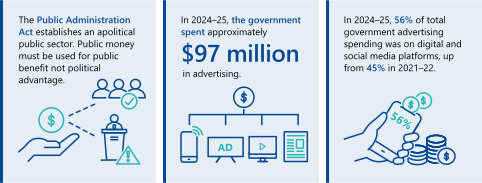
Source: VAGO.
What we concluded
Government communications and conduct do not always meet legislative requirements to be apolitical. For example, we found political content published on a government website, a survey that asks respondents to rate government performance, and public sector involvement in ministers' personal social media content.
Digital channels and social media are increasingly used for government communications and advertising, but legislation and guidance have not kept pace. This creates risks around attribution, transparency and reuse of government-funded content.
Approval processes for government campaigns have improved since our 2022 audit, but gaps remain in oversight and television advertising.
Seven of the 9 campaigns we assessed complied with the Act and Department of Premier and Cabinet's (DPC) requirements. One campaign did not comply with the Act’s permitted purpose for television advertising. The Victorian Infrastructure Delivery Authority's Metro Tunnel opening television advertising segments were integrated into live news and did not use DPC’s prescribed authorisation tag. This reduced transparency by blurring the line between news and paid advertising.
Most agencies met campaign spending reporting requirements, but some could improve the accuracy, traceability and completeness of their reporting.
Data dashboard
View the dashboard full screen
Dashboard data
Download the raw data for spend by media type, top 20 digital channels and social media platforms by spend and campaign spend by agency.
1. Our key findings
What we examined
Our audit followed 2 lines of inquiry:
1. Are government advertising and communications compliant with relevant standards and legislation?
2. Do agencies monitor, understand and report on their advertising and communications spending?
To answer these questions, we examined:
- all departments
- Suburban Rail Loop Authority (SRLA)
- Victorian Infrastructure Delivery Authority (VIDA)
- Victoria Police
- Optimum Media Direction Pty Ltd, the Master Agency Media Services contractor.
Master Agency Media Services contractor
The Master Agency Media Services contractor is the sole supplier the government engages to plan media strategy and buy advertising placement for all public sector agencies. The Department of Government Services (DGS) manages this contract, which Optimum Media Direction currently holds.
Identifying what is working well
In our engagements we look for what is working well – not only areas for improvement.
Sharing positive outcomes allows other public agencies to learn from and adopt good practices. This is an important part of our commitment to better public services for Victorians.
Terms used in this report
Government communication
Any information, message or material published by, or on behalf of, a public sector body.
Government advertising
A type of communication where the government pays for space or placement in media channels to reach a specific audience.
Digital channels and social media
Includes search engines, digital marketplaces, in-app games, podcasts, Facebook, Instagram, X (formerly Twitter), LinkedIn, TikTok.
Social media influencers (influencers)
Individuals that create digital content and influence audiences' attitudes or behaviour through social media. Agencies may refer to them as 'content creators', 'collaborators', 'ambassadors' or 'partners'.
Background information
Figure 1: Government advertising and communications formats
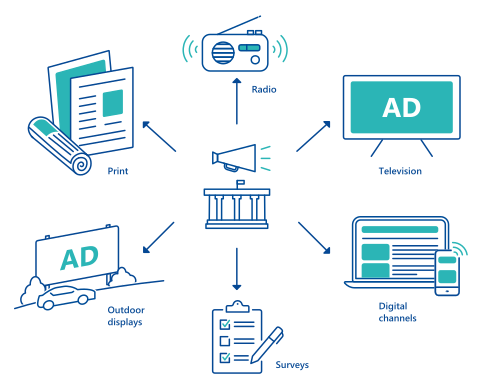
Source: VAGO.
Public Administration Act 2004
The Public Administration Act 2004 (the Act) establishes an apolitical public service. It sets out the values and principles that guide how public servants should act.
In 2017, Parliament amended the Act to regulate government communications and advertising. It set out requirements that communications must be of public interest and apolitical.
It also limited television advertising to a set of purposes because of its high cost and broad reach. This was to ensure public money is used for public benefit, not political advantage.
Code of Conduct for Victorian public sector employees
The Code of Conduct for Victorian public sector employees (VPS code of conduct) requires that public sector employees are impartial and conduct themselves apolitically. It reflects the values and principles set out in the Act. Together, they provide a governance framework that guides public sector agencies’ conduct and performance.
Public Administration (Public Sector Commission) Regulations 2018
The Public Administration (Public Sector Commission) Regulations 2018 (the regulations) define public interest purposes for government communications. It sets out detailed standards to support compliance with the Act.
For example, the regulations require that public sector communications do not mention or point to political parties, and that they do not refer negatively to individuals, groups or organisations without grounds.
Electoral Act 2002 and Authorisation tags for government advertising
The Electoral Act 2002 requires advertisements containing electoral matter to include the name and address of the person who authorised the advertisement.
The Department of Premier and Cabinet (DPC)'s Authorisation tags for government advertising adopt a similar principle – requiring government advertising to identify its source – by mandating all Victorian Government television, cinema and online video advertising campaigns to include an authorisation tag in a prescribed format, with specified text and duration.
What we found
This section focuses on our 3 key findings:
1. Government communications and conduct do not always meet legislative requirements to be apolitical.
2. The government is increasingly using digital channels and social media for advertising and communications, but legislation and guidance have not been updated.
3. Most campaign advertising we assessed met legislated requirements, but there are gaps in television advertising compliance, campaign oversight and spend reporting.

Explore the dashboard
This report has an interactive dashboard, which includes key data behind our findings.
Find the dashboard at audit.vic.gov.au
Consultation with agencies
When reaching our conclusions, we consulted with the audited agencies and considered their views.
You can read their full responses in Appendix A.
Key finding 1: Government communications and conduct do not always meet legislative requirements to be apolitical
We found examples where agencies did not meet the requirements set out in the Act and VPS code of conduct:
- the Premier's media centre website, previously established by DPC on a government platform now managed by DGS, hosts party-political content
- a survey commissioned by DPC had questions seeking public rating on government performance
- SRLA prepares and provides tailored content for ministers' social media accounts every month
- the Department of Transport and Planning (DTP) had guidance for staff on preparing content for ministers' social media accounts, although through the course of our audit DTP told us it is no longer in use.
Guidance to help staff stay apolitical across all forms of government communication is limited. We found that agencies were not always clear about the Act’s requirements, especially about:
- maintaining an apolitical public sector
- not using public resources for political purposes
- responding to government priorities in a way that meets these requirements.
Addressing this finding
To address this finding, we made 3 recommendations to DPC, DGS, SRLA and DTP about:
- strengthening guidance for the public service on maintaining political neutrality
- ensuring the Premier's media centre compliance
- improving internal guidance on managing ministerial requests.
Key finding 2: The government is increasingly using digital channels and social media for advertising and communications, but legislation and guidance have not been updated
The Act was last amended in 2017. Since then, the way government communicates has changed. Digital channels and social media now make up a larger proportion of government advertising spending, with about $40 million spent on these channels in 2024–25. But the legislative and governance framework has not kept pace with these changes.
Inconsistent approach in requiring influencers to disclose government involvement
Across agencies, there was no consistent approach to disclosing government involvement in influencer-created content. This means that audiences may not be aware of the government's involvement in some communications.
Controls over digital and social media content are insufficient for fast-changing media environments. We found examples where agency-produced content was shared on MPs’ and ministers' social media accounts without attribution to the original agency sources. These examples illustrate the risk that agency content could be used for actual or perceived political purposes where controls over attribution, content sharing and editing are weak.
Working well: DJSIR's social media influencers policy and guidelines
The Department of Jobs, Skills, Industry and Regions (DJSIR) is the only agency with social media influencer policy and guidelines, which set out clear steps to help staff engage with influencers and ensure compliance with the Act.
Improvement during our audit: Social media influencer guidance
During our audit, DPC has developed and published guidance on engaging with social media influencers.
Addressing this finding
To address this finding, we made 2 recommendations to DPC about:
- reviewing the government advertising and communications framework
- updating guidance for communicating and advertising on digital channels and social media.
Key finding 3: Most campaign advertising we assessed met legislated requirements, but there are gaps in television advertising compliance, campaign oversight and spend reporting
Seven out of 9 campaigns we assessed complied with the Act and DPC’s requirements. We assessed they were in the public interest, apolitical, generally met mandated multicultural and regional media spend, and were evaluated against their objectives. Agencies follow guidance to report on campaign advertising spending but record-keeping of their spending can be improved to ensure accuracy and traceability.
Two of the campaigns we assessed were noncompliant:
- VIDA's Metro Tunnel opening integrated television advertising segments did not use DPC’s prescribed authorisation tag
- Victoria Police used television advertising for recruitment, which is not a permitted purpose under the Act.
The Metro Tunnel opening television advertising was integrated into live news and did not use the government-prescribed authorisation tag required under DPC's requirements. This makes it difficult for viewers to identify government advertising.
Although VIDA funded the broadcast, it did not retain control over the full content that it paid for. Combined with its presentation within a news format, this blurs the distinction between paid government advertising and broadcaster content.
This format of advertising makes it more difficult for the audience to identify government advertising and for VAGO to assess compliance. This reduces transparency and risks undermining public trust in government communications.
Key issue: Assessing compliance with government advertising requirements remains challenging
The Act was amended in 2017 to provide a legislative framework for governance of communication and advertising by public sector bodies. These legislative changes were intended to:
- make public sector communications clearer and more transparent
- make public sector bodies more accountable for their communication
- support improved oversight by the Auditor-General.
In practice, assessing compliance remains challenging. Agencies have at times adopted broad interpretations of the requirements, while emerging advertising formats and integrated media arrangements increasingly blur the distinction between advertising, editorial content and content shaped by government-supplied messages. This evolving landscape can make it more difficult to determine when statutory requirements apply and whether the transparency and accountability objectives of the Act have been achieved.
Oversight of high-risk advertising campaigns could be improved
Since our last audit, DPC introduced a process requiring agencies to obtain independent legal advice for campaigns identified by the Advertising Approvals Group (AAG) as high risk. But DPC has not established objective criteria for determining whether a campaign is high risk and it did not require documentation of these decisions. This limits the effectiveness of the assurance process and increases the risk that campaigns requiring additional scrutiny are not identified.
We also found weaknesses in the process to declare conflicts of interest, with AAG members approving campaigns involving their own agencies' services.
Campaign spend reporting could be improved
Most agencies, except DGS, reported their campaign spending in annual reports as required by the Department of Treasury and Finance (DTF)'s Financial Reporting Directions. The Department of Families, Fairness and Housing (DFFH) and Department of Health (DH) did not follow the latest reporting format required.
Agencies could improve their record-keeping to ensure accuracy of their reports.
Addressing this finding
To address this finding, we made 4 recommendations to DPC, DGS, DH, DFFH, VIDA and Victoria Police about:
- strengthening oversight of high-risk advertising campaigns
- improving whole-of-government reporting on advertising compliance outcomes
- updating internal guidance to improve compliance
- ensuring compliance with FRD 22 Standard disclosures in the Report of Operations (FRD 22) reporting requirements.
Improvement during our audit: Documentation and reporting
DH started addressing gaps in its documentation and reporting processes during the audit.
DFFH updated its 2025–26 Annual Report campaign reporting and documentation process and templates to address this gap.
See Section 2 for the complete list of our recommendations, including agency responses.
2. Our recommendations
We made 9 recommendations to address our findings. The relevant agencies have accepted 8 recommendations in full or in part and have not accepted one recommendation.
| Agency responses | ||||
|---|---|---|---|---|
| Finding: Government communications and conduct do not always meet legislative requirements to be apolitical | ||||
Department of Premier and Cabinet
| 1
| In consultation with the Victorian Public Sector Commission, review and update guidance to:
| Accepted in part
| |
Department of Premier and Cabinet and Department of Government Services
| 2
| Review and strengthen governance and compliance arrangements to ensure content published on Victorian Government websites and using Victorian Government branding complies with the apolitical requirements of the Public Administration Act 2004 (see Section 3).
| Not accepted by Department of Premier and Cabinet Accepted in part by Department of Government Services
| |
Suburban Rail Loop Authority and Department of Transport and Planning
| 3
| Review and strengthen internal guidance to ensure public sector employees and resources are not used to develop content for ministers' personal communication channels, consistent with the Public Administration Act requirements and the Victorian Public Sector Commission's Code of Conduct for Victorian Public Sector Employees (see Section 3).
| Accepted
| |
| Finding: The government is increasingly using digital channels and social media for advertising and communications, but legislation and guidance have not been updated | ||||
Department of Premier and Cabinet
| 4
| Review existing government advertising and communications framework to:
| Accepted in part
| |
5
| Update and periodically review its guidance for communicating and advertising on digital channels and social media, while the broader framework review (Recommendation 4) is underway. This guidance should address influencer engagement, sponsorship disclosure, branding, attribution requirements and content reuse controls to reduce the risk of misuse (see Section 4).
| Accepted
| ||
| Finding: Most campaign advertising we assessed met legislated requirements, but there are gaps in television advertising compliance, campaign oversight and spend reporting | ||||
Department of Premier and Cabinet
| 6
| Strengthen government advertising oversight by:
| Accepted in part
| |
7
| Strengthen its whole-of-government reporting by:
| Accepted
| ||
Victorian Infrastructure Delivery Authority and Victoria Police
| 8
| Update internal guidance to strengthen its advertising and communications assessment to ensure compliance with the Public Administration Act 2004, particularly television advertising requirements (see Section 5).
| Accepted by Victorian Infrastructure Delivery Authority Accepted in principle by Victoria Police
| |
Department of Government Services Department of Health Department of Families, Fairness and Housing
| 9
| Strengthen record-keeping and governance for campaign advertising disclosures to improve compliance with FRD 22: Standard disclosures in the Report of Operations and reporting accuracy (see Section 5).
| Accepted
| |
3. An apolitical public sector
The Public Administration Act 2004 requires public sector agencies to be apolitical and act in the public interest. This applies to conduct as well as government communications and advertising.
But we found examples of conduct and government communications that did not meet these requirements.
Covered in this section:
- Government communications were inconsistent with the apolitical requirements
- Agencies should not develop content for ministers’ social media platforms.
Government communications were inconsistent with the apolitical requirements
Agency communications
We found examples of government communications managed by DPC and DGS that were inconsistent with the apolitical requirements of the Act:
- the Premier's media centre website contains party-political content (see Case study 1)
- the community attitude research survey commissioned by DPC asks respondents to rate government performance (see Case study 2).
The Premier's media centre website is hosted on the Victorian Government's Single Digital Presence (SDP) platform. DPC established the government-funded SDP in 2018 and set up the Premier's media centre website on the SDP platform, for the Premier's office.
DGS became responsible for the SDP in 2023. DPC and DGS advised that they are not involved in the operation of the website and that the Premier’s office manages the content.
Single Digital Presence (SDP)
The government funds DGS to deliver the Single Digital Presence, a shared web publishing platform intended to improve access to government information and services. DGS maintains the platform's infrastructure, security and functionality, while agencies decide whether to use SDP and are responsible for approving and publishing their own content.
Case study 1: The Premier's media centre website
Political content on the Premier's media centre
Information published on the government-funded Premier's media centre is government communication and must comply with the apolitical communication standards set out in the Act.
We assessed 201 media releases posted to the website from 1 March 2026 to 22 April 2026.
We found that 173 of them contained party-political language and mention opposition party and individuals.
These media releases highlighted governing political party achievements and suggested the opposition party and individuals would not take the same approach. For example:
- 'Only Labor has new solutions to make life safer for families. The Liberals have no solutions – just cuts.'
- 'Only Labor will deliver a health system that works for everyone. Jess Wilson's Liberals have an $11.5 billion budget black hole which means one thing: cuts to hospitals and services.'
This does not align with the apolitical standards of the Act and the regulations.
Most of the media releases address the current government as 'Allan Labor Government' instead of the 'Victorian Government'. This is inconsistent with the Victorian Government digital guide.
Publication of political government communication on the SDP platform is inconsistent with the apolitical requirement set out in the Act and constitutes an improper use of public resources.
Source: VAGO.
Key issue: DPC and DGS caused political content to be published using public resources
Since the SDP was established, DPC and DGS have continued to provide the Premier's office with access to the government-funded platform.
Both agencies told us they have no involvement or responsibility for the content published on the website.
In response to our findings, DPC updated the copyright statement on the media centre to state that content on the website was created by the Office of the Premier. The privacy statement on the media centre still refers to the Victorian Government and DPC.
But issues remain because:
- DGS, through its platform, is causing content to be published that is inconsistent with the Act
- public resources are being used to publish political content.
Case study 2: DPC's community attitude research survey
Sentiment polling in DPC's community attitude research survey
For the past 13 years, DPC has commissioned a community attitude research survey that collects public views about government performance. A survey is a communication tool used to provide information and gather opinions. This survey, published by DPC, is a form of government communication. DPC would not provide us with the full survey. VAGO obtained an extract of this survey as part of DPC's evaluation of its 'cost of living' campaign advertising.
The survey extract we reviewed had a question with 2 parts:
‘How would you rate the State Government when it comes to …
- actively informing the community about financial supports and rebates available to ease cost of living pressure
- providing financial support and rebates to ease cost of living pressures for Victorian households.’
Respondents were asked to rate these statements from 'very good' to 'very poor'.
Government entities may appropriately seek public views on policies or services. But questions should be framed to evaluate awareness, effectiveness or user experience, not government performance.
Specifically, the second part of the question asked respondents to rate the government performance in providing financial support initiatives. This goes beyond assessing awareness, effectiveness or experience of services. It blurs the line between service evaluation and sentiment polling.
Our opinion is that this was inconsistent with the apolitical requirements of the Act and that public resources were used for purposes unrelated to evaluating government services.
Source: VAGO.
Agencies should not develop content for ministers’ social media platforms
Using public resources
The Victorian Government's digital guides provide guidance to the public service about when to publish ministerial content and outline relevant regulations and codes of conduct. It requires that agencies should not:
- have any involvement in the operation of a minister's personal website or social media platform
- prepare material or content specifically for a minister's personal website or social media platform.
The use of public resources, including staff time or publicly funded content, for political purposes is inconsistent with the apolitical requirements of the Act regardless of whether the final content includes explicit political sentiment.
Suburban Rail Loop Authority
Agencies should not use public resources to create tailored content for ministers' personal social media accounts.
SRLA provided documents that explicitly guided staff to develop content solely for ministers' social media channels.
It also provides monthly social media content to its Minister and local MPs to promote the Suburban Rail Loop. In the project's social media strategy, the SRLA team develops tailored content for the Minister’s channels each week and maintains a monthly content compilation from Suburban Rail Loop sites for government use – including tailored posts for local MPs to support coordinated project messaging.
Agencies can appropriately support ministers by directing them to content already published on official agency channels. But creating, tailoring or adapting content solely for politicians' personal websites or social media accounts is not an appropriate use of public resources and is inconsistent with the apolitical requirements of the Act and digital guides.
SRLA advised us that they have removed the word 'tailored' from their strategy. However, the SRLA's continued use of public resources to prepare content specifically for ministers' personal social media accounts is inconsistent with the Act and does not meet public expectations of an apolitical public service.
Department of Transport and Planning
DTP provided documents that explicitly guide staff to develop content solely for ministers' social media channels. DTP advised that the guidance we assessed is now no longer being used.
Based on the information provided by DTP, we remain concerned that DTP has not clearly articulated a position that staff should refrain from creating, drafting or preparing content for publication on ministers' personal social media accounts. Such activity is prohibited under the Victorian Government's digital guides.
We identified its current guidance could be clarified to set clear boundaries for staff.
4. Digital channels and social media
More government advertising and communications is delivered through digital channels and social media, but legislation and guidance have not been updated.
Without adequate controls, this creates risks where publicly funded content could be reused for political purposes.
Covered in this section:
- Government use of communications and advertising channels has changed
- Agencies are working more with social media influencers
- Agencies do not always require influencers to disclose paid or sponsored posts
- Controls over digital and social media content are insufficient for a rapidly evolving media environment
- Agency-sponsored posts are not always managed consistently with relevant policy and do not reflect industry best practice
Government use of communications and advertising channels has changed
Advertising channels
Since our 2022 audit, the way the government communicates has changed.
Figure 2 shows that government spending on television advertising has declined since 2023. The government now spends more on digital channels and social media.
Figure 2: Government advertising spend by media type, from 2021–22 to 2025–26
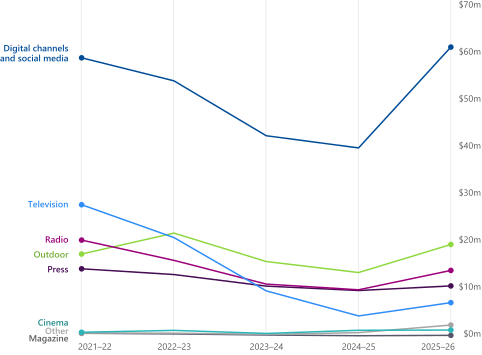
Note: Advertising spend includes campaign, functional and recruitment advertising.
Source: VAGO, based on government advertising spend data provided by Optimum Media Direction (June 2026).
Explore the dashboard
This report's dashboard includes an interactive version of this graph.
Guidance
Despite the government increasing its use of digital channels and social media, existing guidance remains largely principles-based and does not provide agencies with specific direction on managing compliance with legislative and policy requirements when using these channels.
The government has policies and guides about managing public websites and social media accounts. But these policies and guides do not outline:
- how agencies should engage social media influencers
- what disclosure requirements should apply when influencers communicate public messages on behalf of a public sector agency
- the Act and other legal requirements that agencies should follow
- agencies' responsibility for ensuring content created by third parties meets requirements
- the expectation that agencies retain sufficient control and oversight over how their digital content is used, shared, republished or distributed by third parties.
Working well: DJSIR developed its own guidance
DJSIR developed its own social media ambassador guidance and tools covering procurement, risk assessment, briefing, reporting, evaluation and issues management. This guidance demonstrates better practice in identifying and managing risks associated with influencer engagement.
Improvement during our audit: DPC published whole-of-government guidance
During our audit, DPC has developed guidance on engaging with social media influencers and published it in late August 2026.
Agencies are working more with social media influencers
Social media influencers
Agencies publish content on their own social media channels. They also increasingly work with social media influencers to help share messages.
Agencies may use influencers to reach new audiences or communicate with specific groups of people.
Agencies should ensure influencers clearly disclose government involvement so that audiences understand where the communication is coming from.
Controlling output
Agencies remain responsible for ensuring communications shared by influencers meet relevant requirements. But the level of control agencies have over the content they create varies depending on the type of engagement.
Figure 3 outlines the different ways agencies engage social media influencers.
Figure 3: Examples of how agencies work with influencers and what they produce
| Engagement type | Outputs |
|---|---|
| Content creator | Influencers produce content based on scripts or detailed briefs provided by the agency. The content is published on the agency's official social media channels. |
| Media partner | A commercial brand partners with an agency to promote government initiatives. The brand creates social media content and may promote related products, discounts or services alongside government messaging; while the agency develops content that promotes both government messaging and the brand. |
| Brand ambassador | Influencers receive key messages and objectives and create content in their own style. The content is reviewed by the agency and published on the influencer's account, the agency's account, or both. |
| Public relations | Influencers are invited to events or provided with exclusive access to information about a project, service or initiative. There may be limited or no formal agreement regarding outputs. Influencers may choose to post content, allowing agencies to reach the influencer's audience. |
Source: VAGO.
Working well: DJCS maintained control over influencer-generated content
The Department of Justice and Community Safety (DJCS) engaged social media influencers to create content but limited its distribution to official agency channels rather than influencers' personal accounts.
This approach allowed DJCS to maintain control over how the content was published, reducing the risk of noncompliant or inappropriate use through third-party channels.
Agencies do not always require influencers to disclose paid or sponsored posts
Paid or sponsored posts
Social media content shared by influencers engaged by the government is a form of government advertising. Agencies may pay influencers directly or provide in-kind benefits, such as brand exposure, goods or exclusive access to projects.
We selected samples of social media posts created by social media influencers based on a paid arrangement with agencies. We assessed whether:
- agencies had arrangements in place to help ensure the posts complied with the Act
- government sponsorship or paid promotional arrangements were clearly disclosed to audiences.
We did not find any social media posts that were not compliant with the Act. But agencies did not consistently require disclosure of government involvement.
Influencer disclosure
We found agencies require influencers to disclose government involvement in social media content in different ways. For example:
- identifying both the influencer and the agency as authors (Figure 4)
- using a 'paid partnership' label (Figure 5, although as at 6 October 2026 the ‘paid partnership’ label has since been removed from this post)
- including the hashtag '#ad' in the content (Figure 5)
- tagging the agency's account in the post using '@' (Figure 4 and 6).
Key issue: Agencies do not consistently require disclosure of government-sponsored social media content
There is no standardised approach across agencies for requiring influencers to disclose government-funded or sponsored content on social media.
As a result, disclosures are presented inconsistently to audiences. This means that audiences cannot easily distinguish whether a post is:
- sponsored by the government with a pre-scripted message
- sponsored by the government with genuine reviews by an influencer
- not sponsored by the government
- paid or unpaid.
Requirement of disclosure varies
The examples below illustrate less and more mature approaches to requiring disclosure of government involvement in influencer content.
Figure 4: Example of a paid post without clear disclosure of government involvement
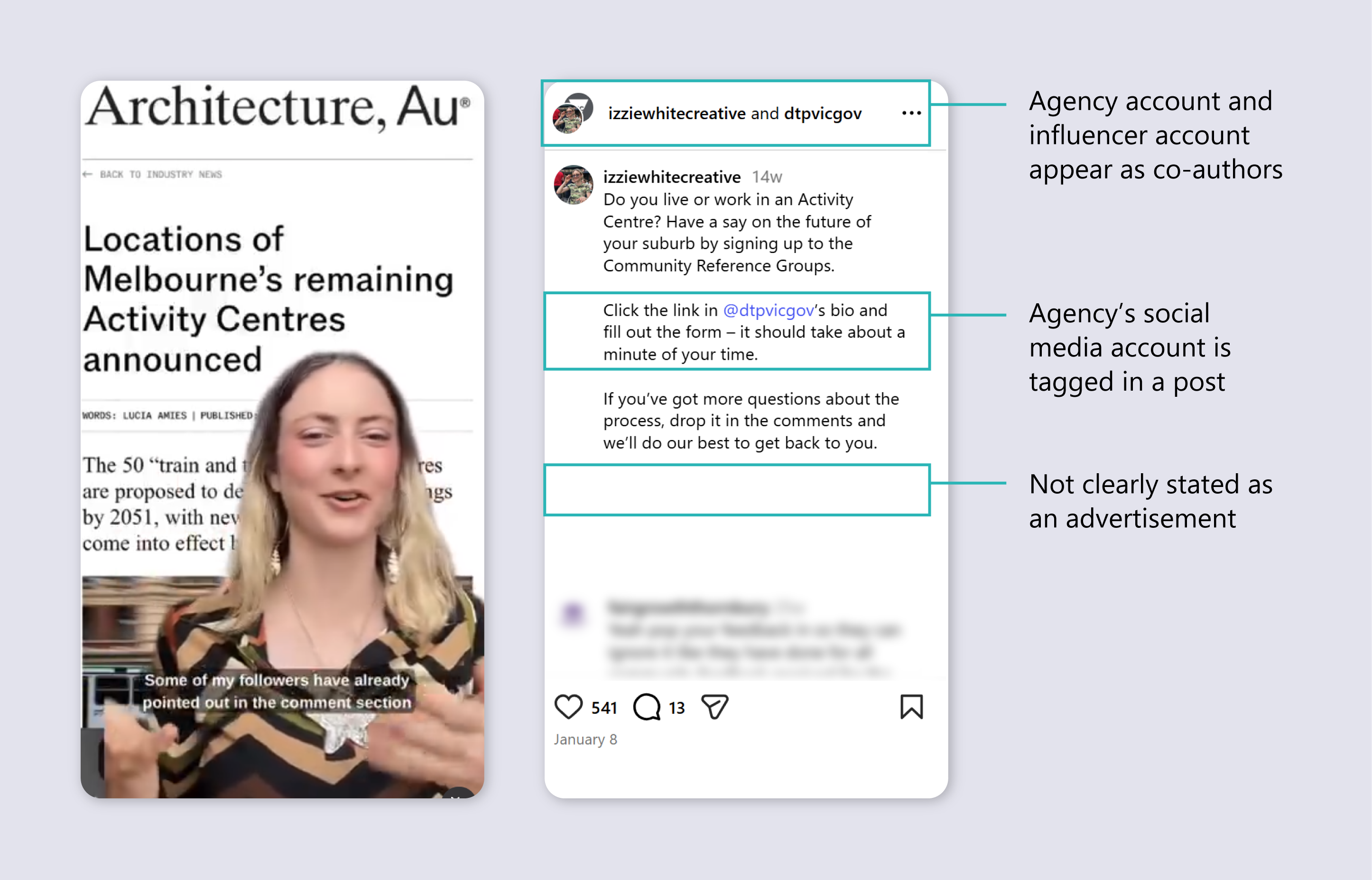
Note: The influencer's post is referenced for context only. This example assesses how agencies managed and controlled publicly funded communications, not the conduct of the individual who created the content. This post did not use '#ad' nor label 'paid partnership'. DTP's account appeared on the post as 'co-author' and tagged in content.
Source: Instagram, posted by 'izziewhitecreative'. Accessed in February 2026. This image was edited to improve resolution but the original content is unchanged. This social media content was commissioned by DTP.
Improvement during our audit: DTP improved disclosure in influencer-created posts during this audit
During the audit, DTP directed its contractor to update the post to include a hashtag '#ad' to address this gap. DTP now requires influencers to use prescribed wording and 'paid partnership' tags on content to disclose government involvement.
Figure 5: Example of a post where government involvement is clearly disclosed using 'paid partnership' and '#ad' labels
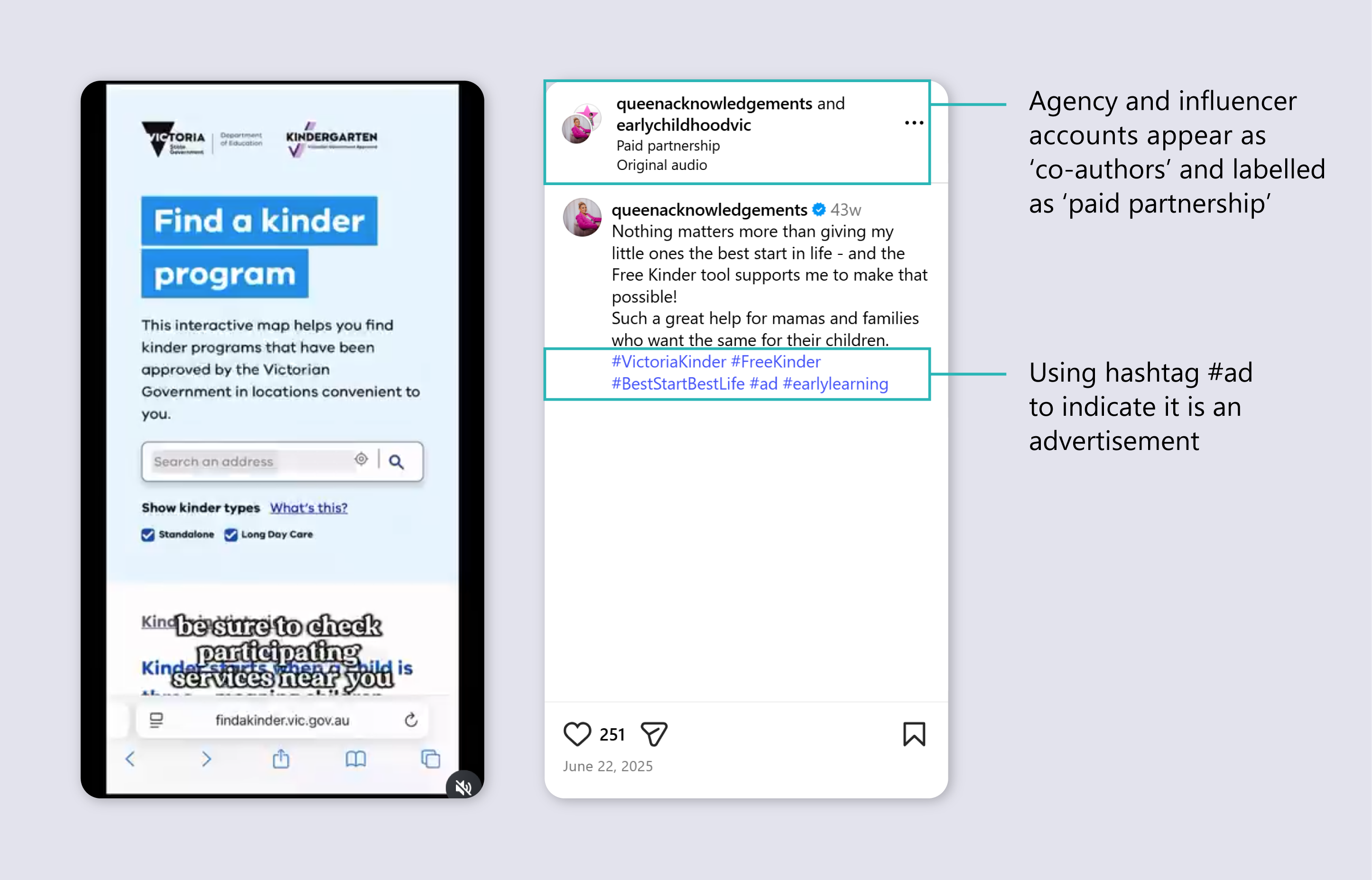
Note: The influencer's post is referenced for context only. This example assesses how agencies managed and controlled publicly funded communications, not the conduct of the individual who created the content.
Source: Instagram, posted by 'queenacknowledgements'. Accessed in June 2026. This image was edited to improve resolution but the original content is unchanged. This social media content was commissioned by the Department of Education (DE).
Figure 6: Example of a paid post that did not disclose it was a government advertisement
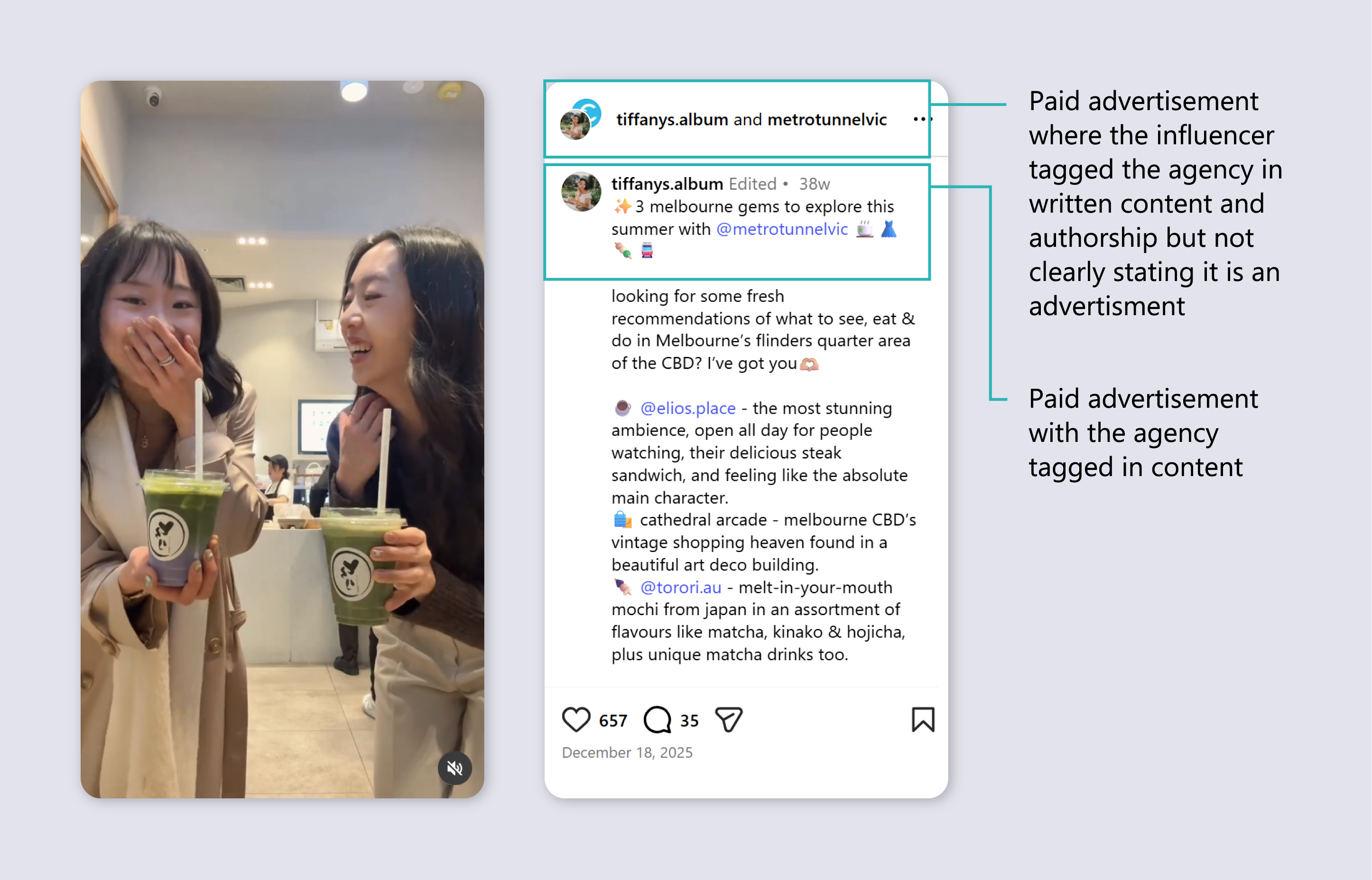
Note: The influencer's post is referenced for context only. This example assesses how agencies managed and controlled publicly funded communications, not the conduct of the individual who created the content.
Source: Instagram, posted by 'tiffanys.album'. Accessed on 5 May 2026. This image was edited to improve resolution but the original content is unchanged. This social media content was commissioned by VIDA.
Controls over digital and social media content are insufficient for a rapidly evolving media environment
Political reuse risk
Agencies often seek to maximise the reach and effectiveness of social media content by encouraging resharing, including by MPs and ministers through their personal social media channels.
We identified several instances where agency-produced content was repurposed without attribution to the original source (see case studies 3, 4 and 5). Agency social media content was repurposed in ways that illustrate risks of political reuse.
We found examples where agencies' existing controls did not prevent the repurposing of content created using public resources, including:
- content not consistently branded with clear government branding or attribution
- agencies not applying measures that require attribution when content is shared or reused.
Agency-produced digital and social media content is a public resource. While agencies cannot fully control how content is used once published, stronger governance arrangements would help to:
- promote clear attribution to agencies
- support stakeholders to share existing agency-branded materials, such as stakeholder communication packs or links to agency-published content
- prevent content from being repurposed for actual or perceived political purposes.
We found examples of better practice from agencies sharing digital content with stakeholders, including publicly available social media communication packs with approved, non-tailored messaging, and ministers resharing agencies' social media posts without modifying the original content (Figure 7).
Figure 7: Example of agency content being shared with clear attribution to original post
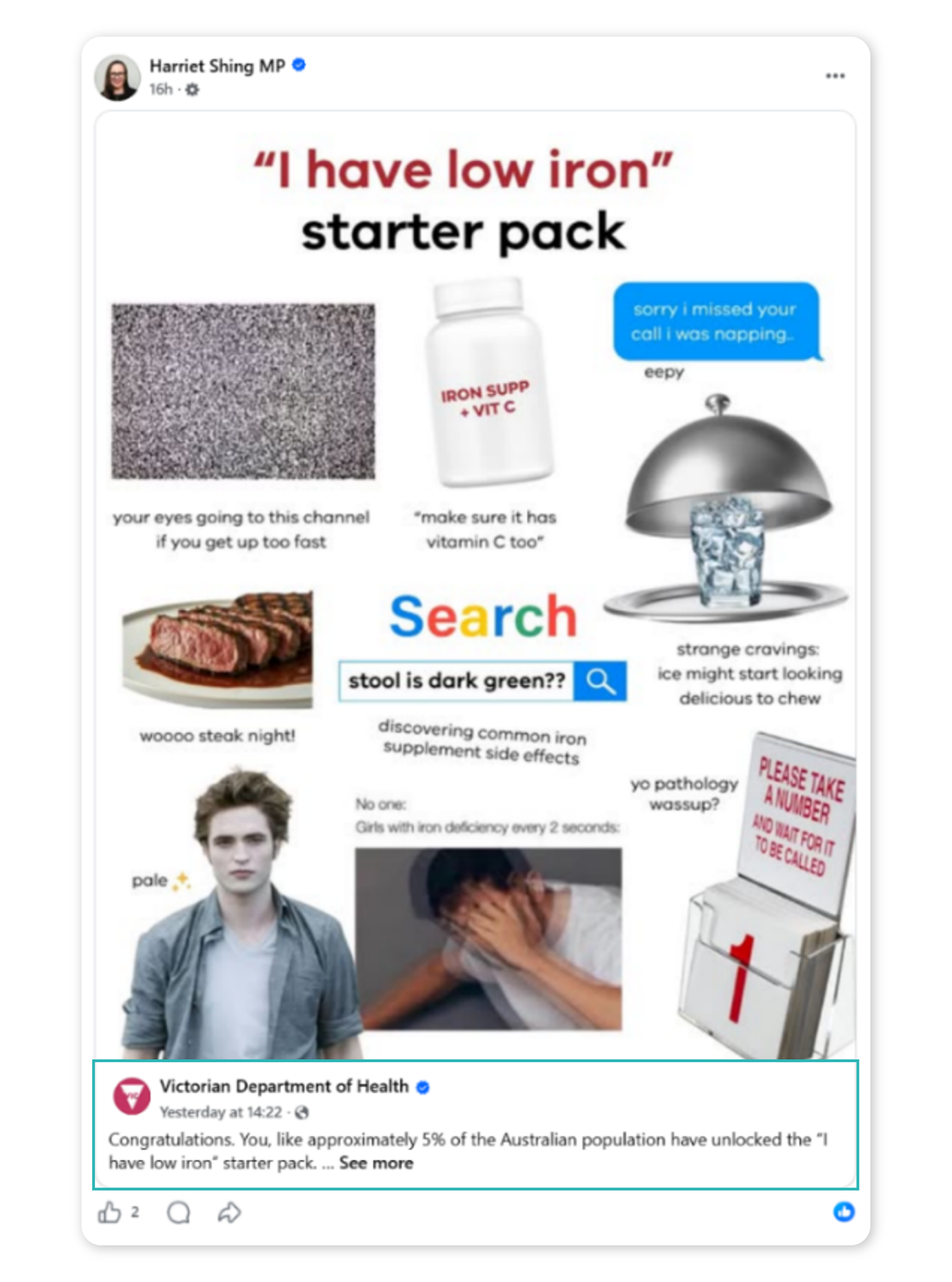
Note: The shared post retained the Department of Health’s original message, branding and link to information.
Source: Facebook, posted by Harriet Shing MP. Accessed on 24 July 2026.
Case study 3: Unbranded social media content
Metro Tunnel opening video
VIDA published a video for the Metro Tunnel opening on its social media account. The video did not contain agency branding or identify VIDA as the source of the content.
This increased the risk that publicly funded content could be reused without attribution to the original source, including for actual or perceived political purposes.
This video was later reposted on then-Minister Gabrielle Williams' personal social media account without attributing to its original post, as Figure 8 shows.
Figure 8: VIDA's Metro Tunnel Project video (left) and the same video reposted without original content (right)
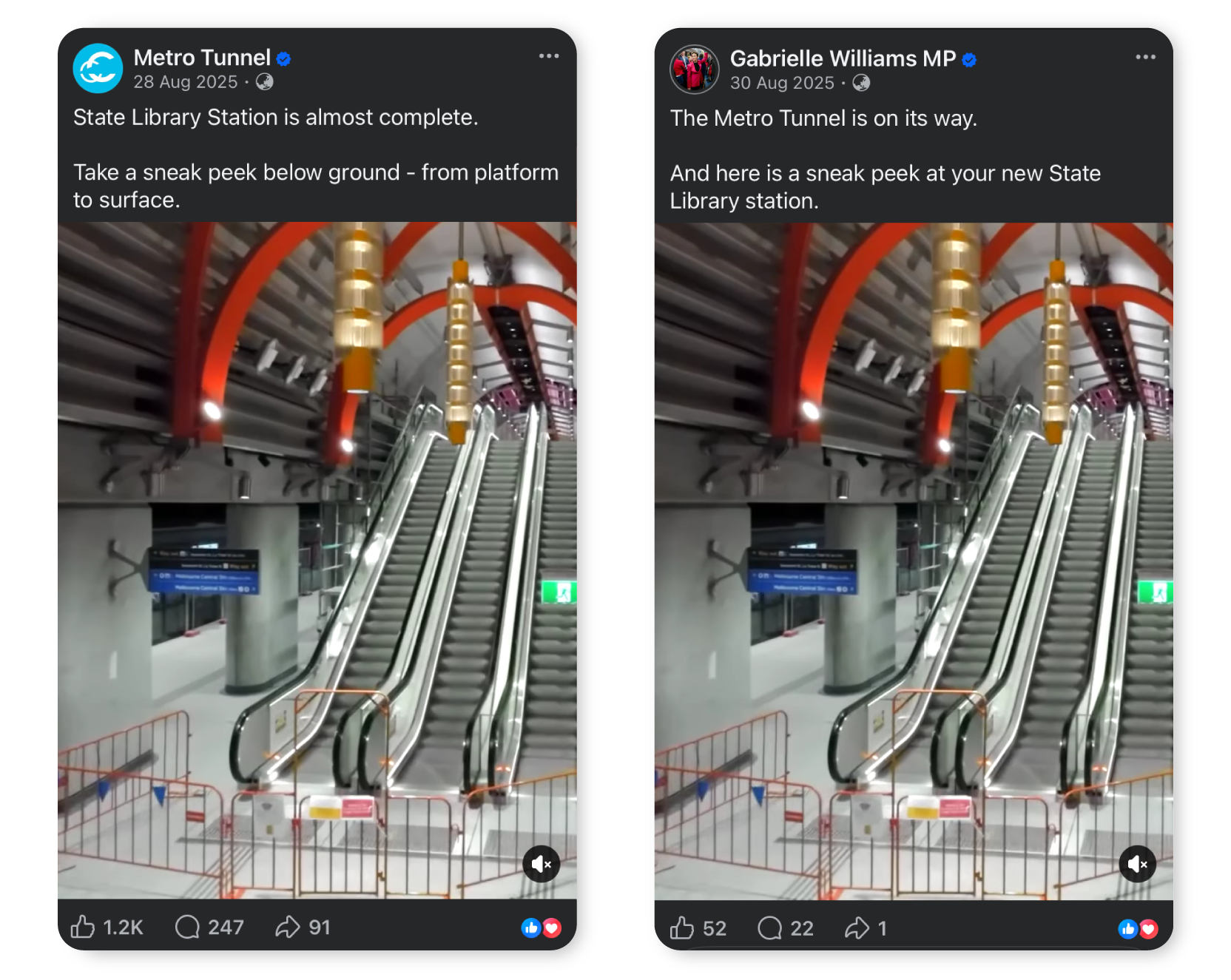
Source: Facebook, posted by ‘metrotunnelvic’ on 28 August 2025 and posted by Gabrielle Williams MP on 30 August 2025. This image was edited to improve resolution but the original content is unchanged.
Note: Individuals are referenced in this case study for context only. This case study assesses the performance of VIDA in undertaking advertising and communications activities, not the conduct of the individuals mentioned.
Source: VAGO.
Case study 4: Example of digital content being repurposed without attribution
Melbourne Airport Rail’s project video was repurposed without attribution
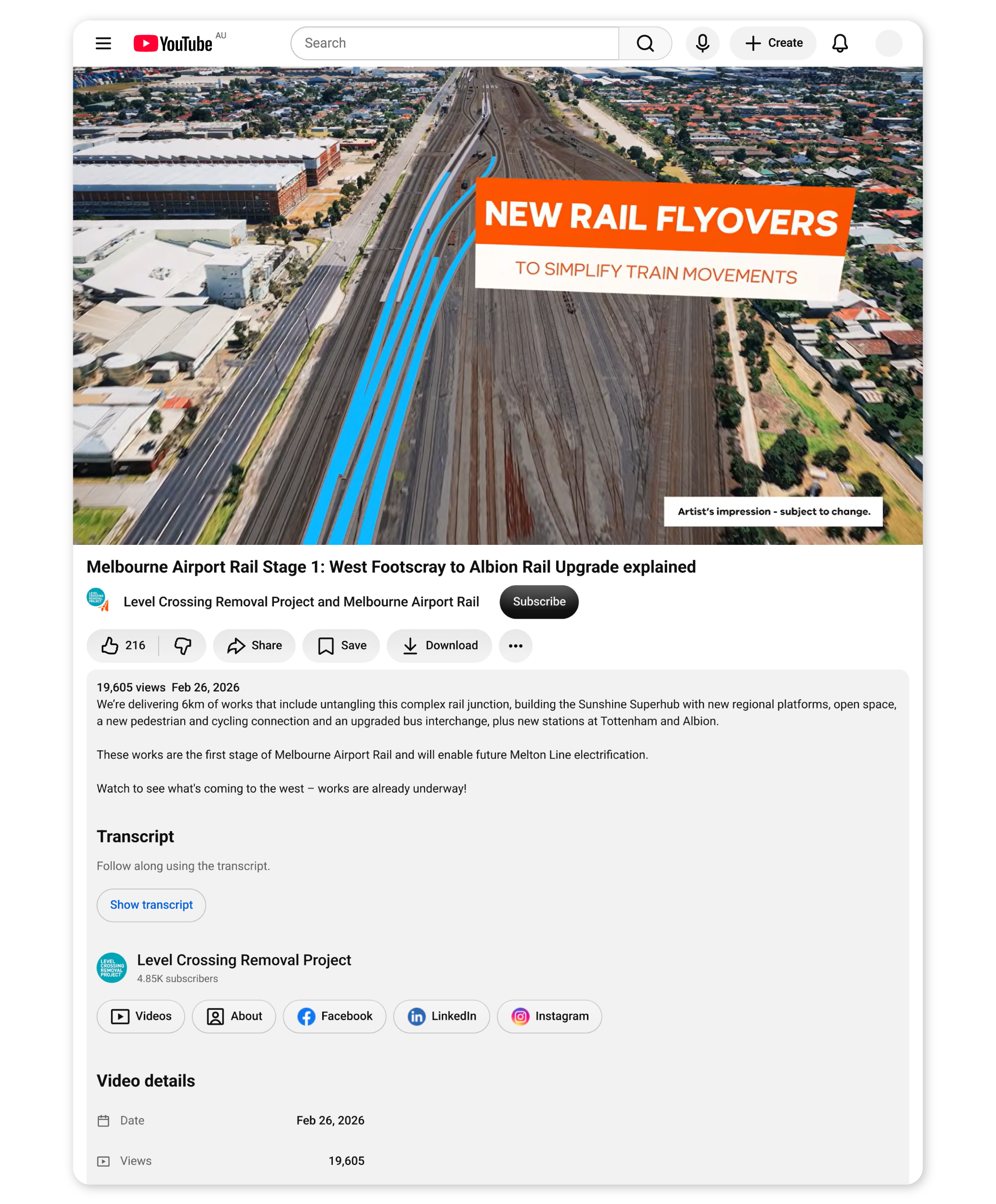
VIDA published a video of the proposed Airport Rail Link. The video did not contain prominent project branding or attribution identifying VIDA as the source of the content, as Figure 9 shows.
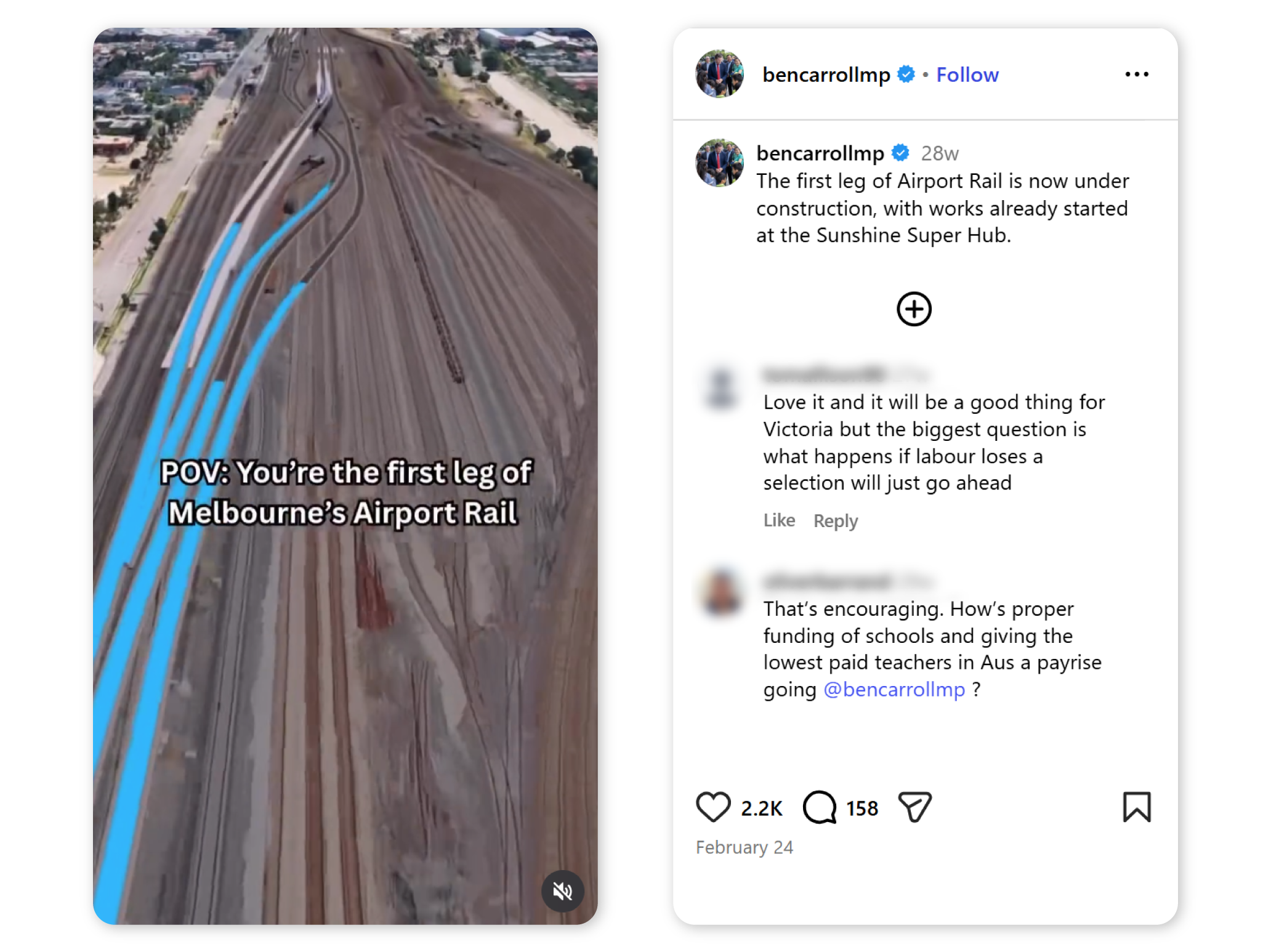
We identified an example where the video was later repurposed on then-Minister Ben Carroll’s personal social media account, without attribution to VIDA. It was modified to include messages that were not part of VIDA’s original post, as Figure 10 shows.
This demonstrates how agency-produced digital content can be reused without attribution when branding and attribution controls are limited. This increases the risk that agency-produced content can be repurposed for actual or perceived political purposes.
Figure 9: An animated video about the Melbourne Airport Rail, published by VIDA on YouTube
Source: Melbourne Airport Rail’s YouTube channel, accessed on 5 June 2026. This image was edited to improve resolution but the original content is unchanged.
Figure 10: The Melbourne Airport Rail video, repurposed and reposted by then-Minister Ben Carroll without original content or attribution
Source: Instagram, posted by ‘bencarrollmp’ on 24 February 2026. Accessed on 22 June 2026. This image was edited to improve resolution but the original content is unchanged.
Note: Individuals are referenced in this case study for context only. This case study assessed the performance of VIDA in undertaking advertising and communications activities, not the conduct of individuals mentioned in this case study.
Source: VAGO.
Case study 5: Example of agency content being repurposed for political use
Homes Victoria’s video
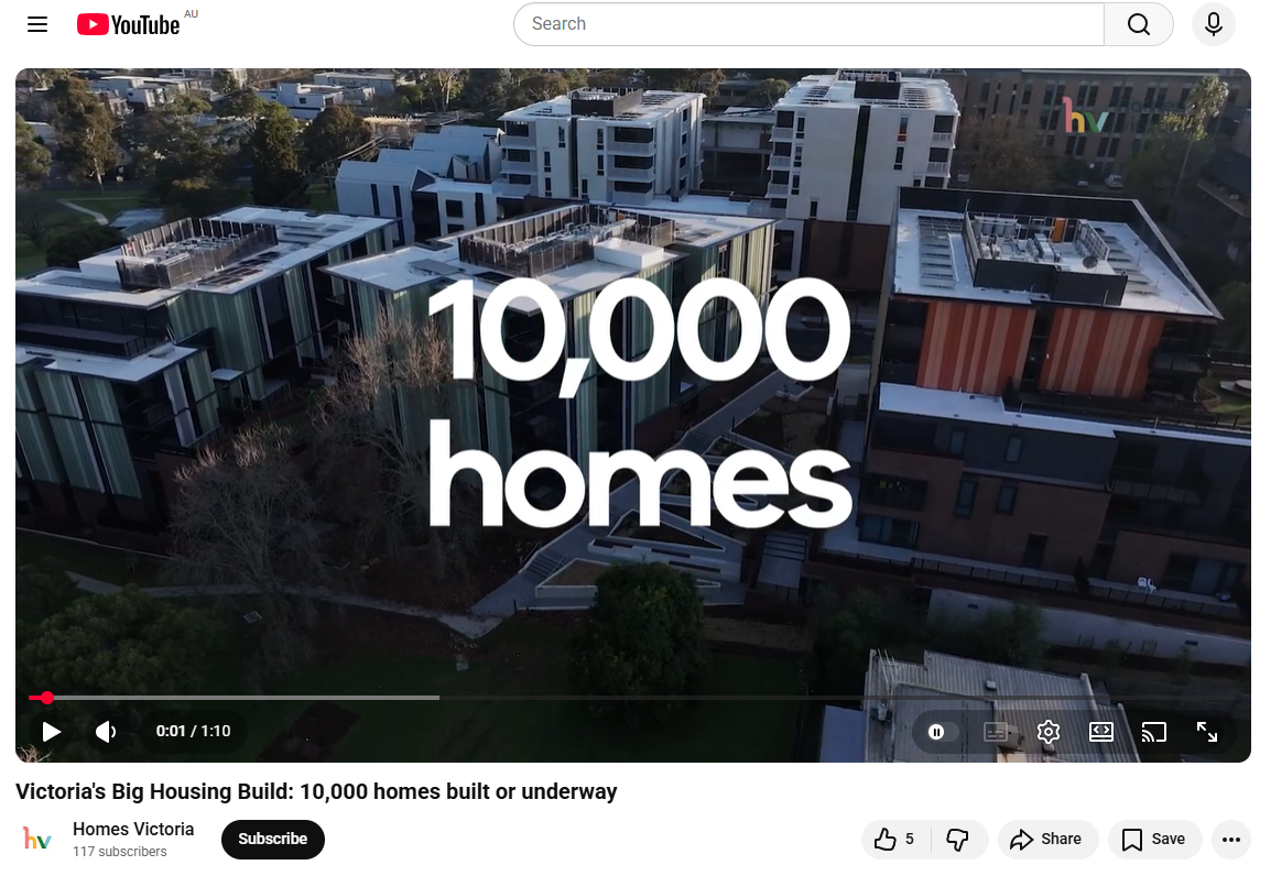
Homes Victoria published a video for Victoria’s Big Housing Build. The video did not contain prominent attribution identifying Homes Victoria as the source of the content, as Figure 11 shows.
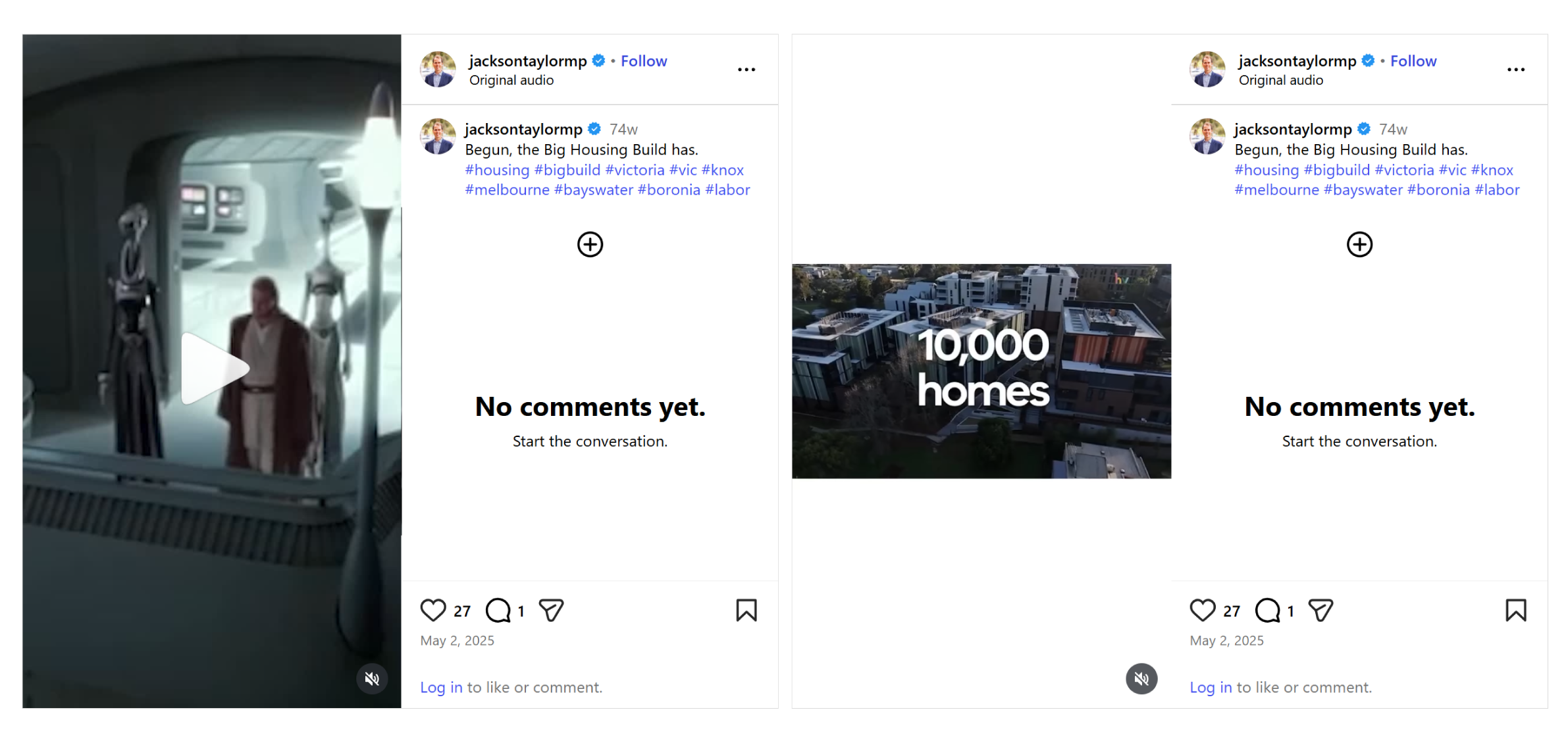
This video was later edited and posted on Jackson Taylor MP’s personal social media account. The video combined a movie clip with the project video. The post highlighted achievements of a political party. The post did not attribute the video footage to Homes Victoria and included a hashtag linking the project to the Labor Government, as Figure 12 shows.
Figure 11: Image of the Big Housing Build video, published by Homes Victoria
Source: Homes Victoria’s YouTube channel, accessed on 22 June 2026.
Figure 12: Repurposed post using the Big Housing Build video without attribution
Source: Instagram, posted by ‘jacksontaylormp’. Accessed on 20 June 2026.
Note: Individuals are referenced in this case study for context only. This case study assesses the performance of DFFH in undertaking advertising and communications activities, not the conduct of the individuals mentioned.
Source: VAGO.
Improvement during our audit: DFFH clarified on its platforms that content cannot be repurposed
In response to our audit finding, DFFH added disclaimers and guidance links to its web and social media platforms, clarifying that social media content cannot be repurposed without permission or attribution, including for political or commercial purposes.
What these examples show
These examples show that when agency-produced content is shared without clear government branding or strict attribution requirements, it can easily be repurposed for political purposes. This may weaken public confidence that government communications are impartial and produced solely in the public interest.
Agency-sponsored posts are not always managed consistently with relevant policy and do not reflect industry best practice
Other types of influencer engagement
Apart from direct payment, agencies also engage influencers or commercial brands by providing in-kind benefits. For example, providing exclusive access to a project or content, or brand exposure.
Agencies may engage influencers through partnerships, sponsorships or invitations to exclusive events. These arrangements may result in influencers sharing content about government initiatives on their social media channels.
Government policy and industry practice
The Victorian Government Sponsorship Policy, which also covers partnership agreements, requires that 'agencies providing sponsorship must ensure that the sponsored organisation provides public acknowledgement of government support'.
Ad Standards, Australia’s advertising regulator, states that 'influencers must disclose any arrangement with a brand to help followers distinguish between advertising content and user generated content… it’s not just where money changes hands – free products or services indicate a relationship that should be disclosed too.'
Ad Standards recommends that influencers disclose any arrangement in a way that is visible and easy to understand, for example by adding hashtags to content (such as #ad, #PaidPromotion, #sponsored) or using platform disclosure capabilities.
Across the cases we assessed, agencies did not have a consistent approach for requiring influencers, content creators or partnered brands to disclose these sponsorship or in-kind benefits. Governance arrangements for sponsored content disclosure have not kept pace with industry best practice.
Further details can be found in case studies 6 and 7.
Case study 6: An influencer produced social media content after participating in a sponsored event
VIDA's Metro Tunnel opening campaign
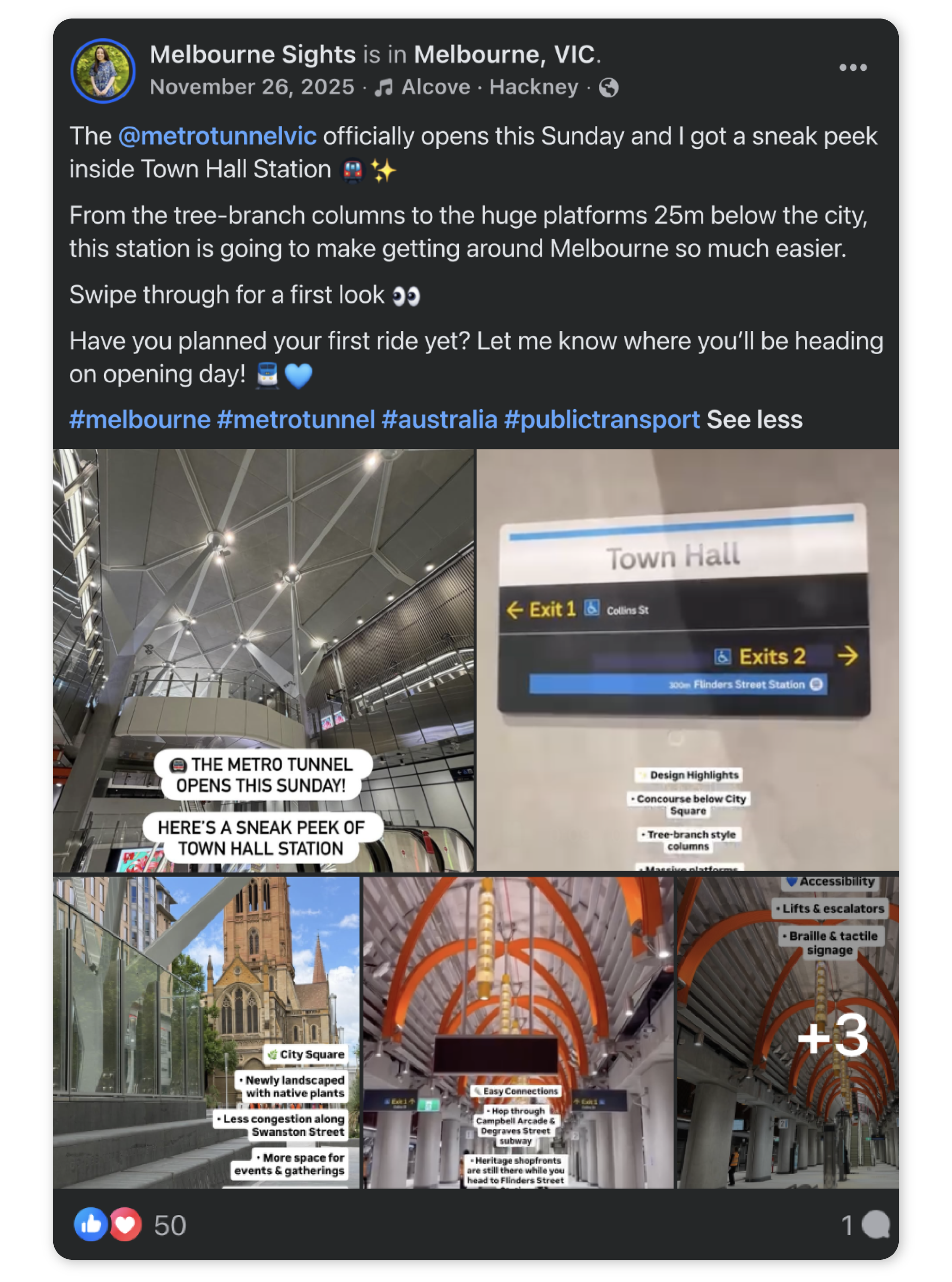
VIDA invited 15 influencers to attend a pre-opening event where they took part in a test train ride and a tour of the new stations. While influencers were not paid, they received in-kind benefits through exclusive access and subsequently published social media content about the stations.
VIDA did not require influencers to disclose the nature of the arrangement or acknowledge government support when publishing content from the event (Figure 13).
Consistent with government sponsorship policy and industry better practice, agencies should establish disclosure expectations as a condition of participation which require influencers to acknowledge government support and remind influencers of government policy and industry disclosure requirements.
Figure 13: An influencer posted about the Metro Tunnel after attending a government-funded event, but was not required to disclose the sponsorship arrangement
Source: Facebook, posted by Melbourne Sights on 26 November 2025. Accessed on 22 June 2026. This image was edited to improve resolution but the original content is unchanged.
Note: Individuals are referenced for context only. This case study assesses how VIDA managed and controlled publicly funded communications, not the conduct of the individuals who created this content or participated in the event.
Source: VAGO.
Case study 7: DTP Youth myki partnership
DTP's social media partnership with a commercial brand
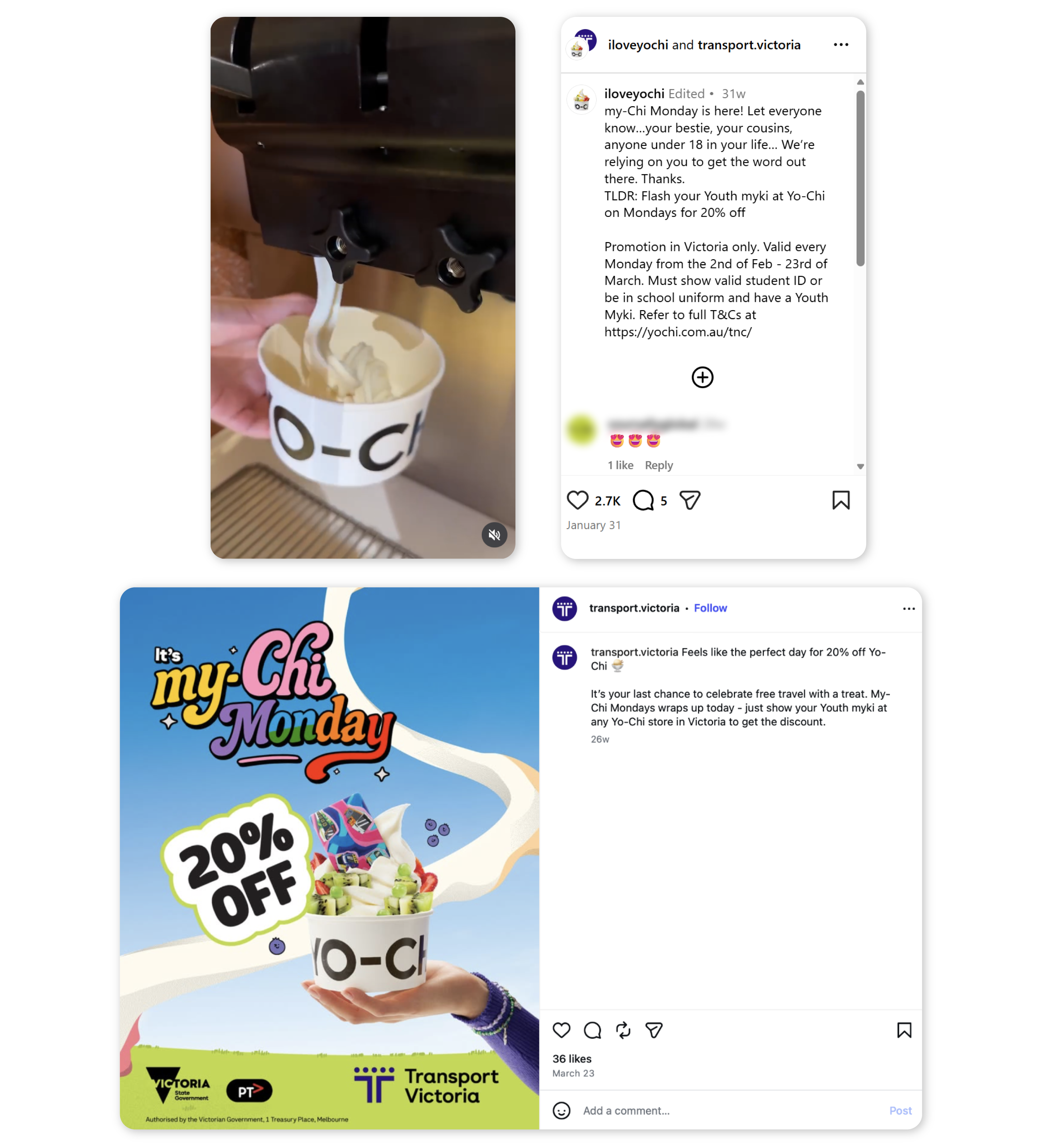
DTP partnered with a commercial brand to promote Youth myki. In exchange for brand exposure, the commercial partner provided product discounts and curated events. Although no payment was made, the arrangement involved in-kind benefits. The social media posts created by DTP and the commercial partner did not clearly disclose the nature of the arrangement.
While the posts were published on both entities' accounts and sometimes displayed both brands, they did not explicitly acknowledge government sponsorship. As a result, audiences may not have clearly understood the government's role in the arrangement.
See examples of the partnership posts in Figure 14.
Figure 14: Social media posts to promote Youth myki, based on a partnership arrangement between a commercial brand and DTP (Transport Victoria)
Source: Instagram. Post by 'iloveyochi' published on 31 January 2026, screenshot taken in May 2026. Post by 'transport.victoria' published on 22 March 2026, screenshot taken in June 2026.
Note: A commercial brand is referenced in this case study for context only. This case study assesses how DTP managed and controlled government advertising and communications, not the performance of the commercial partner.
Source: VAGO.
5. Campaign advertising
Campaign advertising is paid media designed to inform, educate, motivate or change behaviour of the general public.
Campaign advertising compliance has improved. But there are still gaps in television advertising compliance, oversight of high-risk campaigns, and spend reporting.
Covered in this section:
- Legislative requirements for government campaign advertising
- Television advertising did not meet requirements
- The definition of a permitted advertising purpose is unclear
- Compliance gaps remain
- DPC's oversight of government campaigns could be improved
- DPC's reporting of government spending and its outputs could be improved
- Agencies could improve reporting on campaign advertising spending
- Existing advertising definitions no longer reflect current practices
Legislative requirements for government campaign advertising
Permitted purposes
The Act permits television advertising only for a limited set of purposes. Some permitted purposes for general government communications are not listed for television advertising, as Figure 15 shows.
Figure 15: Purposes for government communication and television advertising
| Government communication purposes (regulations) | Television advertising purposes |
|---|---|
| (a) to inform the public of new, existing or proposed public sector policies or projects or Victorian legislation | Not listed |
| (b) to promote public safety, personal security or behavioural change | (a) to promote public safety, personal security or behavioural change |
| (c) to advocate on behalf of Victoria to advance Victoria's position or interests | Not listed |
| (d) to promote awareness of rights, responsibilities, duties or entitlements | Not listed |
| (e) to encourage understanding or use of public sector products and services | Not listed |
| (f) to report on performance in relation to public sector undertakings | Not listed |
| (g) to promote social cohesion, civic pride or community spirit | (b) to promote social cohesion, civic pride or community spirit within the general public |
| (h) to encourage public involvement in decision making by public sector bodies | Not listed |
| (i) to recruit staff | Not listed |
| (j) to promote business opportunities within the public sector | Not listed |
| (k) to promote commercial or economic development within Victoria | (c) to promote commercial or economic development within the state |
| (l) to generate revenue for public sector bodies or for Victoria through consumption of products or services delivered by or in partnership with public sector bodies. | (d) to generate revenue for public sector bodies or for the state through consumption of products or services delivered by or in partnership with public sector bodies |
| Not listed | (e) to promote compliance with legislative requirements. |
Note: The television advertising purposes permitted are outlined in part 5A, section 97D of the Act.
Source: Public Administration (Public Sector Communication) Regulations 2018 and Public Administration Act 2004.
Behavioural change
Behavioural change advertising seeks to influence behaviours, attitudes or habits to achieve a public outcome.
DPC's communication requirements guidance gives examples such as messages around bushfires, water, road and workplace safety. This is different from advertising that primarily informs the public about a government policy, project or service.
Television advertising did not meet requirements
Noncompliant advertising
We selected 9 case studies across 7 agencies for detailed analysis. Two campaigns included television advertising that did not meet the Act or DPC’s requirements.
Government communication and advertising can often serve multiple purposes. For our audit, where a communication appeared to serve multiple purposes, we considered its dominant purpose when assessing whether it met the Act’s television advertising requirement.
| The campaign advertisement for … | does not comply with the Act or DPC's requirements because … |
|---|---|
the Metro Tunnel opening (integrated television segment)
|
See Case study 8 for further detail. |
| Victoria Police recruitment | recruitment is not a permitted purpose for television advertising. |
Case study 8: Metro Tunnel opening integrated television advertising segments
VIDA did not have appropriate controls over its Metro Tunnel opening integrated television advertising segments
Integrated segments are a complex form of government advertising because they blend paid advertising with broadcaster content. They require careful controls to ensure government advertising is clear and transparent, and audiences can distinguish it from other content.
We found that VIDA did not have appropriate controls over its Metro Tunnel opening integrated segments produced in partnership with Channel 7. This made it difficult to determine what content was government advertising and what formed part of Channel 7’s broadcast.
Channel 7 is referenced for context only. This case study assesses how VIDA managed publicly funded advertising and communications activities and discharged its responsibilities under the Act.
The Metro Tunnel opening integrated television advertising segments
In 2025, VIDA and DTP developed the ‘More Ways to Move’ campaign which included the opening of the Metro Tunnel and West Gate Tunnel. The campaign for both tunnels was endorsed with an approved total budget of $3.65 million, with $2.5 million for media placement. The Metro Tunnel opening campaign was delivered in 2 parts, with VIDA promoting the tunnel opening in late 2025, followed by DTP delivering messages about journey and timetable changes.
In November 2025, VIDA entered into a paid partnership with Channel 7 to promote the opening of the Metro Tunnel through integrated television and online content, including:
- a 4pm television news bulletin hosted from a Metro Tunnel station for 60 minutes
- 3 pre-recorded 'integrated segments' published during the live news
- 4pm and 6pm live weather broadcasts from a Metro Tunnel station during the live news
- a published 'brought to you by' 10 second program billboard broadcast, with a voice-over stating ‘7News is brought to you by Metro Tunnel, opening Sunday, search Big Build.’
- one web article
- 7 social videos.
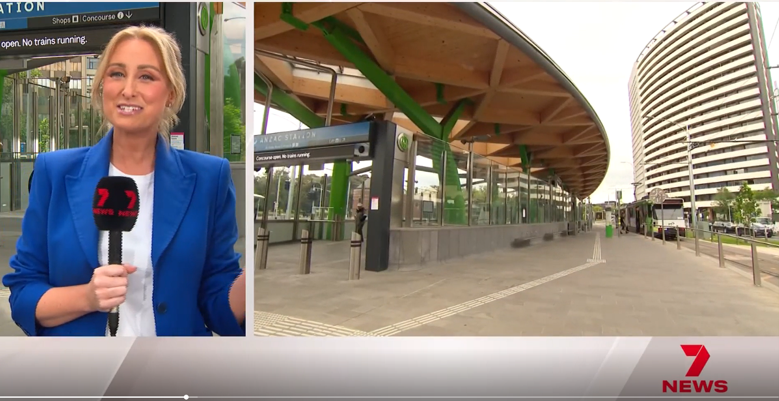
Snippets of the television broadcast are provided below in figures 16, 17 and 18.
Figure 16: A weather reporter broadcasting outside of Anzac Station, explaining station design
Source: Master Agency Media Services contractor. Recording of the news report live on 28 November 2025.
Figure 17: Live news and web video including a 3-minute interview with the Minister for Transport
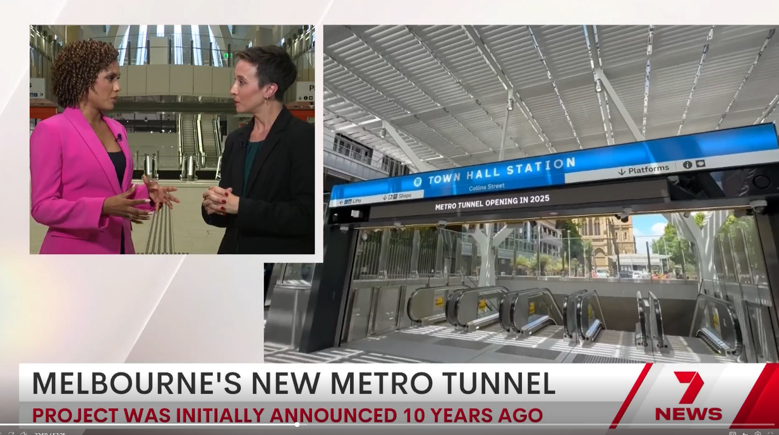
Note: VIDA said this interview was not undertaken under its paid agreement with Channel 7 and had no control over its content.
Source: 7news.com.au, published on 28 November 2025. Accessed on 22 June 2026.
Figure 18: Live news segment promoting food offerings in Metro Tunnel stations

Source: Master Agency Media Services contractor. Recording of the news report live on 28 November 2025.
VIDA could not demonstrate alignment between contracted and published content
VIDA provided its contract with Channel 7, payment records and the published content. We were unable to reconcile VIDA’s description of the content it purchased and controlled with the evidence provided. In particular:
- the agreement and costings included deliverables, such as the 4pm news that VIDA later advised it did not pay for
- the duration of advertising that VIDA paid for differed from the duration quoted in the agreement and from the content ultimately published.
We assessed the 3 pre-recorded segments and they satisfied the behavioural change permitted purpose for television advertising. However, the segments were integrated into the broader news bulletin without authorisation tags, and subsequently packaged into web articles and social media videos. The integration of paid advertising with broadcaster content made it unclear which parts VIDA paid for. This meant we could not assess the integrated segments' compliance with the Act.
VIDA did not adequately manage risks of noncompliance
Public sector agencies are responsible for ensuring that government advertising complies with the requirements of the Act.
In our 2022 audit, we found agencies could not show that their campaigns were effective or delivered value for money. In response, DPC strengthened its communication requirements and assurance process.
Integrated segments are a complex and novel form of advertising. Despite this, we found VIDA did not take reasonable steps to ensure the advertising complied with legislative and DPC’s requirements because:
- VIDA told us it paid for and provided key messages for content it ultimately did not control
- it did not get approval for the integrated segment advertisement, bypassing established assurance processes for compliance, effectiveness and value for money
- it did not apply the mandatory authorisation tag for television advertising.
VIDA advised that the integrated segment format made it impractical to apply the required tag and instead used a ‘brought to you by’ billboard. VAGO does not accept that transparency around government advertising should be compromised.
As a result, VIDA increased the risk that audiences could not distinguish government advertising from Channel 7 editorial content, and reduced assurance that the advertising complied with legislative requirements and represented value for money.
VIDA’s decision not to retain final control over content or follow DPC’s communication requirements introduced unnecessary risk into an already complex advertising campaign.
VIDA could have advertised transparently and more clearly demonstrated compliance by:
- clearly defining and documenting the content being purchased
- obtaining DPC’s required approvals before publication
- applying the required government authorisation tag after each segment
- documenting an agreement with Channel 7 that VIDA retains final control over all paid content.
Note: Channel 7 is referenced for context only. This case study assesses how VIDA managed publicly funded advertising and communications activities and discharged its responsibilities under the Act, not the conduct of Channel 7.
Source: VAGO.
The definition of a permitted advertising purpose is unclear
Television advertising
In 2017, Parliament amended the Act to include additional restrictions on television advertising.
The amendments introduce permitted advertising purposes. They distinguish campaigns that promote ‘public safety, personal security or behavioural change’ from those that inform the public about government policies and projects, or encourage the use of government services. This indicates that Parliament intended these purposes to be treated differently.
Key issue: Unclear legislative definitions make compliance difficult to assess
The Act does not define what constitutes promoting ‘public safety, personal security or behavioural change’. Agencies have broad interpretations of the permitted purpose, making it difficult to assess whether advertising aligns with Parliament’s intent.
Unclear definition led to broad application
We identified different applications of the 'public safety, personal security or behavioural change' purpose across agencies. For example:
- VIDA applied the behavioural change purpose to its Metro Tunnel and West Gate Tunnel opening campaigns because by promoting new infrastructure, it encouraged Victorians to shift the way they travel
- DPC applied the behavioural change purpose to its cost-of-living campaign because it encouraged Victorians to use the government's 'Savings Finder' tool
- Victoria Police applied the same purpose to its recruitment campaign, on the basis that recruiting police officers contributes to community safety outcomes.
In our view, the above behavioural change campaigns more closely align with informing the public about a government project or encouraging the use of a government service. Similarly, recruitment is a distinct purpose and should not be broadly characterised as promoting safety.
These examples illustrate how, in the absence of a clear definition, the behavioural change purpose can be interpreted broadly in ways that may extend beyond Parliament's intended purpose. This risks weakening the Act's tighter controls on television advertising and makes compliance difficult to assess.
Compliance gaps remain
Campaign compliance
Of the 9 campaigns we assessed, 7 clearly complied with the Act and DPC’s requirements. This is an improvement since our last audit, particularly as most agencies:
- met the Victorian Government communication requirements on multicultural media and regional media spend
- evaluated their campaigns within 3 months of campaign conclusion.
Figure 19: A summary of our assessment of the selected campaigns
| Campaign name | Met public interest purpose | Apolitical | Met television advertising purposes | Multicultural and regional policy requirements | Evaluated within 3 months | Accurately reported in its annual report |
|---|---|---|---|---|---|---|
| Metro Tunnel opening campaign – VIDA | Yes | Yes | Could not assess* | Budgeted spend met requirements | Too early to assess | Too early to assess |
| Victorian Big Build Disruptions – VIDA | Yes | Yes | Yes | Yes | Yes | Unable to verify** |
| Victorian Fire Season – DJCS | Yes | Yes | Yes | Yes | Yes | Yes |
| Water safety – DJCS | Yes | Yes | Yes | Yes | Yes | Yes |
| Police recruitment – Victoria Police | Yes | Yes | No | Exempted | Yes | Yes |
| Learn Local brand awareness – DJSIR and Adult, Community and Further Education (ACFE) Board | Yes | Yes | N/A | Yes | Yes | Too early to assess*** |
| Big Housing Build – DFFH | Yes | Yes | N/A | Budgeted spend met requirements | Too early to assess | Too early to assess |
| Real Help, Right Now cost of living – DPC | Yes | Yes | Yes | Yes | Yes | Too early to assess |
| Real Help, Right Now energy affordability – Department of Energy, Environment and Climate Action (DEECA) | Yes | Yes | N/A | Budgeted spend met requirements | Too early to assess | Too early to assess |
Notes: *This assessment refers to the integrated television advertising segments VIDA produced with Channel 7.
**VAGO did not identify any inaccuracies in VIDA’s reported expenditure, but we cannot perform independent reconciliation due to a difference in accounting treatment.
***ACFE had confirmed minor inaccuracies in its 2024–25 reporting. ACFE's 2025–26 reporting was not finalised during this audit.
Source: VAGO.
DPC's oversight of government campaigns could be improved
Risk-based approach
The AAG is chaired by DPC and comprises senior communications executives from departments and representatives from the Premier's office. The AAG plays a key role in reviewing and endorsing agency campaign proposals and assessing campaign strategies and materials for compliance before approval.
In our 2022 audit, we recommended that DPC and agencies adopt a risk-based approach to assessing compliance with the Act.
DPC has since included a new step where the AAG should identify 'high-risk' or 'sensitive' campaigns and require agencies to seek independent legal advice.
DPC defines 'high-risk' or 'sensitive' campaigns as 'any campaigns that could be, or be perceived to be, non-compliant with legislative requirements'.
We found that the new approval step is not working as intended because the:
- definition of 'high-risk' or 'sensitive' was unclear, without objective measures
- definition was documented for the AAG but not shared with agencies, limiting agencies’ visibility of the criteria that may trigger additional scrutiny
- AAG is not required to document its assessment or rationale when deciding that a campaign is not high risk, reducing transparency of decisions
- AAG did not identify any campaigns as high risk or sensitive during the past 2 years.
This is despite the fact that:
- in our 2022 audit, we identified that campaigns about transport infrastructure projects carry higher risk of not complying with the Act, and there were several similar campaigns during the past 2 years
- by-elections during this period, and the pending state election, increase the risk of campaigns being perceived as indirectly or directly influencing voting behaviour.
Working well: Some agencies developed their own campaign risk assessment framework
DE, VIDA and SRLA developed risk assessment frameworks that consider factors such as campaign budget, timing, content and media channels. These frameworks provide more objective criteria for identifying higher-risk campaigns.
Conflict-of-interest process could be improved
AAG members may at times review campaigns that were proposed by their own department. To manage conflicts of interest, DPC requires representatives from the sponsoring agency to withdraw from the endorsement process.
We identified a gap in this process. DPC's cost-of-living campaign promoted the Savings Finder service, which was developed and operated by DGS. While DPC's representative withdrew from the process, the campaign was endorsed by a DGS representative. The conflict-of-interest process did not address the perceived conflict arising when an agency is involved in endorsing a campaign that promotes its own product or service.
Without appropriate conflict-of-interest controls, perceived bias in campaign endorsement decisions may undermine confidence in the effectiveness and integrity of the role of the AAG.
Case study 9: Example of a high-risk campaign that illustrates weaknesses in the risk assessment process
DPC's cost-of-living campaign was compliant but its risks were not adequately escalated
DPC's cost-of-living campaign aimed to promote government savings initiatives to ease cost-of-living pressures. Campaign materials included a call to action directing users to Service Victoria’s Savings Finder website, a service operated by DGS.
DPC's post-campaign evaluation found that some respondents considered the campaign to be 'electioneering', indicating a risk that campaign messaging could be perceived as political.
Despite this risk, neither DPC nor the AAG identified the campaign as high risk or sensitive. The AAG endorsed the campaign without requesting DPC to seek legal advice on compliance with the Act, and DPC did not take additional assurance steps. In particular, it did not:
- seek independent legal advice on compliance with the Act
- raise any reputational risks in its strategy document.
We did not identify political messaging in the campaign materials. But this example demonstrates that the AAG's risk assessment processes were not sufficiently sensitive to campaigns that carry a higher risk of being perceived as political. This means campaigns with higher risks may not receive the extra scrutiny intended by the revised approval process.
Source: VAGO.
DPC's reporting of government spending and its outputs could be improved
DPC's reporting
DPC reports annually on the Victorian Government’s advertising spending and whether it meets policy targets.
When we started our audit in December 2025, the latest published Government Advertising Report was for 2022–23. During the audit, DPC published the 2023–24 report (in March 2026) and the 2024–25 report (in August 2026). DPC had not established a defined timeframe for publishing these reports, which limited transparency and timely access to information.
Budget Paper output
From 2021 to 2026, one of DPC's departmental objectives was to 'maintain compliance with government advertising and communication guidelines to support effective financial management, probity, and accountability of government advertising’.
DPC's measure for this objective was 'relevant communication activity compliant with government advertising and communication guidelines'. This measure was reported as 100 per cent compliant since 2021–22, for 4 consecutive years. DPC advised that they calculated 100 per cent based on 'campaign advertising' endorsed but not on other government communication.
This limits the usefulness of the output measure because it focuses on approved campaign advertising rather than the broader scope of government communications covered by the Act.
Agencies could improve reporting on campaign advertising spending
Meeting reporting requirements
DTF's FRD 22 requires agencies to report on campaign advertising spend (with a media buy over $100,000).
DGS has not published its campaign spend in its annual reports for the past 3 years.
DFFH and DH did not follow the latest reporting format required. They included figures for 'actual spend' but did not include approved spend for each campaign.
Record keeping
Most agencies followed the FRD 22 requirement, but not all of them have a traceable record of their campaign spend to support the accuracy and completeness of their reported figures.
We tested agencies' annual report figures for 2023–24 and 2024–25.
Three agencies (DEECA, DTP and VIDA) provided the underlying records that informed their reporting, but not in a form that allowed recalculation. This means we were unable to verify whether the figures reported in the annual report were accurate.
Existing advertising definitions no longer reflect current practices
Advertising definitions
Agencies report annually on campaign spending, depending on the amount spent and whether the activity is classified as 'campaign' advertising. But existing government definitions of 'campaign' versus 'non-campaign' advertising no longer reflect how agencies classify and use advertising in practice.
Campaign advertising
is paid media designed to inform, educate, motivate or change behaviour of the general public.
Non-campaign (functional) advertising
is generally simple and informative, usually for immediate and short-term appearance.
Source: DPC's requirements.
Existing government guidance defines functional advertising as text-based, short-duration, and requiring less creative input than campaign advertising.
However, we observed examples of advertising classified as 'functional' or non-campaign that shared characteristics commonly associated with campaign advertising (Figure 20).
Figure 20: Examples of ‘functional’ advertising that shares characteristics with campaign advertising
| Traditional functional advertising | Examples we observed that share characteristics with campaign advertising |
|---|---|
Public engagement
| Traditionally, engagement advertising aims to invite the public to provide feedback on consultation. Advertising includes simple notice of timing and location of consultation. We observed examples from recent planning and infrastructure projects where public engagement included more explanation of the project and project benefits. |
| Disruption | SRLA's 'disruption' advertisements also promote local businesses that were impacted by project disruption. |
Source: VAGO.
These examples suggest that current agency practices have expanded beyond the traditional characteristics of functional advertising reflected in government guidance. This means existing definitions may not consistently capture the range of activities that agencies classify as functional advertising. This reduces the comparability and transparency of reported advertising activity and spending.
Appendix A: Submissions and comments
Download a PDF copy of Appendix A: Submissions and comments.

Appendix B: Abbreviations, acronyms and glossary
Download a PDF copy of Appendix B: Abbreviations, acronyms and glossary.
Appendix C: Audit scope and method
Download a PDF copy of Appendix C: Audit scope and method.
Appendix D: Government advertising spend data
Download a PDF copy of Appendix D: Government advertising spend data.