
Public Lottery Licence Extension
Review snapshot
Did the public lottery licence extension optimise value for Victoria?
Why we did this review
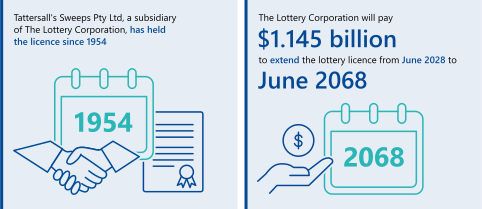
Tattersall’s Sweeps Pty Ltd, through its parent company The Lottery Corporation (TLC), has held the Victorian public lottery licence (the licence) since 1954. The current licence expires in June 2028.
In May 2026, the government extended TLC’s licence after a period of negotiations. It used a 'bilateral' approach, which means it did not negotiate with any other operators. It agreed to a 40-year extension, and TLC will pay the government $1.145 billion upfront.
We did this review to see if the government’s strategy was appropriate and optimised value for the state.
Key background information
Source: VAGO.
What we concluded
We found nothing to suggest that the government's licence approach did not seek to optimise value for the state.
The government had sound reasons for negotiating with TLC bilaterally. The decision was informed by a well-structured program of work that found:
- a competitive process was unlikely to deliver a better outcome than bilateral negotiations
- continuing with TLC would minimise disruption to the state's future lottery tax revenue.
Once bilateral negotiations began, the government's ability to secure additional value from TLC largely depended on licence terms and the degree of policy flexibility it was prepared to provide. Negotiations were guided by a strategy that established objectives and negotiation parameters. We saw no evidence to suggest that agencies did not actively assess and negotiate TLC's proposals against this strategy.
The agreed premium exceeded the reserve price set by the government. The reserve price was informed by a range of modelled scenarios and assumptions based on previous gambling licensing processes. Further cross-checks of key cost assumptions and sensitivity analysis would have provided additional evidence to support the reserve price.
We found no significant probity issues. But the government's approach limited public transparency about key decisions and the reasons for them.
1. Our key findings
What we examined
Our review followed 3 lines of inquiry:
1. Was the decision to adopt a bilateral negotiation process supported by robust evidence and advice?
2. Did the Department of Treasury and Finance and Department of Justice and Community Safety follow relevant commercialisation and probity policies and processes?
3. Did the 40-year public lottery licence extension optimise value for Victoria?
To answer these questions, we examined:
- Department of Treasury and Finance (DTF)
- Department of Premier and Cabinet (DPC)
- Department of Justice and Community Safety (DJCS)
- Victorian Gambling and Casino Control Commission (VGCCC).
Terms used in this report
Agencies
In this report, agencies refers to DTF, DPC and DJCS. It does not include the VGCCC which is referred to separately where relevant.
Bilateral
A bilateral approach involves negotiations between only 2 parties. This contrasts with multilateral negotiations or competitive bidding, which usually involve several potential parties and proposals.
Select expression of interest
The select expression of interest (EOI) process was a structured bilateral process where the government invited TLC to submit and negotiate proposals for a potential extension of the public lottery licence.
Background information
Current Victorian public lottery licence
The current Victorian public lottery licence (the licence) started in June 2018 and is scheduled to end on 30 June 2028. The government granted the licence to Tattersall’s Sweeps Pty Ltd under the Gambling Regulation Act 2003 (the Act). The Lottery Corporation (TLC) is the parent company of Tattersall's Sweeps Pty Ltd.
The licence authorises the operator to run specified public lotteries in Victoria, subject to conditions set by the Minister for Casino, Gaming and Liquor Regulation (the Minister).
The government awarded the 2018 licence through a competitive process. The Minister invited registrations of interest, shortlisted applicants and then assessed formal applications before determining the successful licensee.
The Minister exercised powers under the Act to grant the licence and impose conditions, with associated contractual agreements governing operational and commercial arrangements.
The licence covers:
- TattsLotto
- Oz Lotto
- Powerball
- Super 66
- Weekday Windfall
- Draw Lotteries
- Instant Scratch-Its
- Set for Life.
Context for the current licence extension
On 4 May 2026, the Minister extended the licence with TLC for a further 40 years, from 30 June 2028 to 30 June 2068. TLC will pay the Victorian Government $1.145 billion upfront as part of the agreement.
TLC announced the extension through the Australian Stock Exchange on 5 May 2026. This was the first public disclosure of the extension and nature of negotiations.
As a large, long-term transaction involving a monopoly licence, the extension raises important considerations about the process the government followed, including whether it delivered value for money.
Impact on the state's fiscal targets
The licence extension requires Tattersall's Sweeps Pty Ltd to pay the $1.145 billion to the government in 2 instalments in 2026–27. The payment is reflected in the state Budget initially as unearned revenue in the balance sheet, then it will be progressively recognised in the income statement as revenue on a pro-rata basis over the term of the licence.
The cash benefit to the state happens when the government receives the payments. The upfront payment will improve the state's short-term net debt position and net operating cash flow in the year received.
Public lottery legislation and licensing
Public lotteries in Victoria are governed by the Act, which establishes the legal basis for the Minister to issue licences to carry out gambling activities.
The licence authorises the licensee to run lottery products subject to statutory requirements, licence conditions and responsible gambling obligations. It defines the rights and obligations of the operator and helps the government to oversee lottery activities.
Recent legislative and policy changes
Before 2025, Victorian public lottery licences were subject to shorter maximum terms, usually up to 10 years with extensions permissible for up to one year.
Legislative amendments in 2025 gave the Minister broader discretion over how long to extend licences, which enabled significantly longer-term arrangements.
This change expanded the options available to the government in structuring future licence agreements and was a key enabler of the recent licence extension transaction.
Roles and responsibilities
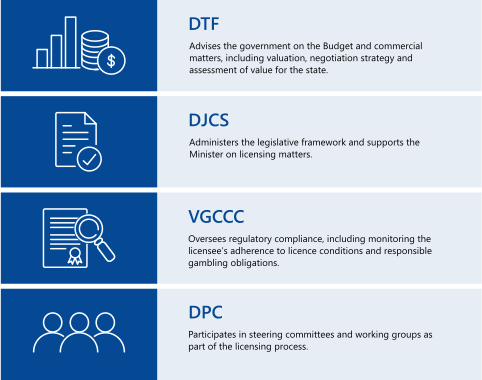
Figure 1: Agencies responsible for the new licence and their main roles
Source: VAGO.
Role of the Independent Review Panel
The Independent Review Panel was established under the Act to provide independent oversight of the integrity of major gambling licensing processes.
Its report on the licence extension, Independent Review Panel Lotteries Licensing Process, focused on the authorisation and licensing process commencing in May 2025.
The Independent Review Panel's statutory function was to assess whether the process was conducted with appropriate probity and integrity. This includes whether conflicts of interest were disclosed and managed, decision-making was free from bias or improper interference, and evaluation processes were systematic and based on defined criteria.
Timeline of key events
The licence extension happened in 2 phases, which are the:
- licence strategy and price discovery phase
- bilateral negotiations, select EOI and invitation to apply process.
The licence strategy and price discovery phase included market soundings, industry and financial analysis to test options before EOI. It informed the government’s decision to negotiate bilaterally with TLC and covers the period from November 2023 to May 2025. Key events are described in Figure 2.
Figure 2: Licence strategy and price discovery phase timeline
| Date | Key event |
|---|---|
| 2023 | |
| 17 November | TLC sends an ‘illustrative proposal’ to the Treasurer and the Minister. This was an initial proposal to extend the licence by 20 to 40 years in return for a material upfront payment. TLC sought the opportunity to discuss with the Treasurer and Minister. |
| 12 December | The government approves DTF to confidentially assess reform options for the lottery licence. |
| 14 December | The Treasurer meets with TLC, along with officials from DTF and DJCS, to discuss TLC's illustrative proposal. The Treasurer noted advice would be sought from DTF and DJCS. |
| 2024 | |
| 7 June | The Minister approves DJCS and DTF to conduct market soundings to gauge interest in the lottery licence. |
| 1–24 July | Market soundings are held with 5 entities to test potential interest in the licence, and to convey the state's objectives and openness to negotiating licence terms. |
| 30 October | Following Treasurer approval, DTF writes to TLC seeking clarification on possible premiums for different licence terms and lottery tax rates. |
| 6 November | The government approves a proposed engagement and negotiation strategy for the next public lottery licence, including bilateral discussions with TLC, subject to a reserve price threshold being met. |
| 27 November | The Treasurer approves the reserve price framework. |
| 28 November | TLC replies to DTF's clarification letter of 30 October. TLC indicated a preference for a long-term licence with current or reduced lottery tax rates. It also proposed other changes that could increase the premium paid to the state. |
| 2025 | |
| 7 April | The government approves commencing a relicensing process with TLC on the potential licence extension. This decision was informed by an assessment of TLC's proposals by DTF and its commercial adviser, in consultation with other relevant agencies. |
Source: VAGO.
The bilateral negotiations, select EOI and invitation to apply process helped govern the negotiations and licence extension. These stages cover the period from May 2025 to May 2026. Key events are described in Figure 3.
Figure 3: Bilateral negotiations, select EOI and invitation to apply process timeline
| Date | Key event |
|---|---|
| 2025 | |
| 19 May | The Minister approves the bilateral engagement and signs the EOI invitation package to be sent to TLC. |
| 27 May | The Minister issues the EOI invitation to TLC. The invitation noted that a competitive approach remains an option for the government if the Minister decides not to extend the licence based on the EOI process. |
| 13–19 June | DJCS, DTF and their advisers correspond and meet with TLC to clarify aspects of the proposals and process. |
| 24 June | The Gambling Legislation Amendment Bill receives Royal Assent, providing greater flexibility in the licence term. |
| 11 July | TLC submits an EOI responding to the EOI invitation. |
| July to December | DJCS, DTF and their advisers continue to evaluate and interact with TLC to clarify aspects of its proposal. |
| 2026 | |
| 11 February | The Independent Review Panel provides a 'letter of comfort' to the Minister indicating that it has no basis for an adverse report based on information available to it at the time. |
| 24 February | The Minister approves DJCS' recommendation to extend the lottery licence for 40 years for a $1.139 billion premium (the final premium was later agreed at $1.145 billion). |
| 5 March | The government endorses the in-principle decision by the Minister under the Act to extend the licence for 40 years from 1 July 2028 to 30 June 2068. |
| 27 March | The Minister writes to TLC proposing licence terms and invites TLC to apply for a licence extension. |
| 21 April | TLC responds to the invitation to apply with its licence extension application, including proposed premiums and licence conditions. |
| 28 April | Agencies finalise the invitation to apply evaluation report, which informs the Minister's decision on the licence extension. |
| 30 April | The Minister agrees to formalise the decision to extend the licence for 40 years for a $1.145 billion premium payment. |
| 4 May | The Minister executes the licence extension documents (and DJCS informs TLC), giving effect to the agreement between the state and TLC. |
Source: VAGO.
What we found
This section focuses on our key findings:
1. Agencies used a structured program of work to help the government make informed decisions.
2. The government had a credible basis for negotiating with TLC bilaterally.
3. Agencies followed a documented strategy during bilateral negotiations and actively considered trade-offs.
4. We found no significant probity issues, but the government's approach limited public transparency.
5. Some cost inputs used to inform reserve price thresholds were not cross-checked by DTF against alternative estimation approaches or subjected to sensitivity analysis.
The full list of our recommendations, including agency responses, is at the end of this section.
Consultation with agencies
When reaching our conclusions, we consulted with the reviewed agencies and considered their views.
You can read their full responses in Appendix A.
Key finding 1: Agencies used a structured program of work to help the government make informed decisions
We found no evidence to suggest the government wanted to negotiate bilaterally with TLC before it considered alternative options.
TLC gave the government an unsolicited illustrative proposal in November 2023. Agencies then carried out a structured program of work to assess options for the future licence. This included engaging a commercial adviser to provide advice on potential licensing approaches and negotiation strategies.
Agencies sought relevant government approvals at key stages of the process. The information provided to the government reflected the evidence available to agencies.
Key finding 2: The government had a credible basis for negotiating with TLC bilaterally
Supported by an external commercial adviser, agencies analysed the industry, undertook market soundings and considered other lottery licence processes to advise the government on potential licensing and negotiation approaches. This work identified factors that may have constrained effective competition, including TLC's access to the national lottery bloc and lower operating costs.
In addition, agencies identified the importance of Victoria's continued participation in the national lottery bloc to minimise potential disruption and risks to future lottery tax revenues.
Taken together, this analysis indicated that TLC was likely to place a higher value on the licence than potential new entrants and provide the state with greater certainty about future lottery tax revenues. This provided a credible basis for the government to adopt a bilateral negotiation approach.
Key finding 3: Agencies followed a documented strategy during bilateral negotiations and actively considered trade-offs
Agencies actively considered trade-offs and negotiated with TLC, including on the material adverse change (MAC) arrangement that relates to lottery tax. This arrangement meant the government accepted a form of constraint on future lottery tax changes in exchange for a materially higher upfront premium.
Agencies had a structured negotiation strategy that was supported by the reserve price framework, defined negotiation parameters and the continuing option to revert to a competitive process.
The government did not accept all of TLC's proposals and accepted some only after negotiating changes. These decisions were informed by analysis carried out by agencies and their commercial adviser. This indicates that the government actively considered trade-offs and maintained negotiation discipline throughout the process.
Key finding 4: We found no significant probity issues, but the government's approach limited public transparency
The government established governance structures to oversee the licensing process. This included:
- a steering committee made up of senior representatives from DJCS, DTF and DPC, which provided oversight and strategic direction
- a project working group, which coordinated analysis, stakeholder engagement and development of key documentation
- the engagement of a probity adviser
- a probity plan, which the steering committee approved in March 2024.
These arrangements provided a structured framework for the government to oversee and coordinate the licensing process.
We found no evidence to cause concern regarding probity matters. This is consistent with probity adviser reporting, and the Independent Review Panel's letter of comfort and its final report completed after the transaction concluded.
However, the government's approach limited public visibility over key decisions and the reasons for them, such as the basis for adopting bilateral negotiations and extending the licence, and how the transaction benefits the state.
Addressing this finding
We made 2 recommendations to agencies about developing a framework to consider how and when information about major commercial transaction processes can be disclosed to support transparency.
Key finding 5: Some cost inputs used to inform reserve price thresholds were not cross-checked by DTF against alternative estimation approaches or subjected to sensitivity analysis
The government used reserve prices as a decision threshold to assess whether a bilateral approach offered enough value compared to a competitive process. These prices were informed by external advice including modelling about the premiums that could be achieved under different strategies. The modelling considered a range of scenarios such as licence term, lottery tax rates and operator types, and relied on a number of assumptions that were informed by market soundings, other licensing processes, and the adviser's insights into the lottery market.
We did not see evidence that some key modelling inputs relating to operator cost assumptions used in the modelling (such as cost of equity and debt, and operating and capital costs) were cross-checked against alternative market-based data or estimation approaches, or subjected to sensitivity analysis. Doing this would have helped to demonstrate that the reserve price thresholds were robust.
Addressing this finding
We made one recommendation to DTF about ensuring that key cost assumptions underpinning valuations and reserve prices are cross-checked against other estimation approaches and subjected to sensitivity analysis.
See the next page for the complete list of our recommendations, including agency responses.
2. Our recommendations
We made 3 recommendations to address our findings. The relevant agencies have either accepted them in principle or in full.
| Agency responses | ||||
|---|---|---|---|---|
| Finding: We found no significant probity issues, but the government's approach limited public transparency | ||||
| Department of Treasury and Finance and Department of Premier and Cabinet | 1 | Work with relevant agencies to develop a framework for assessing how and when information about major commercial transaction processes should be disclosed to support public understanding of key government decisions and their rationale, taking into account commercial confidentiality requirements (see Section 5). | Accepted in principle | |
| Department of Justice and Community Safety | 2 | Apply the framework developed under Recommendation 1 to future processes for the awarding or extension of gambling licences. If such a framework is not established, develop guidance that addresses the same transparency and commercial confidentiality considerations (see Section 5). | Accepted in principle | |
| Finding: Some cost inputs used to inform reserve price thresholds were not cross-checked by the Department of Treasury and Finance against alternative estimation approaches or subjected to sensitivity analysis | ||||
| Department of Treasury and Finance | 3 | For major commercial transactions, ensure that key cost assumptions underpinning valuations and reserve prices are cross-checked against alternative estimation approaches where appropriate, and subjected to sensitivity analysis (see Section 3). | Accepted | |
3. Licence strategy and price discovery
Nothing has come to our attention to indicate that the government had decided on a bilateral approach prior to undertaking a process to consider its options.
The government's decision to adopt a bilateral strategy was informed by market soundings, commercial analysis and expert advice that the incumbent would value the licence more highly than potential competitors, and that effective competition would be limited.
The government also considered that continuing with TLC would reduce risks to the state's future lottery licence tax revenues.
Reserve prices established by relevant agencies played a critical role in assessing whether the outcomes available through bilateral negotiations justified continuing that approach.
However, we did not see evidence showing how alternative assumptions for some key cost inputs may have affected the valuations and reserve price thresholds informing those decisions.
Covered in this section:
- The government explored a range of options for the next licence
- The government established a reserve price framework to inform decision-making
- Reserve prices relied on key modelling assumptions
- A clarification process with TLC informed the negotiation strategy
The government explored a range of options for the next licence
Bilateral negotiations considered alongside other options
DTF, in consultation with relevant agencies, progressed options for the approach to the next licence throughout 2024. This followed government approval on 12 December 2023 that DTF undertake a confidential assessment of reform options.
Informed by ongoing research and analysis, advice provided to Ministers and the government during 2024 showed bilateral negotiations were considered alongside a competitive process. Some advice indicated that bilateral engagement was most likely to maximise value to the state.
However, nothing has come to our attention to suggest that the government or agencies were not committed to a structured process to fully consider available options, consistent with the government decision, before deciding to pursue a bilateral approach with the incumbent.
Rationale for bilateral discussions
DTF engaged a specialist commercial adviser in February 2024 to assist in the development and implementation of options for the negotiation strategy.
Informed by insights into other lottery processes and market soundings with potential operators, the commercial adviser identified several reasons why the incumbent was likely to place a higher value on the licence:
- Structural constraints on effective competition: The government does not control access to national lottery bloc arrangements, which are critical to offering high-value products. Market soundings indicated bidder interest depended on securing bloc access, making strong competition uncertain.
- Strength of incumbency: TLC’s existing position in national bloc arrangements, established products and customer base reduce its commercial risk and operating costs relative to potential new entrants.
- Limited credibility of a competitive ‘fallback': Without guaranteed bloc access, a competitive tender would be unlikely to generate strong participation or meaningful price tension.
- Ability to negotiate value through licence settings: Bilateral engagement allowed direct negotiation of factors such as licence term and risk allocation that were expected to affect the premium TLC would pay.
Key issue: Lottery bloc arrangements
The lottery bloc is an arrangement between lottery operators across different Australian jurisdictions to offer shared national products, with a common prize pool and a coordinated game structure. These arrangements allow participants to access larger jackpots and underpin the commercial value of major lottery products. Access to bloc products is therefore a significant component of a licence holder’s revenue and market position.
Access to the lottery bloc is a key factor affecting the ability of new entrants to compete effectively with the incumbent. Although a new operator may be able to obtain access through commercial negotiation, the terms and cost of participation are uncertain. Any access fees, revenue-sharing arrangements or other commercial conditions may affect the profitability of bloc products and reduce the value of the licence to a potential entrant.
Without access, or with unfavourable access terms, a new entrant may be limited to offering a narrower or less competitive product suite, reducing expected revenue and licence value.
Government approval of strategy
Informed by agency advice, in November 2024 the government approved an engagement and negotiation strategy for the next lottery licence, including bilateral discussions with the incumbent if a reserve price threshold was met. The approval noted that the Treasurer and the Minister would agree on the reserve price threshold. A report setting out the substantive findings from industry analysis was attached to the approval briefing.
We saw nothing that gave us cause for concern that this industry analysis was not sound in terms of providing a credible basis for adopting a bilateral approach.
The government established a reserve price framework to inform decision-making
Analysis of bidding dynamics
The government's decision to continue bilateral negotiations depended on whether TLC's proposals exceeded reserve price thresholds. The testing of the assumptions used to inform those thresholds was therefore important for demonstrating that the decision benchmark was robust.
DTF's commercial adviser undertook modelling to estimate premiums that may be paid by different types of operators over different licence terms and lottery tax rates. The modelling was informed by other gambling licensing processes, market soundings, and the adviser's industry insights. The modelling informed the reserve prices used to assess TLC’s proposals during a bid clarification process.
The adviser considered that in a competitive process, TLC would likely bid only high enough to exceed the next best alternative rather than bid its full valuation of the licence.
The commercial adviser considered that in a bilateral process this dynamic is absent, and TLC may be willing to pay a higher premium if it could directly negotiate licence terms with the government.
Different reserve prices were set for different licence terms and lottery tax rates. They were set above the range of values the commercial adviser considered likely to be achievable through a competitive process, providing a benchmark against which agencies could assess TLC's proposals.
The thresholds were intended to ensure that a bilateral outcome would only proceed where it was expected to deliver greater value than the likely outcomes of a competitive process.
Consideration of licence term
Advice provided to agencies showed a longer licence term was expected to support a higher upfront premium by providing greater certainty and more time for an operator to realise returns on investment. The advice also noted that a longer licence term transfers the risk of structural shifts from retail to online sales to the licence holder, citing lessons from the Victorian wagering and betting licence, where market changes reduced the value of a state-based licence over time.
The commercial adviser also noted that a longer licence term would delay the next opportunity to test the market and reduce future policy flexibility. A longer licence term would also require legislative amendment (with extensions permissible for up to one year at the time of the advice).
The adviser therefore recommended assessing licence duration alongside broader policy objectives and testing different term scenarios through market engagement and price discovery. These were reflected in the reserve price framework summarised above.
The adviser also recommended that where the state is unable to maximise value with TLC, a shorter 10-, 15- or 20-year licence could be considered to reduce the incumbency and cost of capital advantage held by TLC, and to encourage greater competition from potential new entrants.
Consideration of lower lottery tax rates
The lottery tax rate is a key driver of licence value. The commercial adviser modelled the effect of different lottery taxes on expected licence premiums. Under the modelling, higher lottery tax rates reduced the value of the licence to an operator, while lower lottery tax rates increased value by increasing the cash flows available to the licensee.
This analysis informed reserve prices for the lower lottery tax rate options considered by the government.
These reserve price thresholds provided the benchmark against which the government assessed whether lower lottery tax rate options represented sufficient value relative to maintaining the current lottery tax rate.
Reserve prices relied on key modelling assumptions
A standard discounted cash flow approach was applied
The commercial adviser's valuation of premiums across different bidder types was based on discounted cash flow modelling. The discounted cash flow model used a standard valuation approach: forecast cash flows were generated for each bidder type over a licence period and then discounted using a weighted average cost of capital to estimate present value.
General basis for assumptions
The reserve price framework relied on a number of assumptions.
The key financial assumptions made were stated by the adviser to be 'illustrative only' of how a licensee might approach the next licence. The adviser developed these assumptions based on its insights into gambling licensing processes across various jurisdictions, and the observed bidding behaviour of incumbent licensees versus potential new entrants.
Where assumptions materially influence outcomes, it is important that they are tested against alternative evidence when possible to do so, and subject to sensitivity analysis so decision-makers can understand their potential impacts. However, for some cost assumptions used in the modelling, we did not see evidence that these practices were applied.
For finance, operating and capital costs, we did not see evidence that sensitivity analysis was undertaken which would have helped decision-makers understand the potential impact of alternative assumptions. For finance costs, we also did not see evidence that the assumptions used in modelling were checked against alternative market-based approaches and data.
As a result, the robustness of the reserve price thresholds was less clearly demonstrated than it could have been.
DTF's testing of advice
Government decisions about the negotiation strategy relied heavily on advice provided by the commercial adviser engaged by DTF. We would expect to see robust testing of advice provided by external consultants to agencies, particularly for transactions involving a significant public asset such as the public lottery licence.
DTF said the commercial adviser's work was assessed in a range of ways including:
- DTF and DJCS staff participating in market soundings with adviser staff, providing agencies with direct insight into the adviser’s market analysis
- collaboration with the adviser on the reserve price framework and valuation model, including testing assumptions and recommending changes
- involvement in the options and scenario analysis used to inform consideration of the MAC policy
- regular meetings with the adviser, supported by working group and project team forums involving agency staff, to discuss progress, analysis and findings.
These indicate a process of ongoing engagement between DTF and the commercial adviser. We have not seen direct evidence of DTF's testing of key assumptions and recommendations.
A clarification process with TLC informed the negotiation strategy
TLC's baseline proposal
From late October 2024, DTF led a clarification process to obtain further information on TLC's proposals. This was intended to inform assessments against the reserve price framework and the government's negotiation approach.
DTF requested that TLC provide premium payments under a baseline proposal with different licence terms and lottery tax settings. This 'baseline proposal' was one that required minimum changes to licence settings. It also sought a TLC-preferred proposal with additional changes to licence settings valued by TLC.
TLC's response (November 2024) was the first documented evidence of specific premium amounts being proposed to the government. It set out a baseline proposal, and a TLC preferred proposal incorporating alternative licence settings and a higher premium. This included a proposal for an adverse event mechanism intended to compensate TLC should the government make changes to tax settings.
Approval of reserve price framework
The Treasurer approved the reserve price framework on 27 November 2024. The government received TLC's response to DTF's clarification letter including proposed premium amounts the following day.
An assessment plan was developed to consider TLC's clarification response
DTF and its commercial adviser developed an assessment plan before receiving TLC's clarification response. The plan set out a structured and clearly defined methodology for assessing TLC’s proposal, including assessment steps, roles and responsibilities, and reporting requirements.
The plan set out the following objectives:
- maximising the value of the licence, both in terms of upfront licence premium and ongoing lottery tax revenue
- generating an early premium payment for the next licence
- minimising disruption for players and agents
- providing broader community benefits and service enhancements for agents and players.
The plan required the assessment team to evaluate proposals against pre-determined criteria, including whether proposed changes to licence terms are acceptable, whether the licence premium meets or exceeds reserve prices, and whether it could meet the state's objectives. The reserve price framework included scenarios under licence terms of 20, 30 and 40 years, and current and reduced lottery tax settings.
Summary of assessment
An assessment report was prepared in accordance with the assessment plan. This documented the findings and recommendations arising from the evaluation of TLC's clarification response.
The report assessed TLC's baseline proposal against the reserve price framework and other criteria.
The baseline proposal for a 40-year term under current lottery tax settings exceeded the relevant reserve price threshold. The assessment team concluded that the TLC baseline proposal had the potential to meet the state's objectives for a licence with a 40-year term and recommended progressing to bilateral discussions with TLC on that basis.
In April 2025, the government approved the commencement of a relicensing process based on bilateral discussions with the incumbent, while retaining an option to revert to an open competitive process. The accompanying briefing noted the following risks:
- Exceeding value for money expectations for the state can be more challenging under circumstances where there is an incumbent operator. It flagged the development of strategies to mitigate this risk.
- Potential agreement with TLC would be subject to the outcome of proposed legislative amendments including licence term.
In May 2025 the Minister invited TLC to participate in a bilateral relicensing process. The invitation noted that the state would retain the option of reverting to an open competitive approach should negotiations fail to deliver outcomes that met the state's objectives.
4. Bilateral negotiations
Agencies implemented a range of mechanisms to support negotiation discipline in bilateral discussions with TLC, including a bilateral engagement and negotiation plan.
Not all proposals advanced by TLC were accepted, and some were but with modification. The option to revert to a competitive process remained available during negotiations.
The government also negotiated changes to commercial terms including a material adverse change (MAC) arrangement related to lottery taxation, which substantially increased the premium achieved by the state.
Covered in this section:
- The government had a well-structured plan to guide negotiations
- Agencies actively negotiated with TLC
- The MAC arrangement increased the upfront premium significantly
- The process of evaluation found a 40-year licence term was appropriate
- Compliance oversight
- Assessing value in a bilateral process
The government had a well-structured plan to guide negotiations
A framework for bilateral negotiations
Agencies established mechanisms intended to promote competitive discipline within a bilateral relicensing process. These included reserve prices, defined assessment criteria, a structured negotiation plan, preservation of a fallback competitive process, confidentiality arrangements and probity oversight.
Together, these provided a framework for assessing proposals, negotiating licence terms and managing the risk that the absence of competition would weaken the state's negotiating position. We saw no evidence that gave us cause for concern that these mechanisms were not followed.
Key elements of bilateral engagement and negotiation plan
The key elements of the negotiation strategy and approach were set out in a bilateral engagement and negotiation plan (dated 19 May 2025). The plan established negotiation parameters, governance arrangements, strategic risks and non-negotiable requirements.
The plan set out 4 primary objectives. These were to:
- maximise the premium paid by TLC for any extended licence period
- protect the lottery tax stream generated by the licence
- ensure the integrity of the lottery products is maintained
- further promote responsible gambling and harm minimisation in the licence framework.
The plan also outlined a set of guiding principles to ensure the state could achieve the primary objectives.
| They were to ... | which says the government should ... |
|---|---|
| respect the incumbency position of TLC | be mindful of TLC’s incumbency position with effective control of the national lottery bloc. If pushed too hard, TLC may change its approach, which may lead to a sub-optimal outcome for the state. |
| focus TLC's mindset on paying higher value for a more attractive licence | remain open to engaging with TLC on value-enhancing opportunities, or ‘pockets of value’, that benefit TLC and do not go against or cut across the state’s objectives. |
| preserve the optionality of the baseline proposal | retain the option to extend the licence or award a new licence with no changes to existing licence terms and conditions, if negotiations of value-enhancing opportunities become too hard or complex. |
| preserve a fallback to the competitive process | make sure that the final proposal is higher than the reserve price: that is, a floor price below which the state is prepared to fall back to a competitive process. |
The plan also outlined the state's 'non-negotiable' items that would cause a proposal to be immediately disqualified from consideration. Non-negotiables include any proposal that, on a full assessment, has the potential to:
- increase costs to the state (of regulation, operations or in budgetary terms)
- negatively impact the integrity of lottery products
- increase the level of harm from playing lotteries.
Agencies actively negotiated with TLC
TLC response to the EOI
The select EOI was issued to TLC on 27 May 2025. TLC responded to the EOI on 11 July 2025.
On 12 September 2025, following initial policy analysis and other assessments, TLC was requested to further refine and clarify its EOI response through a bid clarification letter. TLC responded to the bid clarification letter on 19 September 2025.
Baseline proposal
Consistent with the EOI invitation, TLC submitted 4 baseline licence extension proposals. The 40-year proposal was TLC's preferred option and was the only option assessed by agencies as meeting their value maximisation expectations. It was the only bid by TLC that met the state's reserve price threshold.
These premiums were unchanged from TLC's November 2024 commercial clarification proposals, which had informed the government's decision to proceed to bilateral negotiations.
Value-add proposals
TLC's proposal responding to the select EOI included possible value-add items. TLC proposed 4 monetary items. If these were accepted by the state, TLC would place a higher premium on the licence. TLC proposed 2 non-monetary items, for which it would not offer a higher premium.
Challenge and refinement of TLC proposals
Agencies did not accept TLC's July 2025 submission without clarification, testing and analysis. During the EOI process:
- 4 rounds of clarification questions were issued (27 questions in total)
- agencies met with TLC
- a formal bid clarification letter was issued in September 2025 seeking refinement and clarification of TLC's proposal
- TLC provided further responses which informed subsequent recommendations.
Agencies did not accept all proposals advanced by TLC, including some value-add items that would have increased the premium.
The MAC arrangement increased the upfront premium significantly
Summary
The final premium paid by TLC for the new licence was $1.145 billion. The licence premium comprises 2 main components:
- a base premium amount for the 40-year licence, accounting for the significant majority of the premium
- a further premium, the significant majority of which reflects the inclusion of a 40-year MAC arrangement.
A MAC arrangement is a contractual mechanism that allocates risk between parties if specified events occur after an agreement is signed. In the context of the lottery licence, changes to lottery tax rates could affect the profitability of the licence holder and therefore the value of the licence.
The MAC arrangement was TLC's main value-add proposal. Under the mechanism proposed by TLC, the government would pay TLC compensation if it chose to raise the lottery tax during the licence term, with compensation capped at the total upfront premium paid for the licence. That is, the government could still choose to raise the lottery tax rate but would need to compensate TLC.
Agencies negotiated TLC’s proposed MAC arrangement by accepting the central taxation protection, while narrowing the circumstances in which compensation could be triggered.
The MAC arrangement resulted in a material increase to the premium TLC paid for the licence.
We have chosen not to identify the value TLC placed on the MAC in this report. This is because it may reveal information relevant to TLC’s negotiating parameters and assessments of value in the context of any future negotiations with other jurisdictions. We considered disclosure of this information in the context of our obligations under section 62 and section 64 of the Audit Act 1994.
Trade-offs
The principal benefit to the state of the MAC arrangement was a significant increase to the upfront premium TLC was willing to pay. Other jurisdictions have MAC-like mechanisms.
Agencies – with input from the commercial adviser – assessed the MAC arrangement as a trade-off between a higher upfront premium and reduced future tax flexibility.
Advice prepared by the commercial adviser and agencies that informed government decisions noted Victoria already has the highest lottery tax rate in Australia at 79.4 per cent, compared with 65 per cent in New South Wales and 48.9 per cent in South Australia. Victoria's tax rate has not materially changed since 1970.
Modelling indicated that licence value was highly sensitive to lottery tax settings. A one percentage point increase in the lottery tax rate was estimated to increase annual tax receipts by approximately $9 million but reduce licence value by approximately $180 million (noting we have not been provided with the modelling underpinning this estimate).
Agencies assessed that providing tax certainty increased TLC's willingness to pay an upfront premium.
Agencies considered that the MAC arrangement did not remove the state's ability to change lottery tax settings. Rather, it altered the financial consequences of doing so by potentially requiring compensation to be paid to the licensee where specified changes occurred. Adviser modelling assessed the potential net financial impact of such scenarios to inform government decision-making.
The process of evaluation found a 40-year licence term was appropriate
EOI evaluation and negotiation outcome report
Consistent with the plan, an evaluation report was prepared which set out the negotiation team's findings on the approval of the licence extension. The report recommended the licence be extended for a 40-year term because:
- the potential for genuine competition for the next licence is unlikely to emerge over the medium term
- the premium value for the proposed 40-year term represents the best value for money of the licensing proposals
- there is a risk that the strategic value of the Victorian licence may reduce over time
- a 40-year licence extension provides greater certainty for retail agents and the likely preservation of the retail channel over the longer term
- a 40-year licence extension would transfer the long-term commercial and operating risks to TLC
- Victoria would continue to benefit from the national scale of TLC.
The report was attached to a March 2026 briefing seeking government endorsement of the Minister's in-principle decision to extend the licence. The report set out the rationale for the findings noted above, with supporting analysis (including for the MAC arrangement).
Compliance oversight
Evidence of compliance
It is VGCCC's role to ensure the ongoing compliance of TLC with legislative regulations. VGCCC monitors TLC by inspections, complaint investigations and audits. Where breaches are identified, VGCCC provides penalties or corrective directions.
For example, in its 2024 audit of TLC, VGCCC identified areas of non-compliance relating to the integrity and security of IT systems and software. As directed by VGCCC, TLC appointed an independent expert to identify the root causes of the issues and provide an assessment and recommendations for remediation. In April 2025, TLC reported that these issues had either been resolved or were 'on track' to be resolved. VGCCC reported receiving regular status updates from TLC, with validation of remediation scheduled to commence from October 2026.
Before TLC was invited to apply for the licence extension, DJCS and DTF considered TLC's compliance record. DJCS reported that TLC had 'demonstrated a strong commitment to regulatory compliance, consumer protection and harm minimisation in its operations in Victoria'.
We found no evidence that gave us cause for concern that TLC’s regulatory and compliance track record was not considered in the licence process.
Assessing value in a bilateral process
Valuation models and negotiation mechanisms cannot fully replicate the market testing provided by competition
For an exclusive licence over a 40-year term with unchanged tax settings, the commercial adviser estimated a theoretical value for the licence of around $1.372 billion. This compares to the final premium of $1.145 billion. However, caution is required in comparing the final premium directly with the modelled value. As with any forward-looking valuation, the modelled value is subject to inherent uncertainty and is sensitive to a range of assumptions, including discount rates. The outcome may also reflect the strong incumbency advantages held by TLC.
The mechanisms adopted by agencies were intended to replicate aspects of competitive tension and support a disciplined bilateral negotiation process. We saw evidence that agencies actively assessed and negotiated proposals advanced by TLC. However, those mechanisms could not replicate the price discovery benefits of a competitive process.
As a result, while agencies sought to maximise value within a bilateral framework, it is not possible to know with certainty whether a higher premium could have been achieved under an alternative approach.
5. Governance and public disclosure
Nothing came to our attention that gave us cause for concern that relevant probity standards and arrangements were not followed throughout the licensing process.
Agencies maintained strict confidentiality to protect commercially sensitive information and support the integrity of the process.
However, aspects of probity planning and implementation could have been managed more effectively.
The government had a credible basis for maintaining confidentiality throughout negotiations. But its approach also reduced transparency over key decisions, including the basis for adopting a bilateral strategy.
Covered in this section:
- Agencies established a comprehensive governance framework, but some arrangements could have been improved
- The government's approach limited public transparency
Agencies established a comprehensive governance framework, but some arrangements could have been improved
Steering committee and working group roles
There is documented evidence of ongoing engagement between key agencies during the pre-EOI stage (November 2023 to May 2025) and the select EOI process (May 2025 to May 2026).
A 2-tier agency governance model was followed, comprising the Gambling Licensing Program (GLP) Steering Committee and a project working group.
The GLP Steering Committee met on matters related to the licence from early 2024. It provided senior oversight and strategic direction for the project. The committee included representatives from DJCS, DTF and DPC who met regularly to review progress, endorse key frameworks and consider strategic issues across a number of licensing projects.
The project working group operated as the primary delivery and coordination body, comprising officers from DJCS and DTF alongside the external project advisers engaged by agencies. It met regularly to coordinate analysis and develop key documentation.
Probity plan
We confirmed with DTF and DJCS that the applicable probity framework was the GLP probity plan, which members of the GLP Steering Committee approved by 21 March 2024. The plan incorporates recognised Victorian Government probity standards, including the Victorian Government Purchasing Board procurement policies.
It is structured around core probity principles, including integrity and impartiality, accountability, consistency and transparency of decision-making, management of conflicts of interest, and the security and confidentiality of information.
The plan sets out expected behaviours, governance roles and responsibilities, and key controls to support these principles, including requirements for conflict-of-interest declarations, maintenance of registers, defined evaluation processes and controlled access to sensitive information.
The project team determined this probity plan to be fit for purpose for the public lottery licensing process project. This probity plan was used as the probity framework for the entire project including market soundings.
Probity adviser
In November 2023, DJCS engaged a probity adviser for the public lottery licensing process. DTF also engaged a probity adviser in July 2024 to provide advice in relation to the licence. After project responsibility returned to DJCS at the EOI stage in May 2025, the DTF-appointed adviser continued as the probity adviser for the project.
The Independent Review Panel considered there should have been greater clarity regarding the respective roles of the 2 probity advisers. It also considered there should have been a clearer description of the role to be performed by the probity adviser throughout the authorisation and licensing process.
Market soundings
Agency staff and their advisers conducting market soundings did not complete conflict-of-interest declarations prior to the soundings. DJCS reported that agency staff completed the conflict-of-interest declarations in November 2024, following the outcomes of the market sounding process and ahead of the confidential assessment report that was received after that in late 2024.
Nevertheless, based on the material we reviewed, we did not identify any matters that gave us cause for concern about the conduct of the market soundings.
Documents were provided to us indicating the type of information to be disclosed to participants in the soundings and the questions to be asked, indicating controls were in place to ensure equity in approach. The probity plan was in place to guide the conduct of personnel during the market soundings. A summary of market sounding feedback provided by each entity was also prepared by agencies, against the questions asked during the interviews with participants.
Conflict-of-interest registers and declarations
All public sector employees are subject to the Victorian Government's Code of Conduct for Victorian Public Sector Employees, which sets out conflict of interest and confidentiality obligations.
DJCS and DTF provided conflict-of-interest registers and declarations. We identified minor recording discrepancies in the DJCS register. However, we saw no evidence to indicate that these affected the coverage or monitoring of conflicts of interest.
Protection of reserve price
DTF applied additional controls to protect the integrity of the reserve price framework. Any disclosure of reserve prices had the potential to undermine the integrity of the process, and the value captured by the government.
Controls included a separate password for all materials including and related to the reserve price threshold. Both the password and file storage of these materials were secured and locked down to a small number of individuals. As well, conflict-of-interest declarations confirmed an individual’s obligation to adhere to the confidentiality requirements of the project.
Probity adviser reports
Two reports were prepared by the probity adviser.
The first report (dated 3 February 2026) covers up to the select EOI process and its evaluation. The adviser found that the process was conducted in accordance with established probity principles, with no material probity risks, non-compliance or unresolved issues identified.
Its observations indicate that core probity controls – such as predefined evaluation criteria, documented governance arrangements, secure handling of information, and conflict-of-interest processes – were established and followed in practice. The report also records one managed conflict of interest, which was addressed through agreed controls and documented in a register.
The second report (dated 14 May 2026) provides a supplementary assessment for the invitation to apply stage, and reaches a similar conclusion that no material probity risks, non-compliance or unresolved issues were identified.
Nothing came to our attention that would indicate the probity adviser’s conclusions were unreasonable.
The second report by the probity adviser was completed after the government executed the licence extension. DJCS advised that the 'main' probity report had been provided to the Minister at an earlier decision stage, prior to the conclusion of the EOI process. This informed the Minister's in-principle decision to agree to extend the lottery licence on 24 February 2026. Agencies also advised that they had met frequently with the probity adviser throughout the process and no probity concerns had been raised. Notwithstanding this, completing the report earlier would have strengthened the contemporaneous documentation of probity oversight.
Independent Review Panel letter of comfort and final report
The Independent Review Panel sent a letter to the Minister on 11 February 2026, advising that within the limits of its jurisdiction, on the material available to it to date, and considering relevant matters required under the Act, the Independent Review Panel has concluded there is no basis for an adverse report. This informed the Minister's in-principle decision to agree to extend the lottery licence in February 2026.
In accordance with legislative requirements, the Independent Review Panel's full report is provided after the granting of a licence extension.
Meeting with the Treasurer
Relevant agencies and TLC advised us that the only meeting they were aware of that took place between TLC and ministers or their staff to discuss the licence extension was in December 2023, when the Treasurer and agency staff met with TLC representatives.
Some aspects could have been managed more effectively
Nothing came to our attention that gave us cause for concern about the integrity of the licensing process. Governance arrangements were established, a probity framework was in place, and neither the probity adviser nor the Independent Review Panel identified material probity concerns.
However, aspects of implementation could have been stronger. Responsibility for probity oversight was not always clearly articulated as responsibilities transitioned between agencies, and the final probity adviser report was completed after the government had finalised its decision.
While we identified no evidence that these matters affected the outcomes of the process, stronger arrangements would have strengthened assurance over the process.
The government's approach limited public transparency
Australian Stock Exchange announcement
The extension of the licence was first publicly disclosed through a TLC announcement to the Australian Stock Exchange on 5 May 2026.
Rationale for not disclosing process
DTF and DJCS advised that maintaining confidentiality throughout the licensing process was critical to preserving competitive tension and protecting the state’s commercial position.
Documentation showed agencies considered that disclosing negotiations could trigger legal or regulatory disclosure obligations, including obligations under stock exchange listing rules. TLC, as a listed entity, may have been required to disclose material developments in negotiations to the Australian Stock Exchange if they became public or sufficiently advanced.
DJCS stated that confidentiality of bilateral discussions with TLC supported the following outcomes:
- confidence on TLC's part that its engagement with the government would not be shared with competitors or referenced in conversations and any other government dealings (this ensured the government could secure a maximum value proposal from TLC, including the potential strategic value of the licence to TLC as the incumbent)
- confidence on the government's part that the bilateral engagement process would not produce counterproductive, unsolicited or potentially disruptive input that could derail negotiations ahead of an open and competitive process, should the bilateral process fail and thus, a competitive process be required
- a level of probity and compliance expected by oversight bodies, such as the Independent Review Panel, regarding a pre-open market bilateral engagement process, as is usual for exceptionally high-value gambling licensing processes.
These considerations provide a credible basis for maintaining confidentiality throughout negotiations. But confidentiality also reduced transparency over key decisions, including the basis for the government’s decision to adopt a bilateral strategy. As a result, Parliament and the community have had limited visibility about the process and the reasons it was adopted.
It is important for agencies to actively consider how to balance transparency objectives with confidentiality requirements from the early stages of major commercial transactions. This includes identifying:
- what information could be disclosed
- when disclosure could occur
- how key decisions and their rationale could be explained to Parliament and the public.
Appendix A: Submissions and comments
Download a PDF copy of Appendix A: Submissions and comments.

Appendix B: Abbreviations, acronyms and glossary
Download a PDF copy of Appendix B: Abbreviations, acronyms and glossary.
Appendix C: Review scope and method
Download a PDF copy of Appendix C: Review scope and method.