
Supporting the Transition from Native Timber Harvesting
Audit snapshot
Is the Forestry Transition Program supporting former native timber workers, businesses and communities to transition from native timber harvesting?
Why we did this audit
The Victorian Government’s decision to end native timber harvesting on public land affects over 1,000 timber workers and 200 businesses in Victoria.
In 2019, the government announced a strategy to phase out native timber harvesting by 2030. In 2023, it brought forward this decision to start on 1 January 2024 – 6 years ahead of the original schedule.
The government has committed $1.5 billion to support the transition from native timber harvesting. This includes $320 million allocated to the Forestry Transition Program (the program), which provides services and financial support for workers, businesses and communities affected by the end of native timber harvesting.
We did this audit to look at how the program is being delivered and whether it is supporting workers, businesses and communities as intended.
Key background information
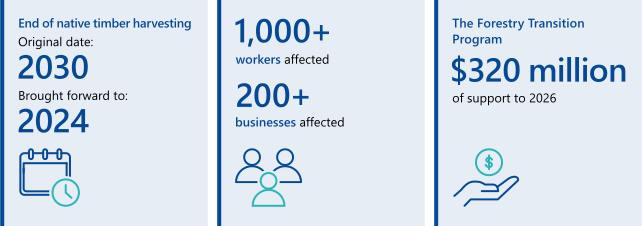
Source: VAGO.
What we concluded
The program is supporting workers, businesses and communities to transition from native timber harvesting. But we found issues with how the Department of Energy, Environment and Climate Action (the department) is administering the program and assessing its outcomes.
Of the workers made redundant after the decision to end native timber harvesting, 87 per cent are in new employment or have retired. But full-time roles have decreased from around 80 per cent to around 60 per cent and part-time, contract and casual roles have increased. It is not clear if workers' new jobs meet their needs or are sustainable. All the businesses we looked at are still in operation.
The department acted quickly after the government brought forward its decision. This included establishing well designed program guidelines to administer grants and support packages.
But it is not clear if the department has applied these guidelines consistently. We found gaps in the department’s records about its decisions, including payment approvals without records of how it verified eligibility. This reduces transparency over how it has allocated support and increases the risk of ineligible payments.
The department is also not adequately monitoring the program’s effectiveness. It cannot reliably show outcomes, such as job security or business viability, or know if businesses and workers will need more support after the program's scheduled end in 2026.
Video presentation
1. Our key findings
What we examined
Our audit followed 2 lines of enquiry:
1. Are the Department of Energy, Environment and Climate Action's (the department) processes to administer forestry transition grants and support payments in line with relevant guidelines?
2. Is the Forestry Transition Program (the program) supporting eligible workers and businesses that need assistance to transition from reliance on native timber harvesting?
To answer these questions, we examined:
- the department
- ForestWorks
- Valuer-General Victoria (Valuer-General), which is a statutory authority in the Department of Transport and Planning.
Identifying what is working well
In our engagements we look for what is working well – not only areas for improvement.
Sharing positive outcomes allows other public agencies to learn from and adopt good practices. This is an important part of our commitment to better public services for Victorians.
Terms used in this report
Native timber harvesting
Cutting and removing trees from naturally grown forests to produce and/or sell timber products.
Transition from native timber harvesting
For workers affected by the government’s decision to end native timber harvesting, transitioning can include:
- keeping their job with the same employer
- finding new, sustainable employment
- retraining or enrolling in education to pursue employment in their preferred sector or another sector
- retiring, if appropriate.
Businesses can transition by:
- diversifying their operations
- continuing non-native timber harvesting operations
- closing native timber harvesting operations with minimal debt
- establishing new operations in affected regions.
Eligible workers and family members
A worker who is made redundant or is at risk of being made redundant because of the decision to end native timber harvesting. An eligible worker can access the Worker Support Program’s services and payments. To do this, they must be or have been working in an eligible Victorian business in the native timber industry.
A family member is a spouse, partner or dependent of an eligible worker. They are eligible to access the Worker Support Program’s services, but not payments.
Background information
The end of native timber harvesting
The government originally planned to end native timber harvesting in Victoria’s state forests by 2030. But in May 2023, it announced it was bringing forward its decision to start in January 2024 (see Figure 1). This was due to the inability to access harvestable timber caused by ongoing litigation processes and increasingly severe bushfires.
Figure 1: Original and accelerated timeline
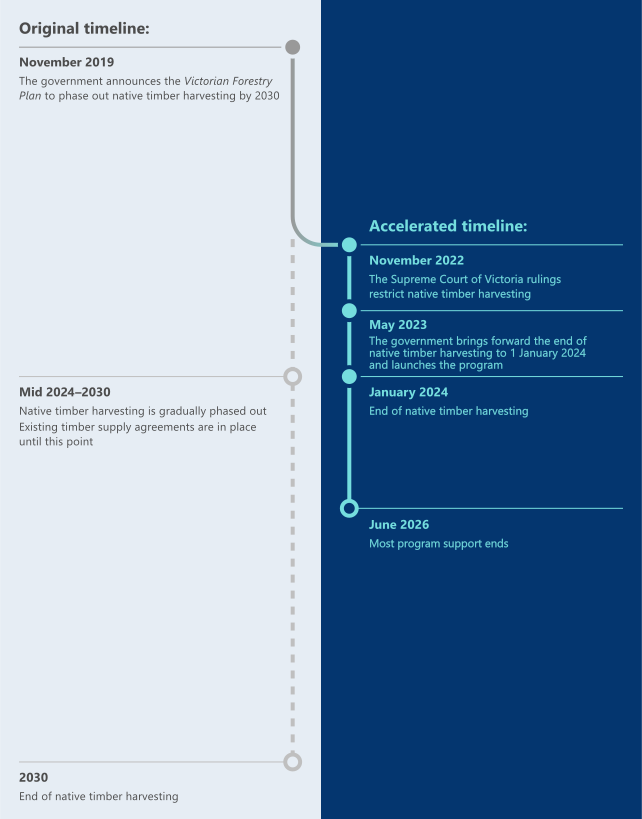
Source: VAGO.
The end of native timber harvesting marked a major change for some regional industries and communities. The industry supported sawmills, harvest and haulage contractors, seed collectors and forest-based service providers across Gippsland and north-eastern Victoria.
The government’s decision to end native timber harvesting directly affects around 1,000 workers and 200 businesses who relied on forestry-related activity. It also affects manufacturers that rely on native timber products in their supply chains (see Figure 2).
Figure 2: Directly affected local government areas
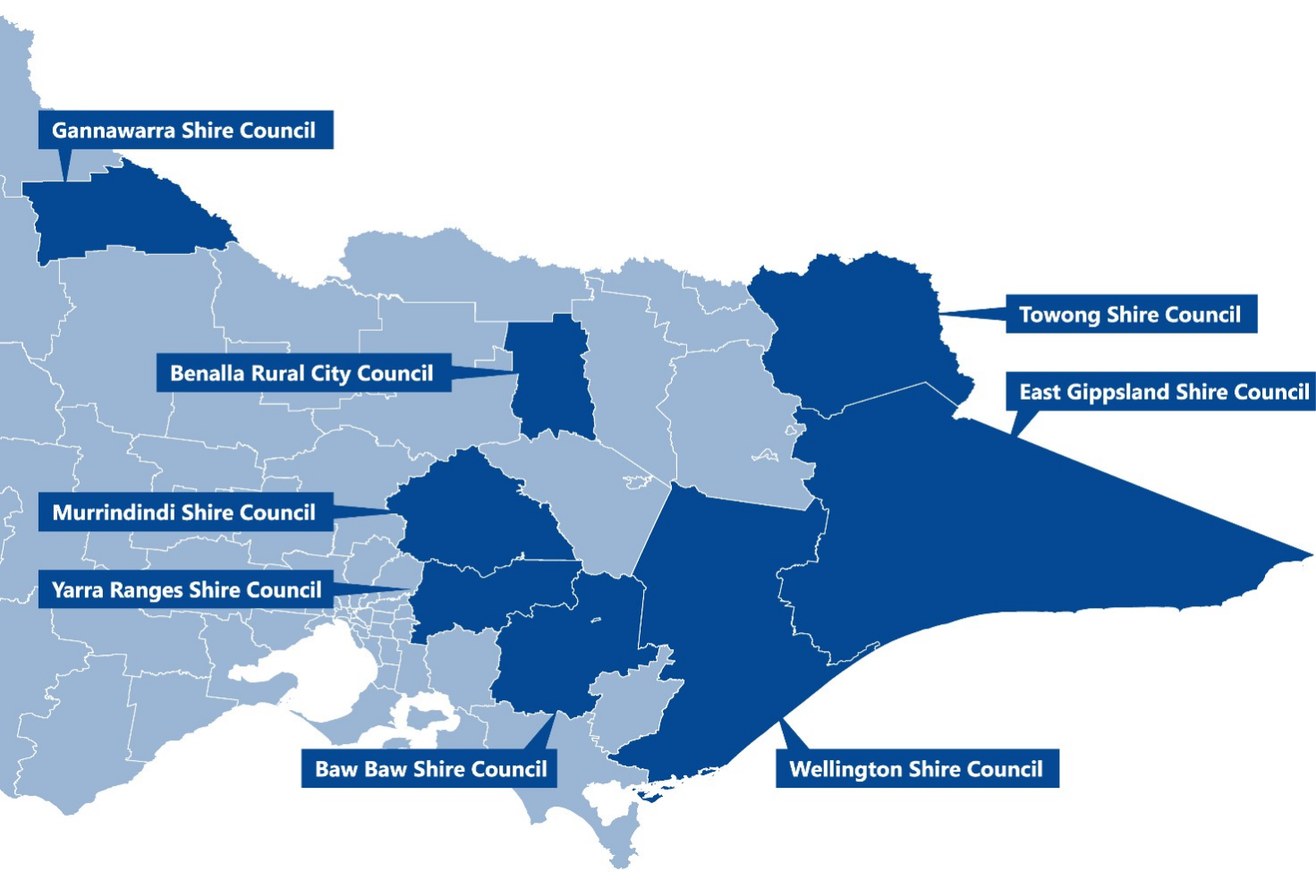
Source: VAGO, based on information from the department.
The program
To support the shortened transition period, the government established the program in 2023 to support workers, businesses and communities affected by the early closure of the native timber industry. It builds on and replaces the 2019 Victorian Forestry Plan, which was the original strategy for Victoria’s transition from native timber harvesting.
The program includes $320 million of funding across 3 streams (see Figure 3). It brings together a range of programs, grants and support packages for workers, businesses and communities affected by the decision to end native timber harvesting. This included on the ground shopfront support for highly impacted communities, along with service‑delivery funding to enable the department to implement the program effectively.
Figure 3: The program’s streams
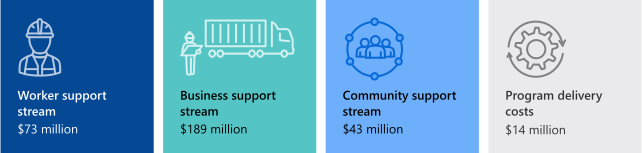
Note: Numbers have been rounded to the nearest million. All figures represent allocations as of 30 June 2025 and are subject to change. The department periodically reviews allocations.
Source: VAGO.
The worker stream includes 2 programs, which are together known as the Worker Support Program. We looked at both in this audit. They are the:
- Victorian Forestry Worker Support Program
- Opal Worker Support Service.
The business stream includes 9 grant and support packages. We looked at 5 in this audit:
- Victorian Timber Innovation Fund (rounds 2 and 3)
- Forestry Transition Fund (rounds 1 and 2)
- Forestry Business Support Package
- Sawmill Voluntary Transition Package
- Community Forestry Support Package.
Grant and support packages
Business grant packages operate through contestable grant rounds, with funding awarded to applicants that best meet the department’s published assessment criteria.
Business support packages are where applications are assessed individually against eligibility requirements. Payments are made based on each applicant's circumstances.
The Victorian Timber Innovation Fund and Forestry Transition Fund are grant packages. The Forestry Business Support Package, Sawmill Voluntary Transition Package and the Community Forestry Support Package are support packages.
The community support stream has 2 programs. We did not look at the community stream as part of this audit.
Roles and responsibilities
Department of Energy, Environment and Climate Action
The department is the main agency leading the transition from native timber harvesting. It:
- designed the program
- administers the program
- delivers the business and community streams
- oversees ForestWorks and the Gippsland Trades and Labour Council, which it contracted to deliver the Worker Support Program
- monitors outcomes to make sure the program is achieving its intended objectives.
ForestWorks
ForestWorks is an industry owned, not-for-profit organisation delivering the Worker Support Program. It supports the majority (around 95 per cent) of Worker Support Program recipients.
ForestWorks provides eligible workers and their families with financial support and services, including:
- one-on-one case management
- relevant and accredited training
- career transition and employment support
- referrals to government services
- support to transition to retirement
- access to health and wellbeing services, including clinical care if required.
ForestWorks delivers these services and reports results based on its agreed timeframes with the department.
Valuer-General
The Valuer-General is a statutory authority responsible for providing independent and impartial valuation services to government. The Valuation of Land Act 1960 governs the Valuer-General's activities.
Guided by the department's frameworks, the Valuer-General provides valuation assessments for plant, equipment and other business assets to support financial calculations under some of the program's business support packages.
Better Grants by Design
The government’s Better Grants by Design guide outlines key principles and processes for designing and delivering grant programs.
Victorian public sector agencies must apply the guide, which supports transparent, consistent and value focused grant management. This is in line with the Standing Directions 2018 under the Financial Management Act 1994 and the Department of Treasury and Finance’s Investment principles for discretionary grants.
What we found
This section focuses on our key findings, which fall into 3 areas:
1. The program is supporting workers and businesses, but the quality and security of new jobs is uncertain.
2. The department could not show it always complied with program rules because of gaps in its record keeping and oversight processes.
3. The department is not adequately monitoring and evaluating the program’s outcomes.
The full list of our recommendations, including agency responses, is at the end of this section.
Consultation with agencies
When reaching our conclusions, we consulted with the audited agencies and considered their views.
You can read their full responses in Appendix A.
Key finding 1: The program is supporting workers and businesses, but the quality and security of new jobs is uncertain
The program has helped workers and businesses transition from native timber harvesting
The Worker Support Program has supported 98 per cent of its registered participants (which includes workers who have kept their jobs and those who were made redundant, and their family members). The department has awarded $31 million in worker support payments.
As of 30 June 2025, 565 workers were made redundant and were eligible for support. The program has supported 377 of them to gain new employment and 112 to retire.
The program has also helped businesses to stay open during the transition. We looked at a sample of 30 business grant package recipients and all remained in operation as of 30 September 2025. These businesses have also committed to retaining at least 326 existing jobs and creating up to 80 new positions.
Working well: The program has helped workers to find new jobs and businesses to stay open
Workers and their family members have accessed a wide range of assistance including support services, education and training funding and support payments (such as income-stability payments and relocation assistance).
The program’s Victorian Timber Innovation Fund and the Forestry Transition Fund have helped businesses to stay open. This includes pivoting business operations and retaining or employing former native forestry workers.
These supports reduce the immediate impact of the decision to end native timber harvesting on workers, businesses and the community, and help the sector to adjust.
New jobs are less secure and may not be meeting workers’ needs
Many workers who were made redundant and then found new jobs are now in less secure employment. Full-time roles have decreased from around 80 per cent to around 60 per cent and part-time, contract and casual roles have increased.
The department collects information about workers’ new jobs, such as their titles, industry and location. But it does not collect information about workers’ new income levels or if the new jobs meet their needs and preferences. This means the department cannot show if the program is achieving its objective to help workers find sustainable employment.
The number of jobs created under the program’s business grants is uncertain
As of 30 June 2025, the department reported that the Victorian Timber Innovation Fund and Forestry Transition Fund had created at least 137 new jobs and led to the retention of 436 jobs. The department is due to assess most of the business grant job creation outcomes in 2026 and 2027.
Results to date do not give a full picture of job creation and often are not supported by evidence (such as progress reports and FTE employee information). This means the department cannot yet show how the program is supporting job creation or if businesses are effectively transitioning.
Addressing this finding
To address this finding, we made one recommendation to the department about improving how it measures and verifies the program’s outcomes for workers and businesses.
Key finding 2: The department could not show it always complied with program rules because of gaps in its record keeping and oversight processes
The department designed the program according to best practice guidelines
The department designed the program to be fair and transparent in line with the government’s Better Grants by Design guide. The department developed clear rules, assessment steps and oversight processes for each of the program’s grant and support packages.
Working well: Grant design was clear and appropriate for each funding stream
We saw evidence the department established fit-for-purpose designs for each worker and business grant and support package. It considered program risks and made improvements during delivery. This included scaled assessments to understand the value and risk of each grant and package. It also introduced whole of program monitoring and amended guidelines as issues emerged.
There are gaps and inconsistencies in how the department documented assessments and payments
It is difficult to assess if the department consistently followed program rules when making payments. This is because we found gaps in its record keeping and oversight processes.
| Out of ... | we found … |
|---|---|
| 50 sampled worker case files | none with evidence of how the department verified applicants’ eligibility. |
| 96 sampled business support package recipients | 12 redundancy claim payments, of which 2 were approved with overpayments and 2 with underpayments. |
| 32 sampled grant payment milestones | only 68 per cent had documented checks before payments were released. This was lowest for the Victorian Forestry Worker Support Program at 46 per cent. |
| 10 site rehabilitation grant payments (totalling $1.35 million) | none had evidence that work had been carried out. |
We also found assessment documents were dispersed across multiple systems with inconsistent naming conventions.
These gaps do not necessarily indicate incorrect payments. But the department cannot reliably show that it made decisions based on complete and accurate evidence. This reduces transparency and increases the risk of the department making inaccurate or ineligible payments.
It also means the department cannot provide sufficient assurance for over $1.61 million in worker and business support payments. This represents around 2 per cent of the total $79.24 million in support payments relating to the workers and businesses we sampled as of 30 June 2025.
Addressing this finding
To address this finding, we made one recommendation to the department about improving consistency and assurance when it administers grants.
Key finding 3: The department is not adequately monitoring and evaluating the program’s outcomes
The department’s monitoring approach does not assess program outcomes
The program aims to achieve sustainable outcomes for workers, businesses and communities. But the department does not collect data to assess this.
The department uses a dashboard to monitor the program. It includes information about program delivery, such as the number of participants and payments made. But it does not track key measures in the program’s monitoring and evaluation framework. This includes long-term worker employment, business transition progress and communities’ economic activity and social resilience. The department does not:
- collect the right information to know if workers have secured sustainable employment
- regularly track or validate business viability and community resilience indicators
- consistently report on its progress milestones (it has reviewed around two-thirds of these milestones).
As a result, the department’s monitoring shows what the program has delivered, but not its outcomes. Without complete and accurate outcome data, the department cannot assess or demonstrate how effectively the program has supported workers, businesses and communities.
The department does not have a view of long-term outcomes or future needs
The department has a monitoring and evaluation framework for the program. But the program’s mid-term evaluation, which was due in March 2025, was delayed to late 2025. This leaves little opportunity for the evaluation findings to influence the remainder of the program’s delivery.
The program’s final evaluation is due after most activities will end. This means it will report on what has happened, rather than identify ongoing needs. By the time these evaluation findings are available, businesses may have closed and workers may have relocated, limiting the department’s ability to intervene or adjust the program’s support settings.
Without timely insights, the department cannot use the evaluation findings to improve the program or provide targeted assistance during the transition. It also cannot understand if business and workers will need further support once the program ends.
Addressing this finding
To address this finding, we made 2 recommendations to the department about:
- broadening the program’s performance monitoring and evaluation framework to capture its long-term outcomes
- integrating learning and outcomes from the Worker Support Program into broader regional economic and workforce strategies.
See the next section for the complete list of our recommendations, including agency responses.
2. Our recommendations
We made 4 recommendations to address our findings. The department accepted all recommendations in full.
| Agency response(s) | ||||
|---|---|---|---|---|
| Finding: The program is supporting workers and businesses, but the quality and security of new jobs is uncertain | ||||
Department of Energy, Environment and Climate Action
| 1
| Improve how it measures and verifies the outcomes of the Forestry Transition Program’s worker and business grants and support packages. This includes:
| Accepted
| |
| Finding: The department could not show it always complied with program rules because of gaps in its record keeping and oversight processes | ||||
Department of Energy, Environment and Climate Action
| 2
| Strengthen the consistency and assurance of future grant administration by making sure program rules, eligibility assessments and quality checks are applied uniformly across all grants. This should include:
| Accepted
| |
| Finding: The department is not adequately monitoring and evaluating the program’s outcomes | ||||
Department of Energy, Environment and Climate Action
| 3
| Expand and extend performance monitoring beyond the scheduled end of the Forestry Transition Program to assess long-term outcomes for workers, businesses and communities (see Section 5).
| Accepted
| |
4
| Apply lessons from the Forestry Transition Program to improve how future transition supports are integrated with new and existing regional economic and workforce initiatives within the Department of Energy, Environment and Climate Action’s remit (see Section 5).
| Accepted
| ||
3. Support for workers and businesses
The program is helping eligible workers and their families with support services, financial support and training and employment funding.
But many workers have moved from full-time employment to less secure positions. The department cannot demonstrate if workers’ new jobs are meeting their needs or employment outcomes are sustainable.
The program’s business grants and support packages have helped businesses to stay open and compensate for lost income. But the department has not yet verified job creation or retention outcomes arising from this support.
Covered in this section:
- The program has supported workers to find new jobs, retire and access support payments
- Some workers have less secure employment
- Many workers accessed training and education support, but it is not clear how this supported jobs
- Business grants have helped businesses stay open, but it is difficult to track job outcomes
- Business support packages have compensated for lost income
The program has supported workers to find new jobs, retire and access support payments
The Worker Support Program
The department launched the Worker Support Program in November 2022. It includes the Victorian Forestry Worker Support Program and Opal Worker Support Service.
The Worker Support Program provides services (such as career assistance and training) and payments (such as hardship assistance) for eligible workers.
The department‘s intended outcomes for the Worker Support Program are that eligible workers:
- are employed in sustainable jobs or supported to retire
- have a strong sense of wellbeing and are confident about their future.
ForestWorks is supporting most (95 per cent) of the Worker Support Program participants. This includes Opal Australian Paper (Opal) production workers and their family members. The Gippsland Trades and Labour Council is supporting Opal trades workers and their family members.
Worker results
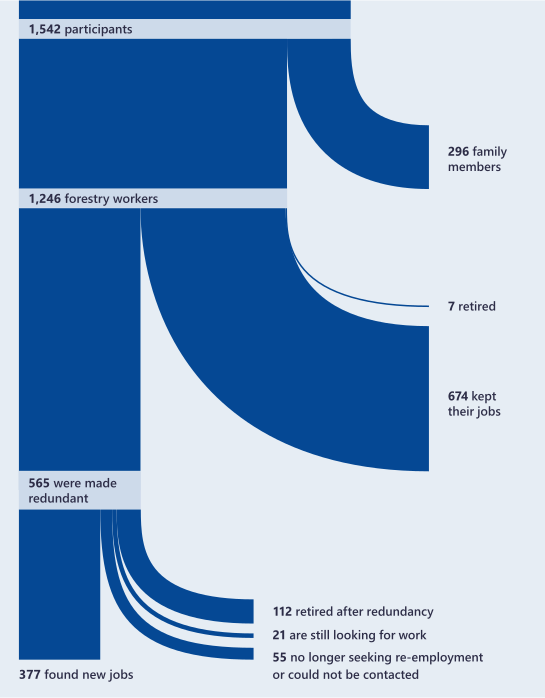
As of 30 June 2025, the Worker Support Program had supported 1,542 eligible participants (98 per cent of a total 1,577 people who registered for the program). This includes:
- 1,246 eligible workers
- 296 family members.
Over half of these workers have kept their existing jobs and nearly half were made redundant. Of the 565 workers who were made redundant, 87 per cent have either found new jobs or retired (see Figure 4).
The remaining 35 registered participants (2 per cent) had applications that were cancelled or duplicated or were ineligible to receive assistance.
Figure 4: Worker Support Program outcomes for eligible participants
Source: VAGO, from the department's June 2025 dashboard data.
Of the 377 workers who were made redundant and then found new jobs, nearly a quarter of roles are in the wood products, forestry, pulp and paper or forestry-support sectors. The other three quarters are across different industries, showing that most workers left the native timber supply chain.
Identifying and engaging eligible workers
ForestWorks has taken action to identify and reach potentially eligible workers and their family members for the Worker Support Program. Workers and their family members then register themselves if they would like to receive support.
ForestWorks has reached workers using multiple channels, including:
- social media
- flyers
- bulk text messages
- information sessions
- site visits
- community and industry events.
The department also provided ForestWorks with a list of businesses facing potential closure. ForestWorks has engaged these businesses to identify eligible workers.
From February 2023 to May 2025, ForestWorks participated in or delivered at least 26 events where it:
- received 121 new program registrations
- engaged directly with 63 potential employers. This resulted in 31 employers hiring a total of 59 workers through referral pathways and partnerships.
Support payments for workers
As of 30 June 2025, the department has funded over $31 million in support payments to 432 workers. There are 4 types of payments available for eligible workers through the Worker Support Program.
| The ... | is for workers who … | The government has funded ... |
|---|---|---|
| top-up payment | are made redundant or had a casual contract end. | $23.3 million over 355 recipients. |
| over-45 payment | receive the top-up payment and are over 45 years old. | $7.1 million over 221 recipients. |
| relocation payment | have a new job more than 50 kilometres away and need to relocate. | $430,184 over 21 recipients. |
| hardship payment | are experiencing significant hardship and are not eligible for other government payments. | $291,000 over 97 recipients. |
For more information about these payments, see Appendix D.
Health and wellbeing support
The department identified health and wellbeing as a key need for workers affected by the decision to end native timber harvesting. It aims for employees to have a strong sense of wellbeing and confidence about their future by the end of the program.
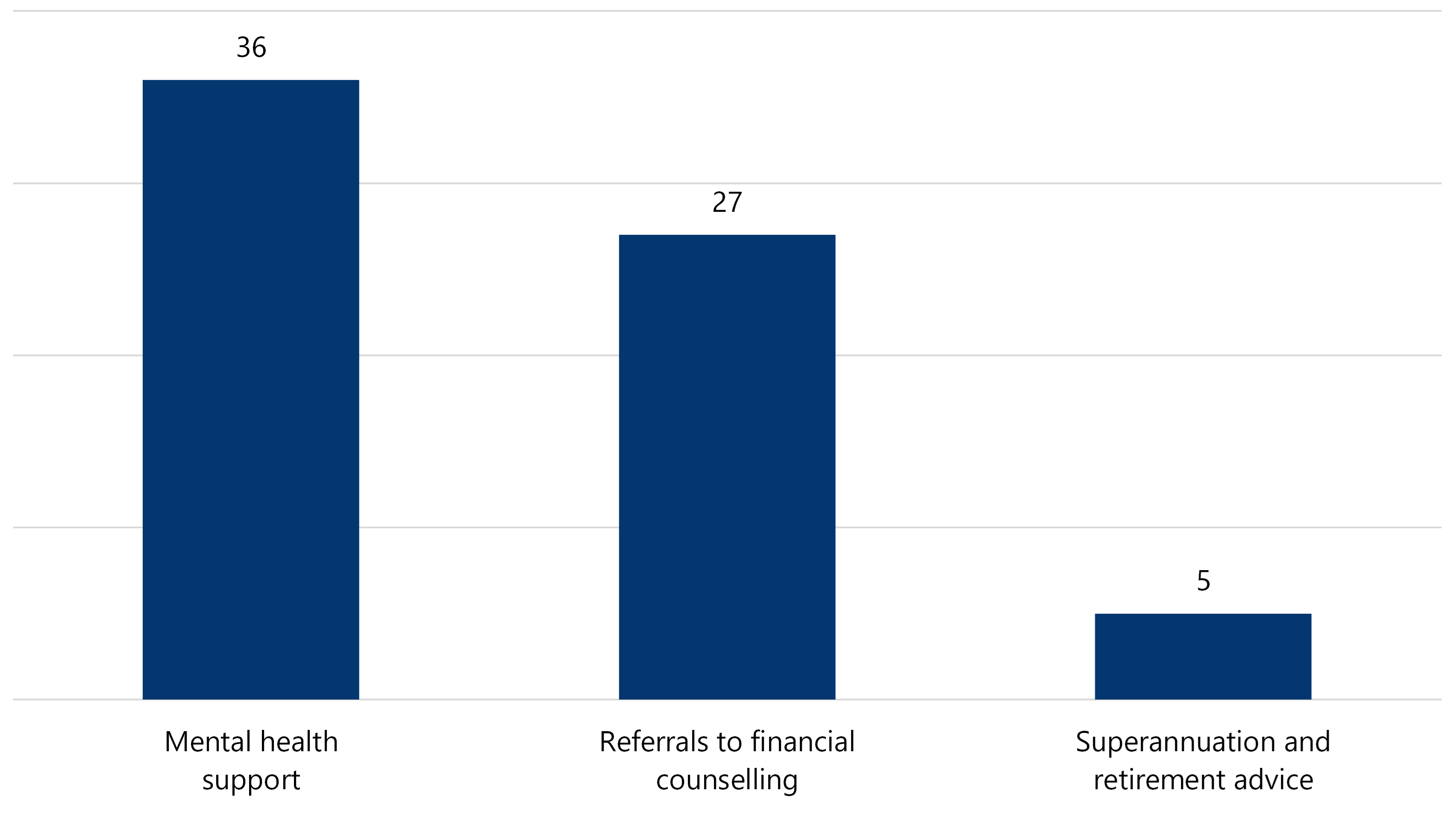
The Worker Support Program offers referrals to health and wellbeing services. This includes clinical services, mental health services and payments for up to 10 sessions with an approved service provider.
The uptake of health and wellbeing support has been low. Only 68 people (4.4 per cent of Worker Support Program participants) accessed support, as Figure 5 shows.
Figure 5: Participants accessing different types of health and wellbeing support
Source: VAGO, based on the department's June 2025 dashboard data.
ForestWorks advised that uptake was lower than initially expected. Coordinators developed connections with participants and, in some cases, provided informal support to workers and their family members outside the program’s formal scope.
Some workers have less secure employment
Employment security
Some workers who were made redundant moved to less secure employment. As Figure 6 shows, full-time roles have decreased from around 80 per cent to around 60 per cent and part-time, contract and casual roles have increased.
Figure 6: Change in employment type among redundant workers active in new employment
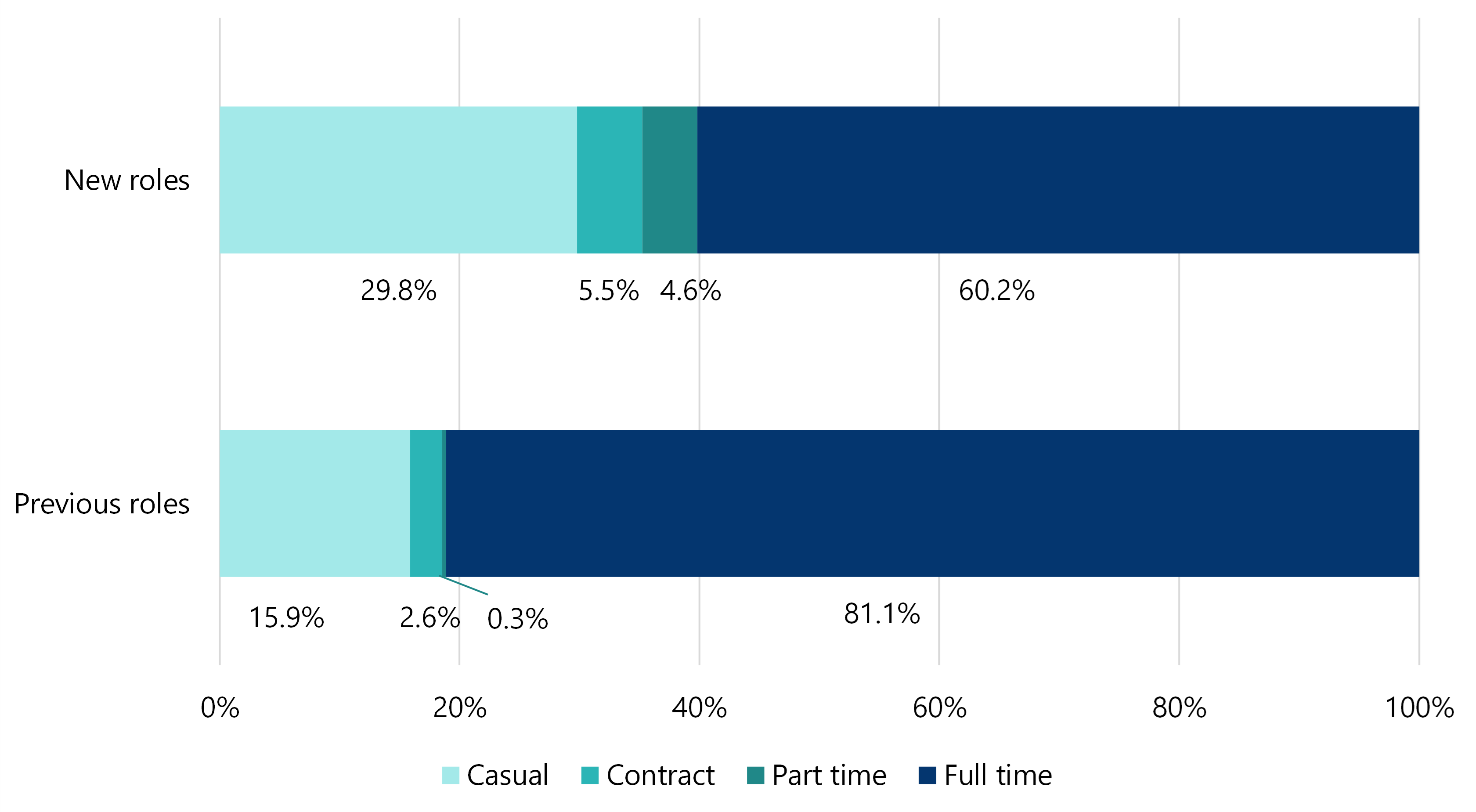
Note: Some workers were employed in more than one role. Only previous or new roles with a recorded status of casual, contract, part-time or full-time are included in this analysis. Numbers have been rounded so may not equal 100 per cent.
Source: VAGO, based on the department's June 2025 dashboard and Global Engagement Management System data.
Meeting workers’ needs
One of the program’s goals is to help workers achieve their personal and career objectives. But the department cannot show that workers’ new roles meet their needs or align with their interests.
The department requires ForestWorks to provide evidence of workers’ employment outcomes. This includes detailed explanations of how it has met the needs of workers.
But the department and ForestWorks do not collect evidence of employment outcomes, such as job offers or payslips. Instead, ForestWorks relies on informal discussions with new employers and workers and does not consistently document this. Without evidence, the department cannot check the accuracy of ForestWorks’ reported results.
The department and ForestWorks also do not collect consistent information about whether a worker's new job meets their needs or if, for example, they are looking for new roles. ForestWorks has notes of some workers' satisfaction with their roles but this is inconsistent.
The department collects job placement information for redundant workers, including their new role and the Australian and New Zealand Standard Industrial Classification (ANZSIC) industry classification. However, it does not collect salary information or access Australian Tax Office data to compare previous and new earnings.
As a result, the department cannot determine whether workers have moved into higher or lower paid roles or fully understand the economic impacts on workers or the affected communities.
Many workers accessed training and education support, but it is not clear how this supported jobs
Training and education support
The department has funded $3.67 million to 1,041 workers and their family members to access training and education support. This is over two-thirds of the Worker Support Program’s participants.
Of these participants, around 60 per cent were workers at risk of redundancy or family members of those workers. The remaining 40 per cent were already made redundant.
Each person can receive up to $8,000 for training expenses, such as course fees, books, materials, travel and clothing. As Figure 7 shows, course fees accounted for 90 per cent of all training and education support payments.
Figure 7: Training and education support payments
| Category | Number of payments | Total received |
|---|---|---|
| Course fees | 1,032 | $3,317,417 |
| Travel | 212 | $287,011 |
| Books and materials | 51 | $9,953 |
| Other | 74 | $51,589 |
| Total | 1,369 | $3,665,970 |
Note: The total number of participants (1,041) is less than the number of payments because some people accessed more than one type of payment.
Source: VAGO analysis of the department's June 2025 dashboard and Global Engagement Management System data.
ForestWorks partnered with the following specialist education and training organisations:
- Gippsland TAFE to offer 13 tailored forest-operations units
- Construction, Forestry, Maritime Employees Union (CFMEU) for onsite support to Opal workers
- 245 registered training organisations across Victoria for education and skills recognition.
We found that most funded course fees were for accredited training, including:
- obtaining certificates
- high-risk work licences (to qualify for performing specific tasks, such as dogging or rigging)
- higher education courses
- industry training
- machinery and vehicle licences
- recognition of prior learning
- obtaining new skill sets
- tickets to qualify working in specific environments, such as heights or confined spaces.
The most common course participants accessed was to gain a licence to drive heavy rigid vehicles.
Impact of education and training support on employment outcomes
Around 40 per cent of people who received education and training support were workers who were made redundant then later found new employment. But it is not always clear if or how this support has helped these workers to secure new jobs.
As Figure 8 shows:
- redundant workers who later found new jobs received $1.47 million of total education and training support funding
- workers who were at risk of redundancy but later kept their existing job received $1.39 million (38 per cent) of support funding.
Figure 8: Education and training support provided for workers by participant type
| Participant outcome | Value of support received | Percentage of total spend | Participants supported |
|---|---|---|---|
| Redundant workers in new jobs | $1,473,005 | 40% | 318 |
| Kept existing job | $1,386,047 | 38% | 407 |
| Family member | $504,130 | 14% | 213 |
| Other* | $142,036 | 4% | 43 |
| Retired | $102,274 | 3% | 43 |
| Seeking new job | $58,479 | 2% | 17 |
Note: Figures have been rounded to the nearest dollar and percentage, so percentages do not equal 100 and sum of value of support received does not match total received in Figure 7 *’Other’ includes participants who are no longer looking for work or not contactable.
Source: VAGO, from the department's June 2025 dashboard data.
The department captures information on education and training participation and employment pathways through its program dashboard. This includes reporting participants’ previous employment and the industry codes of the education or training they undertook.
The department reported employment industry information for 133 participants. Of these:
- 116 were made redundant and then gained new employment. For 91 of these workers
(78 percent), the industry of their new employment matched the industry they undertook education or training in. - the remaining 17 participants were family members, workers who retained employment, retirees, or individuals no longer seeking work.
We looked at a sample of 50 participants' case files. The records show participants’ invoices and claim forms for education and training expenses. But they do not include attendance logs or completion certificates. This means the department cannot confirm whether participants completed training or the extent the funding helped redundant workers to secure new jobs.
ForestWorks advised us that the payment of course fees indicates that training occurred. ForestWorks also advised that it has processes in place to verify whether participants complete training or are no-shows and pays invoices accordingly. However, it provided no evidence to verify or validate this across the sampled participants.
Business grants have helped businesses stay open, but it is difficult to track job outcomes
Business grant programs
The Victorian Timber Innovation Fund and Forestry Transition Fund are grants to help businesses stay open and continue employing people across affected communities.
| The … | provides … | for … |
|---|---|---|
Forestry Transition Fund
|
| businesses and industry groups to expand, diversify or start new businesses.
|
| Victorian Timber Innovation Fund | grants up to $1 million | businesses to explore, invest and implement new opportunities. |
The Victorian Timber Innovation Fund and Forestry Transition Fund have different expectations for creating or retaining jobs.
The Victorian Timber Innovation Fund focuses on innovation and diversification. Some, but not all, rounds required job creation. The Forestry Transition Fund links funding to job creation and offers incentives for employing redundant forestry workers.
Job creation and retention
It is too early to know if the Victorian Timber Innovation Fund and Forestry Transition Fund are helping businesses to retain workers and create jobs.
We looked at a sample of 30 businesses receiving grants under the funds. As of 30 June 2025, these businesses had collectively committed to creating or retaining 406.5 FTE jobs (see Figure 9).
Business continuity is an important part of keeping and creating jobs. As of 30 September 2025, all 30 businesses that received grant funding were still active.
However, the commitment by grant recipients to create 80.5 FTE jobs only includes 9 displaced native timber workers. This reflects a low uptake of the Forestry Transition Fund’s $20,000 wage‑subsidy incentive for employers hiring displaced workers.
Figure 9: Forestry Transition Fund and Victorian Timber Innovation Fund employment commitments
| Commitment | Forestry Transition Fund | Victorian Timber Innovation Fund |
|---|---|---|
| Total jobs to retain | 65.0 FTE | 261.0 FTE |
| Total jobs to create | 53.5 FTE | 27.0 FTE |
Note: Figures are from a sample of 15 Forestry Transition Fund and 15 Victorian Timber Innovation Fund grant packages. Not all grant agreements included FTE requirements, so the actual number of jobs to be created or retained may be different than the published figures.
Source: VAGO, based on the department’s Forestry Transition Fund rounds 1 and 2 grant agreements and approval documentation.
The department's monitoring dashboard reports that the Victorian Timber Innovation Fund and Forestry Transition Fund have collectively created 148 new jobs. This number is different to the department’s internal status report, which indicates that as of 30 June 2028, 69 funded businesses created 137 new jobs, including 72 through the Victorian Timber Innovation Fund and 65 through the Forestry Transition Fund, and retained 436 jobs.
Most businesses are due to measure and report against job creation milestones in 2026 or 2027. But for those already reported, the department does not have consistent evidence to show businesses achieved their milestones.
In its grant agreements with businesses, the department requires evidence, such as progress reports, statutory declarations and audit opinions, to verify employment outcomes. But several files lack this. For example:
- some submissions are overdue or incomplete
- some statutory declarations do not include FTE information for jobs created or retained.
Business support packages have compensated for lost income
Business support packages
We looked at 3 business support packages that provide discretionary funding to help businesses manage the fiscal impact of ending native timber harvesting.
| The … | provides … | to eligible … |
|---|---|---|
| Forestry Business Support Package | financial compensation for loss of plant and equipment, loss of income, site rehabilitation and employee redundancy reimbursements | forest-based contractors. |
| Sawmill Voluntary Transition Package | sawmills with VicForests supply contracts that voluntarily exit native timber processing. | |
| Community Forestry Support Package | community forestry operators and firewood customers, including forest produce licence or agreement holders. |
Compensation payments
Compensation for sawmills, contractors and native timber processors formed a major part of business support packages. Payments helped them manage the fiscal impact of ending native timber harvesting and to stay open. This includes compensation for:
- loss of income
- timber volume
- plant and equipment compensation.
The department provided $41.8 million in loss of income and timber volume compensation to 61 businesses (see Figure 10).
Figure 10: Loss of income and timber volume compensation by support package
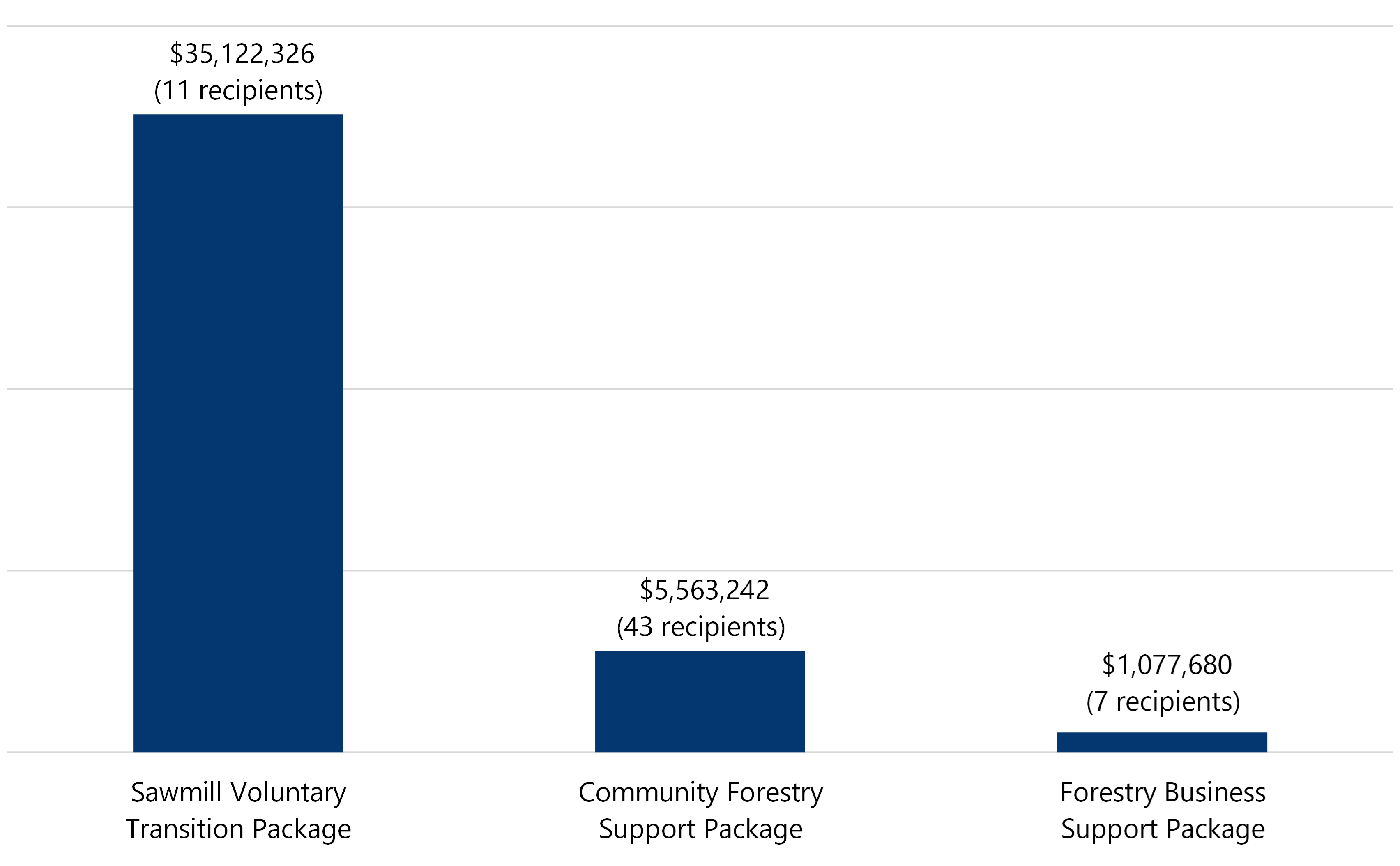
Note: Figures are based on the department's costings crosschecked against payments specified in grant agreements. Figures have been rounded to the nearest dollar.
Source: VAGO, based on grant submission applications requesting redundancy payments.
The department engaged the Valuer-General to conduct independent valuations of plant and equipment under the Sawmill Voluntary Transition Package and Community Forestry Support Package.
Applicants provided depreciation schedules that complied with the Australian Taxation Office. The Valuer-General assessed equipment using the valuation methods outlined in each program's guideline.
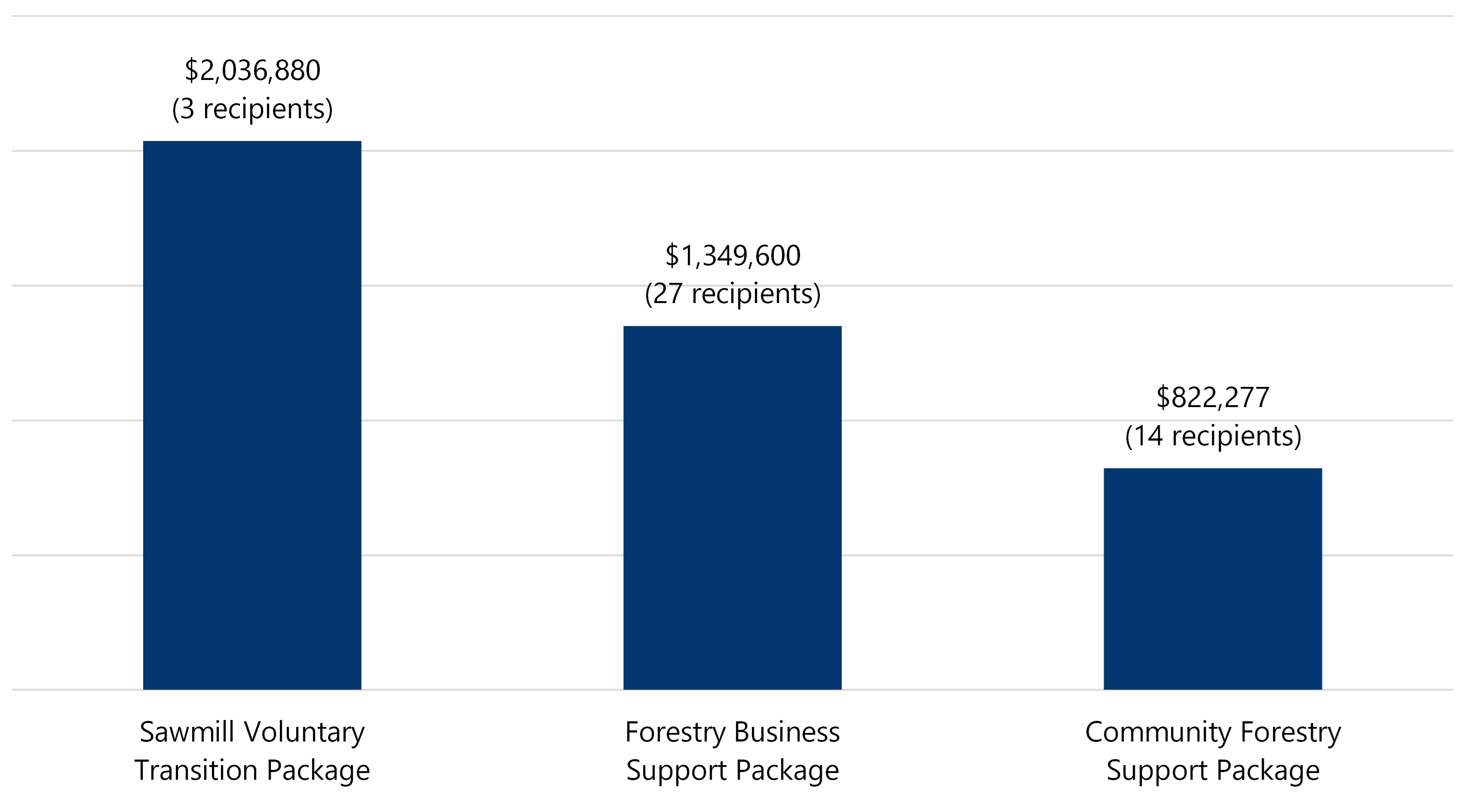
As of 30 June 2025, the department had awarded $4.2 million to 44 businesses for plant and equipment compensation, as Figure 11 shows.
Figure 11: Plant and equipment compensation by support package
Source: VAGO, based on the department’s grant records and Valuer-General records.
Employee redundancy payments
The sawmill, community forestry and forestry business support packages also included reimbursement for staff redundancy payments to help businesses meet their obligations under the Fair Work Act 2009 and the National Employment Standards.
As of 30 June 2025, the department had provided $1.4 million to businesses across 12 redundancy applications, as Figure 12 shows.
Figure 12: Number and value of approved redundancy payments
| Support package | Applications received | Applications approved | Total payments |
|---|---|---|---|
| Sawmill Voluntary Transition Package | 6 | 6 | $1,303,643 |
| Community Forestry Support Package | 6 | 2 | $51,686 |
| Forestry Business Support Package | 5 | 4 | $47,144 |
| Total | 17 | 12 | $1,402,473 |
Note: The variance reflects applications that requested redundancy support compared with those where redundancy payments were approved and paid by the department. Total payments have been rounded to the nearest dollar.
Source: VAGO analysis of applications requesting redundancy payments as part of grant submissions.
Reimbursements only applied to genuine redundancies and were capped at award or National Employment Standards limits. To claim, businesses submitted a redundancy spreadsheet showing each worker’s:
- start date
- years of service
- award classification
- calculated entitlement.
In August 2024, the department updated the Forestry Business Support Package guidelines to also include payroll evidence.
4. Program delivery
The department designed worker and business support packages in line with the government’s Better Grants by Design guide. The department made most support payments according to program rules and followed the required formulas for calculating compensation.
But the department cannot provide sufficient assurance for over $1.61 million in worker and business support payments. This is because the department has not consistently applied administrative, record keeping or quality assurance processes when assessing eligibility and making payments.
Although this represents around 2 per cent of the total $79.24 million in payments relating to the workers and businesses we sampled, it reduces confidence that the department has assessed every payment accurately and in line with program rules.
Covered in this section:
- The department designed the program according to guidelines
- The department cannot always show it confirmed support eligibility for workers
- The department has not kept consistent or complete records when administering business packages
The department designed the program according to guidelines
Program design
The department designed the program using the government’s Better Grants by Design guide. This created a solid foundation for the department to administer the worker and business support packages.
| Packages have … | which means ... |
|---|---|
| scaled rules and assessment steps | the department can assess each package according to its size, complexity and risk. For example, it uses simple checks for low-risk payments and more structured testing for higher-risk grants. |
| clear eligibility criteria and payment formulas | applicants know their entitlements and assessors have a consistent basis for assessment. This supports fair, transparent decisions across the program. |
| whole-of-program monitoring | the department has oversight of all grants to track progress, find anomalies and manage risks. |
| flexibility | the department can review issues as they arise and update guidance, clarify rules and tighten controls as needed. |
The department cannot always show it confirmed support eligibility for workers
Assessing workers' eligibility and needs
The department cannot show that all Worker Support Program recipients were eligible to participate in the program.
To administer the Worker Support Program, ForestWorks must assess workers’ eligibility using the department’s criteria. But when we reviewed a sample of 50 worker case files, none contained an eligibility assessment to show that workers met the criteria to participate in the Worker Support Program.
After assessing eligibility, ForestWorks must interview the worker to complete a needs assessment. This is to understand what type of support the worker should receive. Needs assessments include, for example, the worker’s employment, interests, and support needs, including training, health and wellbeing or employment support.
But in our sample, only 54 per cent of workers’ case files contained these needs assessments. It is not clear if all workers had a needs assessment. This also means the department does not know if ForestWorks has met all its obligations under its grant agreement.
Of our sample, 22 participants were Opal workers who received group-based rather than individual support while their redundancies were pending. This suggests some Opal workers may not have received the level of tailored support ForestWorks provided to other workers.
Ineligible hardship payments
Around one-third of the program’s total hardship payments for workers may have been given to ineligible recipients. This represents $102,000 across 34 payments.
The Worker Support Program’s eligibility criteria states that hardship payments are a one-off payment available to workers who are not receiving other government assistance. But 32 workers who received hardship payments also received other forms of government support.
The program’s eligibility criteria do not define what type of government support this includes (for example, Australian Government or state-funded support). This means there is ambiguity around the definition of ‘government assistance’. The department cannot show how it assessed eligibility for these 32 hardship payments.
In 2 other cases, hardship payments were made to workers’ family members. The program’s eligibility criteria state that these payments are for workers only, which means these payments were ineligible. In both cases, the worker associated with these family members also received a hardship payment.
All other worker support payments were in line with eligibility criteria. This includes relocation, top up and over-45 payments.
Ineligible training and travel payments
The program allows each participant up to $8,000 in training costs, which includes up to $500 for travel and accommodation.
If the total expenditure for the participant exceeds $8,000, ForestWorks has a delegated approval pathway for final assessment and approval. Circumstances where participants have exceeded the $8,000 training costs include when the participants experience financial restraints and require extra funding to further their career.
Across the program, we found 109 payments that exceeded funding limits without delegated approval, totalling $113,846.52 of overpayments (see Figure 13). This includes:
- 19 payments over $8,000 for training
- 90 payments over $500 for travel and accommodation.
Figure 13: Ineligible funded training and travel expenses
| Payment type | Number of payments | Total value exceeding limit |
|---|---|---|
| Training funding over $8,000 | 19 | $20,717.76 |
| Victorian ground travel and accommodation costs over $500 | 90* | $93,128.76 |
| Total | 109 | $113,846.52 |
Note: *The department applied the $500 limit in April 2024 and removed it in September 2025, so this number only includes payments between these dates.
Source: VAGO, based on the department's dashboard, Global Engagement Management System data and April 2024 eligibility criteria.
ForestWorks approved 16 of the 19 training payments that exceeded the $8,000 limit using its internal approval processes. While ForestWorks' practice guide allows it to approve training above this limit, the department’s program guideline does not give ForestWorks the authority to do so.
ForestWorks applied special consideration to approve 5 payments above the training cap. However, ForestWorks did not document clear or consistent criteria for when special consideration should apply.
During the audit period (January 2024 to 30 June 2025), the April 2024 Worker Support Program service framework and eligibility criteria included a $500 cap on travel and accommodation costs. During this time, ForestWorks made payments above this amount. The department removed the cap in the September 2025 framework update.
Ineligible redundancy claims
The department does not have consistent records for how it verified redundancy claims.
Business support packages across the program ask for various levels of evidence for the department to verify redundancy claims. For example, the Forestry Business Support Package asks for businesses to supply more evidence than other packages, including workers’ final payslips. The department applied redundancy rules consistently under the Forestry Business Support Package.
The Sawmill Voluntary Transition Package and Community Forestry Support Package ask businesses for less stringent calculation spreadsheets. While this complies with the program guidelines, records in these 2 packages show inconsistencies in how the department verified workers':
- award rates
- years of service
- employment status.
It is unclear how the department verified these redundancy claims.
Across all packages, we found application files with incomplete evidence for redundancy claims. Payment amounts for these claims do not align with either the applicant’s spreadsheet or the department’s calculations. The department cannot always demonstrate how it reviewed, validated and quality-assured these claims before releasing payments.
We also found the department approved:
- one payment that was above the hourly rate limits in the relevant award and National Employment Standards without evidence that it tested these rates, resulting in a $12,391 overpayment (see Case study 1)
- 2 ineligible payments totalling $33,340 for directors of companies where the department did not confirm their dual capacity as both director and worker (see Case study 2)
- 2 underpayments totalling $16,250 to businesses due to discrepancies in applying award rates and National Employment Standards.
Case study 1: Redundancy payments
Redundancy claims approved without evidence of employee status or award compliance
Under the National Employment Standards and business support package guidelines:
- businesses can only claim redundancy payments for genuine redundancy
- claims must be in line with the relevant award or the National Employment Standards.
But a business applying for redundancy compensation submitted its application without supporting payroll documentation. It also used an hourly rate 2.4 times higher than the maximum Timber Industry Award rate for comparable roles.
The department reimbursed $21,402 without confirming eligibility or aligning hourly rates with the relevant award. This was an overpayment of $12,391.
Source: VAGO analysis of transition support documentation.
Case study 2: Redundancy eligibility
Redundancy claim approved for a company director without evidence of dual capacity
A business applied for compensation for a redundancy payment made to its company director. Under the National Employment Standards, directors are only eligible for redundancy if they can demonstrate dual capacity. This means that they also have a genuine employee role in addition to their director responsibilities. But the applicant did not provide evidence of this, such as payslips, contracts or position descriptions.
The department approved the claim, but these eligibility records are missing from the application file. There is no evidence that the department verified if the director was a genuine employee.
Source: VAGO analysis of transition support documentation.
Grant performance management
Checking that grants are delivering what they promise is essential for publicly funded programs.
While the department outsourced the Worker Support Program delivery to ForestWorks, it has overall responsibility for the program’s integrity. Outsourcing gives the department less direct control over grant administration, but it does not remove accountability for it to oversee the process.
The Better Grants by Design guide requires agencies to check progress in a way that reflects the value and risk of each grant. The department designed reporting arrangements that align with this approach. For example:
- the Victorian Timber Innovation Fund and Forestry Transition Fund require milestone reports and financial risk assessments for higher-value projects. The Worker Support Program also requires ForestWorks to submit milestone reports
- the Forestry Business Support Package, Community Forestry Support Package and Sawmill Voluntary Transition Package require statutory declarations to confirm that businesses have met their obligations.
Milestone report
Milestone reports in agreed grant agreements outline deliverables the department expects grant recipients to deliver, for example the number of workers receiving support payments. Grant recipients then report against these deliverables.
The department uses this information to confirm a grant recipient is meeting its milestones before releasing payments for the next stage of work.
The department has collected many of the program’s required milestone reports. But it cannot always show that it reviewed them before releasing payments. Across 690 reporting milestones, only 68 per cent have evidence of departmental review. This is lowest for the Worker Support Program, as Figure 14 shows.
Figure 14: Departmental review of milestone reports
| Grant stream | Reporting milestones | Milestone reviews completed |
|---|---|---|
| Victorian Timber Innovation Fund and Forestry Transition Fund | 465 | 365 (78.5%) |
| Worker Support Program | 225 | 104 (46.2%) |
| Total | 690 | 469 (68.0%) |
Note: Figures have been rounded. Totals may not sum exactly due to rounding.
Source: VAGO, based on the department’s grant agreements and monitoring and evaluation reporting.
This raises concerns about the department’s oversight and assurance of the program, especially for the Worker Support Program. It means the department cannot show that it has always verified the program is progressing as expected before it releases payments.
Incomplete monitoring also limits the department’s ability to identify emerging risks, intervene early when deliverables fall behind or demonstrate that support packages are achieving their intended outcomes.
The department has not kept consistent or complete records when administering business packages
Business grants and support administration
The department’s approach to administration varies across the program’s businesses grants and support packages.
| For the … | the department has ... |
|---|---|
| structured assessment pathways, formal applications and weighted scoring against published criteria.
|
| simpler processes to prioritise timely delivery. This includes governance manuals and process maps, which set out assessment steps.
|
While this approach is in line with the Better Grants by Design guide, the department does not have consistent records for how it administered these packages.
Gaps in supporting evidence make it difficult to know whether the department always followed program guidelines and internal processes to assess and administer grants and compensation payments.
| For example, the department has clear records showing ... | But it has inconsistent or incomplete records for how it ... |
|---|---|
| authorised delegates approved all business grant payments. | verified recipient eligibility, valuations and key information (such as payroll or timber volumes). |
| it calculated timber compensation payments using program formulas and made payments in line with these calculations. | used timber sales agreement data to confirm its calculations. |
These gaps mean the department cannot demonstrate that it made all payment decisions based on full and accurate evidence.
The department has also stored key assessment documents across the multiple systems, often using inconsistent naming conventions, including for:
- eligibility checks
- valuation files
- invitations to apply
- business unit reviews
- payment calculations.
Risk-based assessment of business grant applicants
The department designed business grants and completed risk assessments according to program guidelines. But there is missing evidence for how it scored assessments. This means it is not clear how the department applied eligibility criteria when awarding grants.
The department designed the Victorian Timber Innovation Fund and the Forestry Transition Fund to make sure only viable projects received funding. As contestable grant rounds, the guidelines for both funds require assessors to apply structured, risk-based assessment processes. This includes:
- weighted scoring against published merit criteria
- due diligence checks, such as financial risk assessments for projects over $50,000
- organisational capability reviews and probity checks.
These requirements help to confirm that applicants have the financial and operational capacity to deliver their proposed projects.
When assessing applications, the department completed eligibly checks, basic compliance requirements and financial risk assessments as required. This helped it to confirm that applicants were able to meet their financial obligations.
But the department does not have evidence of always completing the weighted scoring assessments required under program guidelines. Only 27 per cent (8 out of 30) of the business grant applications we sampled had completed scoring templates or clear records showing how the department compared proposals against its published criteria.
In one case, the department’s assessment panel minutes say that scoring is yet to be finalised, but it approved the project to proceed. The department also did not show how it addressed panel members' concerns about risks, such as cashflow issues or unclear co contribution arrangements.
The lack of weighted scoring records means the department cannot show:
- how it applied assessment criteria across grant applications
- whether it completed all required assessment steps.
Integrity of valuations and compensation payments
For plant and equipment compensation, the Valuer-General completed valuations on the department's request for all 44 business applicants. Each valuation report includes:
- clear instructions
- the stated purpose and scope of work
- the methodology applied, including key assumptions, inspection methods and valuation approaches.
The reports are supported by depreciation schedules, asset inventories and photographic evidence of the plant and equipment.
But the valuations do not always align with the program guidelines. We found:
- examples where the Valuer-General endorsed valuations without an onsite inspection, which is required under program guidelines
- that a departmental officer did not attend any site inspections, which is as required under program guidelines.
This does not necessarily mean that valuations were incorrect. But these gaps reduce confidence that all compensation decisions followed program rules and guidelines.
Site rehabilitation payments
The Sawmill Voluntary Transition Package and Community Forestry Support Package include site rehabilitation payments to help businesses carry out environmental remediation.
Across the 2 packages, the department approved 10 payments totalling $1.35 million, as Figure 15 shows.
Figure 15: Number and value of site rehabilitation payments
| Program | Applications submitted | Application approved | Total value |
|---|---|---|---|
| Sawmill Voluntary Transition Package | 7 | 6 | $1,150,000 |
| Community Forestry Support Package | 4 | 4 | $200,000 |
| Total | 11 | 10 | $1,350,000 |
Source: VAGO, based on Sawmill Voluntary Transition Package and Community Forestry Support Package applications and grant agreements.
Program guidelines for site rehabilitation payments do not require applicants to provide a scope of works or evidence of work completed. Businesses also do not have to demonstrate what rehabilitation activities they completed or how they used the funds.
Businesses are required to provide statutory declarations as part of their grant agreements, but the department’s documentation does not always list rehabilitation funding as a separate line item. This makes it difficult to verify if businesses completed rehabilitation activities.
Without evidence of works delivered, the department cannot demonstrate that recipients used these funds for their intended purpose or achieved environmental outcomes.
5. Program outcomes
The department’s monitoring and evaluation arrangements show program activity, such as payments made and number of participants.
But they do not always provide reliable information. Data gaps, manual entry and inconsistent verification reduce confidence in the accuracy and completeness of reported results.
The department does not collect data to assess if the program is achieving its objectives, such as whether worker support has led to sustainable employment. The department also does not assess whether workers and businesses will need ongoing support beyond the program’s 2026 end date.
Covered in this section:
- The department’s data and monitoring systems are not adequate to assess outcomes
- The department does not assess long-term outcomes and future needs
The department’s data and monitoring systems are not adequate to assess outcomes
Monitoring data
The department captures program activity and milestone information in its grant management system. This feeds into the department’s monitoring dashboard, which it launched in January 2024.
The dashboard combines the department’s grant management system data with data from its delivery partners to show detailed information about:
- grant payment amounts
- the number of participants in the Worker Support Program
- training enrolment, worker retention, and worker re-employment figures.
Issues with data quality and completeness
Complete, accurate and reliable data is essential for the department to measure, report and assess program results. But we found several cases where monitoring data was incomplete or unverified.
The most comprehensive data collection is for the Worker Support Program. ForestWorks and Gippsland Trades and Labour Council regularly enter worker support information into the department’s grant management system. But the department does not consistently crosscheck the data before it feeds into the dashboard.
We sampled 50 worker support files and found no evidence of training completion records. Of the 32 sampled participants in new employment, only 8 included documentary evidence, such as job offers or payslips.
The department’s agreements with ForestWorks and Gippsland Trades and Labour Council require them to give evidence of employment outcomes, such as job offer letters, training attendance or completion records under the Worker Support Program. But the department does not consistently seek or hold this information.
The department also does not verify if Worker Support Program participants have completed their funded education and training or obtained new skills.
For the Victorian Timber Innovation Fund and Forestry Transition Fund, where reporting milestones have been due, many grant files do not have evidence that the department verified reported results.
Business support packages do not require milestone reporting. While most payments under these packages are compensation payments, the lack of milestone reporting for site rehabilitation payments means the department cannot track if this funding is contributing to site rehabilitation.
Together, the lack of verification and reporting gaps mean the department cannot show that its dashboard data is accurate. This limits its ability to assess if the program is delivering its intended outcomes or to identify any further support needs.
Quality assurance framework
The department has a quality assurance process to check ForestWorks’ reporting for the Worker Support Program. The department:
- uses its grant management system to capture consistent and accurate data
- makes sure that ForestWorks and the Gippsland Trades and Labour Council carry out internal pre-data-entry checks
- manually checks data, including crosschecking reported data with departmental records.
The department also:
- provided training for ForestWorks staff on how to create and update workers’ profiles on the grant management system and how to correct errors
- held drop-in sessions with ForestWorks staff to clarify data questions
- updates its dashboard twice weekly to identify issues and correct data where needed.
While the department has quality assurance processes for the Worker Support Program, it does not regularly collect evidence of workers attending or completing training, or if training has helped them find new jobs.
ForestWorks engages a third-party provider to help determine eligibility and payment amounts. But the department does not verify the eligibility assessments made by this third-party provider. This reduces confidence that the department is effectively overseeing how ForestWorks and its partners administer worker support payments.
The department does not assess long-term outcomes and future needs
Evaluation limitations
The department’s evaluation approach does not help it improve program delivery or understand the program’s long-term outcomes.
The department has a draft monitoring and evaluation framework, which outlines useful measures to meaningfully assess the progress and outcomes for the program’s 3 streams. The department has incorporated many of these measures into its data collection (albeit with the previously discussed limitations in record keeping).
The department engaged a third-party provider to complete a mid-term and final evaluation of the program. But the mid-term evaluation report was delayed from March 2025 to late 2025.
The Treasurer approved the department to extend program funding to 2027–28. While this extension may provide opportunity for evaluation findings to inform later stages of delivery, delays to the mid‑term evaluation limit its capacity to influence the remaining program delivery.
Assessing longer-term transition outcomes
Regularly reporting verified outcome data is essential to understand whether the program is leading to sustainable transitions for workers and businesses. But the department does not currently report on long-term transition success.
The department’s dashboard tracks program activity, rather than its outcomes. For example, it does not include measures, such as the number of:
- workers securing sustainable employment that meets their needs
- businesses completing transition plans
- communities maintaining economic activity and social resilience.
Without this, it cannot demonstrate if the program is delivering sustainable results or value for money, as required by the Better Grants by Design guide.
The department collects data on long-term measures in its draft monitoring and evaluation framework. This includes numbers for worker employment, mental health support access and business relocation. But the department does not include this data in its reporting. For example, mental health referral data exists, but is not included in monitoring information. This makes it difficult to assess the program’s progress against these long-term measures.
Informing continuous improvement
The department has reviewed the program several times to:
- adapt to government policy changes
- clarify its guidelines
- adjust delivery processes.
These operational improvements are evidence-based. But they are not a substitute for outcome based program improvements.
Because the department does not collect or verify many key outcome measures, it cannot assess if these adjustments are improving results for workers, businesses or communities. This means the department’s current monitoring arrangements do not provide the evidence needed to drive meaningful continuous improvement or assess the program’s long-term effectiveness.
Appendix A: Submissions and comments
Download a PDF copy of Appendix A: Submissions and comments.

Appendix B: Abbreviations, acronyms and glossary
Download a PDF copy of Appendix B: Abbreviations, acronyms and glossary.
Appendix C: Audit scope and method
Download a PDF copy of Appendix C: Audit scope and method.
Appendix D: Worker support payments
Download a PDF copy of Appendix D: Worker support payments.