
Sustainability Reporting by Water Corporations
Audit snapshot
Is metropolitan water corporations’ sustainability reporting complete and reliable?
Why we did this audit
Victoria’s metropolitan water corporations have committed to achieving net zero emissions by 2030.
To track this, they publicly report sustainability information, such as their greenhouse gas emissions and climate risks.
The Victorian Government has signalled that sustainability reporting requirements for the public sector will be changing. It is important that water corporations have robust reporting processes to prepare for this.
In this audit we assessed 4 metropolitan water corporations’ sustainability reporting to see if it was complete and reliable.
Key background information
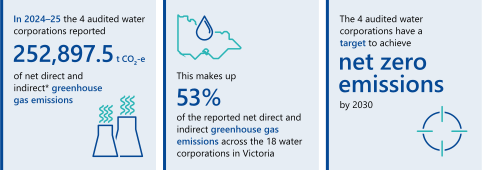
Note: t CO2-e stands for tonnes of carbon dioxide equivalent.
*Indirect emissions are produced by the electricity an entity uses. They do not include other indirect emissions, such as emissions from a commercial flight taken by an employee for business travel.
Source: VAGO.
What we concluded
Water corporations report each year against hundreds of sustainability indicators. This provides transparency on their progress towards the government's climate and sustainability commitments.
Water corporations’ sustainability reporting in 2024–25 was incomplete and inconsistent. None of the 4 water corporations we audited met all their mandatory reporting requirements. The level of detail they reported and format they used varied significantly. We also found some errors.
However, some reporting requirements are complex and overlap. And the Department of Energy, Environment and Climate Action’s guidance is not always clear. This makes it challenging for water corporations to transparently and consistently report against some indicators.
The government uses some of the sustainability information water corporations report. However, the effort it takes to collect and report it may not be proportionate to its overall impact.
The government does not have an overarching framework to assure the information water corporations report is complete, accurate or even comparable. This makes it difficult for the public to understand if they are on track to meet their net zero targets.
1. Our key findings
What we examined
Our audit followed one line of inquiry:
1. Is sustainability reporting underpinned by accurate information and effective internal processes?
To answer this question we examined 2024–25 sustainability reporting by the 4 metropolitan water corporations:
- Greater Western Water
- Melbourne Water
- South East Water
- Yarra Valley Water.
Identifying what is working well
In our engagements we look for what is working well – not only areas for improvement.
Sharing positive outcomes allows other public agencies to learn from and adopt good practices. This is an important part of our commitment to better public services for Victorians.
Terms used in this report
t CO2-e
t CO2-e stands for tonnes of carbon dioxide equivalent. This is a standard unit used to measure greenhouse gas emissions.
Indicator
In this report an indicator is information an entity must report under a sustainability reporting framework.
Metric
In this report a metric is a quantitative measure that assesses an entity’s sustainability performance, progress or outputs.
Background information
Water corporations' emissions
Water corporations provide water and sewerage services to homes and businesses across Victoria.
Providing clean drinking water and treating sewerage requires a large amount of energy. This makes them a major source of the state’s greenhouse gas emissions.
The state’s 18 water corporations reported they produced over 475,000 t CO2-e in net emissions in 2024–25. These emissions largely come from wastewater treatment plants, electricity used to power treatment plants and car travel.
The 4 metropolitan water corporations we audited have committed to achieving net zero emissions by 2030.
Victorian Government sustainability reporting requirements
The Minister for Water sets reporting requirements for all 18 water corporations in a letter of expectations. The letter has 8 priority areas, including one for climate change.
We looked at the indicators in the climate change priority area. Water corporations report on these indicators in their annual reports.
The minister requires water corporations to report:
- their direct and indirect emissions
- how much electricity they produce and use
- their emissions from transport
- how their organisation is adapting to climate change.
Water corporations must also comply with FRD 24: Reporting of environmental data by government entities (FRD 24). Some of the minister’s requirements overlap with FRD 24.
Direct and indirect emissions
Water corporations are required to report emissions they:
- directly produce, such as emissions from a company vehicle or treating wastewater
- indirectly produce, such as emissions from the electricity that powers their offices or pumps drinking water.
Australian Government reporting requirements
The National Greenhouse and Energy Reporting Scheme (National Scheme) is Australia’s national climate reporting framework. It requires corporations that meet certain thresholds to report their:
- energy use and production
- greenhouse gas emissions.
The 4 audited water corporations are National Scheme reporters. They report this data to the Clean Energy Regulator, which uses it to develop national policies and programs and inform international reporting.
Future sustainability reporting requirements
The Australian Accounting Standards Board’s AASB S2 Climate-related Disclosures (AASB S2) came into effect on 1 January 2025. It requires certain private sector entities to report their:
- governance processes and controls
- climate related risks and opportunities and how they impact their strategy
- risk management processes
- performance against climate related metrics and targets.
Public sector entities, including the 4 audited water corporations, are not required to report under AASB S2.
The Department of Treasury and Finance (DTF) and the Department of Energy, Environment and Climate Action (DEECA) are considering how AASB S2 could apply to Victorian public sector entities.
In January 2026, the International Public Sector Accounting Standards Board released climate-related reporting requirements specifically for public sector entities. Australia does not formally adopt International Public Sector Accounting Standards Board standards, so these requirements do not apply directly to Victorian entities. However, they provide a public-sector framework that may help inform how climate-related disclosure requirements similar to AASB S2 could be interpreted and applied in the Victorian public sector.
Victoria’s sustainability reporting frameworks will continue to evolve and public bodies must be ready to respond.
Roles and responsibilities
Figure 1 outlines the key sustainability reporting entities for Victoria.
Figure 1: Key sustainability reporting entities
| Entity | Responsibilities |
|---|---|
| DEECA |
|
| DTF | Issues FRD 24 under the Financial Management Act 1994 |
| Clean Energy Regulator | Regulates the National Scheme as an independent statutory authority |
Source: VAGO
What we found
This section focuses on our key findings, which fall into 3 areas:
1. Water corporations’ 2024–25 reporting was incomplete, but this may be due to overlapping requirements and inconsistent guidance.
2. We found material misstatements in 3 water corporations’ 2024–25 reporting.
3. There are no formal processes or frameworks to assure water corporations’ reporting is reliable.
The full list of our recommendations, including the water corporations’ responses, are at the end of this section.
Consultation with entities
When reaching our conclusions, we consulted with the audited entities, DEECA and DTF and considered their views.
You can read their full responses in Appendix A.
Key finding 1: Water corporations’ 2024–25 reporting was incomplete, but this may be due to overlapping requirements and inconsistent guidance
Incomplete reporting
None of the 4 water corporations reported against all mandatory indicators in their 2024–25 annual reports.
For example:
| require(s) water corporations to ... | but ... | |
|---|---|---|
| FRD 24 | explain which sites, assets and facilities their reporting covers | Greater Western Water, South East Water and Yarra Valley Water did not do this. |
| FRD 24 and the letter of expectations | report how many kilometres their staff travelled on commercial airlines | Greater Western Water did not report this. |
| FRD 24 and the letter of expectations | report how many vehicles they own by category (for example, passenger vehicles or goods vehicles) | Yarra Valley Water did not segment this information. |
They also did not include commentary for some of the 59 indicators where they are required to explain their results.
While their reporting was incomplete, these gaps are not significant enough to affect how users might view or use their annual reports.
Overlapping requirements
Water corporations are responsible for making sure their reporting is complete.
However, many requirements in FRD 24 and the letter of expectations overlap. Water corporations must report against 277 mandatory indicators in the letter of expectations and 29 indicators in FRD 24.
The letter of expectations indicators overlap with 18 of the 29 FRD 24 indicators.
For example, both FRD 24 and the letter of expectations require water corporations to report their total electricity use. While both require them to segment their electricity use by source, the letter of expectations also requires them to report:
- their electricity use for the previous reporting period
- written commentary to explain each value.
In addition to National Scheme reporting, the volume and level of detail water corporations must include creates a substantial reporting burden. This may be one of the reasons why their reporting was incomplete in 2024–25.
Inconsistent guidance
The letter of expectations requires water corporations to annually report how they are integrating climate change adaptation and risk into their decision-making.
However, DEECA’s guidance on this requirement does not clearly explain the level of detail they must include.
DEECA also told us that a water corporation does not need to report this information again if it has published it in a previous annual report or other public document.
We saw some instances where South East Water and Yarra Valley Water referred to other public plans and documents for information about their climate adaptation performance instead of publishing it in their annual report. This contradicts the letter of expectations and makes it difficult for users to easily access, understand and compare their performance.
Reporting burden
The government uses some sustainability data reported by the public sector to inform its Whole of Victorian Government emissions reduction pledge 2026–30.
However, beyond this and other ad hoc use cases, it is unclear if the government uses sustainability reporting to monitor and report against its climate change commitments or for other purposes.
This suggests the effort required to report this information may not be proportionate to its overall impact.
Addressing this finding
To address this finding we made 2 recommendations to DTF and DEECA about:
- streamlining sustainability reporting requirements
- revising FRD 24’s definition of materiality.
We also made one recommendation to DEECA about strengthening guidance for water corporations
Key finding 2: We found material misstatements in 3 water corporations’ 2024–25 reporting
Material misstatements
We assessed if the metrics water corporations reported in 2024–25 are accurate and reliable.
When we recalculated their results, we found material misstatements in 3 water corporations’ reporting.
Both Greater Western Water and South East Water excluded some facilities we assessed as under their operational control from their National Scheme reporting. This led to material understatements in their emissions and electricity use metrics.
We found one material overstatement in Melbourne Water’s reporting due to a calculation error.
Material misstatement
A material misstatement is an error or omission that could impact how a user understands a report. For example, an inaccurate calculation or missing result.
Manual processes
Water corporations need to collect a large volume of data from multiple sources to meet their reporting requirements.
All water corporations use Excel workbooks to compile this data, which staff manually check and maintain. These manual processes increase the risk of material misstatements, especially with the amount of data they capture, compile and maintain.
We saw many instances of hard-coded values and manual calculations, which further increases the risk of human error.
Two of the 4 water corporations did not keep adequate records to support their 2024–25 reporting. However, the other 2 had more mature practices that documented how they prepared their sustainability reporting.
Hard-coded values
A hard-coded value is a number that has been manually entered into a workbook cell instead of being linked to a source document or reference dataset.
Addressing this finding
To address this finding we made one recommendation for water corporations to investigate opportunities to strengthen their sustainability reporting processes.
Better practices for sustainability reporting
Appendix D outlines practices that water corporations and other public entities could adopt to strengthen their sustainability reporting.
It provides examples to help entities make complete and accurate disclosures as their sustainability reporting frameworks continue to mature.
Key finding 3: There are no formal processes or frameworks to assure water corporations’ reporting is reliable
DEECA’s checks
Part of DEECA’s role is to support the minister by reviewing water corporations’ annual reports before tabling. It also has a role in providing guidance and working with water corporations on sustainability reporting issues.
DEECA checks each water corporation’s annual report to make sure it covers relevant requirements. It told us its role is not to provide assurance to water corporations or check the accuracy of their reporting.
However, inconsistent advice from DEECA has led to some water corporations misunderstanding its role and the extent of its checks. This means they may rely on DEECA’s checks to identify accuracy and completeness issues.
No broader framework
The government does not have an overarching assurance framework for sustainability reporting. This means it does not know if water corporations’ sustainability reporting is complete, accurate or comparable.
Working well: Independent reviews
Melbourne Water engaged an external firm to verify the accuracy of its 2024–25 National Scheme reporting.
It also engaged an external law firm to review sustainability information in its 2024–25 annual report. The law firm assessed if the information it reported could be considered misleading or deceptive.
Working well: Readiness for future reporting requirements
South East Water has been doing internal audits that focus on climate change since 2018. This has helped it identify areas for improvement and mature in this reporting space.
Greater Western Water, South East Water and Yarra Valley Water have also assessed their readiness for potential future reporting obligations.
Addressing this finding
To address this finding we made:
- one recommendation to DEECA about clarifying its role in the annual reporting process for water corporations
- one recommendation to DTF and DEECA about working with the government to develop and implement an assurance framework for sustainability reporting.
2. Our recommendations
We made 5 recommendations to address our findings. The relevant entities have accepted the recommendations in full, in part or in principle. The Department of Treasury and Finance did not accept one recommendation.
| Entity responses | ||||
|---|---|---|---|---|
Department of Energy, Environment and Climate Action and Department of Treasury and Finance
| 1
| Review and streamline sustainability reporting requirements for water corporations by considering their intended purpose and use (see Section 3).
| Accepted by Department of Energy, Environment and Climate Action Accepted in principle by Department of Treasury and Finance | |
Department of Energy, Environment and Climate Action
| 2
| Provide clearer and more authoritative guidance, including clarifying that the Department of Energy, Environment and Climate Action does not provide assurance, to support water corporations to fully and consistently meet their sustainability reporting requirements (see sections 3 and 5).
| Accepted by Department of Energy, Environment and Climate Action
| |
Department of Treasury and Finance and Department of Energy, Environment and Climate Action
| 3
| Revise the definition of materiality in FRD 24: Reporting of environmental data by government entities to focus on users’ information needs (see Section 3).
| Accepted in principle by Department of Energy, Environment and Climate Action Accepted in principle by Department of Treasury and Finance | |
Department of Treasury and Finance and Department of Energy, Environment and Climate Action
| 4
| Work with the government to develop and implement an assurance framework for sustainability reporting at a whole of government and entity level (see Section 5).
| Accepted in principle by Department of Energy, Environment and Climate Action Not accepted by Department of Treasury and Finance | |
Greater Western Water, Melbourne Water, South East Water, and Yarra Valley Water
| 5 | Adopt better practices to improve the consistency, reliability and transparency of their sustainability reporting (see Appendix D).
| Partially accepted by South East Water Accepted by all other audited water corporations | |
3. Completeness of sustainability reporting
None of the 4 water corporations met their mandatory reporting requirements for their 2024–25 annual reports.
Water corporations are responsible for making sure their reporting is complete and reliable. However, overlapping requirements in FRD 24 and the minister’s letter of expectations create a significant reporting burden.
DEECA’s unclear guidance also contributes to reporting gaps, which make it difficult for the government and the public to understand and compare results.
It is unclear how the government uses the information water corporations report.
Covered in this section:
- Water corporations did not meet their mandatory reporting requirements in 2024–25
- Overlapping requirements and DEECA’s inconsistent guidance contribute to reporting gaps
Water corporations did not meet their mandatory reporting requirements in 2024–25
Reporting requirements
Water corporations must report against 306 mandatory indicators, including:
- 29 indicators from FRD 24
- 277 indicators in the letter of expectations.
Eighteen of the FRD 24 indicators overlap with the letter of expectations indicators.
2024–25 reporting
None of the 4 water corporations reported against all 306 indicators in their 2024–25 annual reports.
While their reporting was incomplete, the indicators they missed would likely not affect how users understand their sustainability performance.
For example, one indicator in the letter of expectations requires water corporations to provide written commentary to explain their reported renewable and non-renewable energy use from fuels. However, none of them explained all the figures they reported.
Another example is FRD 24 requires entities to include information on their organisational boundary. But Greater Western Water, South East Water and Yarra Valley Water did not do this.
Climate adaptation reporting
The letter of expectations requires water corporations to demonstrate how they are reasonably progressing to integrate climate change adaptation and risk into planning and decisions across all aspects of their business.
According to DEECA’s guidance, water corporations must explain:
- the governance and decision-making processes they use to manage climate risks
- the key climate risks they have identified
- how they identified key risks
- actions they have taken to manage risks, including any case studies
- metrics they use to measure success, for example, adaptation outcomes, progress against adaptation plans, strategies or frameworks.
Water corporations must provide a written summary to address each of these points.
Completeness of climate adaptation reporting
As Figure 2 shows, in 2024–25 water corporations did not meet all their climate adaptation reporting requirements.
Figure 2: Completeness of water corporations’ 2024–25 climate adaptation reporting
| Reporting area | Greater Western Water | Melbourne Water | South East Water | Yarra Valley Water |
|---|---|---|---|---|
| Governance and decision-making | No | Yes | No1 | Yes |
| Identified key climate risks | No | Yes | No1 | Yes2 |
| Approach to identify risks | No | Yes | No1 | No1 |
| Risk management actions | Yes | Yes | No1 | Yes |
| Metrics to measure success | No | Yes2 | No1 | Yes2 |
Notes: 1The water corporation did not include this information in its 2024–25 annual report. Instead, its report referred to other publicly available documents that addressed the requirement.
2The water corporation included this information in its 2024–25 annual report but it is not consolidated and appears across different sections.
Source: VAGO.
Responsibility for complete reporting
Water corporations are responsible for making sure their reporting is complete and meets user needs.
Water corporations use checklists, internal reviews and DEECA’s proformas to meet their reporting requirements.
We saw evidence that senior management and the board at Melbourne Water, South East Water and Yarra Valley Water reviewed and signed off on their 2024–25 annual reports, including their sustainability reporting.
Melbourne Water also used a compliance checklist to map where it addressed each reporting requirement in its report.
Greater Western Water provided evidence that its board approved its annual report. But it could not show that it internally reviewed its sustainability reporting before the board approved it.
While water corporations have some documented review processes and other controls, they did not pick up all of the gaps in their 2024–25 reporting.
Working well: South East Water's managing director approves National Scheme reporting
South East Water demonstrates better practice with its National Scheme reporting by:
- clearly documenting its internal reviews
- getting its managing director to formally sign off on it.
Proforma
A proforma is a structured template that shows how to present information for a report or other document.
Overlapping requirements and DEECA's inconsistent guidance contribute to reporting gaps
DEECA'S guidance and tools
DEECA provides guidance and tools to help water corporations report against FRD 24 and the letter of expectations, including:
- the Annual Reporting Indicator Handbook, which provides guidance about letter of expectations indicators
- annual report proformas
- the Environmental Data Reporting Tool, which is a workbook for collecting data and reporting on FRD 24 indicators
- guidance about FRD 24 reporting
- a model report for FRD 24, which includes guidance and examples.
Inconsistent guidance
DEECA’s Annual Reporting Indicator Handbook does not align with one of its proformas.
The handbook says entities must report their projected total emissions for each year leading up to their net zero target in 2030. However, the example in the proforma shows a graph ending in 2024–25.
In their annual reports, Greater Western Water, South East Water and Yarra Valley Water only showed their emissions until 2024–25 instead of 2030.
Guidance for climate adaptation reporting
DEECA has not specified how much detail water corporations need to include about their climate adaptation performance and how to report it.
As a result, they often provide different levels of detail and disperse information across multiple sections of their annual reports.
For example, demonstrating better practice, Yarra Valley Water reported the key actions it took in 2024–25 to manage its climate-related risks. However, South East Water only noted it is continuing to deliver the goals and actions in its 2022–27 Climate Adaptation Action Plan without saying what these goals and actions are.
DEECA told us it does not require a water corporation to include information about climate adaptation in its annual report if it has reported it in a previous year or in another public document.
However, this conflicts with the minister’s expectation that they annually report against this indicator. It also makes it difficult for annual report users to get a full picture of water corporations’ performance and compare their progress over time.
DEECA told us that from 2025–26 this indicator will change to seek information on key climate risks and metrics.
Overlapping and onerous requirements
Many requirements in FRD 24 and the letter of expectations overlap. According to DEECA’s handbook, when indicators overlap, a water corporation does not need to report against both in its annual report.
However, there are instances where overlapping indicators have different reporting requirements.
For example, both the letter of expectations and FRD 24 require water corporations to report how much electricity they use each year.
FRD 24 requires entities to report their energy use in megawatt hours and segment their use by source.
In addition to FRD 24’s requirements, the letter of expectations requires water corporations to report:
- how much electricity they used in the previous reporting year for all sources
- written commentary on their total electricity use and use by source.
In this example, if a water corporation chose to only report against the FRD 24 indicator it would not meet the letter of expectations’ additional requirements.
Of the 306 mandatory indicators, water corporations must provide written commentary to explain each result for 59.
In addition to their National Scheme reporting, this level of commentary makes it repetitive and at times onerous for water corporations to meet their obligations. It also reduces accessibility for readers, who may have to read through repetitive or overlapping information.
Balancing reporting effort with its value
DEECA told us it uses water corporations’ reporting to inform its sustainability policies and prioritise its work program.
The government used some collated sustainability data from across the public sector to inform its Whole of Victorian Government emissions reduction pledge 2026–30.
Beyond this and other ad hoc use cases, it is unclear if the government uses public sector entities’ sustainability reporting to systematically monitor and report against its climate change commitments or for other purposes.
FRD 24 states its purpose is to provide transparency on sustainability performance and promote continuous improvement in the public sector’s sustainability reporting.
The Commissioner for Environmental Sustainability Victoria uses FRD 24 data reported by departments to audit their environmental management systems.
In its 2022–23 report, the commissioner noted there is no single database for analysing FRD 24 data across the broader public sector. This means it may not be feasible to assess and compare data for the more than 300 entities required to report under FRD 24.
Collecting and reporting sustainability information can be a significant administrative burden for some entities. And the government’s current approach for collecting, storing and using this information limits its practical value. This suggests the effort required is not proportionate to its overall impact on the government’s decisions and accountability for climate change.
Materiality threshold for FRD 24
Under FRD 24, if an activity makes up more than 1 per cent of an entity’s total scope 1 and 2 emissions it is considered material and the entity must separately report it.
Compared with the industry threshold of 5 per cent used in the National Scheme, the FRD 24 threshold is low.
As many Victorian public sector entities only contribute a small share of the state’s total emissions, the 1 per cent threshold requires them to measure, monitor and report many minor emission sources.
The administrative effort required for this level of reporting is disproportionate to its overall impact.
In addition, using a 1 per cent materiality threshold may set a low tolerance for error and elevate immaterial issues.
Revising FRD 24’s materiality threshold would:
- focus reporting on activities that are meaningful to understanding an entity’s total emissions and broader sustainability impact
- align FRD 24 with contemporary sustainability reporting
- balance the administrative effort for public sector entities with the value and usefulness of the data.
Scope 1 and 2 emissions
Scope 1 emissions are emissions an entity directly releases into the atmosphere through its own activities. For example, emissions from fuel burned in an entity’s vehicles.
Scope 2 emissions are emissions an entity indirectly releases through its electricity use. For example, emissions produced by a power station that supplies electricity to its office.
4. Accuracy of sustainability metrics
We found material misstatements in Greater Western Water’s, South East Water’s and Melbourne Water’s 2024–25 sustainability metrics.
Water corporations have immature processes for collecting data and cannot always readily access underlying source data.
They also use manual processes and tools to collate data and calculate their results. This:
- increases the risk of human error
- makes it difficult to verify data
- reduces transparency over the completeness and accuracy of their results.
Covered in this section:
- We found material misstatements in 3 water corporations’ 2024–25 reporting
- Water corporations use manual processes for their reporting, which increases the risk of errors and reduces transparency
We found material misstatements in 3 water corporations' 2024–25 reporting
Material misstatements
We recalculated the sustainability metrics water corporations reported in 2024–25 to check if they are accurate and reliable.
We found material misstatements in 3 water corporations’ reporting.
Both Greater Western Water and South East Water excluded some facilities we assessed as under their operational control from their National Scheme reporting. This led to material understatements in their emissions and electricity use metrics.
We also found one material overstatement in Melbourne Water’s reporting due to a calculation error.
We consider an error or omission to be material if the variance is equal to or greater than 5 per cent of the entity’s total emissions or energy. We determined this threshold based on industry thresholds, including the threshold National Scheme auditors use.
See Appendix C for more information about our method.
Operational control
Under the National Greenhouse and Energy Reporting Act 2007 an entity is required to report emissions and energy use for all the sites and facilities it operationally controls.
The Act considers a facility under an entity’s operational control when it has the authority to set its health and safety, operating and sustainability policies.
If more than one entity has this authority (and one has not been formally nominated as the operational controller) then the entity with the greatest authority has operational control. Entities must document their operational control assessments.
We found material misstatements in both Greater Western Water’s and South East Water’s 2024–25 National Scheme reporting due to missing documentation about facilities under their operational control.
Greater Western Water's material misstatements
Greater Western Water excluded the Sunbury Recycled Water Plant from its 2024–25 National Scheme reporting.
The water corporation told us Downer Group has operational control of the site. But it could not provide a documented operational control assessment to support this.
In the absence of this documentation, we assessed the site as under Greater Western Water’s operational control because it:
- holds the Environmental Protection Authority licence for the site
- has a project deed with Downer Group that says it must review all policies it prepares for the facility.
Greater Western Water should have included the Sunbury site in its 2024–25 National Scheme reporting. As Figure 3 shows, this led to 2 material misstatements.
Figure 3: Material misstatements in Greater Western Water's 2024–25 National Scheme reporting
| Metric | Greater Western Water result | Our recalculated result | Variance | Total reported energy consumption and scope 2 emissions | Variance (percentage of total) |
|---|---|---|---|---|---|
| Electricity consumption (GJ) | 115,699 | 130,726 | 15,027 | 170,064 | 8.8% |
| Scope 2 emissions* (t CO2-e) | 24,747 | 27,961 | 3,214 | 24,677 | 13.0% |
Note: *Scope 2 emissions are emissions an entity indirectly produces through its electricity use.
GJ stands for gigajoule.
Source: VAGO.
South Eastern Water's material misstatements
South East Water excluded the Boneo Water Recycling Plant from its 2024–25 National Scheme reporting. A John Holland–SUEZ–Beca joint venture manages the site.
South East Water told its managing director it did not include emissions from the site in its reporting because it believes it does not have operational control. However, it could not provide a documented operational control assessment to support this.
In the absence of this documentation, we assessed the site as under South East Water’s operational control because the joint venture agreement refers to South East Water’s authority in several areas, including processes for approving policies and site access.
We saw evidence that SUEZ (on behalf of the joint venture) reported 2024–25 emissions from the site in its National Scheme reporting.
South East Water should have included the recycling plant in its 2024–25 National Scheme reporting. As Figure 4 shows, this led to 3 material misstatements.
Figure 4: Material misstatements in South East Water's 2024–25 National Scheme reporting
| Metric | South East Water result | Our recalculated result | Variance | Total reported energy consumption and scope 1 and 2 emissions | Variance (percentage of total |
|---|---|---|---|---|---|
| Electricity consumption (GJ) | 89,439 | 105,894 | 16,455 | 161,750 | 10.2% |
| Scope 2 emissions (t CO2-e)1 | 19,130 | 22,650 | 3,520 | 19,130 | 18.4% |
| Scope 1 emissions (t CO2-e)2 | 8,732 | 10,874 | 2,142 | 11,603 | 18.5% |
Notes: 1Scope 2 emissions are emissions an entity indirectly produces through its electricity use.
2Scope 1 emissions are emissions an entity directly releases into the atmosphere. In this figure they are emissions produced by handling wastewater.
GJ stands for gigajoule.
Source: VAGO.
Melbourne Water's material misstatement
We found one material misstatement in Melbourne Water’s 2024–25 annual report.
Melbourne Water published figures for an FRD 24 metric that did not match its source calculations. As Figure 5 shows, this led to a material misstatement.
The figures reported for landfill and recycling should add up to the total units of waste disposed, but there is a 1,286.3 kg variance. This means that Melbourne Water overstated the total kilograms of waste it disposed.
The individual recycling waste streams (FOGO, paper and cardboard and mixed recyclables) should also add up to the total recycling figure, but there is a 329.7 kg variance. This is an immaterial misstatement.
Figure 5: Material misstatement in Melbourne Water's 2024–25 annual report
| Metric | Calculated result | Published figure | Variance (kg) | Variance as a percentage of total waste |
|---|---|---|---|---|
| Total units of waste disposed (kg) | 18,592.5 | 19,878.8 | 1,286.3 | 6.9% |
| Landfill (kg) | 10,856.0 | 10,856.0 | - | - |
| Recycling (kg) | 7,736.5 | 8,066.2 | 329.7 | 1.8% |
| 3,260.4 | 3,260.4 | - | - |
| 3,490.0 | 3,490.0 | - | - |
| 986.1 | 986.1 | - | - |
Note: FOGO stands for food organics and garden organics.
Source: VAGO.
Audit opinions for future reporting
The Victorian Government has signalled it is reviewing the state’s sustainability reporting framework in response to AASB S2.
Entities that must report under AASB S2 are subject to audits and/or reviews. Their reporting is independently checked to make sure it is accurate, complete and prepared properly.
We prepared an illustrative ‘short-form’ audit opinion for each water corporation based on:
- their FRD 24, letter of expectations and National Scheme reporting
- the material misstatements we identified.
See Appendix E for these audit opinions.
Water corporations use manual processes for their reporting, which increases the risk of errors and reduces transparency
Manual processes
Water corporations need to collect a large volume of data from multiple sources to meet their reporting requirements.
However, their processes for collecting and storing data are relatively immature.
At all 4 water corporations, data is collected by different business areas and compiled in Excel workbooks that staff check and maintain.
We saw many instances of hard-coded values, which makes it difficult to trace and replicate calculations.
This manual approach:
- increases the risk of human error
- may lead to incomplete, inconsistent or unreliable data
- makes it difficult to access, validate and audit source data.
It also does not align with the more structured systems and controls entities typically use for corporate reporting, such as financial reporting.
We experienced this firsthand when water corporations could not always readily provide us with data.
Our data analysis
As part of this audit we planned to assess if water corporations’ reported information was complete and reliable.
However, in some cases they could not provide all the data we requested.
For example, we obtained reasonable assurance over all 4 water corporations’ electricity consumption data. They gave us all the information we needed to assess the data’s completeness and reliability.
However, we could only obtain limited assurance over Greater Western Water, Melbourne Water and Yarra Valley Water’s water consumption data. These water corporations could not give us information about their original data sources or how they collected the data.
Due to these gaps, we could only obtain limited assurance over their reporting and had to rely on the information they provided.
Reasonable assurance
We achieve reasonable assurance by obtaining and verifying direct evidence from a variety of internal and external sources about an auditee’s performance. This enables us to draw a conclusion against an objective with a high level of assurance.
Limited assurance
We obtain less assurance when we rely primarily on an auditee’s representations and other evidence generated by them. However, we aim to have enough confidence in our conclusion for it to be meaningful.
Figure 6: Level of assurance we obtained over water corporations' datasets
| Greater Western Water | Melbourne Water | South East Water | Yarra Valley Water | |
|---|---|---|---|---|
| Electricity consumption | Reasonable | Reasonable | Reasonable | Reasonable |
| Electricity production | Limited | Reasonable | Limited | Reasonable |
| Wastewater handling | Limited | Limited | Limited | Reasonable |
| Transport fuels | Limited | Reasonable | Reasonable | Reasonable |
| Water consumption | Limited | Limited | Reasonable | Limited |
| Waste | Limited | Mix of reasonable and limited | Mix of reasonable and limited | Limited |
| Offsets | Mix of reasonable and limited | Reasonable | Reasonable | Reasonable |
Source: VAGO
Record keeping requirements
FRD 24 and the minister’s letter of expectations do not set explicit record keeping requirements.
However, under the National Greenhouse and Energy Reporting Act 2007 an entity must keep records that support accurate reporting and allow the Clean Energy Regulator to assess if it meets its obligations.
The National Greenhouse and Energy Reporting Regulations 2008 also requires entities to keep records in a format that is easy to access for audits and inspections.
The Clean Energy Regulator recommends that entities use a basis of preparation document to:
- help meet these record-keeping requirements
- document their processes to ensure calculations are repeatable.
A basis of preparation document records the methodology an entity used to prepare its National Scheme reporting. It typically explains:
- how the entity assessed operational control and its facilities’ boundaries
- an entity’s reportable activities, associated emissions and energy sources
- its calculation methods, including any sampling strategies
- quality assurance and review processes.
Beyond sustainability reporting, the Public Records Act 1973 requires Victorian public offices to completely and accurately record their activities and decisions to meet their needs, the government’s needs and the community’s needs.
Record keeping for 2024–25 reporting
Greater Western Water and Yarra Valley Water did not have a basis of preparation document or other appropriate records for their 2024–25 annual report and National Scheme reporting.
This made it difficult for us to access source data, understand their methods and replicate their calculations.
While they had developed some procedures, these were either out of date or incomplete.
South East Water told us it used the basis of preparation document it developed in 2022–23 for its 2024–25 reporting because it had not changed its underlying processes.
Working well: Melbourne Water's basis of preparation document and standard operating procedures
After we started this audit Melbourne Water developed a basis of preparation document. It explains the processes, calculations and assumptions it used to prepare sustainability metrics for its 2024–25 annual report.
While Melbourne Water developed this document for annual reporting, it aligns with its National Scheme requirements as well.
Melbourne Water also has standard operating procedures that outline its operational control and processes to estimate emissions.
5. Overarching assurance framework
DEECA checks water corporations’ annual reports before tabling. It told us its role does not involve providing assurance or checking if their reporting is accurate.
However, some water corporations rely on DEECA’s checks to assure their data is reliable and complete.
The government does not have an assurance framework for sustainability reporting.
Covered in this section:
There are no formal processes or frameworks to assure water corporations' sustainability reporting is reliable
DEECA's reviews
DEECA supports the minister by reviewing water corporations’ annual reports before tabling.
It told us these reviews involve:
- assessing each report against the Annual Reporting Indicator Handbook to confirm it covers all mandatory indicators
- verifying line item values to check totals in tables add up
- crosschecking totals against the raw emissions data water corporations separately provide to DEECA.
Despite DEECA’s reviews, the 4 water corporations tabled incomplete information in 2024–25. The only changes DEECA asked water corporations to make to their 2024–25 annual reports were updates to the disclosure index.
Inconsistent understanding of DEECA's role
DEECA told us its role does not involve providing assurance to water corporations or checking if their reporting is accurate.
However, we saw an instance where DEECA asked water corporations to review their calculations after identifying a potential issue.
We also found water corporations do not consistently understand DEECA’s role and the extent of its compliance checks.
In a paper for its board, one water corporation said DEECA has a role in overseeing and coordinating its annual reporting process, including checking it complies with statutory requirements and providing feedback.
Another water corporation told us DEECA’s role involves providing guidance and overseeing compliance. It said DEECA uses a quality assurance process to make sure its reports are in the correct format.
A third water corporation told us it submits its annual report to DEECA, which reviews it against reporting requirements and provides feedback. In prior years, DEECA told this water corporation that its reporting did not meet expectations and asked it to correct it.
DEECA’s checks and feedback have contributed to a perception among water corporations that it provides assurance over their sustainability reporting.
As a result, some water corporations rely on DEECA’s checks to assure their boards that their sustainability reporting is complete and reliable.
No overarching assurance framework
The government does not have a framework to check, monitor and compare water corporations’ sustainability reporting.
Unlike financial reporting, sustainability reporting is not subject to independent assurance to confirm it is free from material misstatements before it is tabled in Parliament.
This makes it difficult for the government to:
- assess if the sustainability information water corporations report is complete and reliable
- identify areas for improvement
- compare results across the public sector
- inform the public on its progress towards net zero.
Without an assurance framework, users cannot have the same level of confidence in sustainability information that they do for financial information.
Additionally, given sustainability reporting informs the Whole of Victorian Government emissions reduction pledge 2026–30, the government cannot be confident it will meet the pledge’s targets without an assurance framework.
Appendix A: Submissions and comments
Download a PDF copy of Appendix A: Submissions and comments.

Appendix C: Audit scope and method
Appendix D: Better practices for sustainability reporting
Download a PDF copy of Appendix D: Better practices for sustainability reporting.
Download Appendix D: Better practices for sustainability reporting
Appendix E: Audit opinions for future reporting
Download a PDF copy of Appendix E: Audit opinions for future reporting.