
Delivering School Upgrade Projects
Audit snapshot
Does the Victorian School Building Authority deliver targeted and well managed school upgrade projects that meet school needs?
Why we did this audit
Every student in Victoria should have access to safe, high-quality learning environments.
The Victorian School Building Authority (VSBA) is a division within the Department of Education (the department). VSBA delivers school upgrade projects to:
- help meet urgent demand for school places
- improve the condition of schools.
But in 2023–24, the department reported that a significant number of VSBA projects would cost more than planned and take longer than expected. And as at September 2025, the number of government schools in poor condition in Victoria has not declined since then.
We did this audit to look at how VSBA is delivering school upgrade projects and whether projects are meeting school needs.
Key background information
Source: VAGO
What we concluded
VSBA understands the physical condition of government schools and has strategies to target funding to schools that are in poor condition.
But VSBA's recommendations to the government do not always align with these strategies. It is unclear why VSBA makes some of its recommendations, which include schools that are not in poor condition. We also found issues with how VSBA creates, documents and explains changes to its cost estimates during projects.
In both cases, a lack of basic record keeping reduces transparency and accountability.
VSBA consults extensively with schools during the design phase of upgrade projects. It also makes sure designs comply with building quality standards.
But VSBA does not give schools all the information they need to understand the long-term costs associated with their design choices. It also does not gather feedback from all schools once projects are completed. Because of this, it is not clear how satisfied schools are with project outcomes.
Data dashboard
View the dashboard full screen
Dashboard data
Download the raw data for school conditions and announced investments.
1. Our key findings
What we examined
Our audit followed 3 lines of inquiry:
1. Does the Victorian School Building Authority (VSBA) apply a consistent and transparent process for identifying and recommending school upgrade projects?
2. Does VSBA effectively procure and deliver school upgrade projects?
3. Does VSBA deliver school upgrade projects that meet school needs?
To answer these questions, we examined VSBA, which is a division in the Department of Education (the department).
Identifying what is working well
In our engagements we look for what is working well – not only areas for improvement.
Sharing positive outcomes allows other public agencies to learn from and adopt good practices. This is an important part of our commitment to better public services for Victorians.
Terms used in this report
Asset
School assets include a school’s main building and classrooms, as well as other facilities and infrastructure such as playgrounds, sports centres, toilet blocks and landscaping features.
Contingency
A contingency is part of a project budget set aside to respond to scope changes or unforeseen risks.
Schools
This report uses the term ‘schools’ to refer to government schools only.
School upgrade projects
School upgrade projects are construction projects delivered by VSBA to modernise, refurbish or improve existing school facilities.
School contributions
School contributions are financial payments made by schools that add to government funding for school upgrade projects. Contributions allow schools to increase the scope of government-funded construction work.
Background information
School upgrade projects
In its plan The Education State – Excellence in Every Classroom, one of the government’s key priorities is to provide ‘welcoming, world class and modern schools, which meet the needs of local communities – because every child should have access to a great local school’. To support this, VSBA builds, expands, modernises and maintains schools across the state.
This audit focuses on VSBA's school modernisation and upgrade projects funded through the state Budget. In this report, we refer to these projects as school upgrade projects.
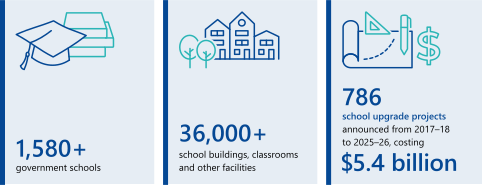
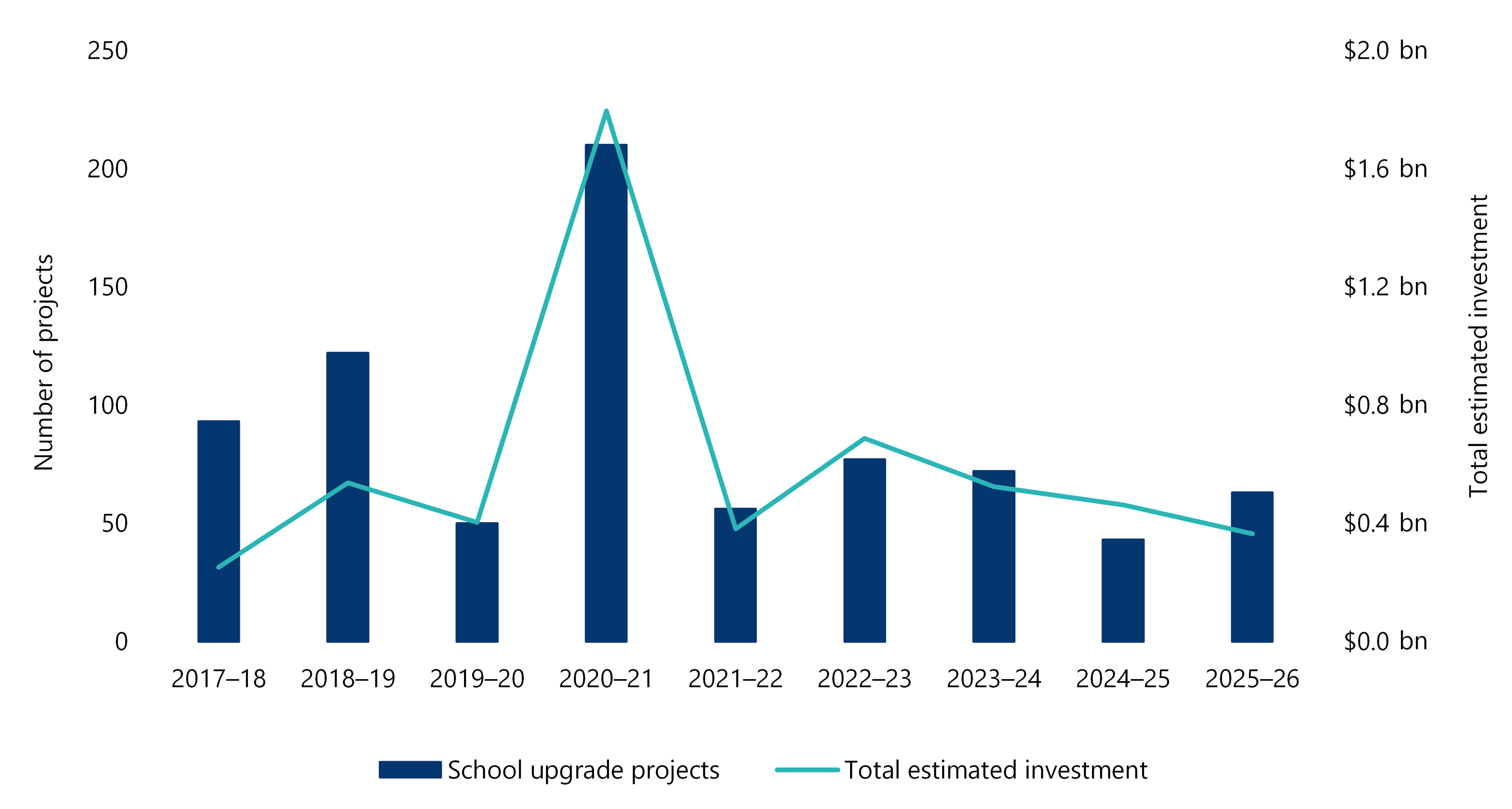
Between 2017–18 and 2025–26, the government has announced 786 funded school upgrade projects with total estimated funding of $5.4 billion, to be delivered by VSBA. Figure 1 shows an annual breakdown of these figures.
Figure 1: School upgrade projects funded through the Budget per funding year
Source: VAGO, based on VSBA data.
Roles and responsibilities
VSBA is responsible for school upgrade projects. It is part of the department and works closely with schools, as Figure 2 describes.
Figure 2: Roles and responsibilities for school upgrade projects
| Role | Responsibilities |
|---|---|
The department
|
|
VSBA
|
In addition to school upgrade projects, VSBA manages the design and construction of new schools, runs school grant programs, delivers audit programs and gives advice to schools about maintenance and minor works. |
School principals
|
|
Source: VAGO.
What we found
This section focuses on our key findings, which fall into 3 areas:
1. VSBA does not always make recommendations for school upgrade projects in line with its strategies for improving school conditions.
2. VSBA’s costings and timelines for school upgrade projects are not always transparent.
3. VSBA could do more to make sure upgrades meet school needs.
The full list of our recommendations, including the agency's response, is at the end of this section.
Consultation with agencies
When reaching our conclusions, we consulted with the audited agency and considered its views.
You can read its full response in Appendix A.
Key finding 1: VSBA does not always make recommendations for school upgrade projects in line with its strategies for improving school conditions
VSBA’s targets and strategies to improve school conditions are well designed
VSBA has a good understanding of schools’ physical condition and has strong objectives and targets to make improvements. Its strategies are designed to direct funding to schools that are in poor condition.
| The strategies VSBA uses are ... | which outlines ... | including ... |
the department's 2024–34 Asset Strategy
| 5 objectives for school conditions
| an objective that school assets are safe and in good condition.
|
VSBA's 2025–34 Strategic Asset Management Plan
| key performance indicators (KPIs) to meet the department’s 2024–34 Asset Strategy
| a KPI that no school is in poor condition by June 2034.
|
VSBA’s Capital Investment Strategy
| how VSBA should prioritise funding
| that schools should be prioritised based on their:
|
Working well: Understanding school conditions
Over a 5-year cycle, VSBA engages an external assessor to visit schools in Victoria and rate the condition of every asset at every school. It uses this information to create an overall condition score for each school, which it uses to prioritise schools and make recommendations to the government.
VSBA’s recommendations to the government do not always align with its strategies
VSBA’s recommendations to the government, about which schools should receive funding for upgrade projects, do not always align with its strategies.
VSBA highlights the need to target funding to schools that are in poor condition. Between 2022–23 and 2024–25, VSBA made recommendations that were consistent with its Capital Investment Strategy to support this.
But in 2025–26, VSBA recommended some schools that were not rated as being in poor condition. VSBA could not show it prioritised schools based on need. Instead, it made recommendations based on often informal, undocumented processes. These processes fail basic record keeping requirements for the public sector.
VSBA tracks its progress against the objectives in the department’s 2024–34 Asset Strategy and the KPIs in its Strategic Asset Management Plan. But it does not advise the government on whether it is likely to meet the target of no school being in poor condition by 2034.
Addressing this finding
To address this finding, we made one recommendation to VSBA about:
- amending its Capital Investment Strategy to explain how it prioritises and recommends school upgrade projects.
Key finding 2: VSBA’s costings and timelines for school upgrade projects are not always transparent
We could not recreate VSBA’s cost estimates for projects
It is not clear how VSBA calculates contingencies in its project budgets or adjusts costs during a project.
We looked at a sample of upgrade projects VSBA recommended in 2025–26. But using VSBA’s data, we were unable to recalculate them to align with VSBA's cost estimates. This is because VSBA made ad-hoc cost changes to cost estimates during projects with limited or no documented reasons.
VSBA adapts its cost estimates to suit each school's unique circumstances. But this lack of documentation reduces the consistency and transparency of VSBA’s processes.
VSBA does not provide enough information about its management fee
VSBA charges a management fee (called the Portfolio Asset Management Allowance) for each school upgrade project to cover its management and administration costs. It has a model to assess whether the fee aligns with its actual costs across all school upgrade projects. But VSBA does not:
- track how it spends this fee for individual projects
- explain to schools how it calculates the fee or describe the services the fee covers.
Project costs and times sometimes exceed VSBA’s estimates
The information VSBA gives to the government and schools about expected costs and timelines for projects are not always accurate.
| For projects completed between 2017–18 and 2025–26 ... | have exceeded VCBA's estimate in ... |
|---|---|
| costs | 29 per cent of projects. |
| timelines | 25 per cent of projects. |
VSBA commissioned independent costings analysis that shows cost and time overruns between 2021 and 2023 were because of high inflation and market volatility following COVID-19.
VSBA does not have adequate controls on key financial data. It relies on manual processes for checking and extracting some data, which has led to inconsistencies and errors in the information provided to us. We also found an error in VSBA's reporting, which was included in the state Budget.
There are issues with how VSBA reports on milestones, risks and contractors during various project phases. For example, we found errors in VSBA’s milestone reporting and inconsistencies in its monthly project risk reports.
Addressing this finding
To address this finding, we made 4 recommendations to VSBA about improving how it:
- documents changes in its cost estimates to improve transparency and repeatability
- includes datasets in its data governance framework
- accounts for project uncertainty in its contingencies and adapts to new information
- captures and communicates costs associated with its management fee.
Key finding 3: VSBA could do more to make sure upgrades meet school needs
VSBA does not give schools all the information they need to make informed decisions
VSBA clearly informs schools of construction costs for different project design options. It does this by providing schools with detailed cost plans and discussing what can be delivered within the project budget.
Schools rely on VSBA and their VSBA-appointed project manager to provide them with knowledge and expertise to make informed decisions.
But in its design discussions, VSBA does not always fully inform schools about the long-term maintenance and whole of life costs related to their chosen designs.
Working well: VSBA consults well with schools about project designs
We found extensive consultation between VSBA, architects and schools on project design that considers schools’ strategic plans and educational visions.
VSBA also maintains and regularly reviews comprehensive guidance for architects on minimum quality standards for school facilities.
VSBA does not collect feedback from all schools
VSBA appoints an independent assurance service provider to evaluate completed school upgrade projects. The evaluations look at how satisfied schools are with aspects of the upgrade, such as accessibility, safety and aesthetics.
The evaluation looks at a sample of projects each year. But we found evidence of VSBA changing the selected schools with little explanation.
VSBA also does not have a formal portfolio-wide process to capture school feedback from all schools on project management processes, construction quality and design aspects upon completion of a project.
Addressing this finding
To address this finding, we made one recommendation to VSBA about:
- supporting schools to make informed decisions about the whole-of-life costs of upgrades.
2. Our recommendations
We made 6 recommendations to address our findings. The relevant agency has accepted all of them.
| Agency response(s) | ||||
|---|---|---|---|---|
| Finding: Victorian School Building Authority does not always make recommendations for school upgrade projects in line with its strategies for improving school conditions | ||||
Victorian School Building Authority
| 1
| Amend the Capital Investment Strategy so it includes all factors that influence funding prioritisation, including how the factors are weighted, and set up a process to regularly review and endorse the strategy through an appropriate governance forum (see Section 3).
| Accepted
| |
| Finding: Victorian School Building Authority's costings and timelines for school upgrade projects are not always transparent | ||||
Victorian School Building Authority
| 2
| Expand project costings to include:
| Accepted
| |
3
| Expand the data governance framework to include all publicly reported data to better assure its quality and accuracy (see Section 4).
| Accepted
| ||
4
| Establish a process for structuring contingencies that:
| Accepted
| ||
5
| Create guidance for schools that explains how the Portfolio Asset Management Allowance is set and the services it allows the Victorian School Building Authority to deliver (see Section 4).
| Accepted
| ||
| Finding: Victorian School Building Authority could do more to make sure upgrades meet school needs | ||||
Victorian School Building Authority
| 6
| Support schools to make informed decisions about whole-of-life costs for school upgrade projects by providing:
| Accepted
| |
3. Targeting schools in poor condition
VSBA has strategies that support its goal of upgrading schools that are in poor condition and it tracks its progress towards achieving this. It also has tools and processes to identify, prioritise and recommend which school upgrade projects should receive government funding.
But VSBA's recommendations to the government do not always align with its strategies. They are often influenced through informal, undocumented processes.
Covered in this section:
- VSBA understands which schools are in poor condition and has strategies to address this
- VSBA's recommendations do not always align with its strategies
- VSBA reports on its performance but not on the likelihood of achieving its 2034 target
VSBA understands which schools are in poor condition and has strategies to address this
Understanding school condition
Victoria has over 1,580 government schools comprising more than 36,000 assets.
To understand the condition of schools, VSBA uses an external assessor to visit each school in Victoria over a 5-year cycle.
The assessor gives each school asset a score from one (which means the asset has serious structural issues or multiple defects) to 5 (which means it has no defects). For example, an assessment gave a score of:
- 2 for a roof with leaks
- 3 for a toilet block with damaged vanity units and misaligned doors.
VSBA then uses these scores to calculate an overall school condition rating.
| A condition rating ... | means the school is in ... |
|---|---|
| of 3.50 or over | good condition. |
| between 3.25 and 3.49 | worn condition. |
| under 3.25 | poor condition. |
Current school conditions
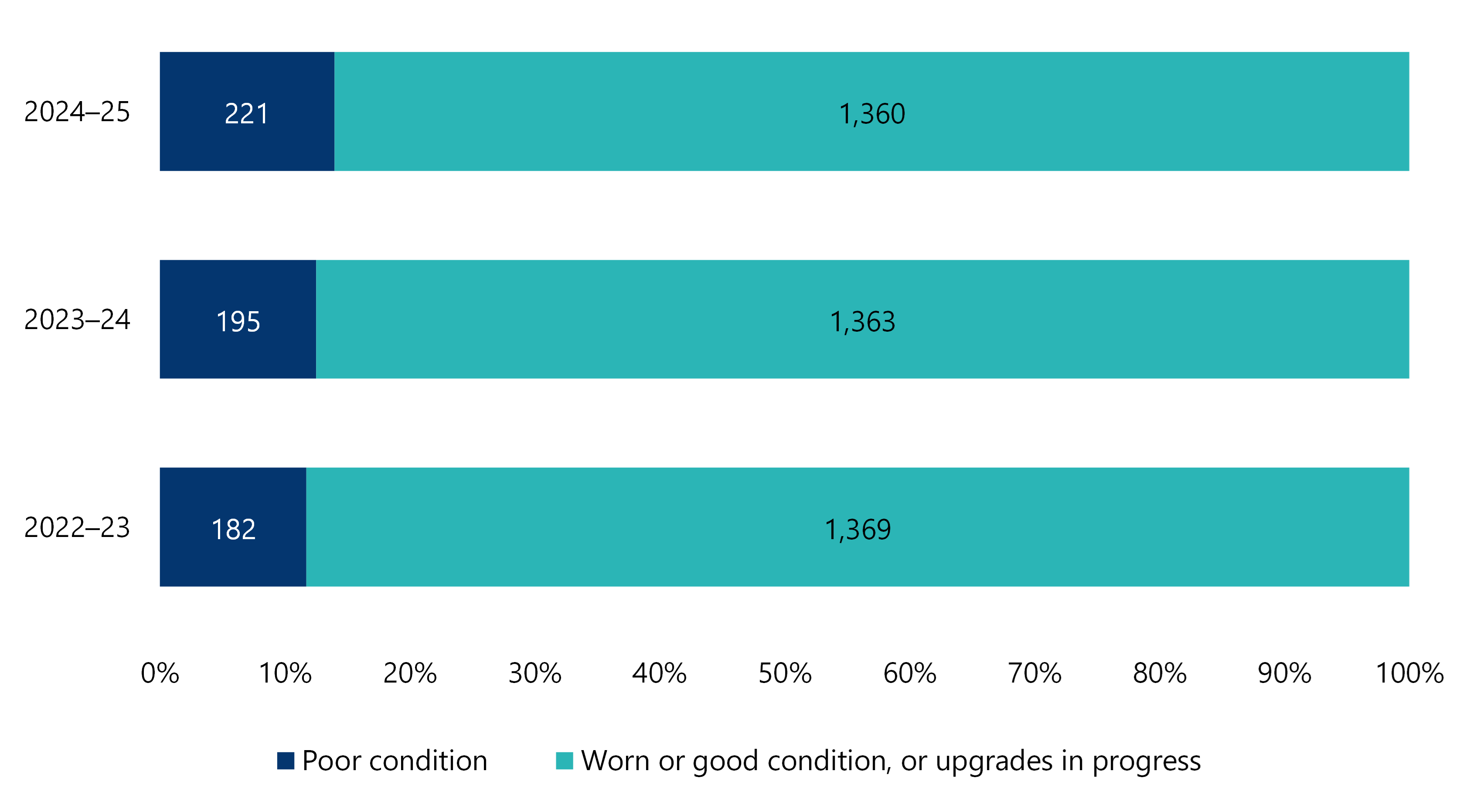
As at October 2024, VSBA rated 221 schools as being in poor condition, which is 14 per cent of all government schools.
The first 5-year cycle for assessing school’s condition was complete in 2022–23. This means every school had received a condition score. But as VSBA continues to assess schools and update its condition scores, the number of schools in poor condition has not declined, as Figure 3 shows.
Figure 3: Schools in poor condition per year
Note: Schools that were in poor condition at their last assessment but have since started a school upgrade project are not included in the total number of schools in poor condition.
Source: VAGO, based on VSBA data.
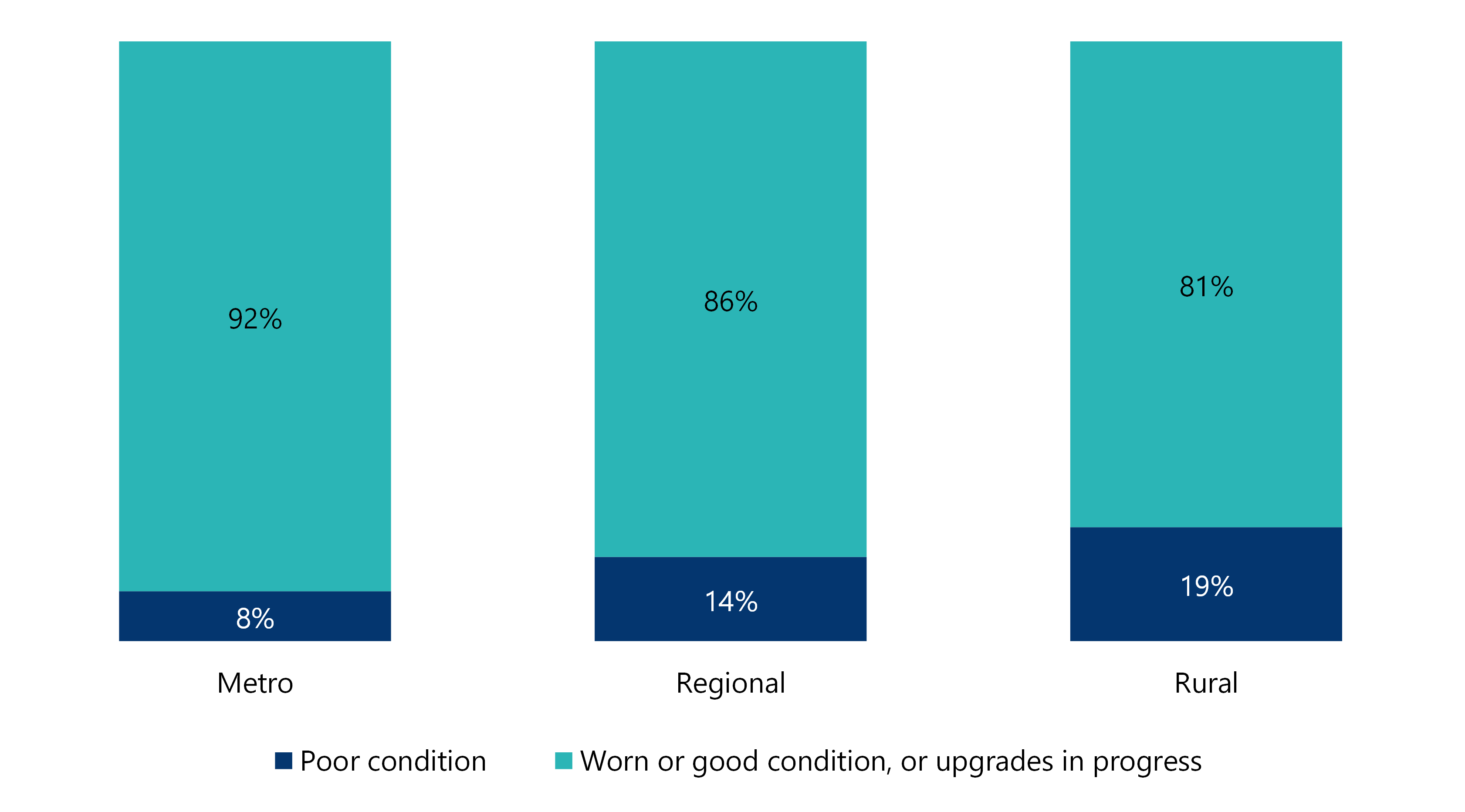
Schools in regional and rural areas are more likely to be in poor condition than schools in metropolitan areas, as Figure 4 shows.
Figure 4: Poor condition schools by location
Source: VAGO, based on VSBA data.
VSBA’s strategies for prioritising schools
Three main strategies guide VSBA’s work during the process to prioritise schools for upgrade projects. They are:
- the department’s 2024–34 Asset Strategy, which includes an objective that school assets are safe and in good condition
- VSBA's 2025–34 Strategic Asset Management Plan, which sets out KPIs for VSBA. One of these KPIs is that no school is in poor condition by June 2034
- VSBA‘s Capital Investment Strategy, which aims to provide a transparent, evidence-based and consistent approach to prioritising schools for upgrade projects.
Both VSBA’s Strategic Asset Management Plan and Capital Investment Strategy say a school’s condition score is the primary measure VSBA should use to assess whether schools are safe and in good condition. The Capital Investment Strategy provides clear, repeatable guidance on how VSBA should use these scores.
The Capital Investment Strategy also lists other factors that VSBA can use to prioritise schools. This includes whether schools face multiple ‘compounding’ challenges, such as poor academic performance or difficulty in staffing. But the Capital Investment Strategy does not give more details about how VSBA should consider these factors when making recommendations.
VSBA's KPIs and strategic objectives
The department and VSBA have clear objectives for school conditions and managing schools’ assets.
VSBA’s Strategic Asset Management Plan has 6 objectives that relate to school upgrade projects, as Figure 5 shows. They align with the department’s 2024–34 Asset Strategy objectives.
VSBA's Strategic Asset Management Plan has 13 targets and KPIs to help it meet these objectives. For example, under the objective that 'schools are in good condition', VSBA has a KPI to make sure no school has a poor condition score by June 2034.
In its 2021 Strategic Asset Management Plan VSBA had a target that no school would be in poor condition by June 2030. It changed this target in its plan for 2025–34.
Figure 5: The department's 2024–34 Asset Strategy and VSBA's Strategic Asset Management Plan objectives
| 2024–34 Asset Strategy objectives | Strategic Asset Management Plan objectives |
|---|---|
| Assets are safe and in good condition | Schools are in good condition |
| Preventative and reactive responses to condition are timely and effective | |
| Schools are compliant with safety related legislation and departmental policies | |
| Assets are fit for purpose and inclusive | Schools are functional to facilitate the delivery of modern-day pedagogy |
| Facility design enables schools to be inclusive environments | |
| Social benefits are increased |
Source: VAGO, based on information from VSBA.
VSBA's recommendations do not always align with its strategies
How VSBA recommends schools
VSBA uses condition ratings as a key way to prioritise schools for upgrade projects. It then creates recommendations about which schools should receive funding.
These recommendations are sent to the government through the Minister for Education. The Minister for Education provides an annual business case to the government for school upgrade projects, which includes VSBA’s recommendations.
The government then makes the final decision about which schools receive funding for upgrade projects.
Business case
A business case is an official document that outlines to the government the need for an investment, and the expected benefits and estimated costs of any recommendations made.
VSBA’s recommendations in 2025–26
In 2025–26, VSBA made recommendations to the government that were inconsistent with its Capital Investment Strategy.
| VSBA recommended upgrades for ... | which included ... | at a total estimated cost of ... |
|---|---|---|
| high-priority schools requiring an upgrade | 10 schools | $146.0 million. |
| locally driven infrastructure projects | 48 schools | $19.7 million. |
Of the 10 schools that VSBA recommended as high-priority school requiring an upgrade:
- Three were not ranked as being in poor condition, but were instead in ‘worn’ condition. These schools were Buckley Park College, Glenroy College and The Grange P-12 College.
- Three were not recommended in 2023–24 and 2024–25, but were selected ahead of other schools that had previously been recommended and not been funded. These schools were Buckley Park College, Glenroy College and Yarrawonga College P-12 (although Yarrawonga College P-12 had a poor condition rating).
The Capital Investment Strategy does not mention 'locally driven infrastructure projects'. Of the 48 schools in this category, 8 had a good condition ranking. This means that according to the Capital Investment Strategy, they should be the lowest priority to receive funding.
The Minister for Education’s business case to the government also included recommendations for school upgrade projects covered in the government’s 2022 state election commitments. This included 29 schools for upgrade projects at a total estimated cost of $311.5 million.
Election-commitment schools are separate from and not covered by the Capital Investment Strategy, as they are a clear expression of the government’s priorities.
Schools with 30 or fewer students
In 2025–26, VSBA also noted that it would not recommend schools with 30 or fewer students, as they are at risk of closing.
But as of February 2024, 108 schools in Victoria have 30 or fewer students. Of these schools, 31 per cent are in poor condition, representing a total of 515 students.
While these schools still have access to other VSBA funding programs and annual maintenance support, these students are learning in poor conditions with no prospect of major investment in their facilities. This contradicts the government's Education State priority that ‘every child should have access to a great local school’.
Informal consultation and unclear reasons
VSBA’s reasons for making recommendations in 2025–26 that were inconsistent with its Capital Investment Strategy are not clear.
For example, VSBA's internal documents outline reasons for categorising 10 schools as high priority. But these reasons do not always align with the Capital Investment Strategy. Instead, they include:
- advocacy from the school or community
- that the school has an ‘active local member’.
VSBA also told us it received direction from the Treasurer that funding for school upgrade projects was limited in 2025–26. VSBA said it reduced the number of recommendations to the government as a result of this.
VSBA told us that when it develops its recommendations, it consults with the department’s regional offices and discusses potential recommendations with the Minister's office. But this type of consultation is not:
- mentioned in the Capital Investment Strategy
- fully documented by VSBA.
VSBA’s failure to fully document its consultations means it is not clear how these discussions influenced VSBA's recommendations, or if they led to deviations from agreed processes.
Following the Capital Investment Strategy is vital for VSBA to make transparent recommendations to the government. VSBA should make sure its recommendations align with its Capital Investment Strategy. Or if they do not, it should properly document and justify its reasons for making the recommendations.
Without this, it is difficult for VSBA to show that the projects it recommended in 2025–26 are the best use of government funding or how well they align with VSBA’s strategic objectives, if at all.
VSBA has also revised its Capital Investment Strategy several times since it was first used in 2022–23. But we have not seen evidence of the department’s Infrastructure Planning and Delivery Committee approving these changes.
VSBA's recommendations in previous years
In 2022–23, 2023–24 and 2024–25, VSBA’s recommendations to the government aligned with its Capital Investment Strategy.
VSBA prioritised schools with a poor condition score and reported whether these schools included other factors in the Capital Investment Strategy, such as poor academic performance.
| Despite this, between 2015–16 and 2024–25 ... | that received funding were in ... |
|---|---|
| 19 per cent of schools (168 schools) | poor condition. |
| 33 per cent of schools (299 schools) | worn condition. |
| 48 per cent of schools (426 schools) | good condition. |
VSBA reports on its performance but not on the likelihood of achieving its 2034 target
No school in poor condition by 2034
In 2025–26, VSBA told the government the number of schools in poor condition is increasing. It said it would cost $3.5 billion to upgrade every school in poor condition. By doing so, VSBA outlined the overall cost of meeting its target that no school is in poor condition by 2034.
But it did not say:
- if it is on track to meet that target based on its recommended projects
- whether it can achieve the target.
It is important that VSBA tells the government about its progress towards this target to support the government’s long-term decision-making.
The number of schools in poor condition is increasing (as shown in Figure 3), which suggests that VSBA is not on track to meet its target. We found that:
- 81 per cent of schools with a poor condition rating in 2023–24 were still in poor condition in the 2025–26 business case
- 30 schools with a poor condition rating in 2023–24 no longer had this rating in the 2025–26 business case, but an additional 95 schools had received poor condition ratings.
VSBA's KPI reporting
VSBA’s Strategic Asset Management Plan for 2025–34 outlines that VSBA is expected to report against its KPIs to:
- its Portfolio Design Committee every quarter
- the department’s Infrastructure Planning and Delivery Committee every 6 months.
It issued its first report to the committees in October 2025, which is in line with these expectations.
4. Delivering school upgrade projects
VSBA creates cost estimates for school upgrade projects. But these estimates sometimes contain calculations or factors that are not explained, making them not possible to recalculate.
VSBA does not fully inform schools on how it uses its management fee. It also has no process to set contingencies to meet a project’s unique circumstances.
Of school upgrade projects completed from 2017–18 to 2025–26, 29 per cent have exceeded their estimated costs and 25 per cent have gone over their expected completion time. We found issues with the quality and accuracy of key financial data VSBA uses to report on school upgrade projects.
VSBA has extensive project management arrangements that largely comply with relevant standards. But we found issues with its milestone, compliance and risk reporting processes.
Covered in this section:
- VSBA’s cost estimates in its recommendations to the government are not transparent
- VSBA does not have adequate controls over key financial data
- VSBA does not always clearly justify its project budgets, contingencies and fees
- Expected timelines have not been met in 25 per cent of projects
- There are gaps in VSBA’s milestone, compliance and risk reporting
VSBA's cost estimates in its recommendations to the government are not transparent
VSBA's cost estimates
VSBA includes cost estimates for school upgrade projects when it makes its recommendations to the government. These cost estimates show:
- a project's estimated construction costs
- other allowances and fees, such as:
- contingencies
- cost escalations (to account for price increases during a project)
- consultant and project management fees.
To help it create its cost estimates, VSBA uses information such as the:
- school’s condition score
- school’s functionality score, which VSBA calculates using the department’s data about a school’s asset value, size and enrolment
- estimated cost per square meter to complete upgrade work, which depends on an asset’s condition and the required upgrades.
VSBA feeds this information through a specialised tool, which gives a cost estimate for the required upgrades.
VSBA uses this data and other information (such as the school’s context, project history and long term planning materials) to make a final project budget estimate.
Undocumented budget changes
We looked at 3 budget estimates for projects VSBA recommended in 2025–26. Using VSBA’s data, we could not recalculate them to align with VSBA's recommendations.
We found VSBA had made changes to its standard costings.
Some of these changes were in line with VSBA’s process guidance. But many did not align with the guidance and VSBA gave limited or no documented reasons for making them. For each of the 3 projects, this represented between 12 and 16 per cent of VSBA’s final budget estimates.
It is reasonable for VSBA to tailor estimates to each school's unique circumstances. But a significant portion of a project’s budget is at VSBA’s discretion. Not fully documenting reasons for making changes means that VSBA:
- reduces transparency over this process
- risks using inconsistent approaches when creating project budgets, which could reduce the accuracy of its recommendations to the government.
It is important that VSBA creates its budget estimates consistently to provide reliable advice and support the government to make informed decisions about where to invest.
Risks to data quality
In 2022, VSBA developed a data governance framework. It defines the standards, processes and responsibilities for managing its data. But VSBA has not fully integrated the data it uses to create project cost estimates into this framework.
Some of the data VSBA uses to create cost estimates relies on manual entry and has gaps in formal controls, such as validation. This introduces a risk that the costings VSBA provides to the government may not be accurate and reliable.
VSBA has several controls in its cost estimate process to achieve value for money for projects. This includes:
- using quantity surveyors to estimate likely construction costs
- analysing historical data to check whether estimates are realistic
- setting minimum standards for construction to maximise value
- considering contractors’ proposed costs in a formal tender phase.
Despite these controls, VSBA’s estimates were above the final tender costs in just over half of cases in early 2025. However, this is a significant improvement from results in 2022 and 2023.
VSBA does not have adequate controls over key financial data
Reporting on key financial data
Every year in the state Budget, the department reports on the total estimated investment in school upgrade projects. Depending on the project, this can include:
- school contributions
- actual project costs.
But VSBA does not capture this information through its data governance framework. Instead, it partly uses manual data extraction and handling processes to produce this data. VSBA gave us inconsistent versions of this data during this audit.
We looked at a sample of 10 completed projects as case studies. We found 2 significant errors in VSBA’s actual project costs and school contribution data. This includes one data point that was published incorrectly in the state Budget.
Our reporting relies on data provided to us, which VSBA told us has involved extensive manual checks. However, VSBA were unable to provide us with consistent and reliable data to support total estimated investment, school contributions, and actual project costs. Where possible, we have verified this data against the 2025–26 state Budget.
Published financial data is a key transparency measure to track the delivery of school upgrade projects. VSBA should be able to produce it consistently and without error.
VSBA does not always clearly justify its project budgets, contingencies and fees
Project costs exceeding estimates
Schools first learn they are receiving funding for a school upgrade project through state Budget announcements.
Announcements include a specific funding amount and project scope. For example, the 2025–26 state Budget included $6.6 million for Lakes Entrance Primary School to construct a new learning and library building.
We compared the actual costs for school upgrade projects with the funding allocated in the state Budget.
For completed school upgrade projects from 2017–18 to 2022–23, the actual costs have exceeded their allocated funding in 29 per cent of projects, as Figure 6 shows.
Figure 6: Proportion of projects that did not meet estimated costs per funding year
| Funding year | Proportion of projects over budget |
|---|---|
| 2017–18 | 14% |
| 2018–19 | 25% |
| 2019–20 | 36% |
| 2020–21 | 34% |
| 2021–22 | 33% |
| 2022–23 | 13% |
Note: Most 2023–24 projects are not yet complete in our dataset. This figure only tracks completed projects with full data available. An overspend is when actual costs exceed the revised total estimated investment.
Source: VAGO, based on VSBA data.
If a project is likely to go over budget, VSBA can apply for additional project funding from the government. Otherwise, it can undertake value management or access other savings.
VSBA did not apply to the government for extra funding for any school upgrade projects until 2020–21. It received extra funding for:
- 7 per cent of projects funded in 2020–21
- 9 per cent of projects funded in 2021–22.
VSBA commissioned independent costing analysis that shows that high inflation following COVID-19 impacted projects between 2021 and 2023.
In our case study sample of 10 completed projects funded from 2018–19 to 2021–22, we found that 4 of them exceeded their initial estimated funding. This was because of:
- needing to fix defects
- quotes being higher than expected
- project delays.
Project contingencies
Each school upgrade project budget includes a project contingency to meet any unexpected costs that arise during construction. But it is not clear how VSBA sets these contingencies or manages them during a project.
The project contingency was used in all of our 10 case study projects. In 3 of these cases, it was used in full.
In one case study project, VSBA reduced a contingency during the tender phase to save money after quotes were higher than expected. This suggests contingencies are not always protected to make sure they are available if needed during construction.
In infrastructure projects, contingencies are typically calculated and allocated based on the outcomes of early planning and design work. This significantly reduces project and cost uncertainty.
But VSBA told us it allocates contingencies to individual projects based on a proportion of the total project budget. It uses independent advice to help set the overall budget for a project, including its contingency. But when it is identifying which schools it will recommend for upgrade projects, VSBA does not do on-site assessments of schools to create its cost estimates. Instead, it relies on a ‘desktop’ costing process to create cost estimates from available data. This is because of the large volume of projects it needs to cost and to avoid raising school expectations.
This approach of funding projects before detailed planning and design work has happened differs from the approach in other types of infrastructure projects. It also means VSBA cannot design a contingency around the specific needs of the project until after funding has been announced.
Given this uncertainty, VSBA must be sure that it has set an adequate contingency that can respond to unexpected costs. Potential changes to the contingency could then be made after planning and design work, which reduces project and cost uncertainty.
But we have not seen evidence of:
- how VSBA rationalises or sets its contingencies
- a consistent approach to adapting contingencies once a project has started and more information is available
- how VSBA makes sure it has structured contingencies to account for uncertainty and risk.
VSBA’s management fee
VSBA charges a management fee of 5 per cent for each school upgrade project to cover its costs. VSBA communicates this fee to schools. But it does not clearly explain what services it provides in exchange for this fee.
Creating clear guidance for schools that explains the fee, including how it is calculated and the services provided, would improve transparency.
In 2025, VSBA created an estimate model to help assess its actual project management costs against the fee. But it tracks these costs at an overall portfolio level, rather than a project level.
School contribution
Schools can, with VSBA approval, contribute their own funding to school upgrade projects for additional work not covered under the government’s allocated scope and budget. This available funding comes from funding provided to schools in previous years that was not spent on delivering education and services, and from fundraising.
From 2017–18 to 2025–26, schools have contributed to 28 per cent of school upgrade projects. The median contribution is $130,000 and the total from all schools is $91.3 million.
Schools can propose additional works during the design phase of their project. VSBA then assesses if the:
- proposed addition to the project scope is feasible
- school’s funding is secure.
In 65 per cent of completed projects with school contributions from 2017–18 to 2025–26, the final project cost was below the project budget (including the contribution). In these cases, VSBA transfers unspent funds to the school.
Of our 10 case study projects, 8 involved school contributions for additional scope. In each case, the request for contributions followed VSBA’s processes. They occurred during the design phase, had an explicit reason, were approved by the school and added to the announced project scope.
In some cases, schools request contributions for additional work if quotes from contractors are higher than expected. In these cases, schools and VSBA will choose whether to go ahead with the additional work, raise more funds if necessary or save on costs elsewhere in the project.
Expected timelines have not been met in 25 per cent of projects
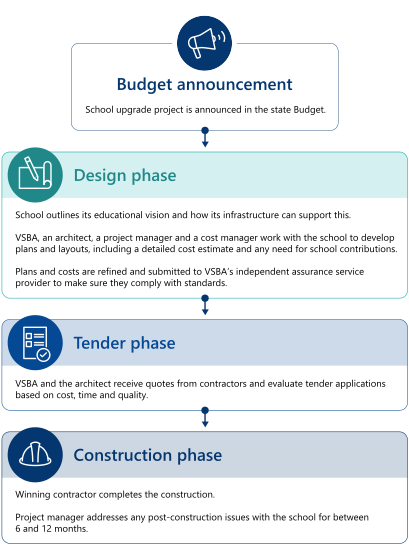
Overview of project process
Each project goes through several phases, as shown in Figure 7.
Figure 7: Overview of school upgrade project phases
Source: VAGO.
Timeline for design and tender phases
In its recommendations to the government and communication with schools, VSBA provides a standard schedule for projects’ design and tender phases.
VSBA tells the government and schools that the design and tender phases of an upgrade project together take 68 weeks. But the actual median time for completed projects funded between 2017–18 and 2025–26 was 83 weeks.
| During this time ... | had design and tender phases of ... |
|---|---|
| only 109 projects (17 per cent) | of 68 weeks or under. |
| 539 projects (83 per cent) | longer than 68 weeks. |
This suggests that VSBA’s expected times for project design and tender processes are not accurate and require updating.
Time to complete projects
VSBA says the construction phase of a typical school upgrade project will take between 12 and 18 months. When combined with 68 weeks for the design and tender phases, this means a school upgrade project is typically expected to take between 827 and 1024 days.
Each project receives its own timeline, which reflects the project's scope. For projects funded since 2017–18 and reported as complete, 25 per cent have exceeded their estimated completion date.
For projects funded in 2020–21, this rate increases to 45 per cent. Most of these projects began in late 2020. VSBA told us that longer construction periods in 2021 were caused by COVID-related cost increases, material and labour shortages and a general downturn in productivity.
Figure 8 shows average completion times for projects per funded year.
Figure 8: Average completion times for projects per funded year
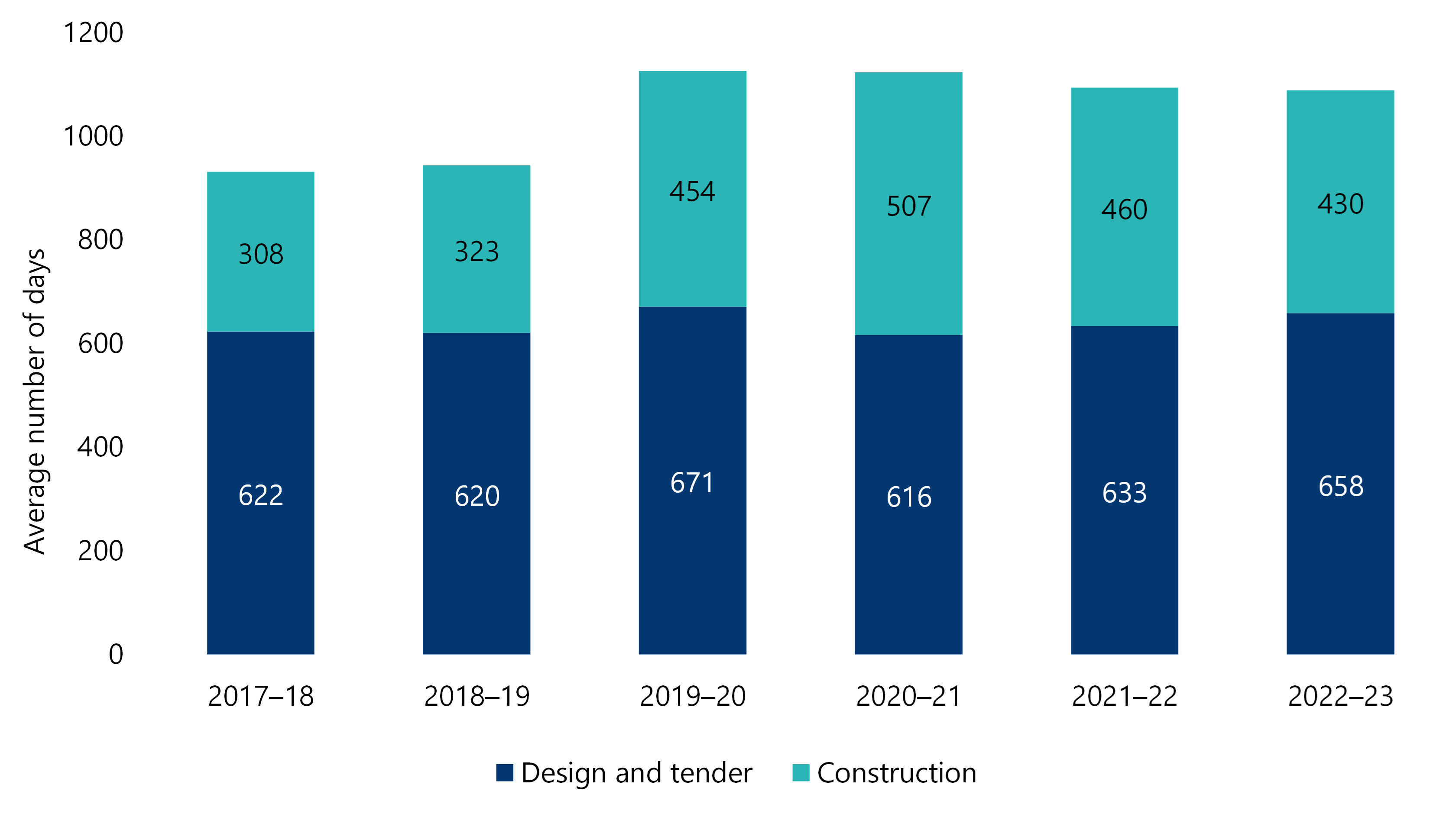
Note: This chart excludes projects funded in 2023–24 and 2024–25, as most projects funded in these years were not complete in our dataset.
Source: VAGO, based on VSBA data.
There are gaps in VSBA's milestone, compliance and risk reporting
Issues with timeline reporting
In all of our 10 case study projects, we found inconsistencies with how VSBA reports milestone dates.
None of the projects’ monthly reports have a complete set of expected milestone dates to provide a baseline for reporting.
In 4 cases, we found examples of incorrect or illogical reporting, such as tender assessments starting before tender documentation is finalised.
In 5 cases, we found evidence of VSBA amending planned milestone dates during projects’ planning and design, procurement, construction and defects liability phases.
Incomplete and inaccurate reporting against milestone dates undermines VSBA's ability to give clear baseline data to schools about planned versus actual results for delivering school upgrade projects.
Compliance with procurement standards
Every year, VSBA reports to the Department of Treasury and Finance about whether it complies with the Project Development and Construction Management Act 1994 and associated Ministerial Directions for public construction procurement (Ministerial Directions).
In 2024–25 VSBA reported it fully complied, except for 2 components relating to:
- publishing details of procurements
- establishing processes to monitor supplier performance.
VSBA gave evidence to the Department of Treasury and Finance to show it complied with other components of the Ministerial Directions. This evidence was mostly guidance from VSBA’s guidance documents to show that its processes aligned with the Ministerial Directions.
But our review of 10 case study projects shows that VSBA does not always follow these processes. For example, one case study project that required a probity plan under the Ministerial Directions did not have one.
VSBA’s independent assurance service provider also reviews its procurement documentation processes. Its July 2025 report found:
- consistent problems with VSBA project staff not uploading all the documents required under the Ministerial Directions, such as conflict of interest declarations
- the tender evaluation reports VSBA submitted were incomplete, which delayed its review processes.
Inconsistencies in risk reporting
VSBA-appointed project managers are responsible for keeping risk registers, and outlining risks and mitigation strategies in monthly project reports.
In our 10 case study projects, there were inconsistencies in how project managers recorded and updated risks. We found:
- 8 projects outlined key risks in their monthly reports, including one project that was not consistently identifying risks
- 2 projects included risk agenda items in their monthly reports, but did not complete them.
VSBA's independent assurance service provider has given VSBA findings about inconsistencies in its risk registers and incomplete risk documentation. It has also given VSBA recommendations, such as to maintain and review risk registers.
Using an independent assurance provider is a good control and VSBA now regularly reports on its risk register to governance committees.
But the issues across VSBA’s reporting shows that is has not consistently implemented its assurance provider’s recommendations. This undermines the purpose of, and investment in, the external assurance process.
If VSBA does not consistently identify and record project risks and mitigation strategies, schools and other stakeholders may not be aware of risks to timing, budget, procurement and construction quality, or be able to address them.
Contractor reporting regime
In 2024–25 VSBA reported that it does not fully meet the Ministerial Direction under the Project Development and Construction Management Act 1994 to monitor supplier performance and receive supplier feedback.
VSBA said this is due to the high volume of tenders and projects it works on each year.
Without strong, formal reporting on contractor performance, VSBA limits its ability to:
- make sure it is using the best contractors
- track contractors’ performance over time
- understand how contractor selection impacts project outcomes.
VSBA said it is trialling a new process to monitor its suppliers’ performance and says it has introduced channels (such as email inboxes) to receive supplier feedback.
5. Meeting school needs
VSBA runs thorough consultation with schools during projects’ design phases. It makes sure schools are informed about estimated construction costs and has controls to make sure design plans follow guidelines.
But schools may not be fully informed about how design decisions could impact upgrade projects’ long term costs, which they are responsible for.
VSBA evaluates a representative sample of completed school upgrade projects. But selection process for this sample is unclear. There is no formal channel for all principals to provide feedback on projects.
Covered in this section:
- Schools are consulted during the design phase
- VSBA does not fully inform schools about whole-of-life costs
- VSBA does not collect feedback from all schools
Schools are consulted during the design phase
Project design and meeting school needs
All of our 10 case study projects had complete design documents that set out the school's context, plans and needs relating to its learning environment.
This gives schools a clear opportunity to draft their vision for future assets and provides a solid foundation for design consultations.
All of our 10 case study projects included extensive consultation between architects and schools on project design, with multiple meetings for each project.
Design documents also included a cost plan developed by a quantity surveyor, which showed costings within the planned budget for priority work or features.
Throughout the design phase of school upgrade projects, schools consulted with VSBA and the project architect about features to accommodate in the project budget.
Of our 10 case study projects, 8 included a proposed design alteration (such as reducing the number of plants or pinboards) to bring its value within the assigned budget. In all cases, the school was informed and consulted.
VSBA does not fully inform schools about whole-of-life costs
Whole-of-life approach
The Department of Treasury and Finance's Asset Management Accountability Framework says decisions about an asset in one stage of its life can affect its performance and cost in others.
VSBA’s Building Quality Standards Handbook (the handbook) says VSBA should take a ‘whole of life’ approach to school upgrade projects. It encourages VSBA and its project managers to consider the feasibility of different design approaches, including whole-of-life costs.
Schools are responsible for managing new assets once projects are complete. This means they are ultimately responsible for decisions made during the school upgrade projects that go on to affect the performance and costs of new assets. So it is important that schools are well informed and actively engaged in decisions that impact whole-of-life costs.
Whole-of-life costs
Whole-of-life describes the total cost of an asset over its full life, including the cost of developing, producing, operating, maintaining and disposing the asset. For example, the whole-of-life costs of solar panels would include the costs to install and maintain the system over the number of years it can function, and the costs of replacing it.
Informing schools of whole-of-life costs
VSBA clearly informs schools of construction costs for different design options. But its design discussions with schools generally do not consider the long-term maintenance and whole-of-life costs for schools’ chosen designs.
VSBA says the handbook is the main way whole-of-life costs are accounted for in for school upgrade projects.
During a project’s design phase, architects must describe the expected impacts when a design deviates from the handbook. This includes:
- the reason for the proposed deviation
- expected benefits and consequences, including for an asset’s lifespan, maintenance and functionality.
In all 10 case study projects, VSBA’s independent assurance service provider reviewed each design to find any deviations from the handbook.
We found one example where the architect advised a proposed deviation that would increase the asset’s yearly maintenance cost from $250 to $1,500. This was approved by VSBA and the school endorsed the overall design documentation that contained this information.
But across our 10 case study projects, we saw no other evidence of VSBA consulting schools about whole-of-life costs. It is not clear if schools are fully informed about the impact and long-term costs of decisions they agree to during design and construction phase.
There is also no requirement for VSBA to assess the whole-of-life costs for changes made during a project’s construction phase. This includes VSBA:
- assessing whether proposed variations still align with the handbook
- consulting with schools about how changes could impact whole-of-life costs.
Each school also receives annual maintenance funding from the department, which is separate to school upgrade project budgets. This department adjusts this funding after an upgrade project is completed, based on factors such as the size and age of school assets. It does not factor in other whole-of-life costs of a school upgrade project when this funding is adjusted.
Schools’ capability as informed decision-makers
As schools rarely take part in complex construction projects, they are unlikely to have the expertise and experience to assess whole-of-life costs and make informed decisions about upgrade designs.
An objective of the department's 2024–34 Asset Strategy is that schools are accountable and capable. This means they should:
- be accountable for their decision-making
- have the necessary asset management capabilities
- receive training to continuously improve how they manage assets.
Schools often do not have the capability to make decisions about whole-of-life costs. They rely on VSBA and the wider project team to provide them with the knowledge and expertise to do this.
The Office of the Victorian Government Architect (OVGA) regularly evaluates VSBA’s school upgrade projects. It has found that schools are not always given the guidance they need to make informed decisions about whole-of-life costs.
In its 2024 report, OVGA said ‘the decision to substitute or reduce quality is leading to poor build outcomes, with extensive long-term issues for schools to address through their own limited budgets. Schools are not skilled to offer direction in value management processes, or to assess short-term versus long-term benefits and risks.
It is important that VSBA makes sure schools are actively engaged on decisions relating to whole of-life costs. This includes making sure:
- schools finish the design phase with a clear understanding of the whole of life costs associated with the project
- design consultants and contractors explain to schools the potential long-term risks of design decisions taken to manage costs
- it consults with schools during construction about any change that materially impacts whole of life costs.
VSBA does not collect feedback from all schools
Project monitoring and evaluation
VSBA monitors and evaluates the performance of school upgrade projects through its independent assurance service provider. These are in addition to OVGA’s evaluations.
| The assurance service provider delivers ... | to ... |
|---|---|
| monthly assurance reports | monitor the delivery of VSBA's school upgrade projects. |
| post-occupancy evaluations | evaluate the performance of VSBA's school upgrade projects post-handover, approximately 12 months after completion. |
Unexplained evaluation selection
A project’s post-occupancy evaluation includes feedback from principals, teachers and any other relevant facility users. It aims to identify any design issues, trends and recommendations about design aspects of an upgrade such as accessibility, safety and aesthetics.
The evaluation process samples 25 per cent of completed projects each year. VSBA's independent assurance service provider identifies eligible projects, from which VSBA selects a representative sample based on:
- asset type
- location
- total estimated funding.
But we found evidence of VSBA changing the selected schools in the sample without documenting reasons for doing so. This reduces the evaluation’s objectivity and limits confidence that the final sample can provide lessons for all school upgrade projects.
VSBA uses post-occupancy evaluation feedback to:
- report against 2 KPIs in its 2025–34 Strategic Asset Management Plan
- recommend changes to the handbook.
To make sure its evaluations are transparent and reliable, VSBA should document reasons for any changes to the sample of selected schools at the time.
In 2024, OVGA also recommended that VSBA:
- create brief explanations about:
- why it has selected particular schools to be evaluated
- any underlying issues that need to be considered during the evaluation
- provide findings from post-occupancy evaluation reports to architects, construction contractors and schools.
But it has not yet done this.
VSBA also does not have a formal process to evaluate school upgrade projects for compliance with the handbook’s guidelines after a project is complete (unless the school upgrade project has been selected for the evaluation program).
Input from all schools
The post-occupancy evaluation process mainly focuses on design aspects of school upgrade projects, rather than project delivery processes.
If a school is not selected for the post-occupancy evaluation program, its staff do not have a clear opportunity to provide formal feedback on whether the upgrade meets their expectations.
VSBA would benefit from gathering feedback from all schools after each school upgrade project, including feedback on:
- construction quality
- project management processes
- engagement with key delivery personnel including VSBA staff, construction contractors and architects.
VSBA provides surveys to principals involved with other types of school building projects to understand their experiences and inform improvements. VSBA told us it is exploring a similar approach for school upgrade projects. If adopted, this would strengthen VSBA's ability to monitor and evaluate whether its school upgrade projects meet school needs.
Appendix A: Submissions and comments
Download a PDF copy of Appendix A: Submissions and comments.

Appendix B: Abbreviations, acronyms and glossary
Download a PDF copy of Appendix B: Abbreviations, acronyms and glossary.
Appendix C: Audit scope and method
Download a PDF copy of Appendix C: Audit scope and method.
Appendix D: Announced investments
Download a PDF copy of Appendix D: Announced investments.