
Delivering the Suburban Rail Loop
Audit snapshot
Is precinct planning and project delivery for Suburban Rail Loop East proceeding as planned to realise the benefits in the SRL business and investment case?
Why we did this audit
The Suburban Rail Loop (SRL) is a 90 km rail loop planned to link Melbourne's eastern and western suburbs via Melbourne Airport. It is Victoria's largest infrastructure investment.
The SRL is intended to deliver new public transport connections as well as economic and liveability benefits by supporting growth in population, housing and employment in the precincts surrounding SRL stations.
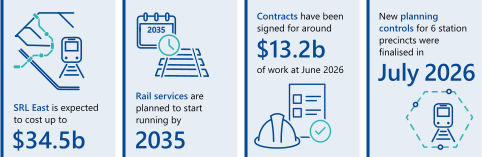
The first stage of the project, SRL East, includes 26 km of twin tunnels from Cheltenham to Box Hill, with 6 new underground stations and corresponding precincts. The government publicly reported it will cost up to $34.5 billion and has committed to running trains by 2035.
The government's funding and financing strategy for SRL East requires $11.5 billion contributions from each of the state Budget, the Australian Government and new revenue-raising measures, including profits from the state developing and selling property in SRL precincts.
We did this audit to see if the Suburban Rail Loop Authority's (SRLA) work on SRL East is on track to meet the government's cost, time and benefit targets.
Key background information
Source: VAGO.
What we concluded
SRLA has made significant progress planning SRL East precincts and delivering early rail infrastructure works and is forecasting that it will deliver the project in line with the government's announced cost and completion date targets. However, delays, cost increases and emerging risks mean this is not reasonably assured at this early stage.
The project has experienced significant delays. SRLA finished one early works package around 6 months late and procurement processes for the stations packages are delayed by around one year. This puts the government's target to start running trains through SRL East by 2035 at risk.
On the evidence available to date, we conclude also that the project is more likely than not to exceed its publicly disclosed cost of up to $34.5 billion. This is due to:
- additional costs to manage unexpected ground conditions and contamination
- higher than expected market pricing for the Linewide and stations packages
- added project costs and delays because of government decisions to slow down spending on the project to manage the state's debt levels.
SRLA included significant contingency in its cost estimates and has allocated these allowances across relevant works packages to deal with a range of cost pressures in the early stages of delivering the works. But with around 9 years of complex rail infrastructure construction and system integration ahead, across 5 major works packages, it is unclear whether SRLA has sufficient contingency for unexpected cost increases and delays in later stages.
The government's strategy to fund the project is not transparent and some funding sources are uncertain.
The state does not yet have enough funding approved to sign the contract for the second stations package. The Australian Government has publicly committed $6 billion of the expected $11.5 billion after providing further funding of $3.8 billion in its 2026–27 Budget.
The government's new revenue raising measures are intended to fund one-third of the project costs. These measures include a levy on all public transport fares in metropolitan Melbourne and regional Victoria. It has been using this levy to raise revenue since January 2025. The levy is not fully consistent with the state's value capture framework.
SRLA's draft planning controls support the project's expected housing and employment benefits for the 6 SRL East precincts. However, these benefits depend on private investors, who already face challenging market conditions to buy and develop property. This puts both the project's expected benefits and revenue from new value capture measures at risk.
Note on recent changes at SRLA and efforts to improve project delivery confidence
SRLA has had significant changes in leadership and senior management since the end of 2025. The new team advised us at the end of this audit that it:
- has undertaken a detailed review of the project schedule, work package interfaces and costs, to understand opportunities for time savings to help de-risk the project and potentially reduce costs
- plans to propose a range of actions to the government in the second half of 2026 aimed at improving its capacity to deliver the project on time and on budget.
SRLA's work to improve project delivery confidence is a work in progress and we cannot provide any assurance on the likelihood of its success given the limited evidence available to us at the time of finalising our report.
However, we note that the:
- current project delivery approach, including the strategy to divide the main rail infrastructure works into 5 works packages, and to minimise and manage the interface risks across these packages, was endorsed by government based on detailed planning and advice by SRLA in consultation with central agencies since 2020
- changes currently under consideration by SRLA to improve project delivery confidence will likely require substantive changes to existing project delivery and commercial arrangements, and involve significant and potentially costly commercial negotiations with incumbent and prospective contractors to obtain agreement and implement.
Given the cost, scale and significance of this project and its ongoing impact on the state's finances, we intend to revisit delivery progress as part of future engagements to provide assurance to the Parliament and community. Future engagements can assess the success of SRLA's efforts to deliver the project on time and on budget.
1. Our key findings
What we examined
Our audit followed 3 lines of inquiry:
1. Is Suburban Rail Loop Authority's (SRLA) precinct planning for Suburban Rail Loop East (SRL East) proceeding as planned and consistent with delivering the benefits asserted in the SRL Business and Investment Case?
2. Are SRLA's precinct planning outputs consistent with realising the project funding streams identified in the SRL Business and Investment Case and related advice to the government?
3. Is SRLA on track to meet the timelines, scope and budget approved by government for the SRL East rail infrastructure, precinct and related works?
To answer these questions, we examined:
- SRLA, which is delivering the project
- Department of Transport and Planning (DTP), which is the client for the project
- Department of Treasury and Finance (DTF)
- Department of Premier and Cabinet (DPC).
Background information
Project scope
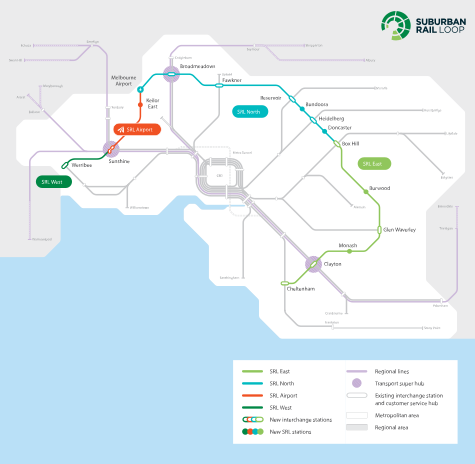
As Figure 1 shows, the SRL is a 90 km planned rail loop with 3 sections – East, North and West – complemented by Melbourne Airport Rail.
Figure 1: SRL map and sections
Source: SRLA.
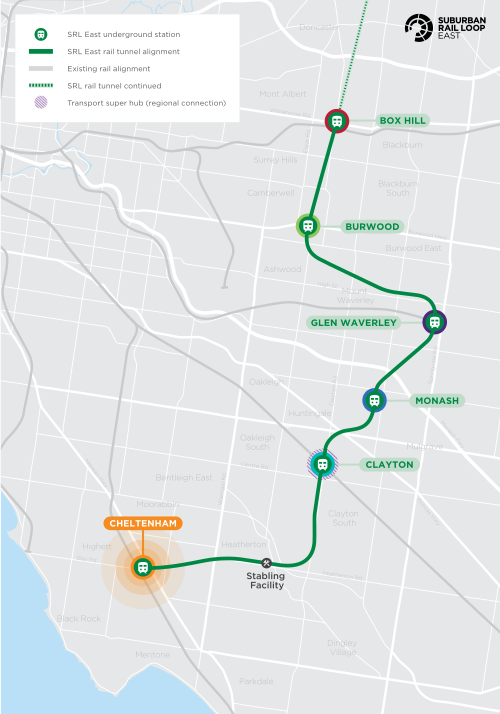
SRL East is the first stage of the project. SRL East includes 26 km of twin tunnels from Cheltenham to Box Hill, with 6 new underground stations and corresponding precincts, as Figure 2 shows.
The SRL Business and Investment Case defined a precinct as the area within 1,600 metres of each new station.
The government has committed to running services through SRL East by 2035.
Figure 2: SRL East map
Source: SRLA.
Project objectives
DTP is the project client. DTP has specified capability objectives and requirements for the SRL project for the delivery agency, SRLA. DTP's capability objectives for the project include that the SRL must:
- facilitate employment and population growth in the areas within 1,600 metres of each new SRL railway station, and notes that population and employment must be created within precincts to a level that would ensure the viability of the infrastructure and services offered
- ensure that SRL precincts have the hallmarks of 20-minute neighbourhoods as defined in Plan Melbourne 2017–2050.
Precinct planning and benefits
The government intends for SRL East to increase housing and employment opportunities in the station precincts.
SRL precincts are the areas within a 1,600-metre radius of an SRL station.
SRLA released draft structure plans and planning scheme amendments (PSAs) for areas within approximately 800 metres of the future SRL East stations at Box Hill, Burwood, Glen Waverley, Clayton, Monash and Cheltenham for public input in March 2025.
The precinct structure plans and PSAs intend to attract sufficient development investments to support the projected growth in households, jobs and population in each precinct.
An advisory committee reviewed the draft structure plans and PSAs in the second half of 2025, which involved public hearings. The committee provided its report to the Minister for Planning, Minister for the Suburban Rail Loop and SRLA in February 2026. DTP published a notice of approval of amendment for each of the final PSAs in the Victoria Government Gazette in July 2026.
Cost and funding
The 2026–27 state Budget indicated SRL East is expected to cost between $30 billion and $34.5 billion.
The government has announced $11.8 billion in state funding to cover the early development stages, initial and early works (I&EW) package and some of the main works packages.
It is seeking a matching contribution of around $11.5 billion from the Australian Government, which has currently committed to $6 billion. This reflects announced funding from the Australian Government to mid-2026.
The government aims to cover the rest through value capture sources.
Value capture
Value capture refers to government capturing a portion of the incremental economic value created by government investments, activities and policies. These actions may generate alternative revenue streams, assets or other financial value for Government which could assist in funding those investments and activities.
Source: Victoria’s Value Creation and Capture Framework (2017).
In addition to the $11.8 billion of announced state funding, the government approved, but did not publicly announce, an additional $11.5 billion in funding in December 2023. The government confirmed additional state borrowings of $11.5 billion to fund the project when announcing the value capture project 2 years later, in December 2025.
This brings the approved state funding to $23.3 billion and total approved project funding to $29.3 billion (including the Australian Government's contribution). This represents around 85 per cent of the project's estimated total cost.
Works packages and spending so far
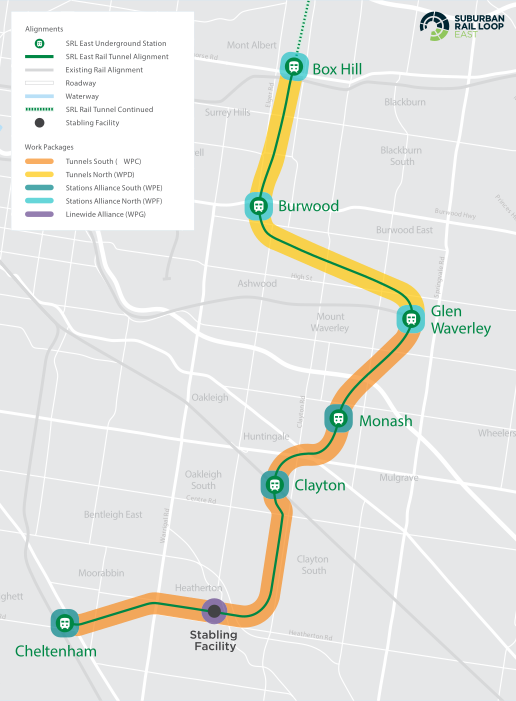
SRLA has established the following works packages (WP) to deliver SRL East and has contracts or agreements in place for each package.
- The I&EW stage includes the following works packages:
- WPA: initial works and early works (completed)
- WPB: power construction supply works (in progress)
- SRLA-managed works: enabling works that were largely transferred out of WPA (in progress).
- The main works stage includes the following works packages:
- WPC: tunnels south – Cheltenham to Glen Waverley (in progress)
- WPD: tunnels north – Glen Waverley to Box Hill (in progress)
- WPE: stations alliance south – Cheltenham, Clayton and Monash (in procurement)
- WPF: stations alliance north – Glen Waverley, Burwood and Box Hill (in procurement)
- WPG: Linewide, which is a line-wide works alliance to deliver line-wide systems and a franchise agreement with an initial term of 15 years to operate the finished rail network (in progress).
Figure 3 shows the works packages and locations for SRL East.
Figure 3: SRL East works package locations
Source: SRLA.
SRLA's reports show that as at 31 December 2025 it had spent $5.7 billion on the project, comprising:
- $1.8 billion on initial works and early works packages (against a $2.2 billion budget)
- $1.9 billion on the main works packages (against a $23.8 billion budget)
- $2.0 billion on other main works activities, including land acquisition and precinct planning (against a $6.9 billion budget).
What we found
This section focuses on our key findings, which fall into 4 areas.
1. The project is unlikely to be delivered on budget and on time.
2. The project's funding strategy is not transparent and involves significant uncertainty.
3. SRLA's draft planning controls for SRL East precincts are consistent with the project's objectives.
4. SRLA has a sound commercial strategy, and has improved how it works with central agencies, but can better manage integrity and oversight risks.
These findings reflect our assessment of the evidence available to us on the status of the project at the end of 2025, as well further evidence provided by SRLA on a range of matters up to the point of finalising this report in mid-2026.
The project is still in the early delivery phase, with a number of packages still in procurement and subject to future government decisions and milestones which will influence the final outcomes.
The full list of our recommendations, including agency responses, is at the end of this section.
Consultation with agencies
When reaching our conclusions, we consulted with the audited agencies and considered their views.
You can read their full responses in Appendix A.
Key finding 1: The project is unlikely to be delivered on budget and on time
The project is at an early stage but there are already significant emerging risks to its timelines, scope and budget. These risks are due to:
- the complex nature, scale and scope of the project
- SRLA's delivery and contracting approach
- external factors not fully in SRLA's control.
Our analysis indicates the project is likely to cost more than the government's upper estimate of $34.5 billion. This analysis, based on evidence as at the end of 2025, suggests a potential final project cost of more than $36 billion.
SRLA has also identified significant additional costs, not covered by the project budget, for works and investments needed to achieve the government's claimed benefits for the project and its value capture revenue target. The government is yet to fully fund these costs, which may exceed $2.5 billion.
Despite significant effort it is unclear if SRLA's project budget, including contingency allowances, will be enough to cover cost increases and emerging risks to the delivery schedule. These include increasing construction costs, contamination, delays in signing key contracts, and complex design and construction interfaces between the works packages.
Contamination and other risks have already led to significant additional costs and delays for both the initial and main works packages.
The project cost estimate
Figure 4 shows the government's 2021 cost estimates for key project components, compared with SRLA's budget at December 2025, and our assessment of the potential outturn cost based on evidence of actual and expected costs at that point.
Figure 4: SRL East: Government estimate, SRLA budget and potential outturn cost of key components ($ million)
| Component | Government estimate 2021 | SRLA budget December 2025 | VAGO's estimated potential outturn cost |
|---|---|---|---|
| Initial and early works | 2,200 | 2,200 | 2,220 |
| Main works | 30,692 | 30,692 | 32,338 |
| Precinct development works | 1,515 | 1,520 | 1,520 |
| Total | 34,407 | 34,412 | 36,078 |
Notes: The amounts shown are nominal. Figure 4 does not include the initial project development costs of around $300 million, approved by the government as part of the 2019–20 state Budget, for costs associated with development of the project business case and design and pre-construction work.
The government's publicly disclosed upper cost estimate for SRL East of $34.5 billion also excludes these initial development costs and has been rounded up from $34.4 billion to $34.5 billion. The potential outturn cost estimate is based on our analysis of the project's delivery progress and procurement outcomes for the initial and early works and main works packages to end of 2025. This includes analysis of indicative outcomes from procurement processes that were in progress at the end of 2025.
Source: VAGO, based on information provided by SRLA and DPC.
Our assessment of the likely outturn cost for SRL East is around $1.7 billion higher than SRLA's budget at December 2025 because we include some known cost increases that were not reflected in the SRLA budget at that time:
- expected procurement outcomes for the stations packages, with advice by more than $1.0 billion
- higher costs for the Linewide package, based on the contract signed in December 2025 which included a target cost of $353 million to manage contamination at the Southern Stabling Yard (SSY).
The government's estimate and our assessment of the potential final project cost shown in Figure 4 do not include a range of other significant costs the government has yet to fund, including:
- at least $1.6 billion for station interchange works (SIW) to provide connections between the new SRL stations and existing stations at Southland, Glen Waverley and Box Hill
- between $500 million and $750 million to acquire around 21 strategic sites for developing or reselling to meet the value capture revenue target.
The state signed a franchise agreement in December 2025 for the operation and maintenance of the SRL East railway once it is completed, with a nominal cost of around $3.9 billion over its first 15-year franchise period. Consistent with the approach to funding other significant rail infrastructure works, the operation and maintenance costs are not included in the announced cost estimate of up to $34.5 billion, and SRLA will need to seek funding approval from the government to meet these costs.
Developing and reviewing cost estimates
SRLA has developed, reviewed and refined its cost estimates for the works packages as design work and procurement has progressed since 2020.
DTF also reviewed SRLA's cost estimates at key points and found they were reasonable.
The funding submissions for SRL East in 2020 for I&EW and in 2021 for main works were informed by SRLA's reference designs. They were also based on a range of assumptions, including the government's promised completion date of 2035.
SRLA has progressively tested these cost estimates as works packages have been procured, contracted and moved into delivery, with mixed but largely negative results:
- while SRLA procured contractors for the I&EW and tunnels packages below its initial cost estimates:
- the contract cost for I&EW WPA nearly doubled from $535 million to over $1 billion
- contamination and poor ground conditions are creating cost pressures on the tunnels packages
- the Linewide package now has a contracted target outturn cost (TOC) of $6.7 billion, which is:
- around 10 per cent higher than SRLA's pre-tender estimate in November 2023
- 27 per cent higher than its initial estimate in 2022
- the contract costs for the stations packages are expected to exceed SRLA's 2024 estimates by between 15 and 20 per cent due to rising construction costs.
Emerging risks
In 2024 DTF's cost adviser reviewed SRLA's cost estimates for the stations packages. The review found that global economic uncertainty and inflationary pressures on construction costs will lead to higher cost increases than SRLA's estimates allowed, at least in the short term.
In 2025 DPC and DTF's advice to the government on major capital projects highlighted material and labour cost increases as the main risk to project delivery. This risk is particularly relevant for SRL East.
Figure 5 outlines our assessment of significant risks to the project's timelines, scope and budget.
Figure 5: Risks to the project's timelines, scope and budget
| Source of risk | Risk factors |
|---|---|
The project's scope and complexity
|
|
SRLA's delivery approach
|
|
External factors not fully in SRLA's control
|
|
Source: VAGO.
SRLA is aware of these risks. It has contractual and commercial strategies to manage them, including incentivising package contractors to:
- deliver on time and on budget
- work together to coordinate designing and delivering critical works and site interfaces.
Some of the risks can only be cost-effectively assessed as the main works progress. This means SRLA may need to modify its agreements with contractors, which is normal in a project of this scale and complexity.
SRLA's contracting approach
SRLA will not be able to assess if the project's overall budget is sufficient until it has signed contracts for all the packages and agrees on final designs with the contractors.
However, even if SRLA awards contracts within the project's overall budget, there is still a significant risk of cost increases. This is because it based contracts on either incentivised target cost (ITC), reimbursable cost or alliance contracts. These contracts are not for a fixed price. They include a target cost negotiated by SRLA with the contractor. The target cost can be changed to deal with risks and unforeseen circumstances.
SRLA's contracting approach is deliberate and reasonable. It is very likely that using fixed price contracts would have resulted in higher upfront contract prices due to tenderers including significant risk premiums in their contract bids.
While SRLA incentivises contractors to manage costs, the cost reimbursement contracts mean the state largely retains the risk of rising labour and material costs.
Contingency allowances
SRLA's total cost estimates of $32.9 billion for the I&EW and main works included significant contingency allowances of $9.5 billion, or 29 per cent, to deal with unforeseen risks.
SRLA has already used a significant portion of its contingency allowances. It is unclear whether the remaining contingency provisions for the main works program will be sufficient to absorb the cost impacts from known threats to project delivery such as contamination and the complex delivery and milestone interfaces between works packages.
This is a cause for concern given the project is still in its early stages. However, SRLA claims it has enough contingency remaining to meet foreseeable cost pressures.
Risks to delivering on time
The government is unlikely to meet its public commitment to run train services through SRL East by 2035.
The project has already had significant delays:
| The ... | has been delayed by ... |
|---|---|
initial and early works package
| at least 6 months, with:
|
tunnels south package delivery
| at least 2 months due to poorer than expected ground conditions, including contamination.
|
Linewide works package procurement
| 17 months, with SRLA signing the contract in December 2025, compared with the target of July 2024.
|
Stations work packages procurement
| at least 12 months, with SRLA not expecting to award the contract for:
|
A combination of factors caused these delays, including risks that SRLA knew about: in particular, the risk of ground contamination and issues with SRLA giving contractors access to sites.
SRLA has not finalised contracts for the 2 stations packages (WPE and WPF) due to ongoing procurement delays.
The state does not currently have enough funding confirmed to sign the contract for WPE. This is currently the most significant risk to SRLA delivering the project on time.
In December 2025 DPC advised the government that if the preferred contractor for WPE is not approved before the caretaker period starts for the 2026 state election, there will be a significant cost increase across work packages E, F and G, and the start of SRL East rail services will be delayed beyond the end of 2035.
SRLA's contract for the final work package (the Linewide package) requires completion in May 2035. Meeting this date relies on the tunnelling and stations package contractors finishing and handing over sites on time.
SRLA has around a 7-month contingency in its delivery schedule in case of delays. It is forecasting that services will start running through SRL East on 31 December 2035. However, it is unclear if SRLA's schedule contingency will be enough to cover known and future risks to the project's delivery.
SRLA advised us at the end of this audit that it is examining a range of options to adjust the project schedule and works sequencing to improve its capacity to deliver the project on time. SRLA's proposed actions in this area have not been finalised or agreed with relevant existing and prospective contractors, meaning we cannot provide any assurance on the likelihood of success.
Impact of government decisions to slow down project spending
In April 2024 the government directed SRLA to delay spending around $1.4 billion on the project until after the state Budget's forward estimates period of 2023–28. The government made this decision to manage challenges to the state's finances and help it achieve step 4 in its fiscal strategy, which is to stabilise state debt.
The direction to SRLA was to reduce and delay spending by pushing substantial works and spending out beyond the forward estimates period. SRLA actively sought to implement the required deferral of expenditure and transparently advised the government in August 2024 that delaying spending in the project's early construction stages would:
- increase the final cost by around $1 billion, with around $800 million of this due to the impacts of delaying works to later years because cost escalation meant the delayed works would be paid for at higher labour and material rates than if completed earlier
- require an additional $20 million funding for the Linewide package for bid cost reimbursement to extend the procurement phase
- impact work package D's costs and delivery schedule, but these impacts could not be confirmed until after the contract is signed
- create other risks for the main works packages schedule, interfaces, timelines and scope.
SRLA also advised that it could only reasonably defer $800 million. It said it would continue to assess ways to meet the $1.4 billion target.
SRLA has not met the $1.4 billion spending reduction target for 2023–28. Our analysis indicates that rather than spending less in this period, SRLA expects to spend around $874 million more than the approved spending profile in place before the government's decisions in April 2024.
This has been necessary to address additional costs on the I&EW package and the tunnels packages. The government has approved this additional spending.
SRLA advised the government in December 2025 that its direction in 2024 to slow down spending on the project has introduced greater risk and cost for the project. The SRLA advice suggested that market bidders for the stations and Linewide packages had increased their prices to manage risks from future cost escalation and uncertainty due to potential changes in the state's requirements for the timing of project spending.
This advice from SRLA clearly indicates that the government direction to slow down project spending has resulted in higher project cost and risk without achieving lower project spending in the period to 2028–29 to support the government's fiscal strategy.
Unfunded and underfunded costs
There are significant additional costs the government has not funded yet. Some of these costs are crucial for meeting the government's value capture revenue targets and delivering the project's intended benefits.
These costs, which Figure 6 outlines, are either not covered or not fully covered by the government's published project cost estimate of up to $34.5 billion.
Figure 6: Unfunded and underfunded costs
| Cost | Funding status |
|---|---|
$1.7 billion for SIW to connect 3 new SRL East stations with existing adjacent stations
|
|
$500 million to $750 million to acquire 21 strategic sites for value capture revenue from future state-led property development or resale
|
|
Up to $425 million for Voluntary Purchase Schemes to acquire residential, commercial and business properties
|
|
Up to $137 million for the Glen Waverley Multi-Level Car Park (MLCP), which is required to meet one of the project's environmental approval conditions
|
|
Source: VAGO
SRLA advised us at the end of this audit that it is examining a range of approaches to minimise these costs by changing, removing or deferring some scope. SRLA will need additional funding from the state Budget or other sources to meet any remaining costs.
SRLA also plans a future funding request to the government to meet the costs of the first 15 years of the operation and maintenance franchise for the SRL East railway. These costs of around $3.9 billion are not included in the announced cost estimate of up to $34.5 billion for the project.
Addressing this finding
To address this finding we made 2 recommendations to SRLA about:
- taking all reasonable steps to ensure value for money when it negotiates post–contract award variations to address issues it knew about before awarding contracts
- undertaking a whole-of-project budget review and schedule risk assessment when all the main works package contracts have been signed.
Key finding 2: The project's funding strategy is not transparent and involves significant uncertainty
According to the government's public announcements and 2021 SRL Business and Investment Case, the project will be funded from 3 revenue streams:
- $11.5 billion from the Victorian state Budget
- $11.5 billion from the Australian Government
- $11.5 billion from value capture measures.
At June 2026 there is a $5.5 billion gap in the project's approved funding, and significant uncertainty that funding targeted from sources other than the state Budget will be fully achieved. For example, the plan to collect value capture revenue over a 40‐year period involves inherent uncertainty about the timing and amount of revenue collected and relies on future governments retaining the measures.
In addition, the government's public announcements about the project's funding strategy and decisions are not transparent.
State Budget funding
The government has approved $23.3 billion from the state Budget to fund the project. However, it has only publicly announced $11.8 billion, comprising:
- $300 million in May 2019 for the business case and early development work
- $2.2 billion in November 2020 for I&EW
- $9.3 billion in November 2021 for main works.
In December 2023 the government approved an additional $11.5 billion for main works. It did not publicly announce this decision or clearly disclose it in the Budget papers. The government confirmed additional state borrowings of $11.5 billion to fund the project when announcing the value capture project 2 years later, in December 2025.
Since 2019 DTF and DPC have consistently advised the government that the state Budget cannot fully fund the project's expected $34.5 billion cost without limiting spending in other areas and missing its fiscal targets.
Australian Government funding
As at June 2026, the Australian Government has announced a $6 billion funding commitment for the project. The state has requested $11.5 billion.
The Australian Government's initial funding commitment of $2.2 billion was confirmed in early 2025. SRLA can only use this $2.2 billion for land acquisition, geotechnical and development works and utility upgrades.
In November 2025 the Australian Government announced it would contribute additional funding to the project as part of deliberations on its 2026–27 Budget. The further funding commitment of $3.8 billion was confirmed in May 2026 as part of the Australian Government's 2026–27 Budget.
The current $5.5 billion gap means the state does not have enough funding approved to sign a contract for the second stations package, WPE. The target signing date for the WPE contract was May 2026 and is now May 2027.
The target signing date for the WPF contract was July 2025. This contract is unsigned.
If the state does not secure sufficient additional funding from the Australian Government to cover the contract for WPE, it will need to borrow more money or introduce new revenue-raising measures to sign the contracts and meet the project's current timeframes.
Lack of public transparency on the largest value capture revenue measure
The timing and content of announcements about government decisions on the package of value capture measures intended to fund one-third of the SRL East project cost lack transparency.
DTF and DPC advised the government that it needed to announce the project's value capture measures before the end of 2024:
- so impacted parties can understand and plan for the new charges
- to ease concerns from the community and financial markets about the project’s funding.
The government announced the value capture package in December 2025. In this announcement it said it will use 5 value capture measures to fund the project:
- existing land tax revenue in SRL East precincts
- existing windfall gains tax revenue in SRL East precincts
- infrastructure contributions from property developers
- a car parking levy from 2035 on car park owners
- revenue from state-initiated property development.
However, it did not announce its decision to introduce a new levy on public transport fares from 1 January 2025 as part of the annual Consumer Price Index (CPI) fare increase. The levy involves an annual 1 per cent increase to all public transport fares in metropolitan Melbourne and regional Victoria, on top of existing annual CPI adjustments.
The government plans to allocate 60 per cent of the revenue it collects through the levy, estimated at $4.8 billion in net present value (NPV) terms to 2062, to fund SRL East.
This levy will be the project's largest source of value capture revenue.
The government first approved the levy in August 2021. It also confirmed it in December 2023 and November 2024 when it made further decisions on the project's value capture revenue package.
In November 2024 the government confirmed it needed the levy to service its borrowings for the project.
The government and Transport Victoria did not acknowledge the levy in their public communications about the 2025 and 2026 annual fare increases.
Consistency with the state's value capture framework
The government's 2017 Victoria’s Value Creation and Capture Framework outlines principles for value capture measures, including equity, transparency and avoiding unintended consequences.
According to the framework, value capture measures should only collect revenue from people and businesses who benefit from the investment.
The government has determined that the project's value capture measures should collect new, incremental revenue that captures part of the wealth uplift and other benefits that are expected to result from the SRL East rail investment.
Figure 7 shows the value capture measures that do not fully align with the framework.
Figure 7: Value capture measures that do not fully align with the framework
| Value capture measure | Consistency with value capture framework | Assessment |
|---|---|---|
Public transport fare levy (to collect an estimated $4.8 billion)
|
|  |
|  | |
Land tax in SRL East precincts (to collect an estimated $5.7 billion)
|
| |
| | |
| |
Source: VAGO
Profits from state-initiated development
As part of the project's value capture package, the government approved a revenue target of $1.4 billion NPV, or $3.4 billion in nominal terms, over 30 years from profits on state-initiated property development in SRL East precincts.
This is a 'net' income target, which means it refers to the return after covering planning, development, marketing and any related financing costs for state-initiated development.
Presently there is significant uncertainty about whether this revenue target can be achieved. This is because DTF and SRLA do not have a comprehensive strategy or plan to deliver these returns despite 4 years of work.
SRLA intends to provide further advice to the government in the second half of 2026 on a recommended approach to state-initiated development and how realistic the target of $1.4 billion is.
There are other risks that may impact this revenue, including:
- challenging market conditions in the property development sector
- negative market sentiment about state property taxes for investors in Victoria
- uncertainty about the availability of strategic sites identified for potential acquisition by the state
- a lack of approved funding to acquire these sites.
It is also unclear if the government will uphold its commitment to include social and affordable housing in these developments.
If revenue from state-led development is delayed or less than anticipated, it will create broader funding pressure for the project and state Budget.
Addressing this finding
To address this finding we made 3 recommendations to DTF and SRLA about:
- advising the government on publicly disclosing more comprehensive information about its funding decisions and value capture package for the project
- advising the government to finalise the model for value capture revenue from state initiated development
- developing a strategy to address any funding shortfalls from the Australian Government.
Key finding 3: SRLA's draft planning controls for SRL East precincts are consistent with project objectives
The government intends for the project to significantly increase housing and employment opportunities in SRL East precincts.
SRLA has drafted structure plans and PSAs for the 6 precincts. The PSAs were finalised in July 2026 with notices of approval of the amendments published in the Victoria Government Gazette. These plans and amendments are essential because:
- significant development needs to happen before SRL East opens in 2035 to support the planned population and job growth
- many of the project's value capture revenue measures depend on this development.
SRLA's draft planning controls for SRL East are consistent with benefits realisation, but there are risks
SRLA released the draft structure plans and PSAs for public consultation in March 2025 for the Box Hill, Burwood, Glen Waverley, Clayton, Monash and Cheltenham precincts. Based on our assessment of the draft planning controls for the Cheltenham precinct, these plans and amendments should allow enough redevelopment to support the uplifts in population, households and employment needed to deliver the benefits asserted for the project in the SRL Business and Investment Case.
Structure plan
A structure plan is a planning document used to implement a framework or vision for a precinct. It includes the future layout of streets, parks, community facilities and development sites, and provides guidance around the types of buildings and land uses that are appropriate. It also provides contextual information about the local landscape, cultural values, policy environment and economic drivers.
Source: Victorian Planning Authority.
The Minister for Planning set up an advisory committee to consider the draft plans, amendments and supporting documents in the second half of 2025. This process included public hearings.
The advisory committee submitted its advice to the Minister for Planning, the Minister for the Suburban Rail Loop and SRLA on 20 February 2026.
The remaining planning controls were finalised in July 2026.
Development in the SRL precincts largely depends on the actions and investments of private developers and individuals.
Development may be also constrained by:
- structural barriers to combining individual land parcels
- challenging market conditions in Victoria for property development.
Delays in finalising new planning settings
SRLA released the draft structure plans and PSAs for public consultation around 12 months later than planned. The PSAs were finalised in July 2026, which is around 7 months later than originally planned.
Commitment to build 70,000 homes
In December 2024 the government announced that SRL East will build 70,000 homes across the 6 station precincts.
The government included this claim in presentations for the Public Accounts and Estimates Committee inquiries into the 2024–25 and 2025–26 Budget estimates. The state Budget papers for 2025–26 state that 'the SRL will be Australia's largest housing project and is expected to deliver 70,000 more homes around the six SRL East precincts'.
The Big Build website says the project will 'enable around 70,000 new homes to be built in these areas by the 2050s'. This is a more accurate description of SRL East's housing goals.
However, the project's scope and budget do not include funding to build any new housing.
In addition, the business case projected that SRL East will contribute to an incremental increase of around 26,000 households. This is because the claimed 70,000 additional households in SRL East precincts over the next 30 years includes around 52,000 households that were projected to be built even if the project does not proceed.
SRLA told us it will deliver housing by developing the land it owns next to the stations. But it did not provide evidence to support this.
Local infrastructure funding
The government's overall cost estimate of up to $34.5 billion includes $1.5 billion for community infrastructure and development works in SRL East precincts.
SRLA intends for this work to support population growth in these communities, improve employment opportunities and deliver other benefits promised in the business case.
However, SRLA has not sought specific funding from the government to deliver this work.
In mid-2024 an external review of SRLA, commissioned by DPC, identified concerns about accountability and forward momentum for developing and activating the precincts. The review emphasised the importance of precinct development to realising the project benefits.
In March 2025 SRLA released draft implementation plans for each precinct for public consultation. It released these plans alongside the draft structure plans and PSAs.
The implementation plans:
- identify the actions needed to achieve the structure plan's vision for each precinct and acknowledge that delivering these actions will require coordination across the government
- identify more than 170 key projects across the 6 precincts and assign delivery responsibility to relevant local councils and government agencies
- do not commit any funding for these projects or explain any approaches for funding community infrastructure.
In February 2025 SRLA advised the government it could deliver the more than 170 key precinct development projects within the $1.5 billion precinct infrastructure allocation.
However, advice to the government in July 2025 indicated local councils and residents had highlighted funding for precinct infrastructure as a key concern during the public consultation process.
SRLA told us it will scope and cost the final key projects and seek funding from the government after the structure and implementation plans have been finalised.
Affordable housing
DTP's project requirements to SRLA identify affordable housing as important for the project but do not specify a required proportion for affordable housing. It is not clear how SRLA's draft planning controls will ensure more affordable housing in SRL East precincts.
The government announcement in December 2024 on the results of community consultation on precinct vision documents referred to feedback on the need for more affordable and social housing.
SRLA's draft structure plans and PSAs acknowledge the need for more social and affordable housing. They signal SRLA's intent to support a range of housing types, including affordable housing, in the 6 precincts.
However, they do not include mandated affordable housing targets for developers. This contrasts with the approach adopted in the government's other priority precincts across Melbourne that imposed a target of 6 per cent affordable housing for new developments.
Increasing affordable housing in SRL East precincts will rely on private developers opting into the Voluntary Public Benefit Uplift Framework. The draft framework we examined is intended to enable developers to exceed specified density limits if they provide public benefits, such as affordable housing, public open space or improvements to the public realm. The uptake of these provisions will be entirely outside the control of the state.
It is also unclear if the government will uphold its commitment to require state-initiated development to provide social and affordable housing as part of its future implementation model for SRL East precincts.
Addressing this finding
To address this finding, we made one recommendation to SRLA about coordinating with the government and local communities to determine, fund and deliver appropriate precinct development to support expected population growth in the precincts.
Key finding 4: SRLA has a sound commercial strategy, and has improved how it works with central agencies, but can better manage integrity and oversight risks
SRL East is the state's largest, most expensive and most complex infrastructure project to date.
To deliver a project of this scale the state needs strong governance, oversight and delivery arrangements.
After early issues and frustrations, SRLA has improved how it works with the government and central agencies, DPC and DTF.
SRLA has a clear commercial strategy and has set up extensive governance and oversight arrangements.
While it is working to lower its owner’s costs, this could reduce its ability to oversee contractors and identify emerging risks.
We did not look into SRLA's procurement processes for all external advisors. However, we did come across a potential integrity issue with one advisor it engaged.
SRLA is aware of other integrity risks to the project, including risks associated with acquiring land and allegations of corruption within the construction industry and unions. While SRLA has processes and actions to mitigate these risks it has only recently initiated targeted actions to specifically look for potential issues or integrity breaches relating to its main contractors using subcontractors, such as labour hire companies, that may have alleged criminal associations.
Working with the government and central agencies
In mid-2024 an external review of SRLA identified a range of governance challenges for the project, including issues with trust, cooperation, information flow and role clarity between SRLA and central agencies.
In October 2024, advice to the government about this review indicated that setting up SRLA as a statutory authority with an independent board created challenges in the flow of information and decision-making processes because SRLA officers viewed the board as the project's primary decision-maker.
These challenges became more visible at the end of 2023 when the board implemented a significant decision about managing a contract before seeking the government's approval.
Since 2021 SRLA's reports back to the government on a range of matters have been regularly delayed.
We also saw evidence central agencies were frustrated about the timing and level of detail in SRLA's progress reports.
SRLA has since improved how it provides information to central agencies and the government following recommendations from the external review. It now contributes to monthly project tracker reports to the government, which have status updates on each work package and highlight key risks.
In October 2024 the government approved SRLA setting up steering committees for the work packages, which include SRLA, DTF, DPC and DTP staff. These committees began meeting in early 2025 and considered complex commercial, financial and technical issues as they arose. The multiple steering committees were consolidated into a single SRL coordination group that is chaired by SRLA and began meeting monthly from early 2026.
The Minister for the Suburban Rail Loop has also developed an annual statement of expectations – in consultation with the Premier and the Treasurer – for the SRLA board. The statement confirms the government’s expectations for the project's governance, decision-making and reporting processes.
The first statement of expectations was due by the end of 2024. But it was not approved until July 2025. The approved statement identifies the following principles for the board to support aligned and integrated strategy and decision-making for the SRL East project:
- timely
- transparent
- streamlined
- collaborative.
DPC advised the government in October 2024 that the flow of information to central agencies, the Premier and the Treasurer would improve if relevant senior officials from DPC and DTF attended SRLA board meetings as observers.
We understand that DPC and DTF are not attending SRLA board meetings.
Commercial strategy and project management
Underinvestment in the resources needed to properly plan, manage and oversee this project would risk significant unplanned costs and delivery challenges for the state and an end product that does not support the realisation of the planned project benefits.
Our analysis indicates that SRLA has set up extensive project governance and oversight arrangements at the organisation and individual work package levels, and has a clear contracting and commercial strategy.
SRLA has invested significant resources in contract design and into procuring and managing the approved multi package delivery approach.
SRLA told us its reimbursable cost contracting models and related commercial strategies respond to a highly constrained major construction market, where a fixed-price contracting model would put the state at risk of paying significant risk premiums.
SRLA's approach is intended to best protect the state's interests by using collaborative, open-book delivery models, including alliance and ITC contracts, which should mean costs are transparent and help it identify delivery risks early.
While SRLA's approach is sensible, there are inherent risks to reimbursable cost contracts, which we discuss in key finding 1.
Owner's costs and savings
SRLA's $32.9 billion budget to deliver the project comprises $2.2 billion for the I&EW and $30.7 billion to deliver the main works packages and precinct planning work. The total budget includes around $5 billion for what it refers to as owner's costs, including:
- $3.7 billion for SRLA's staff and external advisers to manage contracts and oversee individual works packages
- $1.3 billion for organisational or 'corporate owner's costs'.
Owner's costs
Owner's costs are costs not covered by the contracted target cost for each works package, such as SRLA's staff and external adviser costs for contract management and oversight on individual works packages and its general costs to operate the organisation.
This $5 billion does not include around:
- $1.9 billion for SRLA to acquire land
- $1.0 billion for minor works
- $563 million for precinct structure planning.
In March 2024 DPC commissioned an external review of SRLA's corporate structure and owner's cost estimates in response to a request from the government. The aim of the review was to deliver efficiencies and other benefits to the SRL project.
The review benchmarked SRLA owner's costs against agencies delivering similar infrastructure projects. It found SRLA's total owner’s costs were around 18 per cent of the project's total estimated cost. This was above:
- relevant benchmarks of 10.5 to 13 per cent
- a benchmark of 8.95 per cent for the Victorian Infrastructure Delivery Authority in 2022.
The review found SRLA’s higher owner’s costs were reasonable given SRL East is an automated railway that requires complex designs and engineering specifications to integrate systems and meet safety accreditation standards.
The external review and SRLA identified potential savings of up to $500 million in owner’s costs. The government endorsed this saving target in October 2024.
In August 2025 the government considered a delayed report back from SRLA on its progress implementing the savings. SRLA had strategies to deliver $414.8 million of the $500 million owner’s cost savings target, including reducing its workforce and reliance on external advisors.
The government decided not to reduce the project’s total estimated cost. Instead, it decided to keep any savings as a contingency to manage future cost pressures.
Reducing owner's costs creates risks due to SRLA’s largely reimbursable cost contracts. In particular, any reduced oversight may lessen its capability to effectively manage technical, design or commercial issues, which could lead to contract variations.
SRLA is required to report back to the government again in 2026 on further progress meeting the savings target.
Integrity risks
The 2024 review of SRLA's owner's costs found that SRLA expected to spend around $1.2 billion to engage external advisors to 2034–35.
It mainly uses these external advisers to provide specialist advice, meet short-term resourcing needs and provide third-party assurance and validation over decisions.
Despite this, the reviewer found in most instances SRLA could not provide a rationale for the selected mix of external advisers and in-house employees or staff.
We did not undertake a detailed review of SRLA's procurement processes for external advisers. However, we did look at how it engaged one adviser whose work on value capture and state-initiated development was relevant to our audit.
SRLA and broader public sector procurement frameworks, policies and guidance advocate open, equitable and competitive procurement to ensure contestability and value for money.
SRLA's board approved the sole source procurement of this adviser in April 2024, with a maximum contract value of $1 million. It engaged the adviser to work on opportunities to accelerate private sector development in SRL precincts. By mid-2025 SRLA had extended the adviser's contract twice, which more than doubled its total potential fees to over $2.7 million.
The relevant SRLA and public sector guidance acknowledge that sole source procurement can be appropriate in certain limited or exceptional circumstances such as genuine urgency, specialised services or security or confidentiality considerations. Our analysis indicates that the circumstances cited by SRLA for the sole source engagement of this adviser did not fully satisfy these tests.
In addition, the robust management of probity issues – including actual, potential and perceived conflicts of interest – when engaging professional advisors protects the integrity, fairness and impartiality of government procurement processes. Appropriate identification and management of conflicts is essential to protect the independence of advice obtained by public sector agencies.
It is not uncommon for actual, perceived or potential conflicts of interest to arise for professional advisers. Such conflicts do not necessarily compromise the integrity of an engagement if they are transparently disclosed, assessed and properly managed.
We found SRLA did not follow open, equitable and competitive procurement processes and did not adequately manage conflict of interest and other issues during the engagement. Our concerns are that SRLA:
- did not go out to market for any of the work, and so cannot be assured it got value for money
- did not address the adviser's readily apparent conflicts of interest, which arise from the adviser's relationships with the private development sector
- did not address gaps in conflict-of-interest declarations by the adviser's staff
- allowed the adviser to commence work priced at over $1.5 million before it approved the relevant contract variations.
SRLA's responses to us on some of these issues were inconsistent with advice it had previously provided to its board and CEO, and with the engagement terms agreed with the adviser. Specifically, SRLA asserted to us that the information the adviser was given access to was not commercially or market sensitive. However, SRLA's:
- advice to its board and CEO recommending the initial engagement and the variations emphasised the confidential sensitivity of the work to be undertaken
- contract with the adviser required work that should have involved the provision of confidential and commercially sensitive information to the adviser.
SRLA acknowledged some of the issues we raised and had also undertaken its own internal review of procurement practices and advised that it was strengthening the processes for the engagement of external advisers.
The project has faced other potential integrity risks. We sought evidence on SRLA actions to identify and respond to other potential integrity issues that are relevant to its core project planning and delivery work, specifically:
- allegations of corruption and criminal links within the construction industry and construction unions
- integrity risks where the state intends to acquire land for a project, particularly when decisions on which locations to acquire are confidential, as was the case with SRL East.
SRLA has processes and actions to mitigate these risks. But it has only recently initiated targeted actions to specifically look for potential issues relating to its main contractors using subcontractors, such as labour hire companies, that may have alleged criminal associations, despite having access to relevant information to do so.
Our limited review of evidence held by SRLA suggests that at least one of its main package contractors has previously engaged at least one labour hire company that subsequently had its licence cancelled by the Labour Hire Authority and been the subject of publicly reported investigation and charges by Victoria Police's Taskforce Hawk. Established as Operation Hawk in July 2024, Taskforce Hawk specifically targets criminal behaviour linked to the construction industry.
SRLA advised us at the end of this audit that it:
- has regular engagement with Victoria Police and Taskforce Hawk through the alliance established by the government in 2025 involving state and federal law enforcement and regulators and other relevant entities with a role in addressing allegations of criminal or unlawful conduct on Victorian Government construction sites
- cooperates with Victoria Police in respect of any of its enquiries
- refers all allegations of criminal and corrupt conduct it receives to regulators and enforcement bodies, including the Labour Hire Authority, which is responsible for regulating the labour hire industry
- is not aware of any regulatory or enforcement action by Victoria Police or the Labour Hire Authority in respect of labour hire companies in relation to activities on SRL East sites.
Addressing this finding
To address this finding, we made 2 recommendations to SRLA about:
- managing its approach to reducing owner's costs carefully to avoid reducing its capability to actively participate in and oversee the delivery of works packages and contractors
- implementing its planned actions, including new initiatives and improvements to its existing processes to identify and respond to construction industry integrity risks.
See the next page for the complete list of our recommendations, including agency responses.
2. Our recommendations
We made 8 recommendations to address our findings. DTF accepted the 3 recommendations directed to it. SRLA did not accept the recommendations directed to it.
| Agency response(s) | ||||
|---|---|---|---|---|
| Finding: The project is unlikely to be delivered on budget and on time | ||||
Suburban Rail Loop Authority
| 1
| Take all reasonable steps to ensure value for money when negotiating post–contract award variations to address issues that were known about before it awarded contracts (see Section 3).
| Not accepted
| |
2
| Comprehensively review the project budget and schedule for risks once all main works package contracts have been signed (see Section 3).
| Not accepted
| ||
| Finding: The project’s funding strategy is not transparent and involves significant uncertainty | ||||
Department of Treasury and Finance
| 3
| Provide advice to government on publicly disclosing more transparent information about its funding decisions and value capture package for the project (see Section 4).
| Accepted
| |
4
| Develop a strategy to address any shortfall in Australian Government funding (Section 4).
| Accepted
| ||
Department of Treasury and Finance and Suburban Rail Loop Authority
| 5
| Advise government on finalising the approach to achieving the new revenue targeted from state-initiated development (see Section 4).
| Accepted by the Department of Treasury and Finance Not accepted by the Suburban Rail Loop Authority | |
| Finding: Suburban Rail Loop Authority’s draft planning controls for Suburban Rail Loop East precincts are consistent with project objectives | ||||
Suburban Rail Loop Authority
| 6
| Coordinate with the government agencies and local communities to determine, fund and deliver appropriate precinct development works to support expected population growth in the precincts (see Section 5).
| Not accepted
| |
| Finding: Suburban Rail Loop Authority has a sound commercial strategy and has improved how it works with central agencies but can better manage integrity and oversight risks | ||||
Suburban Rail Loop Authority
| 7
| Manage its approach to reducing owner's costs carefully to avoid reducing its capability to actively participate in and oversight the delivery of works packages and contractors (Section 6).
| Not accepted
| |
8
| Implement its planned actions including new initiatives and improvements to its existing processes to identify and respond to construction industry integrity risks (see Section 6).
| Not accepted
| ||
3. SRL East is unlikely to be delivered on budget and on time
SRLA has made significant progress in planning the SRL East precincts and procurement for, and early delivery of, the rail infrastructure works.
However, project delivery on time and on budget is unlikely due to challenges and risks emerging at an early stage of the works including delays, unexpected ground conditions and contamination, higher than expected costs for some works packages and the impacts of government decisions to slow down spending on the project.
SRLA has prudently included significant contingency allowances in its budget and schedule for the works, but it is unclear whether these will be sufficient to absorb the cost increases from known threats to the project budget and timelines.
The government has also approved but not yet funded the construction of interchanges between 3 new SRL East stations and existing Metro train stations. These interchanges are important for project benefits realisation, but will cost at least an additional $1.6 billion.
Covered in this section:
- SRL East budget and schedule targets
- The project is unlikely to be delivered on budget
- The project is unlikely to be delivered on time
- Impacts of government decisions to slow down project spending
SRL East budget and schedule targets
Project cost and timing
The SRL is Victoria's largest infrastructure investment. Advice to the government in February 2020 indicated that the estimated cost for the full SRL project scope was $88 billion. The estimated cost for the SRL East rail infrastructure works was $37 billion at that time.
Advice to the government in August 2021 confirmed an estimated capital cost for SRL East of up to $34.4 billion comprising:
- $2,200 million for I&EW
- $30,692 million for main works
- $1,515 million for 'SRL East Precinct Works' that were subject to future funding submissions.
The 2026–27 state Budget papers indicate that SRL East is expected to cost between $30 billion and $34.5 billion.
The government has announced that train services will be running on SRL East by 2035.
For more information, see Section 1.
Further information
We have been careful to balance our goal to provide assurance and relevant information to the Parliament and community with the need to protect SRLA's and the state's commercial position when presenting the information set out in this section. Our audit examined significantly more detailed evidence on a wide range of commercially sensitive matters than is presented here.
For more information about the scope of this audit and our methods, please see Appendix C (Scope and method).
The project is unlikely to be delivered on budget
Summary
There are real risks to the achievement of the timelines, scope and budget approved by the government for this investment. These risks do not necessarily arise from SRLA making poor choices in its scoping, contracting and delivery approach, but rather from:
- the significant scale and complexity of the project
- project planning, procurement and delivery experience to date
- the fact that there is a further construction period of around 10 years, meaning the project is exposed to a range of risks both within and outside of SRLA's direct control, such as government decisions requiring it to slow down project spending.
In addition, this state's recent experience with relevant precedent projects involving large-scale tunnelling, engineering and system integration works – such as North East Link, Metro Tunnel and the Westgate Tunnel project – suggests a likelihood of cost overruns. None of these projects have been or will be delivered on budget.
Our analysis indicates that SRL East is likely to cost more than the government's upper estimate of $34.5 billion.
SRLA has had mixed experience with procurement cost outcomes for project works packages. It is unclear whether SRLA's cost and schedule contingency allowances will be sufficient to absorb the impacts arising from known threats to project delivery such as rising construction costs, contamination and the complex delivery and milestone interfaces between the works packages.
While SRLA's budget and cost estimates included significant contingency provisions at the outset of the project, these have been materially eroded in the very early stages of the main works delivery program. Advice to DTF and our analysis indicates that the contingency remaining is unlikely to be sufficient.
Government decisions in 2024 to slow down project spending across the forward estimates period increased project costs and created additional risks to the delivery of the project by 2035.
There are other significant unfunded costs that may need to be incurred to support benefit realisation and value capture revenue. These costs are not covered by SRLA's project scope and budget and include around $1.6 billion to build passenger interchanges between 3 of the new SRL East stations and existing Metro train stations.
The project is likely to be over budget
The government's published expected cost for SRL East of up to $34.5 billion is likely to be exceeded based on project procurement and delivery outcomes to date.
Figure 8 shows the key components of the state's cost estimate and SRLA's budget for the project since August 2021 and our assessment of the potential outturn cost based on evidence of actual and expected costs at December 2025.
Figure 8: SRL East cost estimate and potential outturn cost ($ million, nominal)
| Cost component | State estimate August 2021 | Baseline budget June 2023 | SRLA budget December 2025 | VAGO's estimated potential outturn cost |
|---|---|---|---|---|
| Initial and early works (I&EW) | 2,200.0 | 2,200.4 | 2,200.0 | 2,220.3 |
| WPA – initial and early works | 714.5 | 1,280.3 | 1,248.0 | |
| WPB – power construction supply works | 157.0 | 61.7 | 61.7 | |
| SRLA-managed works | 0.0 | 47.5 | 61.0 | |
| SRLA owner's costs | 187.2 | 169.1 | 150.5 | |
| Geotechnical and development costs | 115.0 | 111.6 | 109.7 | |
| General contingency (unallocated) | 319.4 | 17.5 | 12.0 | |
| Land acquisition costs | 592.3 | 512.3 | 512.3 | |
| Voluntary Purchase Scheme | 0.0 | 0.0 | 65.0 | |
| Precinct activation | 35.0 | 0.0 | 0.1 | |
| Other costs | 80.0 | 0.0 | 0.0 | |
| Main works | 30,692.0 | 30,691.9 | 30,692.0 | 32,337.5 |
| Tunnels (WPC and WPD) – package costs, and SRLA minor works and owner's costs | 9,103.8 | 7,829.7 | 8,015.7 | |
| Stations (WPE and WPF) – package costs, and SRLA minor works and owner's costs | 7,868.8 | 7,666.6 | 9,096.7 | |
| Linewide (WPG) – package costs, and SRLA minor works and owner's costs | 7,950.6 | 8,264.2 | 8,741.4 | |
| Other main works and planning costs | 5,768.7 | 6,931.5 | 6,483.7 | |
| Precinct development works | 1,515.0 | 1,520.0 | 1,520.0 | 1,520.0 |
| Total | 34,407.0 | 34.412.3 | 34,412.0 | 36,077.8 |
Notes: The amounts shown are nominal. Figure 8 does not include the initial project development costs of around $300 million approved by the government as part of the 2019–20 state Budget for costs associated with development of the project business case and design and pre-construction work. The government's publicly disclosed upper cost estimate for SRL East of $34.5 billion also excludes these initial development costs and has been rounded up from $34.4 billion to $34.5 billion.
Other main works and planning costs include general owner's costs for the main works, precinct planning costs and a general contingency allowance that has not been allocated to a specific works package.
We have included high level summary cost information for the main works packages that are currently in delivery (tunnels and Linewide) or procurement (stations) to protect the commercial position of SRLA and the state in managing risk and costs under these packages.
Our assessment of the potential outturn cost is informed by procurement outcomes and delivery performance to early 2026. The project is in the early delivery phase, with 2 main works packages still in procurement and subject to future government decisions and milestones which will influence the final outcomes.
Source: VAGO, based on information provided by SRLA and DPC.
Our assessment of the potential outturn cost for SRL East is around $1.7 billion higher than SRLA's budget at December 2025 because our estimate includes some known cost increases that are not yet reflected in the SRLA budget.
But our estimate is also conservative because it does not include the full cost impacts of other actual and potential project scope.
| Specifically, our estimate includes the cost impacts of ... | But does not include the full cost impacts of ... |
|---|---|
| procurement outcomes for the stations packages: advice to the government in December 2025 indicates the costs of these packages will exceed SRLA's budget by more than $1.0 billion (SRLA will not reflect these increased costs in its budget until contracts are executed in 2026 and 2027). | using a fifth tunnel boring machine (TBM) for WPC: implementing a strategy to use an additional TBM for WPC to manage schedule risks. SRLA is assessing a proposal from the WPC contractor. This proposal indicates that using a fifth TBM may be cost neutral. |
| procurement outcome for the Linewide package: the Linewide package contract signed in December 2025 included higher costs than budgeted, including $353 million to manage contamination at the SSY. | building a new multi-level car park at Glen Waverley station: SRLA's budget and our estimate include $82.5 million for this work, but SRLA has had previous estimates of up to $137 million. SRLA is finalising negotiations on the construction costs with the preferred respondent for the WPF contract for a cost that is close to SRLA's budget allocation for this work. |
| poor ground conditions at Clarinda: SRLA's budget for WPC does not yet include the estimated additional $102 million in costs to manage worse than expected ground conditions at the Clarinda TBM site, the actual costs may be higher. | precinct activation: The funding submission approved by government for I&EW included $35 million for precinct activation initiatives to build local community support for the project. SRLA subsequently removed the budget line item for this during 2025 but did not reduce the overall I&EW budget by an equivalent amount to reflect the undelivered scope. |
| the Voluntary Purchase Scheme (VPS) for properties close to the project works: SRLA budgets zero cost for this scheme on the basis that it will fully recoup the property acquisition costs at some future point. We have included $65 million for this scheme, reflecting SRLA's previous budget estimate, but note that it estimated a full cost of up to $425 million. |
We outline the key reasons for our higher estimate of the potential project outturn cost below.
We note that central agencies rated both the I&EW package and the main works packages as amber at 30 June 2025 based on their assessment that the project had emerging issues but government intervention was not required at that point.
More broadly, DTF advice to the government across the major projects portfolio indicates that the level of capital investment occurring across the eastern seaboard is placing severe pressure on the construction market and supply chain, resulting in capacity and capability challenges across the sector, and significant escalation in the price of materials (concrete, aggregate, steel, asphalt) and labour above what was assumed in the SRL business case. Material increases have also been observed in management and supervision, and design costs for mega projects.
There are also significant unfunded costs that are not included in the state estimate, SRLA budget or our assessment of the likely outturn cost shown in Figure 8. These costs will need to be incurred to support project benefits realisation and value capture revenue. The costs include:
- at least $1.6 billion for SIW to provide paid-to-paid connections between the existing Metro Trains stations and future SRL stations at Southland, Glen Waverley and Box Hill
- between $500 million and $750 million to acquire around 21 strategic development sites for development or resale to meet the value capture revenue target.
SRLA advised us at the end of this audit that it is examining a range of approaches to minimise or defer the costs for SIW. The final scope and funding for SIW and strategic property acquisitions will be subject to future government decisions.
Consistent with the approach to funding other significant rail infrastructure works, the operating and maintenance costs to deliver rail services once SRL East is completed are not included in the announced cost estimate of up to $34.5 billion. The state signed a franchise agreement in December 2025 for the operation and maintenance of the SRL East railway, with a nominal cost of around $3.9 billion over its first 15-year franchise period. SRLA will need to seek funding approval from the government to meet these costs.
Cost estimates
SRLA has adopted a rigorous process in progressively developing, refining and reviewing its cost estimates as design work and procurement has progressed since 2020 from initial concept design to more detailed reference design. This has been complemented by DTF engaging its own advisors to independently review SRLA's cost estimates for works packages at key points.
The funding submissions for the SRL East I&EW and main works in 2020 and 2021 respectively were based on cost estimates informed by the level of design work done at the time and a range of assumptions including a project completion date of 2035.
These SRLA cost estimates formed the basis for the project budget range advised to the government and disclosed in the state Budget papers and are broadly reflected in Figure 8 as the baseline budget at June 2023.
DTF’s independent reviews of SRLA's cost estimates for individual works packages found SRLA's cost estimates to be generally reasonable, and within 3 to 5 per cent of the independent estimates.
However, DTF's cost adviser has also highlighted several risks to accurately estimating the costs of large-scale infrastructure projects with extended delivery timeframes, such as the stations packages. In 2024 the DTF adviser noted that uncertainty in the global economy and inflationary pressures on construction costs in the Australian market will likely result in higher escalation rates than those allowed for in SRLA's cost estimates in the short term at least.
Global uncertainty and inflationary cost pressures appear to remain as significant ongoing risks that will impact on the final project costs.
DPC and DTF have highlighted, in advice to the government on the performance of major capital projects, that cost escalation for materials and labour remain the top risks to project delivery. These risks are particularly relevant for SRL East given the use of cost reimbursement contracting models. The state has largely retained the risks associated with rising project delivery costs for these key inputs.
Procurement outcomes and delivery performance
SRLA's cost estimates have been progressively tested as works packages have been procured, contracted and moved into delivery with mixed results.
Specifically:
- the state awarded a contract for WPA I&EW with a price of $535 million, around $100 million less than the SRLA's cost estimate for the works, but 3 years later the contract price had nearly doubled to over $1 billion, with the state bearing these additional costs (Appendix D provides information on the reasons for this cost increase)
- the procurement outcomes for both tunnels packages resulted in contracts with agreed target outturn costs (TOCs) that were below SRLA's cost estimates, however cost pressures are emerging in the early delivery phases
- evidence on the stations and Linewide package procurement outcomes indicate market pricing responses that are higher than SRLA's initial cost estimates for these packages.
It will not be until SRLA has a contract in place for all packages that the overall project budget can be assessed for adequacy.
However, even if the final contracted costs are within the overall project budget, there are residual cost risks for the state as packages move from contract signing into detailed design and delivery, because the contracts are largely based on reimbursable costs.
Design risk
Design risk relates to the fact that SRLA's cost estimates and budget for SRL East are largely based on design work to the end of 2022 and updated reference designs used in the procurement processes for each works package since then.
Detailed design work continues after contracts are executed for each package and may impact costs. The main works funding submission identified that the scale and complexity of the main works could potentially lead to a material deviation from the concept design used to inform that cost estimate due to more onerous stakeholder and other requirements, poorly articulated scope and any unforeseen scope gaps.
SRLA advised that it takes a range of steps to manage the risk of 'design growth' both before and after contract award on each package. These include detailed oversight of design activities and final approval rights.
Delivery risk
Delivery risk is the risk that cost pressures will emerge during delivery of a works package due to challenges or issues that were unknown when the contract was signed, or were known but their cost impacts were underestimated.
WPA covered more than half of the I&EW scope and is the only major works package completed on the project to date. The WPA contract was signed in November 2021 with a contract price of $535 million. This was around $100 million less than the SRLA's cost estimate for the works of $628 million.
However, 3 years later the contract cost had increased from $535 million to in excess of $1 billion to meet scope variations and the additional costs of:
- discovery of contamination, including asbestos, at worksites including the Southern Stabling Yard (SSY)
- time and effort required to engage with utility service providers and more onerous requirements to deliver non-contestable utilities scope, as well as increasing costs due to utility companies working under SRL East project requirements, rather than their usual conditions
- SRLA delays in providing the contractor with access to work sites due to late commencement of land assembly
- changes arising from design development and procurement activities for SRL East main works packages.
The state has met these additional costs because of the cost reimbursable contract model, limited commercial leverage to negotiate an outcome where the contractor has to materially share the cost overruns, and the risk of contractual claims from the contractor relating to the state providing late access to land. WPA was completed around 6 months after the original contract schedule.
The recently contracted target cost for the Linewide package, WPG, includes around $353 million to deal with contamination at the SSY. It is not clear to us the extent to which these costs should be attributed to the I&EW scope given that the WPA contractor was required to manage contamination at the SSY site.
SRLA argues that it has sufficient contingency allowances remaining within its total project budget to manage cost pressures arising from procurement outcomes and design and delivery risks.
However, given that the contracting approach for all main works packages is based on reimbursable costs, there is a risk that final designs approved by SRLA and any unforeseen site conditions or scope gaps or material delays impacting packages will result in higher actual costs.
The state ultimately bears most of the risk for higher-than-expected costs because while the contracts include provisions for the sharing of cost overruns, the cost risk for contractors is capped.
Contingency
SRLA prudently included significant contingency allowances in its initial cost estimates for the project works to deal with unexpected risks and events that may increase project costs.
SRLA's funding submissions for the SRL East I&EW and main works in 2020 and 2021 estimated a total project cost of $32.9 billion. This cost estimate included total contingency provisions of around $9.5 billion, or 29 per cent. This level of contingency was appropriate given the early stages of project development and design.
Since 2021 SRLA has allocated its contingency across the various works packages as it updated its package cost estimates and budget to reflect further design work, procurement outcomes and delivery progress. SRLA has managed increases in costs at an individual package level within the overall project budget envelope by drawing down on project-wide contingency provisions.
The outcome is that contingency provisions have been used up quickly in the very early stages of the main works delivery program. Relying on contingency to absorb cost increases during procurement limits the amount of contingency funding that will remain available to absorb the cost impacts of delays and unexpected obstacles to delivery; for example, the discovery of contamination at the SSY and unstable ground conditions at Clarinda.
Given that delivering the project involves around 9 years of complex rail infrastructure construction and system integration across 5 major works packages, it is unclear whether SRLA's remaining contingency provisions for the entire main works program will be sufficient to absorb the cost impacts arising from known threats to project delivery, such as contamination and the complex delivery and milestone interfaces between the works packages.
For example, SRLA is awaiting final decisions from the Environment Protection Authority Victoria (EPA) on waste designation and classification for the re-use and/or disposal of spoil arising from tunnelling activities under WPC and WPD. The contracted TOCs for the tunnels packages are based on assumptions about the costs for spoil treatment derived from SRLA's site investigations and sampling. SRLA's strategy is to have most tunnelling spoil classified as 'fill material', meaning it would not need to be trucked to designated hazardous waste facilities.
SRLA has received waste designations from the EPA for the spoil material, meaning soil and rock, to be generated tunnelling from Cheltenham to the SSY, and the SSY to Clayton under WPC. These designations are based on testing and validation work of samples from along the tunnel alignments. SRLA advised us that these designations are consistent with the agreed baseline spoil classifications assumed in the WPC tunnelling contract. SRLA has not received final spoil designations for the WPC tunnelling works between Clayton and Glen Waverley.
SRLA advised us that it has received draft EPA spoil designations covering all spoil to be generated by the WPD tunnelling works and that these are consistent with the agreed baseline spoil classifications agreed in the WPD contract.
If the final remaining EPA spoil designation decisions, or the actual spoil encountered, are significantly different from the assumptions used to inform the agreed costs in the tunnelling contracts, the state will bear any associated additional costs.
Initial and early works
The contingency provision included in the 2020 funding submission for the I&EW package was around 30 per cent of the total budget, and more than 40 per cent of the pre-contingency cost estimate for the works.
SRLA had used around $460 million of this by October 2024 to manage contract variations and cost increases.
By September 2025 there was $17.5 million in unallocated contingency remaining for I&EW.
Main works
For the main works packages, the 2021 funding submission included a contingency provision of around $8.9 billion, or 29 per cent of the overall budget.
SRLA's 2021 funding submission for the main works packages included information on its risk adjusted capital cost estimates, which were based on a risk quantification process. The results of this risk quantification process highlighted that the tunnels and stations packages had the greatest effect on the main works risk-adjusted capital cost estimates. The tunnels packages are in the early stages of delivery with no substantive tunnelling commenced yet and the stations packages have not reached contract execution stage.
The government approves a work package–specific budget at the point of contract award for each main works package based on the contracted outcome. This budget includes SRLA's package-specific contingency provision. SRLA also maintains what it refers to as a general unallocated contingency provision, which is available for use across all main works packages.
SRLA's general unallocated contingency provision for the main works was around $1.4 billion during 2025. This reflected positive procurement outcomes for the 2 tunnel main works packages. The contract amounts were below SRLA's cost estimates for these packages and the savings were returned to the general unallocated contingency pool.
However, DTF advice to the government at the end of 2025 indicated that SRLA would have less than $100 million available as general unallocated contingency based on the actual procurement outcome for the Linewide package and the expected procurement outcomes for the 2 stations packages. The market pricing for these packages is significantly above SRLA's initial cost estimates.
In overall terms, SRLA total contingency provisions across all main works packages have dropped significantly from around 30 per cent of the total budget to less than 20 per cent of the budget, including the unallocated contingency. This is unlikely to be sufficient.
DTF's cost adviser recommends adopting a contingency allowance based on an assessment of package-specific risks, plus an additional contingency amount of 10 per cent of the base cost estimate as 'mega-project' contingency to account for potential cost increases associated with the delivery of mega projects, due to the inherent complexity and abnormal market forces.
DTF's adviser indicated that:
- the mega-project contingency is intended to address additional risk encountered due to the inherent complexity of mega projects, which is difficult to quantify
- the impact of this complexity is evident in the performance of recent major projects and is often related to exposure of these projects to abnormal contractor delivery challenges, resulting in substantial claims for additional costs.
The inclusion of additional contingency provisions seems reasonable given experience on projects of similar scale and complexity in Victoria and other jurisdictions, and current external threats to economic stability.
Other relevant experience
The Metro Tunnel Project, at the time Victoria’s largest ever infrastructure project, was approved with a project total estimated investment (TEI) of $10.9 billion in 2016.
Our 2019 audit, Metro Tunnel Project—Phase 1: Early Works, found that unexpected cost increases for the early works phase had put pressure on internal budgets and wider project contingency funds. We further noted the heavy use of project-wide contingency funds was an early warning flag for the project, particularly as there was at least 5 more years of complex and risky construction works ahead.
The project ultimately had 2 resets, in December 2020 (increasing the TEI to $12.3 billion) and May 2023 (which increased the TEI to $12.8 billion). Notwithstanding this additional funding, our 2024 audit, Metro Tunnel Project: Phase 3 – Systems Integration, Testing and Commissioning, found that further funding would be required to deliver the project.
The state ultimately reached agreement with the contractors to finalise delivery of the project. The state Budget for 2026–27 confirmed a project TEI of $13.5 billion. This is an increase of around 23 per cent on the initial TEI. The Metro Tunnel opened to commuters in late 2025. The state is yet to publish its final cost.
A report by the UK National Audit Office in January 2020 on the delivery of the similarly complex High Speed Two (HS2) railway in the United Kingdom found that a contingency allowance of around 37 per cent of forecast phase one costs was not enough to address the significant cost increases that emerged as the project design was developed in detail and issues such as poor ground conditions became apparent.
While HS2 is significantly larger than SRL East in terms of expected cost, it shares similar civil construction scope and challenges, including significant tunnelling works in densely populated areas, building 6 new stations and designing and building new rail infrastructure and systems including tracks, signalling, safety and communications.
SRLA has used a significant portion of its contingency allowances before all of the main works packages are underway. This is concerning given the early stage of the project and the risks identified above, but SRLA claims that it has sufficient contingency remaining within the total $34.5 billion to meet foreseeable cost pressures.
Contract models
SRLA has signed contracts for all packages except the 2 stations packages.
Figure 9 shows SRLA's contracting approach and actual or expected contract values for the project works packages. This contracting approach has been endorsed by the government.
Figure 9: SRL East contract types and commercial features
| Works package | Contract type | Commercial features | Expected contract value ($ million) |
|---|---|---|---|
WPA: I&EW (contract signed November 2021)
| Managing contractor
| Combination of:
| 1,248
|
WPB: power construction supply works (contracts signed in 2022 and 2023)
| Direct contract with United Energy for regulated assets (contracts signed September 2023)
| Lump sum
| United Energy: 33
|
Variation to WPA contract for unregulated assets (December 2022)
| Reimbursement of costs (note these expected costs are included as part of the WPA expected contract value of $1,248 million)
| WPA: 102
| |
WPC: tunnels south (contract signed December 2023)
| Incentivised target cost (ITC)
|
| WPC: 3,610
WPD: 1,710
|
WPE: stations south
| Alliance contracts expected to be signed in 2026 (WPF) and 2027 (WPE).
|
| WPE: TBC
WPF: TBC
|
WPG: Linewide capital works (contract signed December 2025)
| Alliance
| Same commercial features as for stations alliance contracts.
| 6,718
|
WPG: operations and maintenance (O&M) (agreement signed December 2025)
| Franchise agreement
|
| 3,874
|
Note: The expected contract values are based on the announced and actual contract values for the I&EW packages, the tunnels packages and the Linewide package. The stations packages are currently in procurement, with contract values expected to be confirmed in August 2026 for WPF and early 2027 for WPE.
Source: VAGO, based on information from SRLA.
The most common feature of the contracting approaches for the project is that the contracts are not for a fixed price. Instead, they are based on agreed target costs and SRLA reimbursing actual costs incurred by the contractors.
The target cost included in each contract will be changed to deal with risks and unforeseen circumstances. While there are 'pain share' provisions, the state bears more risk than the contractors for cost overruns.
SRLA's contracting approach is deliberate and reasonable given the scale, complexity and extended construction period for the project.
This is because had the state sought to negotiate fixed price contracts, or reimbursable cost contracts with commercial regimes featuring an uncapped cost risk for contractors, the market would almost certainly have priced the risks associated with delivering the works conservatively and responded with inflated contract bid prices.
SRLA advised us that its contracting models and commercial strategies are:
- informed by its assessment of a highly constrained major construction market environment where a fixed-price delivery contracting model would be challenging to implement without the state paying significant risk premiums
- intended to protect the state's interests by providing:
- collaborative, open-book delivery models to support earlier risk identification
- stronger cost transparency
- more active management of design, constructability and system integration risks.
SRLA negotiates a target cost with the contractor for each package. The contractor is incentivised to meet or better this target cost, with 'gainshare' provisions and reward pools for good performance included to motivate early and below–target cost delivery of the works.
The target cost included in each contract will be changed to deal with risks and unforeseen circumstances. The contracts provide for the state and contractors to share cost overruns, but the cost risk of contractors is capped. This means that the state bears more risk than the contractors, because it will pay for all additional cost overruns once the contractor cap is reached.
In simple terms, the contractors' cost risk cap is broadly equal to the value of their COP margin. This is generally true across the works packages, but there are variations where some contractors may bid a cost risk cap (CRC) that is higher than 100 per cent of their COP. SRLA advised us that the contractor CRCs are set at levels the market will accept to avoid embedding high-risk premiums into the base contract bid pricing.
Incentivised target cost contracts
In September 2021 the government endorsed SRLA using ITC contracts for the 2 tunnels packages instead of fixed price design and construct contracts.
SRLA recommended ITC contracts because it considered that:
- the contractor market may have difficulty offering a lump sum price on a value-for-money basis given the long delivery timeframe, the complexity of tunnelling works, and past experience with the tunnelling contractor market
- the ITC approach was less likely to lead to significant disputes than a standard design and construct contract
- the ITC approach was considered more likely to attract additional market interest
- Victorian Infrastructure Delivery Authority experiences on similar projects indicated that ITC is the preferred approach for works of this nature, scale and complexity.
An ITC contract model is similar to an alliance contract. Put simply, under the ITC model, SRLA pays reimbursable costs for works performed by the contractor, plus COP. Under the ITC contract model, payments are made to the contractor based on:
- actual reimbursable costs (paid even if the target cost is exceeded)
- an agreed margin (in percentage terms) for COP, with the margin at risk if AOCs exceed the target cost
- pain share/gain share payments, based on the extent to which the AOC exceeds or is less than the target cost, which are capped at the COP amount for the contractor and uncapped for the client (SRLA).
The station alliance contracts will have similar contractual provisions to deal with sharing cost overrun risks.
Cost risk or reward regime
The pain share/gain share payments provide a cost risk or reward regime designed to mitigate the budget risk of cost overruns to the state. The regime distributes cost savings or overruns between SRLA and the contractor.
‘Cost pain’ is shared 50/50 between the contractor and SRLA up to the CRC in a similar way to a standard alliance contract type. The CRC equals the sum of:
- the contractor’s COP plus (or minus)
- any reward or risk amount payable under the contract based on contractor performance.
The CRC is not a fixed value and may change due to:
- an adjustment to the TOC and COP in line with the ITC deed. These changes would be in the form of adjustment events and/or variations, meaning the final dollar value will not be known until closer to package completion
- the advent of any potential cost risk or reward amount or key performance indicator (KPI) risk or reward amounts payable under schedule 5 to the contract.
Where the AOC is larger than the adjusted TOC (that is, the project proves to be more expensive than expected), but is below the CRC, the extra cost will be shared equally (50/50) between SRLA and the contractor.
For any AOC amount over the CRC, the reimbursable costs are all payable by SRLA. That is, the maximum liability of the contractor to pay any share of cost overruns is capped at the CRC.
Performance risk or reward regime
The performance risk or reward regime is designed to incentivise the contractor to meet or exceed the minimum conditions of satisfaction, or benchmark level of performance against a variety of KPIs across 7 key result areas.
Failure to meet the minimum conditions of satisfaction benchmark for a KPI means the contractor may face financial penalties of up to $30 million for WPC and $18 million for WPD, though not all KPIs include a risk amount. Contractors who exceed the minimum conditions of satisfaction benchmark are rewarded, in most cases, with financial incentives up to $30 million for an individual KPI for WPC and $18 million for WPD.
Figure 10 outlines the risk and reward details and total amounts at stake for WPC.
Figure 10: Risk and reward details for WPC
| Key result area | Key performance indicator | Risk amount | Reward amount |
|---|---|---|---|
| Safety | Continuous improvement in safety lead indicator performance | No | Yes |
| Harm arising out of performance of the contractor's activities | Yes | No | |
| Stakeholders | Relations with local communities | Yes | Yes |
| Sustainability and environment | Environmental impact arising out of the performance of the contractor's activities | Yes | No |
| Delivering on environmental lead indicators | No | Yes | |
| Sustainability outcomes | Yes | Yes | |
| State requirements | Major Projects Skills Guarantee | Yes | Yes |
| Social Procurement Objectives | Yes | Yes | |
| Building Equality Policy Targets | Yes | Yes | |
| Continuous improvement outcomes | Yes | Yes | |
| Time | Management plans | No | Yes |
| TBM launch | No | Yes | |
| Completion milestones | No | Yes | |
| Collaboration and interface management | Collaboration and interface management survey results | Yes | Yes |
| Quality | Contract compliance | Yes | Yes |
| Defect resolution | Yes | No | |
| Maximum total risk and reward amounts | $150 million | $150 million | |
Source: VAGO, from WPC contract.
The total risk and reward amounts available differ for WPD, which offers a maximum of $90 million in risk or reward incentives. The Linewide package has a different set of KPIs relevant to its scope and allocates a total of $150 million each for risk and reward incentives. The stations contracts have not been awarded so their performance risk or reward regimes remain subject to negotiation.
Notably, the tunnels performance regime does not include risk amounts for failing to meet timing KPIs. There are financial implications for contractors failing to meet delivery timelines but these are laid out at the separable portion level in the liquidated damages regime.
Liquidated damages
In the event that the tunnels contractors fail to meet the practical completion dates for separable portions set in their contract, they may incur financial penalties under the liquidated damages regime.
The separable portions specified in the contracts relate to key components of the works, such as completing tunnelling works between 2 points, and have target completion dates.
If the contractor fails to meet a separable portion practical completion date, the contractor must pay SRLA financial penalties, referred to as liquidated damages, calculated at a daily rate for every day following the agreed practical completion date, up to and including the date the works are completed.
The daily penalty rates are significant and are applied from the first day after a completion date is missed, with significant increases in daily penalties if the works remain uncompleted after 3 months.
The total penalty a contractor is subject to under the liquidated damages regime is capped at 10 per cent of the TOC. The contractor may choose to increase this cap to 15 per cent of the TOC. Should the liquidated damages cap be met or exceeded – either at 15 per cent of the TOC should the contractor choose to increase the cap, or at 10 per cent should they choose not to – then it would constitute a default termination event and allow SRLA to end the contract.
The penalty amounts under the liquidated damages regime are significant at the upper limit (10 per cent of the TOC), particularly when compared to the contractor's COP, and are coupled with the reward incentives noted previously in the performance risk or reward regime. Taken together, SRLA considers these sufficient to incentivise contractors to meet their delivery timeline obligations.
The Linewide contract does not include a liquidated damages regime. SRLA is an owner participant in the project alliance agreement. If the contractor fails to meet the agreed practical completion date then the amount of all losses, damages, costs and expenses suffered by SRLA as a result are treated as reimbursable costs incurred by SRLA for the purposes of calculating the contractor's AOC.
Non-owner participants (NOPs) are not entitled to any reimbursable costs or COP relating to losses, damages, costs and expenses resulting from a failure to meet the practical completion dates.
Unlike the tunnels contracts, the Linewide contract also includes financial penalties for failing to meet the agreed practical completion date in the performance risk or reward regime. The Linewide and stations packages also have additional incentives to achieve interface milestone target dates under the interface milestone regime.
Interface risks
SRLA's separation of the SRL East works into multiple interdependent works packages made sense but creates complex interfaces between the main works packages.
The works involve significant and complex interfaces, both within single work packages (intra-package), and between different work packages (inter-package). Figure 11 provides a broad overview of key interface points.
Figure 11: SRL East overview of interfaces
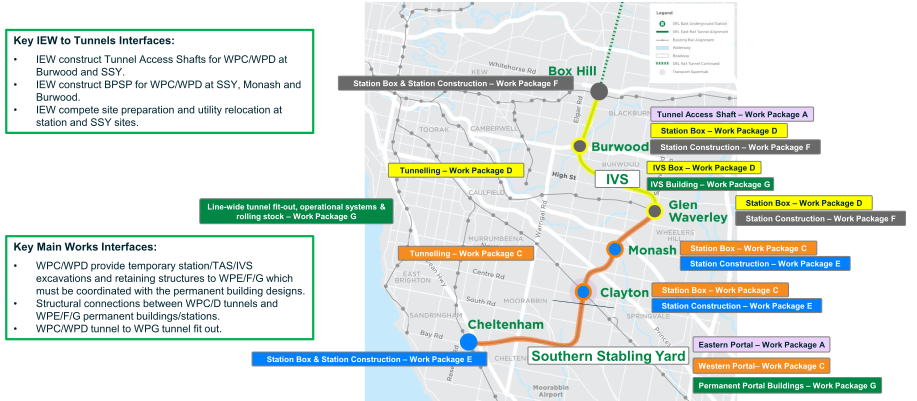
Source: SRLA.
These interfaces create risks to project delivery on time and on budget. These interface risks are particularly complex and critical for the 2 station alliance contracts and the Linewide alliance. Figures 12 and 13 highlight the range and nature of these interfaces.
Figure 12: Interfaces between stations packages and the Linewide package
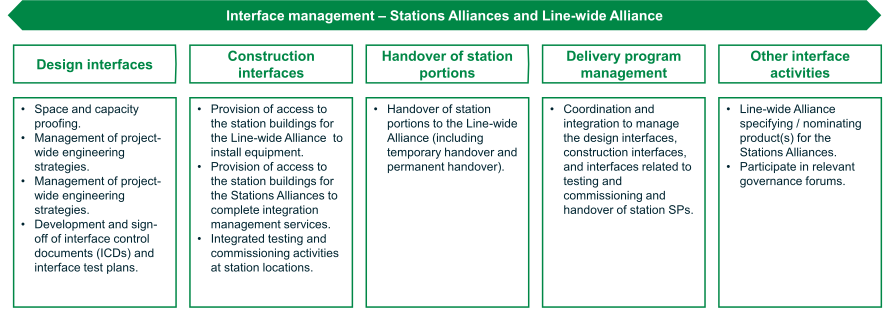
Source: SRLA.
Figure 13: Further detail on interfaces and key dependencies between stations and Linewide packages
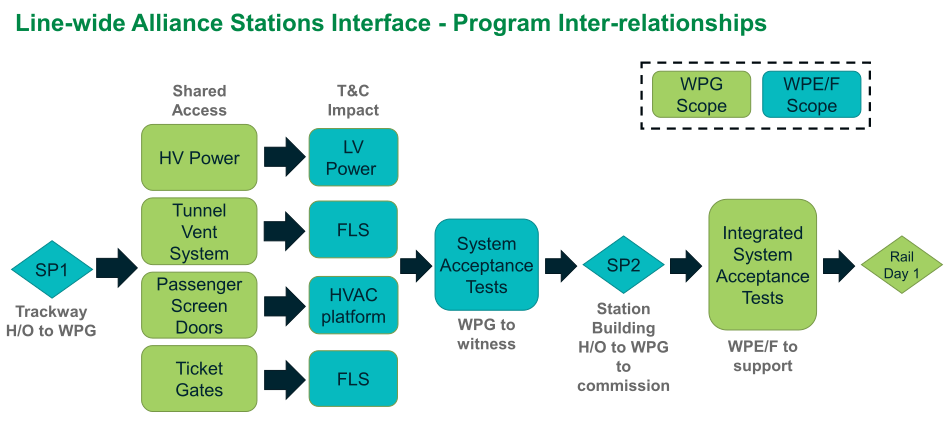
Note: SP stands for separable portion; HV stands for high voltage; LV stands for low voltage; FLS stands for fire and life safety; HVAC stands for heating, ventilation and air conditioning; H/O stands for handover; T&C stands for testing and commissioning.
Source: SRLA.
Successful management of these interfaces is critical to ensure a smooth handover between works packages and to prevent delays in one works package from causing delays in another package(s) and putting the delivery of the project at risk. For example, WPG tunnel fit-out cannot occur until the tunnels have been dug and all relevant works have been signed off and prepared for handover by the contractor.
SRLA demonstrates keen awareness of interface risks and has strategies and contractual and commercial mechanisms in place, or proposed, to manage them. These include building contingency allowances into its delivery program to absorb delays in the delivery of individual packages.
SRLA's key strategy is to incentivise package contractors to deliver key interface milestone works on time and to coordinate activities including design and delivery of critical site interfaces.
For example, the Linewide package contract includes a reward regime to incentivise timely completion of key interface milestones. The contract specifies 14 integrated or shared milestones across works packages E, F and G and the maximum reward amounts.
The total reward amounts available are not material in terms of the overall contract cost estimated for each package. Given this, the effectiveness of this regime remains to be seen. It may have had more chance of incentivising the desired outcomes if the rewards were greater. However, there are other program timeline–dependent KPIs in place for each individual package that add to the incentives for contractors to complete key interface-related works on time.
The scale, complexity and critical interfaces between the SRL East works packages mean there is significant potential for delay and consequential additional costs. Any significant failure by a package contractor to coordinate and deliver interface-related works to the required time, scope and/or quality will put the timely delivery of other packages at risk. This may result in significant cost risks for the state if it needs to renegotiate timelines for multiple packages.
Another key risk relates to increasing costs for construction material and labour. The use of cost reimbursement contracting models means the state has retained most of the risk for increased project delivery costs due to rising costs for materials and labour inputs.
This risk was reinforced in:
- DPC and DTF advice to the government on the performance of major capital projects during 2025, highlighting that cost escalation for materials and labour remain the top risks to project delivery
- SRLA's advice to its board in July 2025 on the stations procurement outcomes, indicating that trade prices have increased significantly over the past few years by around 20 to 30 per cent and that market pricing for similar projects in New South Wales was also showing a 30 per cent increase in costs.
It will not be until SRLA has a contract in place for all packages that the overall project budget can be assessed for adequacy. Even if the contracted outcomes seem to support the adequacy of the overall budget, there is significant risk as packages move into delivery, due to the significant and complex interfaces across the main works packages and the contracting models used by SRLA, which are based on ITC, reimbursable cost, or alliance contracts.
Termination clauses
The commercial framework and contracts used by SRLA for the project include the features we expected to see for a major infrastructure construction project, including termination, suspension and step-in rights for the state.
We provide a short summary of termination provisions in the signed contracts for the tunnels and Linewide packages and in the draft contracts for the stations packages in appendices E, F and G.
In summary, the contracts allow the state to terminate the contract if certain defined conditions are met, such as a major default by the contractor. The state also has the right to terminate the contracts 'for convenience'. This means that the state can terminate the contract for any reason.
The contracts also include provisions dealing with other significant events or circumstances that may impact on the project and the capacity of the parties to fulfil their obligations under the contract. This includes provisions for what are referred to as force majeure events, which are outside the control of either party, and events such as changes in law which impact the project. Force majeure events include natural disasters, fire and explosions that occur at or near a project site and are not caused by the state or the contractor and that prevent work on the project.
The stations and Linewide alliance contracts do not explicitly include force majeure termination clauses. Unexpected events that may impact project delivery are instead resolved through the respective alliance's shared risk model, with particularly significant cases triggering an adjustment event or temporary suspension of works. The state still maintains sole discretion to terminate the contract for convenience in this instance. This incentivises NOPs in the alliance to overcome unexpected challenges during delivery to keep the project on track.
If a works package contract is terminated due to a major default by the contractor, a force majeure event, or if the state exercises its right to terminate the contract for convenience, the contractor is entitled to a termination payment.
The contracts include provisions dealing with how any termination payments will be calculated. For example, the tunnels contracts provide that if the state terminates for convenience, the contractor is entitled to be paid all actual reimbursable costs incurred to that point, plus a range of other costs including costs reasonably incurred by the contractor in the expectation of completing the whole of the contracted works. The contractor is entitled to COP percentage on actual reimbursable costs incurred to the point of termination, but not on other costs reasonably incurred in the expectation of completing the whole of the contracted works.
Our analysis of the relevant contract provisions on the calculation of termination payments did not highlight any significant concerns that the provisions would result in excessive or unreasonable payments to contractors. However, the termination payments provided for under the contracts could be significant depending on what stage of delivery a works package is at.
The contractors for the tunnels, stations and Linewide construction works do not have a right to terminate the contracts with the state.
If the state exercised its termination rights to cancel the project and did not proceed with it there would also be significant sunk costs that would need to be written off. At 30 June 2025, the SRLA financial statements included construction in progress assets of around $3.6 billion.
The state can also direct a contractor to suspend their activities on the project. If the state suspends the contract it is still required to pay the reimbursable costs of the contractor during the period of contract suspension, except where the suspension:
- is caused or contributed to by an act or omission by the contractor, including breach of the agreement
- is due to a determination by SRLA that the:
- AOC will or is likely to exceed the TOC by more than 100 per cent of the aggregate of the CRC
- practical completion is, or is likely to be delayed beyond the agreed practical completion date under alliances by more than 180 days for WPG, or by more than 60 days for WPE and WPF.
Unfunded and underfunded costs
To support the achievement of project benefits and value capture revenue targets the state will need to incur significant costs that are either not covered at all, or not fully covered, by the published project cost estimate of up to $34.5 billion and SRLA's project budget.
These costs are shown in Figure 14. We provide a brief explanation for each cost under the figure.
Figure 14: Unfunded and underfunded costs
| Cost type | Total cost estimate | Included in project cost estimate? | Covered in SRLA project budget? |
|---|---|---|---|
Operate and maintain the SRL East rail service for 15 years
| $3.9 billion
| N/A
| N/A
|
SIW at 3 SRL East stations
| $1.7 billion
| Partly
| $104 million
|
Property acquisitions for state-led development revenue
| $500 million to $750 million
| No
| No
|
Voluntary Purchase Schemes
| Up to $425 million
| Yes
| Net budget impact of $0 based on budgeted:
|
Glen Waverley MLCP
| Up to $137 million
| Yes
| $84 million
|
Note: SRLA's budget at December 2025 showed a net cost of $0 for the Voluntary Purchase Scheme because it assumed that all purchase and holding costs for properties acquired under the scheme will be fully recovered by future sale of the same properties.
Source: VAGO, based on information from SRLA and DPC.
SRL East rail service 15-year operations and maintenance franchise
SRLA plans a future funding request to the government to meet the costs of the first 15 years of the O&M franchise for the SRL East railway. These costs will need to be funded to support achievement of the project benefits.
Consistent with the approach to funding other significant rail infrastructure works, the O&M costs are not included in the government's announced cost estimate for the project of up to $34.5 billion. This cost estimate covers the construction costs for the rail infrastructure and $1.5 billion for precinct development works; it does not include any provision to fund the O&M of the railway.
The WPG contracts signed in December 2025 included a franchise agreement covering the O&M of the SRL East railway for 15 years at a total cost of $3,874.2 million, in nominal terms.
The government approved SRLA signing this franchise agreement and noted that SRLA will make the funding request to the government before 2035 to meet the franchise costs.
The franchisee will not receive a share of the farebox revenue, leaving the state to fully bear the patronage risk on the new rail line. DTF advice to the government in December 2023 indicated that SRL farebox revenue was not expected to be sufficient to meaningfully offset the costs of operating and maintaining the railway. This is consistent with the rest of the public transport network. Our March 2026 report to the Parliament Modernising myki found that Victoria's public transport system is heavily subsidised.
Station interchange works
The SIW consist of underground paid-area connections between the 3 SRL East stations at Cheltenham-Southland, Glen Waverley and Box Hill and adjacent stations on the Melbourne Metro rail lines. A fourth paid-area connection at Clayton station is less complex and costly and will be delivered separately under the WPE stations south package. These are the 4 SRL East stations situated in direct proximity to existing Melbourne Metro stations.
The government approved the delivery of paid-to-paid connections or interchanges between the SRL East and relevant Melbourne Metro rail stations in October 2020, but did not approve any funding for, or the timing of, these works.
The interchanges are intended to enable rail passengers to quickly transfer between the SRL and Metro train stations without needing to leave the paid fare area, and involve underground walkable connection tunnels.
The government approved $75 million for design and development work on the station interchanges as part of the main works funding approval in March 2021.
The Environment Effects Statement (EES) inquiry process for the project examined the station interchange issue in 2022 and found that:
- the addition of paid-area connections would not be required to enable the project to meet its transport objectives, but would add significant value
- an underground paid-area connection should be delivered at Box Hill as soon as practicable and preferably concurrently with SRL East.
In October 2023 the government endorsed a procurement strategy for the SIW based on SRLA delivering the interchange works alongside the stations packages using a separate 'brownfield' alliance contract. This decision was based on SRLA advice that:
- the total projected cost for interchanges at Cheltenham-Southland, Glen Waverley and Box Hill was $1.7 billion
- the approved scope and budget for the stations packages already includes the design and construction of adits at each of the 3 stations
- there was $754 million in unfunded station interchange scope, excluding cost provisions for contingency and escalation.
Figure 15: New SRL station and existing Metro station at Glen Waverley showing adit
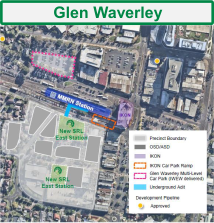
Source: SRLA.
Adit
Underground passageway or tunnel connecting an SRL station concourse to the adjacent Melbourne Metro station concourse. Figure 14 shows the adit between the new SRL station and the existing Metro station at Glen Waverley.
DTF advised the government in October 2023 that it was unable to substantiate SRLA's cost estimates for unfunded SIW because the scoping and design activities were at an early stage.
SRLA told us in early 2026 that:
- its 2023 estimate of $754 million, excluding escalation and contingency allowances, for unfunded station interchange scope was preliminary and a best-case scenario estimate
- its current total cost estimate for SIW is unchanged from 2023, at $1.7 billion
- the current project budget only includes $104 million for SIW.
SRLA's total cost estimate for unfunded interchange works is $1.6 billion. This comprises the $754 million referred to above, plus around $860 million for contingency, escalation and other costs.
SRLA advised us that it is no longer proposing to construct the underground station interchange at Box Hill as part of SRL East works. SRLA's cost estimate for this interchange is $954 million. SRLA indicated that it will recommend to the government that the Box Hill interchange be built as part of the future SRL North scope. This is despite the recommendation from the EES that the Box Hill interchange be given priority.
SRLA advice to us at the end of this audit indicates that it is now proposing to only deliver SIW at Cheltenham-Southland as part of the SRL East complementary works. It did not provide any evidence on the likely costs and savings of this approach.
The scope and funding for SIW are unresolved. SRLA advised the government in 2023 that it would report back in 2024 on detailed scope and cost estimates and would then provide a further submission on funding these works. Neither of these submissions were provided in 2024 or 2025, and they remain outstanding.
The absence of certainty on the scope and funding of interchange works is creating issues for the procurement of the stations packages. Advice to the government from central agencies in July 2025 indicated that a government decision on whether to proceed with, and how to fund, the interchange works should be made as soon as possible to streamline procurement for WPF. SRLA advised us at the end of this audit that it is planning to provide further advice to the government on SIW in August 2026.
SRLA advice to its board in December 2025 indicated that the government is not expected to make a decision on the interchange works until 2027. Delaying the decision until 2027 is likely to mean that SRLA will have to manage the interfaces with the 2 stations packages after contracts for these packages have been signed, rather than being able to specify its requirements as part of the procurement process. This will add to project delivery complexity and risk and mean increased costs.
Property acquisitions for state-led development value capture revenue
As part of its funding and financing strategy for the project the government approved a value capture revenue target of $1.4 billion over a 30-year period for profits from state-led property development in SRL East precincts.
SRLA and DTF have been assessing strategies to achieve this revenue target since 2021. Their advice to the government acknowledges that there will be significant up-front costs and risk involved in state-led property development.
The government's cost estimate for the project of up to $34.5 billion does not include any provision or cost estimate to fund state-led property development.
The government is yet to approve a final strategy and approach for state-led development. However, SRLA advice to the government in May 2025 identified 21 strategic development sites for potential acquisition by the state for development or resale to contribute to the revenue target.
SRLA's advice noted that there is no funding allocated in the current SRL East budget to meet the acquisition cost of between $500 million and $750 million for these sites.
The government's decision on SRLA's advice in May 2025 noted that there:
- is no funding currently allocated within SRL East’s TEI of $34.5 billion for proactive land acquisition for state-initiated property development purposes
- would be a future submission to the government seeking approval to acquire additional select sites and the funding for this.
The report back to the government seeking funding and approval for property acquisition had not been provided by the end of 2025.
Voluntary Purchase Scheme for properties impacted by the project
SRLA is required to establish a Voluntary Purchase Scheme (VPS) for residential, commercial and business properties impacted by the project construction works.
The VPS requirement was an outcome of the Minister for Environment and Climate Action's August 2022 assessment of the EES for the project. Similar schemes have been established for other Big Build projects with significant impacts on residential and other property owners during construction.
Property owners who meet the relevant criteria can opt into the scheme and apply to sell their property to SRLA. The purchase price is based on the Valuer-General's assessment of the unaffected market value of the property. This means the valuation ignores the impact of the project works on the property value. SRLA will also reimburse reasonable removal and other costs incurred by property owners who take up the purchase offer.
SRLA obtained advice from a consultant in early 2023 on the potential cost of the VPS, based on a preliminary financial model that was never finalised, that the total nominal costs of the VPS covering:
- both residential and commercial properties could range between $125 million, based on 30 per cent take-up, and $425 million based on 100 per cent take-up, including a 20 per cent contingency
- solely residential properties could cost between $65 million, based on 30 per cent take-up, and $216 million based on 100 per cent take-up, including a 20 per cent contingency.
In March 2023 SRLA provided advice to the SRL interdepartmental committee that the VPS covered up to 275 potentially eligible residential properties and had a maximum cost of $875 million, assuming every eligible property opts in. SRLA had undertaken its own modelling on VPS costs but cannot locate documentation explaining the basis for the $875 million estimate.
SRLA provided advice to the government in April 2023 on the VPS and its potential cost. The government noted SRLA's conservative cost estimate of $65 million for the residential VPS and approved SRLA funding the scheme from available contingency funding for the I&EW packages.
DPC advice to the government in April 2023 stated that:
- SRLA would seek endorsement of the VPS for business properties at a later time
- the business VPS will be the first of its kind in Victoria and set a significant precedent for future government projects.
SRLA subsequently implemented a VPS for residential properties in Heatherton and planned to extend this to properties in Mount Waverley in March 2026. At 31 December 2025:
- 8 landowners had formally opted into the scheme, all in Heatherton
- SRLA's finance report showed actual expenditure of $2.3 million on the scheme to the end of 2025.
SRLA told us that it had discussions with DTP during the second half of 2025 on the VPS for business and commercial properties. SRLA advised that there is no current timeline for the provision of further advice to the government on this scheme, and that it has not updated its cost estimates.
In addition, SRLA advised us that it will also assess the need to implement a post-construction VPS closer to 2035, when the potential noise and vibration impacts from operating the railway, if any, will be better understood.
The full cost of the VPS for the project will not be clear for a number of years. SRLA's whole of life project budget at 31 December 2025 showed a net cost of $0 for the VPS. This is not transparent because it:
- does not recognise timing differences given that significant VPS costs may be incurred to purchase and manage properties under the scheme up to 2035, but revenue from future sale of these properties will not be realised until post-2035 and is subject to significant uncertainty
- includes no provision for the:
- business and commercial property VPS costs
- post-construction period VPS.
SRLA should update its whole-of-life project budget with a revised estimate of VPS costs to 2035 for residential, business and commercial properties and the holding costs that will be incurred in managing acquired properties.
Glen Waverley Multi-Level Car Park
SRLA is required to provide effective replacement car parking in Glen Waverley as one of the environmental performance requirements from the 2022 EES approval.
SRLA's cost estimates for the MLCP have ranged between $50 million in 2021 and $150 million in October 2024. SRLA:
- initially included the MLCP in the main works scope
- paid the WPA contractor around $7.5 million in 2023 to develop a design and cost estimate for the works for inclusion in the WPA scope
- developed its own cost estimate for the MLCP of $137.4 million in 2024 based on the WPA contractor's design and pricing
- in 2024 decided not to include the MLCP in the WPA scope and to seek a cost estimate from the WPD contractor after that contract was awarded, advising the government in October 2024 that the estimated cost of this option was around $150 million
- obtained a cost estimate and pricing proposal from the WPD contractor for the works in 2025, of around $116 million.
SRLA is now proposing to deliver the MLCP as part of the scope for WPF because it considers that the MLCP scope and timeline are best aligned with the WPF works schedule. SRLA told us at the end of this audit that:
- the WPF preferred respondent's pricing proposal is consistent with the budget allocation for the car park
- it plans to confirm this as a scope variation on that package by the end of August 2026 if it proceeds with the works
- it is also exploring alternative lower-cost options to meet the requirement for replacement parking.
The timely construction of the MLCP at Glen Waverley has implications for the stations packages. Advice to SRLA's Risk and Integrity Committee in November 2025 indicated that if the MLCP is not completed in time to meet project requirements, WPF may have significant delays due to access issues.
SRLA's current project budget includes an allowance of around $84 million for the MLCP scope. SRLA asserts that the car park can be built for this budget as part of WPF, but this costing is yet to be confirmed, and is below SRLA's own cost estimate for the works. The WPD price proposal for the MLCP was 38 per cent higher than $84 million.
SRLA had incurred costs of around $28.2 million in relation to the MLCP to the end of December 2025, including $16 million to acquire land for the car park and payments to a number of contractors for design and pricing proposals.
Appendix F on the stations packages includes further information on the MLCP under the heading 'Risks and emerging issues'.
The project is unlikely to be delivered on time
Target and expected timelines
Construction on SRL East began in June 2022 and is scheduled for completion in 2035.
The project has already experienced significant delays in procurement and delivery, and is unlikely to be completed in time to meet the government's commitment to run train services by 2035.
Figure 16 shows our understanding of SRLA's targeted, contracted and forecast completion dates for each works package.
Figure 16: Planned and forecast completion dates for SRL East works
| Completion date | |||
|---|---|---|---|
| Works package | SRLA initial target | Contracted | SRLA forecast |
| Initial and early works | |||
| WPA | July 2025 | July 2025 | March 2026 |
| WPB | December 2025 | Various | November 2025 |
| SRLA-managed works include Western Port-Altona-Geelong (WAG) oil pipeline relocation | July 2025 | July 2025 | February 2027 |
| Main works | |||
| WPC: tunnels south | July 2029 | February 2030 | December 2030 |
| WPD: tunnels north | July 2029 | April 2029 | April 2029 |
| WPE: stations south | December 2033 | TBC | April 2034 |
| WPF: tunnels north | January 2034 | TBC | November 2034 |
| SIW | September 2034 | TBC | TBC |
| WPG: Linewide works alliance | September 2034 | May 2035 | December 2035 |
| Main works – precinct works | TBC | TBC | TBC |
Note: The target dates are based on SRLA's project reference schedule and other targets developed to inform procurement processes for each package.
The forecast completion dates are based on SRLA advice and evidence provided to us in early 2026 including its master summary schedule for project delivery. The forecast completion date for WPG includes a 7-month contingency allowance from the contracted completion date in May 2035 to provide for potential future delays or changes to planned completion dates.
Source: VAGO, based on information from SRLA.
SRLA's forecast completion dates are as at January 2026 and reflect the impacts of actual and expected delays based on project procurement and delivery progress to date.
The key delays to date have included:
- at least a 6-month delay in finalising the I&EW package due to contamination and other issues
- more than a year delay in relocating the WAG oil pipeline because it has been transferred from WPA to WPG
- at least a 2-month delay in delivering WPC, but SRLA forecasts a delay of up to 10 months
- a 17-month delay in signing the contract for WPG
- delays of at least 12 months in finalising procurement and signing contracts for the stations packages.
These delays result from a combination of factors including known risks materialising such as contamination, SRLA delays in providing land access to contractors and the impacts of government decisions to delay spending on the project. We examine the impacts of those government decisions below.
The most significant risk to SRLA delivering the project on time is that the state does not yet have enough approved funding in place to sign the contracts for the 2 stations packages, WPE and WPF. SRLA is targeting contract award for WPF in August 2026 and May 2027 for WPE.
In December 2025 DPC advised the government that if the preferred contractor for WPE is not approved before the caretaker period starts for the November 2026 state election, the start of SRL East rail services will be delayed until mid-2036 and there will be a project cost increase of up to $1 billion.
SRLA's contract for the final work package, the Linewide package, requires completion in May 2035. SRLA has around a 7-month contingency in its delivery schedule in case there are delays in completing the tunnelling and stations packages. It is forecasting that rail services will start running through SRL East on 31 December 2035.
However, it is unclear if SRLA's schedule contingency will be enough to cover known and future risks to the project's delivery.
SRLA advised us at the end of this audit that it is examining a range of options to adjust the project schedule and works sequencing to improve its capacity to deliver the project on time. SRLA's proposed actions in this area have not been finalised or agreed with relevant existing and prospective contractors, meaning we cannot provide any assurance on the likelihood of success.
Project schedule
Figure 17 shows the SRL East project delivery schedule by works package as at early 2026.
Figure 17: Project delivery schedule by works package as at early 2026
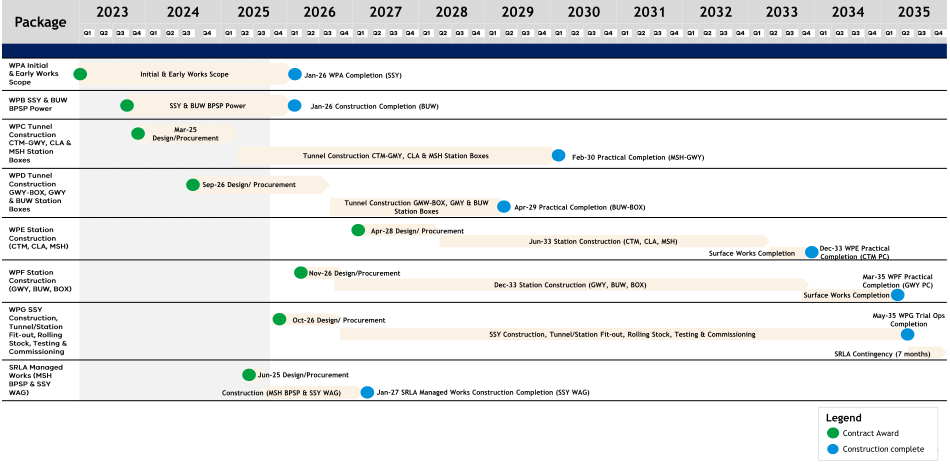
Source: SRLA.
Figure 18 shows the current SRL East project delivery schedule by location. Key information includes:
- colour coding for individual packages
- gaps between 'outgoing' and 'incoming' milestones, representing 'float' or contingency in the schedule
- the high-level project-wide critical path, indicated by the solid red line arrow; each package has its own critical path; and the dotted red line relates to activities that are near the critical path
- the contingency at the end of the project, shown by the beige bar at the end of 2035, to have train services running before the end of 2035.
Figure 18: Project delivery schedule by location with works package details as at early 2026
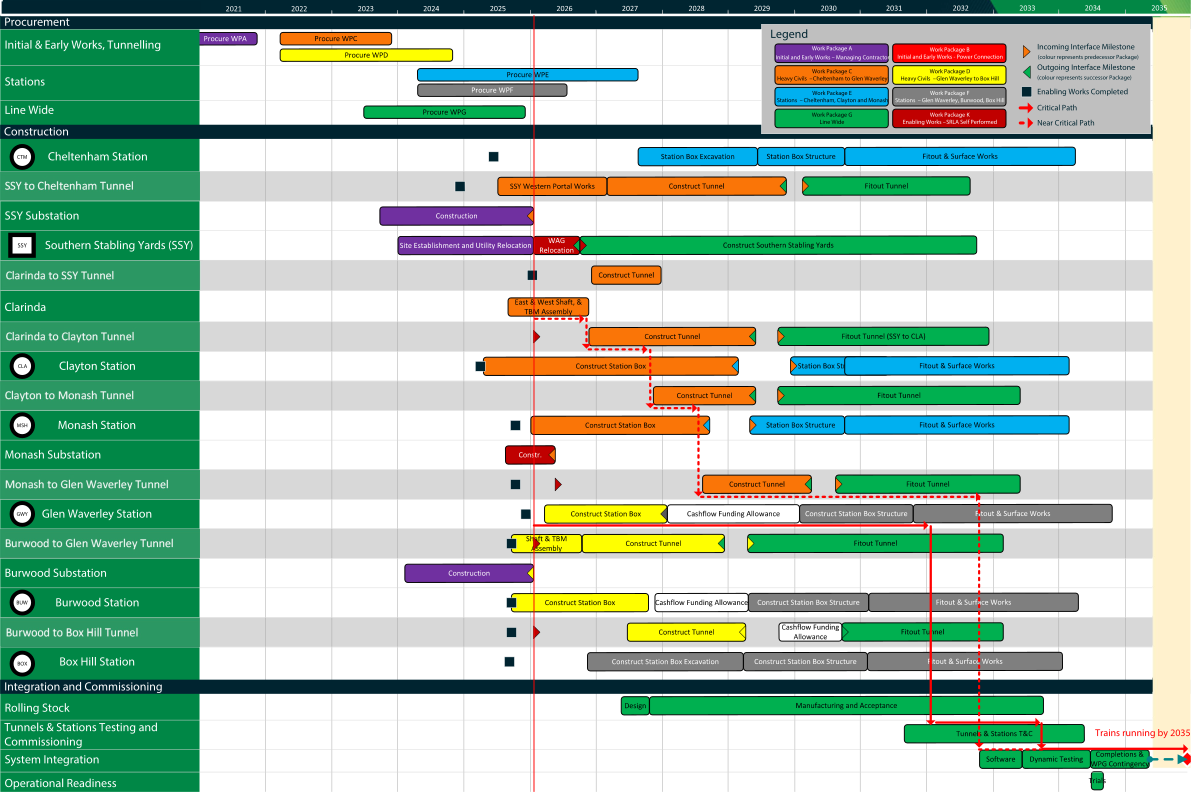
Source: SRLA.
Figure 18 demonstrates the interrelationships and dependencies between packages. This creates risks given that any material underperformance against schedule by one package will have cascading impacts on other packages. This may require SRLA to renegotiate changes to multiple contracts and put the target project completion date at risk.
Schedule risk assessments
Capital project schedules, particularly for contractual purposes, are typically expressed in terms of single-point or deterministic milestone target dates. These dates are developed based on an understanding of project scope and the tasks required to deliver that scope, and are set by including allowances for the potential time impacts of known risks to schedule such as weather, site conditions and supply chain uncertainty for key materials and other inputs.
Schedule risk analysis (SRA) involves quantitative analysis to assess the likelihood and range of time impacts arising from expected sources of uncertainty on a project's schedule. SRA typically involves the use of statistical methods such as Monte Carlo simulation to forecast potential delays. The outputs of SRA include probabilistic ranges for milestone dates rather than single-point dates.
SRLA has prudently sought SRA advice on a number of packages. Given the ongoing procurement processes, this advice was largely based on the schedules proposed by the preferred respondents for packages rather than final contracted programs.
The SRA results on individual packages indicate a high probability of delays across the main works packages. SRLA has incorporated contingency into its delivery schedule program to allow for unexpected, but likely, delays. The residual issues relate to whether sufficient contingency and float have been provided for, and the flow-on impacts of any extended delays on key package interface milestones.
DTF's independent reviews of SRLA cost estimates for main works packages have included a strong focus on SRLA's package delivery schedules, given the potential for delays to impact on final construction costs. These reviews were largely undertaken before the impacts of capital reprofiling on the project master schedule or program were understood.
The DTF reviews in 2024 highlighted that SRLA's approach is generally sound, and identified the need for an ongoing focus on SRAs, including an SRA based on the project-wide integrated master schedule. SRLA addressed this with 2 further SRAs during 2025, which focused on the Linewide package (WPG) but examined the broader whole-of-project schedule.
SRLA told us that the second of these SRAs in September 2025 covered all packages, based on the most current information available at the time, including in relation to the government requirements for a slowdown of project spending. The review found a 90 per cent confidence that WPG can be completed by May 2035, even with the funding delay constraints.
The review recommended that SRLA:
- further explore opportunities to reduce or remove funding constraints to ensure continuity of critical path construction works and de-risk overall project delivery
- re-run the SRA based on key milestone dates for the stations packages prior to contract award, to validate and update current assumptions
- re-run the SRA following receipt of the WPG contractor program
- conduct regular project-level SRAs to ensure activity progress, risks and constraints are consistently monitored and updated as the project progresses.
It will be important for SRLA to continue to monitor, qualitatively assess and update the project wide master schedule as contracts are signed for the stations packages, and as packages move further into delivery, to understand and manage schedule risks.
Current and residual risks to on-time delivery
We have an appendix for each works package that outlines key features, procurement and delivery progress and emerging issues and risks. This includes information on any risks to timely completion of each package.
Any significant failure by a package contractor to coordinate and deliver to the required time, scope and/or quality will put the timely delivery of other packages at risk and result in significant cost risk for the state. This risk is particularly acute for works on the project critical path.
It is unclear whether the cost and schedule contingency allowances made by SRLA will be sufficient to absorb the impacts arising from known threats to project delivery such as contamination and the complex delivery and milestone interfaces between the works packages.
Initial and early works
SRLA expected the I&EW WPA to be closed out in March 2026. Relocation of the WAG oil pipeline was included in WPA but has been transferred to WPG and is unlikely to be completed until early 2027.
Tunnels packages
Despite being relatively early in the delivery phase, both tunnelling packages, WPC and WPD, are facing potential delays due to real and emerging risks around ground conditions including contamination, scope variations and site access. SRLA is expecting a formal claim from the WPC contractor for time and cost relief to manage poor ground conditions at the Clarinda TBM launch site and contamination in the SSY.
SRLA has extended the target contract completion date for WPC from February 2030 to April 2030. However, SRLA is forecasting a completion date for WPC of December 2030.
WPD is currently scheduled to meet its contracted practical completion date of April 2029 after the planned reprofiling of expenditure was abandoned. However, a one-month delay is forecast for tunnelling west from Burwood to Glen Waverley resulting from delayed handover from the WPA contractor. SRLA has indicated that mitigation works are underway to manage and recover this time but has not advised what these works are.
These risks may impact other works packages and the SRL East delivery program as a whole. The tunnel works at Clarinda are on the SRL East delivery program near-critical path, meaning delays are more likely to impact the overall delivery schedule.
Stations packages
Government decisions directing SRLA to defer spending on the project caused delays in the procurement process for the Linewide package. This has resulted in flow-on delays for the stations packages procurement process because respondents needed certainty about key design elements from the Linewide package to inform their bids and prices.
The other key uncertainty impacting the timing of the stations packages is a lack of approved funding. The Australian Government confirmed a further funding contribution of $3.8 billion for the project as part of its budget in May 2026. This funding will enable the state to sign a contract for the first of the 2 stations packages. However, the state does not yet have enough approved funding in place to sign the contract for the second stations package.
SRLA is currently targeting contract award for WPF in August 2026 and for WPE in May 2027. This is around 12 months behind schedule.
Advice to SRLA's board in October and December 2025 indicated that:
- the delay is increasing pressure on schedule contingency in the outer construction years, which is critical to provide sufficient time, up to 2 years, for the testing of rail systems and rolling stock between Cheltenham Station and the SSY
- nominating the preferred respondent for WPE is on the project critical path to achieve SRL East day one rail services in 2035
- delays to the stations procurement process have pushed the WPE preferred respondent decision close to the caretaker period before the November 2026 state election
- obtaining a government decision on the WPE preferred respondent before the caretaker period will require competitive proposals that meet project requirements and budget, with minimal areas requiring clarification and an optimised evaluation and decision-making process.
In December 2025 DPC advised the government that if the preferred contractor for WPE is not approved before the caretaker period starts for the 2026 state election, there will be a significant cost increase across work packages E, F and G and the start of SRL East rail services will be delayed beyond the end of 2035.
Linewide package
SRLA's contract for the final work package, the Linewide package, requires completion in May 2035. Meeting this date relies on the tunnelling and stations package contractors finishing and handing over sites on time.
SRLA has around a 7-month contingency in its delivery schedule in case there are delays. It is forecasting that services will start running through SRL East on 31 December 2035.
However, it is unclear if SRLA's schedule contingency will be enough to cover known and future risks to the project's delivery. These risks include the critical interfaces between the SRL East works packages we discuss above.
The scale and complexity of the package interfaces mean there is a significant potential for delay across the project if a package contractor fails to coordinate and deliver interface-related works to the required time, scope and/or quality. This would put the timely delivery of other packages at risk and potentially result in significant cost risks for the state if it needs to renegotiate timelines for multiple packages.
Impacts of government decisions to slow down project spending
Summary
Government decisions in 2024 to slow spending on SRL East across the state Budget forward estimates period have increased project costs and created additional risks to the on-time delivery of the project.
SRLA actively sought to implement the required deferral of expenditure and transparently advised the government that delaying spending in the early years of construction will increase the final cost of the project by around $1 billion and create schedule and other issues and risks to project timelines.
SRLA was not able to implement the spending slowdown and the government has approved it spending more in the period 2023–24 to 2027–28 to address emerging cost pressures on the project.
In addition, the actions to try and implement the spending slowdown have delayed finalisation of procurement for the Linewide and stations packages and added to project costs.
April 2024 decision to delay project spending
In April 2024 the government directed SRLA to defer around $1.4 billion in capital spending across the state Budget forward estimates period, 2023–24 to 2027–28. This was referred to as capital reprofiling.
The direction to SRLA required it to reduce and delay spending by pushing substantial works out beyond the forward estimates period.
This direction formed part of broader decisions for the 2024–25 state Budget to manage challenges to the state's finances and support achievement of step 4 in the government's fiscal strategy, which is to stabilise state debt levels.
The government decision reduced the 5-year (2023–24 to 2027–28) total cashflow for SRL East from $11.2 billion to $9.7 billion. This deferred, or reprofiled, expenditure of $1,456 million out beyond the forward estimates period. Figure 19 shows the before and after figures and the difference.
Figure 19: Impacts of capital reprofiling on SRLA over the forward estimates ($ million)
| Financial year | Approved funding before government decision | Approved funding after government decision | Difference |
|---|---|---|---|
| 2023–24 | 1,937.1 | 1,934.5 | −2.6 |
| 2024–25 | 1,945.0 | 1,768.9 | −176.1 |
| 2025–26 | 2,109.5 | 1,852.2 | −257.3 |
| 2026–27 | 2,073.7 | 1,831.9 | −241.8 |
| 2027–28 | 3,095.0 | 2,316.7 | −778.3 |
| 5-year total | 11,160.3 | 9,704.2 | −1,456.1 |
Source: VAGO, based on information from SRLA and DPC.
SRLA work to defer spending
The government direction to delay project spending created significant challenges for SRLA because:
- the I&EW package was in delivery and experiencing cost overruns and delays
- the contract for WPC had been recently awarded, in December 2023, meaning SRLA would need to conduct post-award negotiations to reduce expenditure
- it would need to try and negotiate changes with the WPD preferred respondent during contract negotiation, leading to potential delays to contract award, or sign the contract without having agreed on the time and cost impacts of slowing expenditure
- the Linewide and stations packages were in procurement, with WPG further advanced, and SRLA expected that:
- it would need to extend the WPG procurement timeline to allow bidders to respond to the requirement to delay major construction works until after the forward estimates period
- delays to the Linewide procurement timeline would also delay procurement for the stations packages because those respondents had to wait for and incorporate relevant Linewide requirements into their submissions.
Notwithstanding these challenges, SRLA actively sought to implement the revised funding profile approved by the government and transparently advised its board and the government on the impacts.
SRLA undertook significant work to defer project expenditure and still meet the government's public commitments to launch TBMs in 2026 and commence rail services by 2035.
Specifically, SRLA:
- extended the procurement timeframes for the Linewide package, which meant the procurement process for stations packages had to be delayed
- amended contract completion dates for WPF and the Linewide package
- revised the delivery program for the project and amended site access target dates for WPF, WPE and the Linewide package.
The revised project delivery program was crucial to deferring expenditure. The revised schedule was based on the following proposed changes to individual works packages:
- WPC: reducing expenditure by around $80 million in the forward estimates period by performing some works for less than the agreed costs included in the contract, or identifying some works that could be delayed without impacting follow-on contractors
- WPD: negotiating a reduction of $245 million in the preferred respondent's proposed TOC by agreeing to reduced or delayed expenditure
- WPE, WPF and WPG: reducing expenditure for these packages by delaying the majority of major construction works until after the forward estimates period, meaning after 2027–28
- contingency: assuming that there would be no expenditure funded from contingency provisions for any works package during the forward estimates period.
In June 2024 SRLA advised its board that the requirement to slow down spending on the project:
- put the project budget and schedule at significantly higher risk, meaning that operational commencement of SRL East in 2035 may not be achievable
- may result in additional costs to taxpayers due to the need to delay planned activity on individual works packages.
SRLA's advice to its board about the cost implications of delaying project spending was reasonable given that:
- most of SRL East expenditure is on an actual cost reimbursement basis, meaning it is subject to fluctuation based on cost escalation over time, so the deferral of works increased escalation risk, as costs would be incurred later than planned
- SRLA would have to negotiate pricing changes and delays to works with both tunnels package contractors in the absence of competitive tension, creating a risk that these contractors would adopt an opportunistic approach to pricing contract variations.
Advice to the government in August 2024
SRLA advised the government in August 2024 that the requirement to delay spending in the early years of construction would:
- increase the final cost of the project by around $1 billion, with $800 million of this attributable to cost escalation arising from delaying expenditure
- create significant risks to the procurement and project delivery schedules, meaning that operational commencement of SRL East by 2035 may not be achieved due to direct impacts delaying contract award for WPG by around 16 weeks, and delaying package completion dates by:
- 32 weeks to 30 March 2030 for WPD
- 63 weeks to 5 April 2035 for WPF
- 26 weeks to 31 December 2035 for WPG
- require additional bid cost reimbursement funding of $20 million for the Linewide package due to the need to extend the procurement phase
- impact WPD costs and delivery schedule, but these impacts could not be confirmed until after the contract is signed later in 2024
- create other schedule and interface issues and risks for main works package timelines and scope.
SRLA's revised delivery schedule for SRL East maintained government's public commitments to launch TBMs in 2026 and commence rail services by 2035. However, the scheduled date for first rail services was changed from June 2035 to December 2035. This reprofiled program includes a contingency of 7 months, held within WPG, from May to December 2035.
SRLA also advised government that it could only reasonably defer $800 million. This highlighted a $600 million shortfall against the deferral target of $1.4 billion. SRLA said it would continue to assess ways to meet the target.
The government noted SRLA's advice and commitment to report back on how it would meet the $1.4 billion reprofiling target. The government also:
- approved the release from previously approved project funding of up to $20 million to reimburse higher than planned bid costs for WPG respondents due to the extended procurement phase
- accepted SRLA's recommendation that it seek to defer $245 million in spending on WPD by negotiating with the successful contractor after, rather than before, the contract is signed in November 2024, effectively ceding leverage to the contractor.
Advice to the government in February to August 2025
SRLA advised the government in February 2025 that:
- it had identified further changes to the project delivery schedule to partly address the $600 million gap advised to the government in 2024 to achieve the government's April 2024 revised funding and spending profile for the project
- the post-contract award negotiations with the contractor for WPD to defer $245 million in spending on that package were continuing.
DTF assessed the information provided by SRLA and advised the government that there were challenges to meeting the government's required funding profile for the project because:
- SRLA still showed a gap in fully achieving the revised funding profile approved in April 2024
- government decisions in late 2024 approving a settlement with the I&EW WPA managing contractor required a spending increase of around $285 million in the forward estimates period to meet the higher costs for this package.
The pattern of SRLA needing to seek approval to spend more rather than less in the period to the end of 2027–28 to address cost pressures on the project continued throughout 2025.
Specifically:
- in May 2025 the Treasurer approved a funding profile of $2,621 million for 2025–26 to address cost pressures on the 2 tunnels packages. This was $769 million higher than the funding profile approved by the government for 2025–26 as part of the April 2024 decision
- in August 2025 the government approved a revised funding profile for the project that brought forward funding of around $1.1 billion into 2026–27 and $275 million into 2027–28 that had previously been allocated to the 2028–29 financial year. This was based on advice from SRLA that the previously approved spending slowdown was not achievable due to cost pressures on works packages A, C and D and from land contamination cleanup costs.
SRLA advice to the government in August 2025 on the results of negotiations with the WPD contractor also confirmed that achieving the targeted deferral of $245 million in expenditure on that package would increase the package cost by around $200 million and put the target project completion date at significant risk.
The government accepted SRLA's recommendation that the contracted expenditure profile for WPD would not be changed.
Reprofiling outcome
SRLA has not implemented the government's April 2024 decision to defer $1.4 billion in capital spending on the SRL East project during the period 2023–24 to 2027–28.
DTF and SRLA confirmed to us that the current approved funding profile for SRL East was endorsed by the government in August 2025. This is shown in Figure 20 together with the approved funding profiles before and after the government decision in April 2024 directing SRLA to defer $1.4 billion in capital spending on the project during the period 2023–24 to 2027–28.
Figure 20: SRL East capital funding reprofiling outcome 2023–24 to 2027–28 ($ million)
| Financial year | Approved funding before April 2024 | Approved funding profile at April 2024 | Approved funding profile at August 2025 | Actual reprofiling outcome |
|---|---|---|---|---|
| 2023–24 | 1,937.1 | 1,934.5 | 1,934.5 | −2.6 |
| 2024–25 | 1,945.0 | 1,768.9 | 2,142.0 | 197.0 |
| 2025–26 | 2,109.5 | 1,852.2 | 2,621.0 | 511.5 |
| 2026–27 | 2,073.7 | 1,831.9 | 2,888.0 | 814.3 |
| 2027–28 | 3,095.0 | 2,316.7 | 2,448.3 | −646.7 |
| 5-year total | 11,160.3 | 9,704.2 | 12,033.8 | 873.5 |
Source: VAGO, based on information from SRLA and DPC.
Our analysis indicates that rather than spending less in this period, SRLA expects to spend around $874 million more than the approved spending profile in place before the government's April 2024 decision, and around $2.3 billion more than the lower funding profile approved in April 2024.
This outcome has been transparently communicated to and approved by the government based on advice from SRLA and central agencies during 2025. That advice has outlined the need to both:
- bring spending forward to address cost pressures and emerging delivery risks on the I&EW package and the tunnelling packages
- abandon efforts to negotiate a works and spending slowdown on WPD.
SRLA's advice to the government in August 2025 also shows a $1.3 billion reduction in spending in 2028–29 as a result of re-phasing funding approved for this year into earlier years. SRLA's project delivery schedule indicates that this spending reduction in 2028–29 will be difficult to achieve if the overall project schedule is to be maintained.
This is because there are significant tunnel and station construction works scheduled for the 2028–29 period. If those works are delayed, the Linewide package works to fit out tunnels with track and power and install network-wide signalling and control systems will be delayed. This would put the project completion target in 2035 at significant risk.
Unintended consequences of attempts to slow down project spending
SRLA's actions to implement the government direction to slow down and defer project spending have delayed procurement, added to project costs and increased the risk that the target project schedule will not be achieved.
SRLA advice to the government in December 2025 indicated that the April 2024 decision to slow spending on SRL East across the state Budget forward estimates period contributed to higher than expected construction cost bids for WPF and WPG, and higher indicative market pricing for WPE.
SRLA's advice suggested that the higher cost bids for these packages indicated that market bidders were including additional risk allowances in their prices in response to the reprofiling requirements to protect against future cost escalation and uncertainty.
The same SRLA advice indicated that reprofiling had introduced greater risk and cost due to:
- reduced program 'float', meaning lower contingency allowances in construction schedules and less capacity to absorb delays while maintaining the overall schedule
- more works on the project's 'critical path'
- increased interface risks
- compressed and 'out-of-sequence works' and additional staging and temporary work driving higher costs
- subcontractors submitting higher prices to manage risk and escalation for works now scheduled to start later than originally expected.
When considered together with the actual reprofiling outcomes, this advice from SRLA clearly indicates that the reprofiling of the project funding has:
- resulted in higher project cost and risk
- not delivered lower spending in the period to 2028–29 to support the government's fiscal strategy for a range of reasons.
4. The strategy to fund the project is not transparent and involves significant uncertainty
At June 2026 there is a $5.5 billion gap in approved funding to deliver the project and significant uncertainty that funding targeted from sources other than the state Budget and debt will be fully achieved.
In addition, public announcements and information on the government's funding strategy for the project lack transparency. The government approved and introduced a levy on all public transport fares in metropolitan Melbourne and regional Victoria as part of the value capture package for the project.
This levy is referred to as the rail improvement charge and will be the single largest source of value capture revenue. It has been raising revenue for over a year but has not been transparently disclosed to commuters and is not fully consistent with the government's value capture policy framework.
The ongoing uncertainty about key project funding streams means that further borrowings or new revenue-raising measures may be required to manage the impacts of funding the project on the state Budget.
Covered in this section:
- Background information
- Government funding approvals, transparency and gap
- Value capture package: content and transparency
- Consistency of value capture package with relevant government policy framework
- Achieving value capture revenue estimates: risks and uncertainty
Background information
Project funding strategy
Advice to the government since 2019 has consistently emphasised that the state cannot fully fund the expected project cost of up to $34.5 billion from the state Budget and debt alone without further constraining limited budget capacity and falling short of the government's fiscal targets.
The government's funding strategy for the project, outlined in the SRL Business and Investment Case in 2021 and in public announcements is that the project will be funded from 3 equal revenue streams:
- $11.5 billion from the Victorian state Budget
- $11.5 billion from the Australian Government
- $11.5 billion from value capture measures to generate new revenue.
The state government announced this funding strategy without securing a commitment from the Australian Government to provide $11.5 billion.
DTF has had primary responsibility for developing the funding and financing strategy for the project and providing relevant advice and recommendations to the government since 2019.
Government funding approvals, transparency and gap
Total approved funding
The state and Australian governments have approved a total of $29.3 billion in funding for the project to June 2026, comprising:
- $23.3 billion from the state Budget
- $6.0 billion from the Australian Government.
State Budget funding
The state government has approved Budget funding of $23.3 billion for the project, but only publicly announced $11.8 billion.
The publicly announced funding decisions are:
- $300 million in May 2019 for the business case and early development work
- $2.2 billion in June 2020 for the I&EW
- $9.3 billion in November 2021 for main works.
In December 2023, the government approved a further $11.5 billion of Budget funding for the project main works. However, it did not publicly announce this funding decision, or clearly disclose it in the state Budget papers.
Australian Government funding and gap
There is a gap of around $5.5 billion between the state's cost estimate for the project of up to $34.5 billion and the approved funding to June 2026.
This funding gap is a result of the Australian Government committing $5.5 billion less to the project than has been assumed and requested by the state government.
DTF advised government in May 2019 that obtaining an Australian Government contribution of $11.5 billion would be unprecedented for a rail project. DTF indicated that uncertainty around the amount and timing of federal funding meant that the financial viability and deliverability of the project would rely on alternative funding sources being identified, including value capture.
To June 2026 the Australian Government has approved a total of $6.0 billion in funding for the project comprising:
- $2.2 billion approved in 2022 for 'no regrets' spending on land acquisition, geotechnical and development works and utility upgrade costs
- a further $3.8 billion approved as part of its May 2026 Budget for 2026–27.
The state continues to seek the full $11.5 billion from the Australian Government to address the funding shortfall. Central agency advice to the government during 2025 consistently identified the need to secure more funding from the Australian Government as a critical issue.
Our analysis of Australian Government Budget papers indicates that a further contribution of $5.5 billion in its next Budget would take the total Australian Government contribution to $11.5 billion. This would be unprecedented for a single rail project.
The Australian Government Budget for 2026–27 shows Australian Government funding contributions to state and territory rail projects to 2029–30. Figure 21 shows Victoria's share of the Australian Government's announced funding commitments for rail projects for the periods 2026–27 to 2029–30 and 2027–28 to 2029–30 is around 70 per cent for both periods. This is before any additional funding for SRL East.
Figure 21: Rail investment component of Australian Government Infrastructure Investment Program
| Funding period | Total Australian Government funding ($ million) | Victoria's share of total funding ($ million) | Victoria's share of total funding (per cent) |
|---|---|---|---|
| 2026–27 to 2029–30 | 10,692.1 | 7,809.6 | 73 |
| 2027–28 to 2029–30 | 8,638.2 | 6,107.0 | 71 |
Source: VAGO, based on Australian Government Budget Paper No. 3 2026–27.
The Victorian Government messaging that SRL East is actually a housing project, and the suggestion it warrants additional federal investment on that basis, is not transparent given that the project includes no approved scope or funding for housing construction.
The state is not seeking the additional $5.5 billion from the Australian Government to fund the costs of housing. Any additional funding from the Australian Government will be used for the second stations package contract and to fund non-rail precinct infrastructure works of more than $1 billion.
DTF advised the government in November 2024 that if no further federal funding is forthcoming the state could extend the end date for the value capture measures from 2062 to 2082 to generate additional revenue to service additional state borrowings. However, the same DTF advice noted that preliminary modelling indicated that the cost of additional state borrowings over a 60-year period is likely to exceed the additional revenue that may be generated.
The Victorian Government has provided further information to Australian Government officials to support the request for additional funding. Infrastructure Australia's published assessment of the SRL East project in early 2025 recommended that the Australian Government should receive and approve a comprehensive funding and financing strategy, with supporting quantitative analysis that details how value capture will fund one-third of SRL East’s cost, before committing further funding to the project. The state has not provided complete information on the approved value capture package.
In June 2025 the Victorian Government approved DTP providing the SRL East funding and financing strategy implementation plan to the Australian Government to support engagement on an additional funding contribution to SRL East. This implementation plan was approved in November 2024 but does not include any information on the rail improvement charge implemented in January 2025 to fund the project. The rail improvement charge is the largest single revenue-raising measure and is projected to provide around half of all value capture revenue.
Implications of funding gap
The funding gap of around $5.5 billion means the state does not have sufficient funding approved to sign the contract for the second stations package. This package is currently in procurement.
SRLA's initial target date to award the contract for the second stations package was May 2026. SRLA is now targeting contract award for WPE in May 2027. The funding shortfall needs to be resolved before the WPE contract can be signed.
If further Australian Government funding is not approved and sufficient to fund the WPE contract, the Victorian Government will need to approve additional funding, and finance this with new debt or revenue measures. This is because any further significant delays in signing the second stations contract will put the project completion target at significant risk.
Value capture package: content and transparency
Summary
Value capture refers to the government capturing a portion of the incremental economic value created by government investments, activities and policies to assist in funding those investments and activities.
The accepted policy intent of value capture measures is to require those benefiting from significant government infrastructure investments to contribute towards the cost of those investments.
The SRL Business and Investment Case included commentary on the government's intent to rely on value capture revenue to partially meet the costs of the project and stated that:
Inclusion of value capture in the funding mix seeks to ensure a fairer and more equitable allocation of funding than is typical of traditional funding sources, because those who are expected to benefit the most from the project contribute proportionately to its costs. This more targeted funding approach can increase the equity and efficiency of infrastructure funding.
This commentary was consistent with the government's value capture framework in emphasising the intent of value capture measures to support a fairer and more equitable infrastructure funding model by seeking financial contributions from those who benefit most from a government investment.
The government has made a number of decisions on the value capture component of the funding and financing strategy since 2020. The intent is that the state will initially take on additional debt to meet the value capture share of project funding and repay this debt over approximately 40 years using value capture revenues.
However, there is a lack of transparency in the timing and content of announcements about government decisions on the SRL value capture measures. This lack of transparency extends to the decision to impose a new levy on public transport fares. This levy involves an annual 1 per cent increase to public transport fares in addition to the existing annual CPI fare adjustments. It was introduced in January 2025 and will provide more revenue than any other value capture measure, but has not been publicly announced.
In addition:
- the value capture package is also not fully consistent with principles set out in the government's Victoria’s Value Creation and Capture Framework, including equity, transparency and avoiding unintended consequences
- the plan to collect $11.5 billion in value capture revenue over a 40‐year period involves inherent uncertainty about the timing and amount of revenue to be collected and relies on future governments retaining the approved measures.
Government decisions on value capture measures
2021
In April 2021 the government confirmed the need to generate new revenue from value capture measures to service the debt incurred to finance one-third of the SRL East capital expenditure.
The government approved a number of value capture revenue measures in principle and sought detailed analysis and advice from DTF on the design of these measures including levies on property developments and commercial car parking spaces in SRL East precinct areas.
In August 2021 the government considered further advice from DTF and approved a revised value capture revenue package with the following measures:
- a new charge on residential and non-residential property developments in SRL East precinct areas from 2025
- state-led development returns
- a commercial car parking congestion levy in SRL East precinct areas
- windfall gains tax revenues from SRL East precincts, excluding principal place of residence properties
- a surcharge of 0.9 per cent on land transfer duty in SRL East precinct areas from 2025 on non-residential property transactions.
DTF estimated that this value capture package could raise around $6.5 billion net present value (NPV) in revenue to 2062. This fell significantly short of the one-third funding share previously agreed for value capture. The advice to the government on the package also noted that it would not raise any direct revenue from major project beneficiaries, such as universities.
To address the funding shortfall the government agreed to introduce an additional 'rail improvement charge' on metropolitan heavy rail fares by no later than 2025. DTF estimated that this charge could raise up to $4.2 billion NPV. The government decision indicated that revenues from the rail improvement charge would be used to support funding the Big Build infrastructure program, including SRL East.
December 2023
In December 2023 the government approved a further revised value capture revenue package. This value capture package is shown in Figure 22. The government approved it based on advice from DTF that this package would be sufficient to service and repay $11.5 billion in new state borrowings over the next 40 years to meet the target of one-third project funding from value capture sources.
Figure 22: Value capture revenue package to 2062–63 approved by the government in December 2023
| Measure | Rate | Timing | Revenue estimate ($ million) |
|---|---|---|---|
Rail improvement charge: Levy on public transport fares to fund Big Build projects
| 1 per cent annual increase, in addition to existing annual CPI increases, on public transport fares, including concession fares for all metropolitan and regional services, except regional buses
| 1 January 2025, with 60 per cent allocated to SRL East.
| 4,800
|
Infrastructure contributions: Charge on new property developments in SRL precincts
| Interim rates ($2023):
| 1 July 2026
| 2,700
|
State-initiated development: Profits from developing state-owned land in SRL precincts.
| Development profits from state owned land to go toward debt servicing
| TBC
| 1,400
|
Car parking (congestion) levy: Charge on parking spaces in SRL precincts
| Annual levy of $1,590 per liable car parking space ($2023), per the existing Congestion Levy (Category 1 rates) in inner Melbourne
| 1 January 2035
| 700
|
Windfall gains tax: Existing state-wide tax on increase in land value post a rezoning
| Uplift more than $100,000 but less than $500,000: marginal rate of 62.5% on the uplift above $100,000 Uplift $500,000 or more: rate of 50% will apply to the total uplift | 1 July 2023
| 400
|
| Total | 10,000 |
Note: The revenue targets are expressed in NPV terms and cover the period to 2062–63.
Source: VAGO, based on information from DTF and DPC.
The advice to the government on this revised value capture package highlighted that around half the revenue raised will come from the rail improvement charge, meaning that public transport users across the state will contribute the majority of value capture revenue, rather than the people and businesses in the immediate vicinity of the new SRL stations who will also benefit.
The same advice indicated that the impact of the rail improvement charge on public transport fares would compound over more than 30 years and that:
- this may create affordability challenges for some public transport users in the future
- DTP had concerns that the charge may result in a mode shift to private vehicles.
November 2024
In November 2024 the government considered further advice from DTF on the funding and financing strategy for the project, including the value capture package.
The government approved an implementation plan for the SRL East funding and financing strategy and a communications plan to announce the value capture revenue measures.
The communications plan was intended to:
- confirm the state has sufficient funding approved to award the Linewide package contract
- assist in improving market and bidder confidence on funding for the entire SRL East project
- support the public exhibition of draft structure plans for the SRL East precincts.
The government decisions in November 2024 noted and retained the value capture revenue measures approved in December 2023, including the rail improvement charge.
The government also approved notionally allocating land tax revenue accrued in SRL East precincts as a revenue swap with the revenue collected from the rail improvement charge and excluding any reference to the rail improvement charge from public communications on the value capture package.
Delays in announcing value capture measures
DTF and DPC advised the government on multiple occasions about the need to announce value capture measures before the end of 2024 to:
- provide sufficient time for impacted parties to understand and plan for the new charges
- ease community, financial market and contract bidder concerns about whether the project is fully funded.
When approving the new developer contribution charges as part of the value capture package in December 2023, the government acknowledged that it would be necessary to announce these charges in 2024 to provide the development industry with sufficient notice of their introduction. At that time the new charge on developments in SRL precincts was to start from 1 July 2026.
DTF's advice to the government in December 2023 indicated that public announcement was needed in 2024 to provide the development industry with sufficient notice of introduction of the new developer infrastructure contributions charges because:
- it was important to give developers enough time to manage project financing and feasibility issues arising from the new charge
- announcing the interim rates for the new charge 2 years before it commenced in July 2026 would be adequate for most projects currently in planning and development.
The government did not announce the value capture revenue package until December 2025.
This announcement stated that the new developer infrastructure contributions charges would start from January 2027. This provided developers with just over one year to understand and plan for the new charges.
Announced value capture revenue measures
In December 2025 the government announced that there will be 5 value capture mechanisms used to fund the project:
- existing land tax revenue in SRL East precincts
- existing windfall gains tax revenue in SRL East precincts
- infrastructure contributions from property developers
- a car parking levy from 2035 on car park owners
- revenue from state-initiated property development.
This announcement lacked transparency because it did not disclose that the government had approved and introduced the rail improvement charge on public transport fares from 1 January 2025 to raise new revenue to fund the SRL East project and other Big Build projects.
In addition, the government and Transport Victoria did not acknowledge the new public transport fare levy in their public communications about the 2025 and 2026 annual fare increases. As at June 2026, they still have not announced it.
Figure 23 shows public information on the government's announced value capture package for SRL East at June 2026.
Figure 23: Value capture revenue measures announced in December 2025
| Measure | Rate | Timing | Revenue estimate ($ million) |
|---|---|---|---|
Land tax: Annual state-wide tax on land value
| Existing land tax rates published by State Revenue Office Land values above $50,000 taxed on a sliding scale Exemption for principal place of residence | Existing and ongoing
| 5,750 |
Infrastructure Contributions Plan levy: Charges on new property developments in SRL precincts
| Residential 2027–2032:
2032–2035:
2035–2062:
Commercial and industrial
| 1 January 2027
| 2,900
|
State-initiated development: Profits from developing state-owned land in SRL precincts
| Development profits from state-owned land to go toward debt servicing
| TBC
| 1,600
|
Car parking (congestion) levy: Charge on parking spaces in SRL precincts
| Annual levy of $1,590 per liable car parking space ($2023), per the existing Congestion Levy (Category 1 rates) in inner Melbourne
| 1 January 2035
| 800
|
Windfall gains tax: Existing state-wide tax on increase in land value post a rezoning
| Uplift more than $100,000 but less than $500,000: marginal rate of 62.5% on the uplift above $100,000 Uplift $500,000 or more: rate of 50% will apply to the total uplift | 1 July 2023
| 450
|
| Total | 11,500 |
Note: The revenue targets cover the period to 2062–63 and show the share of borrowings supported by each measure. Detailed rates for land tax and windfall gains tax can be found on the State Revenue Office website.
The rates for infrastructure contribution charges will be indexed annually. Non-residential rates will apply on a square metre floorspace basis, aligned with rates outlined in the Train and Tram Zone Activity Centre Infrastructure Contributions Plans.
Source: VAGO, based on information from DTF and DPC.
The key difference between this publicly announced value capture package and the approved package is the reference to land tax, instead of the rail improvement charge.
We deal with the rail improvement charge and land tax issues below, including consistency with the state's value capture framework.
We also discuss progress on state-initiated development and the lack of certainty about how much the government may collect from this value capture measure.
Rail improvement charge and land tax revenue swap
When approving the funding and financing principles for the project in April 2021 the government confirmed that the one-third share from value capture measures needed to be new revenues.
The government first approved the rail improvement charge in August 2021. The government confirmed the charge as part of the project's value capture revenue package in December 2023.
Land tax revenue collected in SRL East precincts was not included in the value capture package approved in December 2023 because it was an existing revenue measure. DTF advised the government in August 2019 that land tax has a narrow base and a relatively low rate, and so captures little land value uplift arising from government investment and policy.
In November 2024 the government made further decisions on the funding and financing strategy and confirmed it needed the rail improvement charge to generate new revenue to service borrowings for the project. The government decisions:
- approved notionally allocating land tax revenue from SRL East precincts to the value capture revenue share collected from the rail improvement charge public transport fare levy as a 'revenue swap'
- noted that notionally allocating land tax revenue in SRL precincts to SRL East does not represent new revenue and that the public transport fare levy is still required to generate new revenue to service SRL-related borrowings
- approved excluding the rail improvement charge from public communications about the value capture package.
These decisions were informed by advice from DTF that notionally allocating land tax revenue in SRL precincts to SRL East does not represent new, incremental base revenue to service the new state borrowings required to finance the project, and that the rail improvement charge is still required to generate new revenue to service SRL-related borrowings over time.
The DTF and DPC advice to the government on this approach was comprehensive because it emphasised that:
- the SRL funding and financing strategy requires the creation of new, incremental revenue sources
- land tax is an existing tax measure, not a new or additional revenue mechanism
- the rail improvement charge is a new revenue measure.
Hypothecating land tax revenue collected in SRL East precincts to the project's value capture funding share represents a cost to the state Budget. This is because applying the hypothecated land tax revenue to the repayment of debt incurred to finance the SRL increases the funding contribution from the state Budget and will reduce the pool of general taxes and charges revenue available to fund other government expenditure.
The fact that this cost to the state Budget will be met by the new public transport fare levy should be transparently communicated to the Parliament and community.
Consistency of value capture package with government policy framework
Policy framework and intent
The accepted policy intent of value capture measures is to require those benefiting from significant government infrastructure investments to contribute towards the cost of those investments.
The government's 2017 Victoria’s Value Creation and Capture Framework sets out principles for value capture measures including equity, transparency and avoiding unintended consequences.
The framework states that value capture mechanisms should:
- be fair, by ensuring any costs to beneficiaries should not impose undue financial hardship
- be proportionate, by applying at a level that is demonstrably commensurate with the amount of private value created
- not create unintended consequences or drive alternative unwanted behaviours
- be transparent, easily understood and be clearly communicated to stakeholders.
Advice to the government since 2019 on value capture measures for SRL East has also been consistent with this policy intent, emphasising that value capture revenue should be new, incremental, revenue that captures part of the wealth uplift and other benefits that are expected to result from the rail investment and new planning settings.
Consistency with the value capture framework
The government's announcement of the SRL East value capture package in December 2025 indicated that it was consistent with its value capture framework and policy intent. The announcement stated that:
Value capture means those who will financially benefit from the SRL – such as those developing property or whose land value has increased through rezoning decisions – will help to proportionately contribute to the cost of the project.
However, as Figure 24 shows, not all of the value capture measures for SRL East are fully aligned with the framework and policy intent that value capture should target direct beneficiaries and generate new incremental revenue.
Figure 24: Assessment of value capture measures against the framework and policy intent
| Value capture measure | Consistency of measure with framework and policy intent |
|---|---|
Rail improvement charge
| It will generate new revenue. However:
|
Land tax
| It captures part of the increase in land value over time. Some of this uplift may result from the new planning controls in SRL East precincts. However:
|
Infrastructure contributions
| It is a new revenue source that will generate revenue directly linked to developments enabled by the new planning controls in SRL East precincts.
|
State-initiated development
| It will generate new revenue. The revenue will be directly linked to developments and/or land value uplift enabled by the new planning controls in SRL East precincts. |
Car parking levy
| Existing measure, but not previously applicable to SRL East project area, so will generate new revenue from application to SRL East precincts.
|
Windfall gains tax
| Existing measure that applies statewide, but it will generate new revenue from SRL East precincts triggered by the project-related planning zone changes.
|
Source: VAGO, based on information from DTF.
In addition to the issues identified with the rail improvement charge in Figure 24, the compounding impact of annual application of the 1 per cent increase on top of CPI increases to fares may undermine or reduce economic and other benefits claimed in the SRL Business and Investment Case.
The business and investment case claimed road user benefits of up to $12.3 billion as part of the total benefits of up to $58.7 billion asserted for the project. The claimed road user benefits largely arose from assumptions made about the extent to which the rail project would take cars off Melbourne roads, thereby reducing congestion and saving travel time.
DTP has identified that the compounding impact of the rail improvement charge on public transport fares may contribute to an increase in the use of private vehicles over time. This would increase traffic congestion.
Achieving value capture revenue estimate: risks and uncertainty
Revenue estimates and uncertainty
The government's approved value capture package includes a revenue estimate for each measure covering a 40-year period.
The publicly announced revenue estimates are:
- $5.75 billion from land tax revenue collected from SRL East precincts
- $2.9 billion from infrastructure contributions by property developments in SRL East precincts
- $1.6 billion in profits from state-initiated property development in SRL East precincts
- $800 million from a levy on owners of off-street car parking spaces in SRL East precincts
- $450 million from windfall gains tax revenue collected in SRL East precincts.
DTF advice to the government on the unannounced rail improvement charge on public transport fares estimated that:
- this charge will raise around $8 billion in NPV terms over 37 years to 2062
- 60 per cent, or $4.8 billion, will be allocated to funding SRL East.
DTF has developed and provided advice to the government on the value capture revenue estimates since 2019. DTF's advice has been transparent that there is significant inherent uncertainty about the timing and amount of revenue to be collected given the 40‐year period covered by the estimates.
Any significant shortfall in actual value capture revenue collected will adversely impact the state’s financial position, and potentially its credit rating. This would need to be addressed with further borrowings or new revenue-raising measures to manage the impacts of funding the project on the state Budget.
The government decision approving the value capture package in December 2023 noted the risks to achieving the funding target, given the substantial uncertainty associated with forecasting revenue outcomes over long time periods. This uncertainty arises from a range of factors including the:
- modelling needed to produce revenue estimates linked to property values, which requires assumptions to be made about a large number of variables including economic variables, planning system settings. As well as government fiscal and other policy settings that may impact infrastructure, housing and property investment incentives and disincentives including taxes and charges on investment
- potential for changes in structural conditions and behaviour over time across the range of residential, commercial and industrial property that may impact on who will buy and invest in property and how much they invest
- fact that economic and financial models largely rely on historical data and trends, which can become less relevant over time as economic conditions change, resulting in less reliable forecasts
- risk that future governments will remove or change the value capture measures.
There is also a timing and delay risk. Under the value capture package approved by the government in August 2021, multiple value capture mechanisms were expected to start generating revenue for the state from 2025 to ease the pressure on the state's Budget and credit rating associated with financing the project. Revenue collection from the levy on public transport fares across metropolitan Melbourne and regional Victoria commenced in January 2025. However:
- commencement of new charges on private developers has been delayed by more than a year to January 2027
- the timing of returns commencing from state-initiated development is uncertain given delays in providing advice to the government on how and when this revenue will be realised and the fact that key sites for development will not be available until after the rail infrastructure is completed
- collecting windfall gains tax revenue from SRL East precincts depends on the timing of the re zoning linked to the precinct planning changes
- revenue from the car parking levy will not commence until SRL East rail operations begin, currently planned for 2035.
In addition to the general issues and risks creating uncertainty about the actual level of revenue that will be generated by the value capture measures outlined above, we have some observations about specific value capture measures below.
Land tax
The government's announced value capture package includes a revenue estimate of $5.8 billion from land tax collected on residential, commercial and industrial properties in SRL East precincts from 2025 to 2062.
This revenue estimate is based on DTF's advice to the government in November 2024 on the results of its modelling of projected land tax revenue for the 6 precincts from 1 January 2025 to end 2062. DTF's advice was clear that the estimate is indicative only, because it was based on a range of assumptions and involves a significant degree of forecasting risk.
We reviewed the underlying assumptions for DTF's land tax revenue estimate and agree that it is a reasonable high-level indicative estimate. DTF:
- estimated the proportion of SRL precinct land in each relevant Local Government Area (LGA) and then multiplied these proportions against the amount of land tax raised in each relevant LGA to establish a baseline land tax revenue estimate for the 2024 calendar year
- increased the land tax base estimate for the years between 2025 and 2029 by the land tax year-on-year growth forecast used for the state Budget forward estimates period
- assumed a consistent long-term growth rate of 5.5 per cent for the period from 2030 onwards.
While there are a number of limitations with these assumptions, they provide a reasonable basis for a high-level indicative estimate. The limitations include:
- land tax applied across residential, commercial and industrial land has a range of exemptions; the estimate assumes that the current mix and density of property type and ownership that applies to the current relevant LGAs will be replicated across the relevant SRL East precinct areas – this is potentially unrealistic given the intent of the precinct structure plans to transform land use
- the use of a single-point long-term annual growth rate from 2030, given the propensity for significant fluctuations in property values over time and the fact that residential, commercial and industrial land values do not typically move in unison.
The actual land tax collected in SRL East precincts in future will be subject to a range of variables. For example, if we assume a single-point long-term annual growth rate of 4.7 per cent from 2030, the land tax revenue estimate would drop from $5.7 billion to $5.1 billion.
Rail improvement charge
The government approved the rail improvement charge as an annual 1 per cent increase to all public transport fares in metropolitan Melbourne and regional Victoria, except for regional buses, on top of existing annual CPI increases.
However, DTP advised us that because Victoria currently has a fully integrated fare structure where the same price applies regardless of what mode of public transport a customer travels on, the charge must in practice be applied to all public transport modes, including regional buses. Advice to the Minister for Public and Active Transport to obtain approval for the annual fare increases for 2025 and 2026 confirmed this.
The government plans to allocate 60 per cent of the revenue it collects from the rail improvement charge to fund SRL East. DTF estimated this at $4.8 billion in NPV terms to 2062 in its advice to the government in December 2023, based on a total revenue estimate of around $8 billion NPV for the rail improvement charge over this period.
The fare revenue and rail improvement charge estimates were based on a range of assumptions about public transport patronage, the CPI and public transport farebox growth over this period.
The DTF advice to the government in November 2024 indicated that the rail improvement charge, also referred to as the public transport fare supplement, will be the project's largest source of value capture revenue. This advice is shown in Figure 25.
Figure 25: DTF advice on the contribution to overall value capture revenue target of individual measures
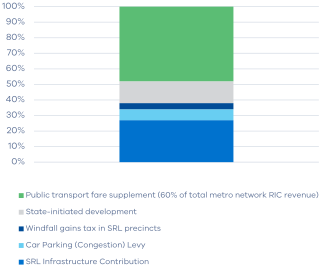
Source: DTF.
DTF's advice to the government in December 2023 on the rail improvement charge indicated that while it had relatively small impacts on fares initially, the year-on-year annual rate increases ramped up significantly over the medium to long term, meaning that the revenue generated by the additional charge would grow exponentially and increase as a proportion of the base fare in real terms.
These issues are illustrated in Figures 26 and 27, which show the projected impact of the charge in nominal and real terms on the daily full fare for Melbourne public transport fare zones 1 and 2 based on an annual increase of 1 per cent.
Figure 26: Nominal (dollars of the day) indicative daily full fare zone 1 and 2 over time based on an annual increase of 1 per cent for the rail improvement charge
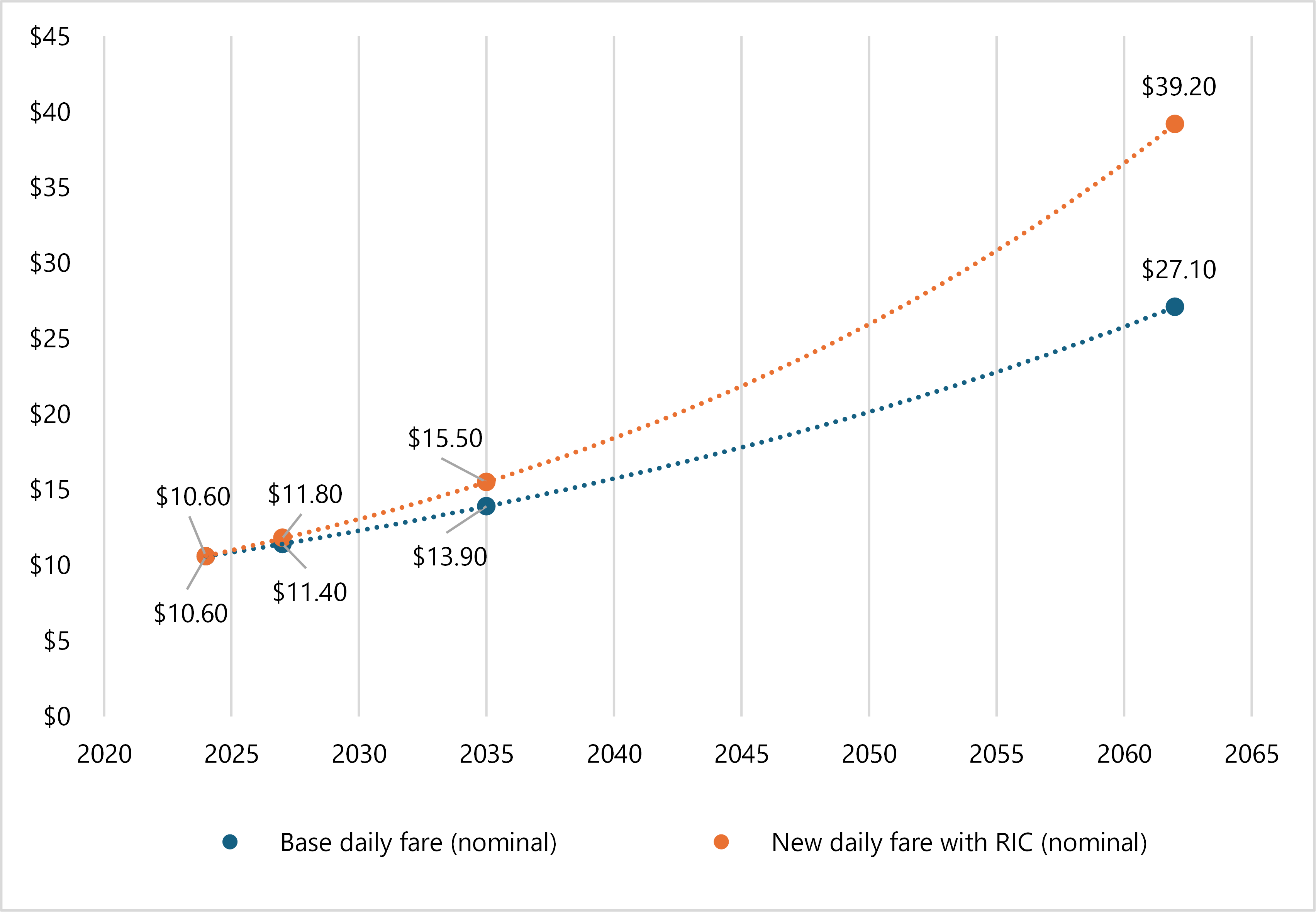
Source: VAGO, based on information from DTF.
Figure 27: Real (today's dollars) indicative daily full fare zone 1 and 2 over time based on an annual increase of 1 per cent for the rail improvement charge
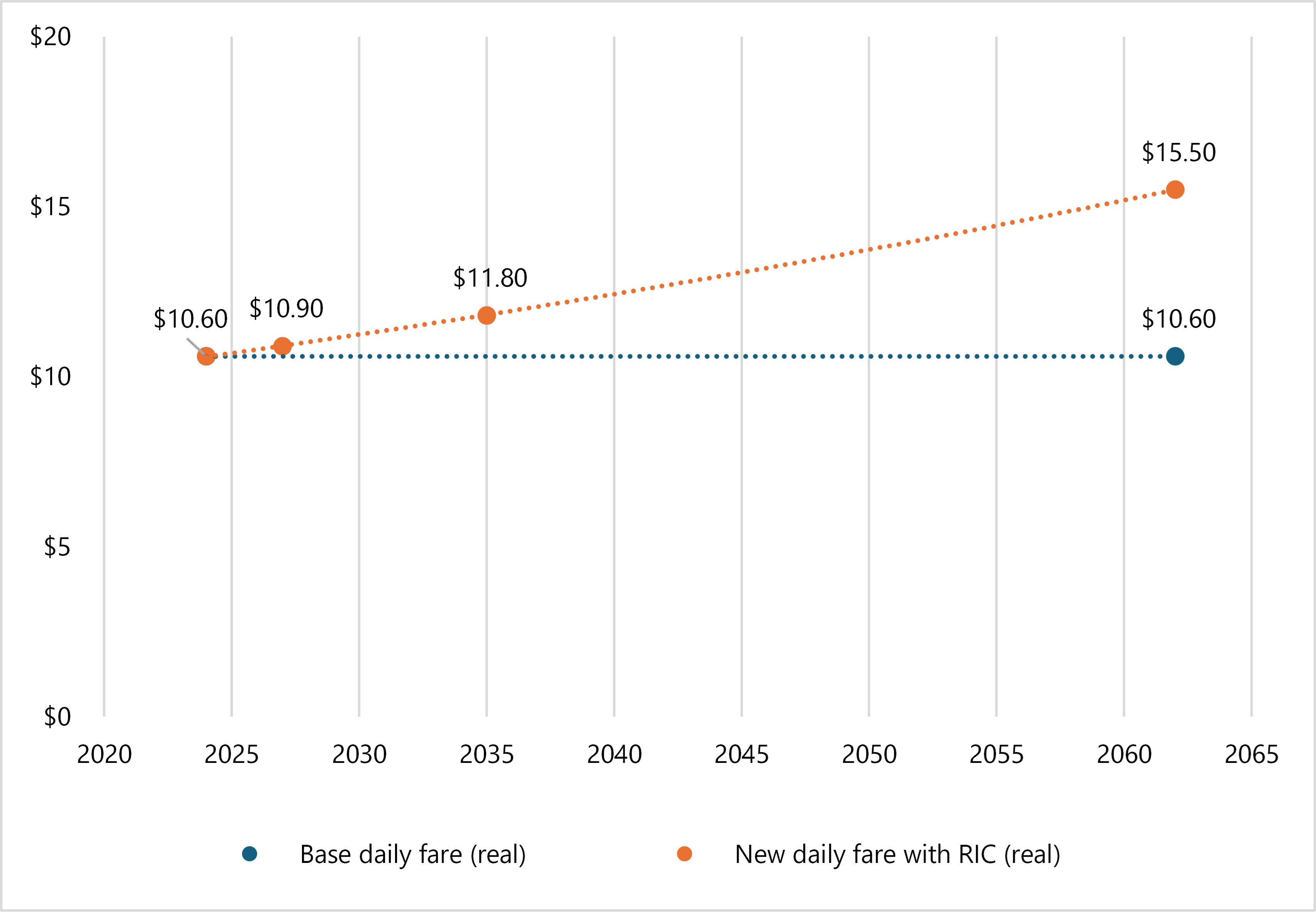
Source: VAGO, based on information from DTF.
DTF's advice also highlighted the rail improvement charge:
- will not deliver significant new revenue to offset SRL East capital costs during its construction period because the revenue largely arises in the longer term. This places greater pressure on the state’s debt position to finance that construction, compared to alternative revenue measures that raise a greater proportion of total revenue earlier
- is a material funding risk because realising most of the revenue would require successive governments to maintain the policy over the long term.
The government decision based on DTF's advice in December 2023 approved the recognition of around $17.7 million in new revenue from the rail improvement charge covering both the 2024–25 and 2025–26 financial years.
The government has made and continues to make decisions impacting the revenue collected from public transport fares since 2023, including fare freezes and the recent free travel periods. The government has also made public transport free for children and free for seniors on weekends.
DTF advised us in April 2026 that public transport fare revenue for metropolitan Melbourne was about 20 per cent under budget in the 6 months to 31 December 2025 and that the total revenue collected from the rail improvement charge between January 2025 and the end of February 2026 was $6.2 million. This is significantly below the forecast revenue from this value capture measure over this period.
Infrastructure Contributions Plan levy revenue
The success of the government's value capture package relies on collecting significant revenue from charges on new developments in SRL East precincts.
The government's announced value capture package includes a revenue estimate of $2.9 billion from the Infrastructure Contributions Plan levy on developers and landowners seeking to increase the number of dwellings or amount of commercial floorspace in a property.
The draft precinct structure plans and revised statutory planning control settings proposed by SRLA are intended to create an environment where developers and employers will commit to invest in significant property developments.
We set out our analysis of the draft precinct structure plans and revised statutory planning control settings for the SRL East precincts in Section 5. In summary, we found that the draft planning controls proposed for the precincts should allow a level of redevelopment consistent with supporting the uplifts in population, households and employment projected in the SRL Business and Investment Case.
If this level of development transpires, the revenue targeted from value capture measures that rely on land value uplift and development in these precincts could be achievable. This is consistent with the results of DTF modelling on a range of value capture measures and settings between 2019 and 2023 to derive revenue estimates to inform advice and recommendations to the government on the value capture package, including developer charges.
However, this development is not certain and achieving it will largely depend on private investment actually materialising through the actions of private developers and individuals. Our findings discussed in Section 5 of this report identified a range of structural and market-based factors that are likely to constrain development including:
- structural barriers to land assembly, particularly lot amalgamation, given the high levels of existing fragmentation and strata-titled residential developments in SRL precincts
- a challenging macro-economic climate and market conditions impacting the building industry, including labour force and material supply chain constraints and pricing
- tax imposts and financing factors that may make delivering higher density of development unviable within SRLA’s forecast timeframes.
These constraints on the level of development that may actually eventuate in the SRL East precincts are broadly consistent with the findings of SRLA's market soundings with potential developers and financiers during 2024 and 2025.
The results of SRLA's engagement with the private development sector suggested weak market sentiment and structural impediments in Victoria will likely dampen private developer activity in SRL East precincts at least in the short term.
Economic conditions and sentiment in relevant investment markets are unlikely to have strengthened given recent and ongoing global economic uncertainty.
DTF advice to the government on the estimated revenue from developer charges was consistent at $2.7 billion in NPV terms between 2023 and June 2025. This estimate was based on higher rates and earlier introduction of these developer charges.
The government approved delayed introduction of the charges and the use of lower initial rates for calculating the charges and maintained the same revenue estimate for the infrastructure contribution plans levy of $2.7 billion in NPV terms.
The revenue target of $2.9 billion for this value capture measure published in early 2026 represents the share of up-front borrowings to be repaid using revenue from this measure.
State-initiated development
State-initiated development relates to development opportunities that leverage government-owned land acquired for the SRL East rail construction and other strategic land holdings to create a funding source for the broader project.
The government's initial funding and financing strategy for SRL East in August 2021 included an approved revenue target of $1.4 billion in NPV terms, or $3.4 billion in nominal terms, over 30 years from state-led property development in SRL East precincts.
This is a 'net' income target, meaning it is the profit targeted by the state after the planning, development, marketing and any related financing costs for state-initiated development have been met.
Progress on state-initiated property development activities in SRL East precincts is not consistent with the scope, timelines and projected returns agreed with the government in 2021. This is because after 4 years of work by DTF and SRLA, there is no comprehensive strategy or plan in place to deliver these returns and significant uncertainty about whether the revenue target can be achieved.
The $1.4 billion revenue target was approved in 2021 based on the state taking on a direct and lead role in financing and delivering around 24 per cent of residential development and 11 per cent of commercial development, including office and retail developments, in the SRL East precincts. This was referred to as state-led development and involved a proposal for the establishment of a state-owned development entity.
In December 2023, the government considered advice on the significant risks and up-front capital investment that would be required to directly develop land. Preliminary DTF modelling at that point indicated that the state would need to invest $2.7 billion to $4.5 billion in nominal terms to generate the revenue targeted from state-led development.
The government:
- approved a move away from the previously endorsed state-led development approach to a state-initiated development approach
- retained the same revenue target
- sought advice from DTF and SRLA by the end of March 2024 on alternative approaches and development strategies to achieve this revenue target.
The change in language from state-led to state-initiated development indicated the government's objective to take on less of the financing and development risks associated with property developments in SRL East precincts, while at the same time expecting the same returns.
SRLA led work during 2024 and 2025 examining state-initiated development opportunities for sites above and immediately adjacent to the planned SRL East stations. This was referred to as over-station and adjacent to station development (OSD and ASD) and involved sites already acquired by the state to deliver the rail infrastructure project.
The report back to the government was provided by SRLA in May 2025, more than a year late. SRLA's advice to the government covered progress in assessing alternative development strategies. The advice:
- provided few answers and no substantive recommendations on an implementation model for achieving the revenue target from state-initiated development
- did not include revenue projections that were comparable with the government's approved target
- indicated that the projected returns from OSD and ASD will not be sufficient to meet the government's revenue target and were actually negative, based on initial reference designs for the OSD and ASD sites, due to the economic climate and property market conditions, including high construction costs and increasing interest rates.
SRLA's advice made it clear that state-initiated development beyond the previously assumed OSD and ASD sites will be needed to achieve the revenue target of $1.4 billion NPV. The advice identified 21 strategic development sites for potential acquisition by the state for development or resale to supplement OSD/ASD returns, but noted that there is no funding allocated in the current SRL East budget to meet the acquisition cost of between $500 million and $750 million for these sites.
The DTF and DPC advice to the government on SRLA's update in May 2025:
- acknowledged that SRLA's submission did not provide a final recommended model for state initiated development or clarity about whether the government's revenue target can be met
- highlighted the potential risks to achieving the revenue target of $1.4 billion NPV, with DPC stating that the revenue target is unlikely to be achieved, creating a funding gap for the project
- indicated that DTF wanted SRLA to provide advice to the government comparing the state initiated development revenue projections against the approved target to determine any funding gap
- noted that challenging market conditions, including high construction costs, are a key factor impacting the potential revenue from state development and that this was validated by SRLA's market feedback exercise
- indicated that any actual profit for the state from OSD/ASD will depend on the procurement approach with developers, market conditions and the final SRL East structure plans
- highlighted funding and other issues associated with SRLA's proposal that the state acquire additional strategic sites, with DPC indicating an understanding that SRLA intends to use powers under the Suburban Rail Loop Act 2021 to compulsorily acquire the sites and noting the limited precedent for such an approach and the potential for the use of these powers for this purpose to erode any social license for SRL East.
DTF indicated that it expected SRLA to undertake further work and report back to the government with an updated revenue target.
DPC went further and recommended that SRLA should seek in-principle endorsement of the new model for state-initiated development and an updated revenue target from the government by 30 June 2025 and provide clarity about whether strategic land acquisition is part of the model to inform Australian Government funding negotiations and public communications on value capture.
The government noted the advice from SRLA on its work on alternative approaches and development strategies to achieve the target of $1.4 billion NPV from state-initiated development and acknowledged that:
- it would be required to make a future decision on a final approach to procurement of OSD and ASD
- subject to that decision, DTF would compare the revenue projections against the target of $1.4 billion NPV to determine the remaining funding gap resulting from the changed approach.
Obtaining greater certainty about the achievability of the revenue target for state-initiated development depends on government decisions to confirm the final development model, and any revised revenue target.
These decisions were expected before the end of 2025 but were not made. SRLA intends to provide further advice to the government in 2026 on a recommended approach to state-initiated development and how realistic the revenue target of $1.4 billion is.
If revenue from state-led development is delayed or less than anticipated for any reason, it will create a broader funding pressure for the project and the state Budget.
Aside from the urgency to confirm a final model for pursuing state-initiated development revenue, there are many other sources of risk and uncertainty for this value capture measure including:
- the inherent volatility of the property market and the long-term horizons for these revenues to accrue
- challenging market conditions in the property development sector
- negative market sentiment about relevant tax settings in Victoria
- uncertainty about the availability of the strategic sites identified for potential acquisition by the state and a lack of approved funding to acquire these sites.
It is unclear if the government will retain any commitment to requiring the delivery of social and affordable housing as part of its final model for implementing state-initiated development in SRL East precincts. Advice to the government in April 2021 projected revenue of $1.8 billion in nominal terms from state-led development based on the inclusion of 10 per cent of residential dwellings as social and affordable housing. The revenue target of $3.4 billion nominal, or $1.4 billion NPV, approved in August 2021 is based on an assumption that no social and affordable housing will be included in state developments.
The final model for pursuing the state-initiated development revenue target remains unclear and the achievability of the government's revenue target from this source is highly uncertain.
5. Statutory planning processes are being delivered in line with project objectives
The draft planning controls proposed for the SRL East precincts should allow a level of redevelopment consistent with supporting the uplifts in population, households and employment needed to deliver the benefits asserted in the SRL Business and Investment Case. However, there are a range of factors that may constrain this development, including structural barriers to lot amalgamation and challenging market conditions in Victoria.
SRLA has identified a range of strategic sites to host a significant portion of development in each of the precincts. In addition, the theoretical maximum capacity for new floorspace in the precincts is significantly higher than SRLA's projected demand for new floorspace to 2041. This acts as a demand buffer, meaning that precincts do not necessarily need to reach their maximum development potential to achieve the benefits outlined in the business case.
The PSAs were finalised in July 2026, approximately 7 months later than originally planned. This should be sufficient to enable timely precinct development.
The government's overall cost estimate for SRL East of $34.4 billion includes an in principle funding allocation of $1.5 billion for precinct development works to support population growth in the 6 SRL East precincts. SRLA is yet to seek access to this funding to deliver key local infrastructure that is critical to attracting and retaining the projected increase in population and employment in the precincts. This creates a risk that the new precincts will be unable to meet the increased demand for services from the projected increases in population. In addition, the private sector may be less motivated to undertake new developments in the precincts if the government fails to demonstrate a commitment to developing them.
The draft planning controls do not include any requirements for social and affordable housing to be included in developments in the precincts.
Covered in this section:
- Draft planning controls consistent with broader project benefits and objectives
- Delays in the precinct planning process
- Uncertainty regarding local infrastructure investments
- No material affordable housing requirement
- Public open space
Draft planning controls consistent with broader project benefits and objectives
Draft planning controls: purpose, coverage and status
In addition to being a significant infrastructure project, the SRL is intended to transform land use across suburban Melbourne, with a particular focus on delivering housing and employment outcomes in the precincts surrounding SRL stations.
The SRL Business and Investment Case defines SRL East precincts as the area within a 1,600 metre radius of an SRL station. SRLA released draft structure plans and PSAs for an approximate 800 metre radius around each of the future SRL East stations at Box Hill, Burwood, Glen Waverley, Clayton, Monash and Cheltenham for public input in March 2025. These are referred to as structure plan areas.
These outputs from SRLA’s precinct planning process will guide future land use and built-form outcomes for the precincts and will significantly influence whether the precincts will attract sufficient investment, development, jobs and population to deliver the benefits promised for the project.
The draft structure plans and planning scheme amendments (PSAs) and supporting documents were considered by an advisory committee in the second half of 2025. This included public hearings that were held from September to December. The advisory committee provided its reports to SRLA and the Minister for Planning and the Minister for the SRL on 20 February 2026.
DTP published a notice of approval of amendment for each of the final PSAs in the Victoria Government Gazette in July 2026.
Draft planning controls do not cover the entire precinct areas
The significant 'with project' growth projections in the business and investment case for jobs, population and households were based on expected development of the entire 1,600 metre precinct areas.
DTP's requirements for the project support an expectation that the precinct planning documents developed by SRLA would cover the full precinct areas.
As indicated above, the draft structure plans and PSAs SRLA released for public consultation in March 2025 cover a radius of 800 metres around each SRL East station. SRLA has advised us that it did not develop planning documents for the full 1600 metre radii because:
- it is not practical to structure plan more than 4,825 ha in middle Melbourne at once to cover the full precinct areas
- it adopted a staged structure planning process to ensure the objectives of each precinct can be achieved.
The extent to which adopting this staged approach to precinct planning places full benefit realisation at risk is not clear. SRLA advice to its minister in April 2023 highlighted risks with this approach, including that it meant delivering the full growth projected in the business and investment case may rely on other planning authorities, like local councils.
Advice to the government in February 2025 indicated that SRLA would recommend to the Minister for Planning that the determination of the structure plan boundaries be excluded from the advisory committee's proposed scope.
Our review of the Minister for Planning's referral of specific matters to the SRL East Precincts Standing Advisory Committee for advice indicates that it did not include the issue of the boundaries for the structure plan areas.
Planning controls are consistent with enabling the project benefits
The draft structure plans and PSAs released by SRLA in early 2025 for the precincts at Box Hill, Burwood, Glen Waverley, Clayton, Monash and Cheltenham should allow a level of redevelopment consistent with supporting the uplifts in population, households and employment needed to deliver the benefits asserted for the project in the SRL Business and Investment Case.
However, development in these precincts is not certain and achieving it will largely depend on the actions and investments of private developers and individuals. There are a range of factors that may constrain development including structural barriers to lot amalgamation and challenging market conditions in Victoria.
The PSAs for all 6 precincts were finalised in July 2026, around 7 months later than originally expected. This delay is unlikely to have a significant impact on the timing of precinct development and the realisation of population, household and employment growth targets.
It is important to note that our findings are based on an assessment of draft planning controls released for public consultation in March 2025 and detailed modelling that was restricted to one of the 6 precincts.
SRL East project benefits
We assessed whether SRLA's precinct planning for SRL East is proceeding as planned and whether or not it is consistent with delivering the benefits asserted in the business and investment case.
The business and investment case asserted significant benefits to be produced by the SRL project, specifically:
- increased productivity and economic growth in Victoria
- improved connectivity across Victoria
- improvements in Melbourne's liveability and thriving communities.
Additionally, recent public announcements from the government in relation to the project highlight:
- a commitment that SRL East will build 70,000 new homes in the 6 precincts
- the results of community consultation on the precinct visions highlighting the need for more affordable and social housing and the importance of open space.
The structure plans and PSAs for the SRL East precincts are critical to realising the benefits asserted in the business and investment case because they outline the vision and planning controls intended to enable significant development. The draft:
- structure plans seek to set a vision, objectives, strategies and actions to support future growth
- PSAs propose new planning controls in each of the precincts to enable the type and level of development envisaged in the structure plans.
The Cheltenham precinct
VAGO engaged a subject matter expert to review SRLA's proposed planning controls for the SRL East precincts.
We selected Cheltenham as a sample precinct to analyse whether the draft structure plan, PSAs and associated planning documents for the precinct are consistent with enabling sufficient future development to support the projected uplifts in population, households and employment stated in the business and investment case.
We also assessed SRLA's Land Use Scenario Capacity Assessment (LUSCA) report, which tested the capacity of each precinct structure plan area to accommodate the expected floorspace demand under the proposed planning controls.
We chose the Cheltenham precinct because:
- Cheltenham is projected to provide a large amount of potential floorspace and see the second biggest increase in overall floorspace capacity by 2041 (a 218 per cent increase)
- Cheltenham's Southland neighbourhood is projected to be near the 60 per cent capacity threshold for reassessment of built form controls (57 per cent capacity at 2041)
- Cheltenham already provides a relatively high degree of certainty regarding its future built form structure, with a large amount of mixed-use uplift in the Southland neighbourhood and surrounding strategic development sites
- Cheltenham also has a large amount of employment uplift in the Bayside Business District, with relatively modest floorspace uptake in the remaining 3 neighbourhoods
- the other precincts included a range of existing features including health and education zones, and structural and spatial and diversity characteristics that would have introduced further complexity into the analysis.
We assessed the potential capacity of the Cheltenham precinct under the proposed planning controls in terms of the gross floor area (GFA) of potential future development in the precinct and considered the viability of the planned future development of the precinct as described under the draft structure plan.
Assessment approach
We modelled the potential built form outcomes across the Cheltenham structure plan area in accordance with the suite of planning scheme controls proposed under the draft PSAs to assess whether the controls are consistent with, or could inhibit, the level of development articulated in the business and investment case and structure plan.
The modelling was designed to produce the theoretical maximum level of development achievable under the proposed planning controls and we used the existing lots within the precinct and current structural boundaries including roads, public land and areas of open space as a starting point.
To model the theoretical maximum development we amalgamated adjoining lots for all locations across the precinct, except for the strategic sites, consistent with the respective built form overlay controls proposed under the PSA.
The modelling produced 365 'super blocks' which were located across existing land parcels without any loss of public land or restructuring of the road network. We derived a theoretical GFA for every hypothetical building produced this way and discounted the aggregated GFAs consistent with development opportunity ratings used in the LUSCA methodology (outlined below).
The level of lot amalgamation used in our modelling is appropriate for assessing the theoretical maximum amount of development possible under the proposed planning controls. However, it is unlikely to be realised, particularly in the short term while the rail infrastructure is constructed. This is due to a range of structural and market-based factors that will likely constrain potential development in the precinct. For example, market availability and challenges with land assembly. This is discussed further below.
For the 4 strategic sites identified by SRLA in the Cheltenham precinct we adopted the same assumptions applied in the LUSCA, which calculated the amount of floorspace capacity at the strategic sites as 20 per cent of the total theoretical capacity in the Cheltenham precinct. The LUSCA does not specifically justify or demonstrate the basis for the GFA assumed for strategic sites.
We found that, overall, the background work, suite of project documents and proposed planning controls are aligned to articulate a coherent rationale for the redevelopment of Cheltenham into a higher density mixed use precinct centred around the proposed SRL East station. The theoretical maximum GFA available under the proposed planning controls was significantly greater than required to achieve the uplift in population, employment and households in Cheltenham projected in the business and investment case. While unlikely to be realised, this may act as a buffer should actual development outcomes fall short.
Strategic sites
The Cheltenham precinct contains 4 locations that SRLA has identified as strategic sites:
- the area around the SRL Cheltenham Station
- Southland Shopping Centre
- former Highett Gasworks site
- Highett Common.
The LUSCA assessment allocated a GFA equal to 20 per cent of Cheltenham's total projected floor space capacity to the 4 strategic sites. We chose not to model the strategic sites separately and instead chose to add the projected GFA from the strategic sites to the total projected GFA for all the modelled areas to maintain consistency with SRLA's LUSCA approach.
The LUSCA does not specifically justify or demonstrate the basis for the GFA assumed for strategic sites. However, they appear to be vital to providing the additional GFA required for the projected increase in population and households, particularly in the short term.
SRLA allocated 20 per cent of the total capacity in the structure plan area to the 4 strategic sites, which amounts to 45 per cent of the total demand for floor space identified in the LUSCA. SRLA expects that this may help mitigate the risks to development caused by the high levels of existing fragmentation and the presence of strata-titled residential developments throughout the structure plan area that will impact land assembly.
As a result, the strategic sites will likely be expected to deliver the greater proportion of development in the precinct in the short term in order to meet the benefits realisation goals for Cheltenham.
Development opportunity ratings/ constraints
SRLA calculated development opportunity ratings for each property in the structure plan areas to anticipate the relative likelihood of each property being developed to its theoretical maximum capacity.
This rating seeks to identify various constraints that might prevent each site from being developed to its full potential under the proposed planning controls. The potential constraints contributing to the development opportunity rating fall into 3 categories:
- Definitive constraints: if any of these conditions apply to a property, it is assumed that further development is impossible. This category includes constraints like whether the site is within a road or rail casement, or if the site is subject to a public acquisition overlay.
- Prohibitive constraints: constraints that limit, but do not necessarily prevent further development. This category includes constraints like a site's development year, whether it is in a strata title development with multiple lots, or if the site is subject to a heritage overlay.
- Property size: smaller lots are more challenging and less feasible to develop than larger ones.
The role of discounting factors is crucial in determining real-world outcomes, especially within a time-bound scenario that is modelling development projections out to 2041. Given this, we consider that the discounting approach adopted by SRLA for the purposes of the LUSCA was reasonable.
Commitments that SRL East will increase housing
The government publicly announced in December 2024 that SRL East will build 70,000 homes across the 6 station precincts. This claim was also included in presentations to the Public Accounts and Estimates Committee Inquiries into the 2024–25 and 2025–26 Budget Estimates.
The Big Build website provides a more accurate description of the project's housing aspirations, indicating that the SRL East will enable around 70,000 new homes to be built in these areas by the 2050s.
We understand that this uplift in housing stock is expected to be delivered through private investment in the precincts, given that the approved scope for the SRL East I&EW and main works packages do not provide for the construction of any new housing.
The SRL Business and Investment Case projects 78,000 additional households in SRL East precincts over the next 30 years. This figure includes around 52,500 households that were projected to be built in these precincts even if the SRL does not proceed. This would indicate an incremental increase of approximately 25,500 households that would be attributable to the delivery of SRL East.
SRLA advised us that it will deliver housing through the development of SRLA-owned land adjacent to the stations, but has not provided evidence to support this assertion and we have not seen any evidence of:
- a government decision approving SRLA to undertake housing developments
- the SRL East budget including any allocation for housing construction.
SRL East's rebranding from Victoria's largest rail project to Victoria's largest housing project is contingent on the claim that it will enable the construction of 70,000 new households, fewer than 30,000 of which will be attributable to the delivery of the project itself.
Delays in the precinct planning process
Final PSAs and structure plans in July 2026
The final PSAs and structure plans were released in July 2026, around 7 months later than originally planned.
The advisory committee provided its report to SRLA and the relevant ministers in late February 2026. SRLA told us that it provided a response to the advisory committee reports to the Minister for Planning in mid-April 2026 to inform the minister's assessment.
DTP published a notice of approval of amendment for each of the final PSAs in the Victoria Government Gazette in July 2026.
The PSAs are critical to value capture and benefits realisation
Advice to the government since 2021 has emphasised that the structure plans and PSAs must be finalised as early as possible to enable the realisation of the SRL project objectives and benefits because:
- significant development needs to occur before SRL East rail operations commence in 2035 to support the asserted population and jobs growth
- achieving value capture revenue targets depends on timely precinct development.
The precinct structure plans and PSAs are intended to create the conditions needed to attract sufficient development to support the projected uplift in households, jobs and population in each precinct.
The government's funding and financing strategy for the project also relies on the timely implementation of built form, height and density controls, and value capture mechanisms in SRL precincts to prevent value leakage from development activity occurring around station precincts.
If development in SRL East precincts is delayed the state risks:
- falling short of the target uplifts in employment, population and households in the precincts
- delays in collecting the targeted value capture revenue.
The funding and financing strategy relies on a steadily increasing stream of value capture revenue commencing in early 2027 from developer charges in the precincts and with state-led development opportunities thereafter. Any value capture revenue shortfalls would need to be met from alternative funding sources.
Managing delays
SRLA implemented a range of measures intended to shorten the precinct planning process, which can otherwise extend over a period of between 5 and 7 years. To allow development to commence as early as possible, SRLA planned to deliver the structure plans and planning controls within 2 and a half years by:
- adopting a revised and targeted stakeholder engagement schedule
- limiting the simultaneous public exhibition of the 6 draft PSAs to one month
- limiting the scope and focus areas for the advisory committee process to those SRLA deemed material to the delivery of the structure plan outcomes
- conducting 6 sets of advisory committee hearings concurrently across a 10-week period, with the committee's report required within 6 weeks of the hearings concluding
- seeking an exemption from the usual notice and exhibition requirements for the final PSAs under the Planning and Environment Act 1987.
SRLA released the draft structure plans, PSAs and supporting documents for public consultation in March 2025. This was more than a year later than originally planned based on SRLA advice to the government in June 2021. There were several contributing factors to this delay including:
- a 2-month delay to releasing the draft precinct vision documents in 2023
- delays in finalising and approving the draft structure plans and PSAs for public release.
These delays meant gazettal of the final PSAs had to be rescheduled for June 2026 because there was no 'float' or timeline contingency left in the program. Advice to the government indicated that this timeline would be sufficient to enable precinct development early enough to meet the benefit uplift targets outlined in the business and investment case.
However, any further delay would likely bring the gazettal approval decision into the caretaker government period for the state election in November 2026. This would mean that gazettal would have to wait until early 2027, putting both the benefits listed in the business and investment case and the value capture component of the funding and financing strategy at risk.
The public consultation period for the draft structure plans and PSAs concluded on 22 April 2025. SRLA received 816 submissions from the public regarding the 6 SRL East precincts and developed 6 submission reports (one per precinct) and a key issues list for consideration by the Minister for Planning.
To save time during the advisory committee hearings process and maintain the then June 2026 gazettal target, SRLA drafted a focused terms of reference for the advisory committee for consideration by the Minister that excluded examination of anything it deemed not material to the delivery of the structure plan outcomes. The following issues were excluded from the advisory committee's scope:
- the business and investment case and information derived from data set out in the business and investment case
- the basis for SRL East structure planning, including relevant provisions in the SRL Act and the established structure plan areas
- application of business and investment case population and employment forecasts to the SRL East structure plan areas
- approaches to funding local, state and state-significant infrastructure
- matters set out in the Minister's Environment Effects Statement (EES) assessment of SRL East infrastructure.
SRLA advised the government in July 2023 that there were still several risks inherent to the precinct planning process that may impact achieving gazettal of the final PSAs in the first half of 2026, including:
- the timeline relied on the Minister for Planning exempting the final PSAs from being exhibited for public consultation prior to gazettal
- the duration of the advisory hearings process was out of SRLA's control and there was potential for extensive deliberations during hearings to cause delays
- a heightened risk of legal challenge if it is perceived that natural justice was not afforded to the public.
The advisory committee was initially required to provide its report to SRLA and the Ministers for the SRL and Planning no later than 7 February 2026, or 7 months following receipt of the Minister for Planning's referral letter, sent on 7 July 2025. The advisory committee provided its reports to SRLA and the relevant ministers on 20 February 2026.
As indicated above, the PSAs for all 6 SRL East precincts were finalised in July 2026.
Uncertainty regarding local infrastructure investments
Local infrastructure investments are critical for liveability in the precincts
The need for a whole-of-government coordinated approach to identifying and funding infrastructure and services in addition to the new rail infrastructure in SRL East precincts has been acknowledged in advice to the government since at least 2020.
In the SRL Business and Investment Case, precinct works beyond the core rail infrastructure investment were identified as part of the enabling scope for the project and subject to SRLA's precinct structure planning. However, so far there have been no commitments made regarding final scope and funding of complementary precinct works to support the targeted uplifts in population.
SRLA released draft structure plans and accompanying draft implementation plans for the SRL East precincts for public consultation in March 2025. The implementation plans identify actions needed to achieve the 'vision' for each precinct and acknowledge that delivering these actions will require coordination across government.
The implementation plans also identify more than 170 key projects across the 6 precincts and assign delivery responsibility to relevant local councils and government agencies but do not commit any funding for these projects or explain the approach to funding community infrastructure.
These works are critical to attract and support the population and employment growth and other benefits promised in the business and investment case. The increase in population, employment and households anticipated in the precincts will generate significantly higher demand for population-serving infrastructure along the SRL East corridor.
DTF consultation with private developers and investors in late 2019 and early 2020 highlighted the need for the government to actively demonstrate long-term commitment to other activities beyond the transport infrastructure investment.
SRLA engaged a consultant in 2020 to prepare cost estimates for an indicative set of precinct intervention works beyond the rail infrastructure investment to support connectivity, liveability and productivity. These interventions included:
- creating or enhancing public open space and adding walking and cycling paths
- improvements in complementary public transport infrastructure
- community infrastructure like libraries and multi-function community hubs
- multipurpose sports courts and other sporting facilities.
The consultant provided an indicative cost estimate of $1.2 billion for the specified works across each of the precincts in November 2020.
In-principle funding allocation for precinct development works
There is an in-principle funding allocation of $1.5 billion for precinct development works as part of the government's overall cost estimate for SRL East of up to $34.5 billion.
This in-principle allocation was identified in 2021 and is subject to future funding submissions from SRLA. It was confirmed in advice to and decisions made by the government in 2023 but has not been formally approved by the government. SRLA is yet to seek access to this funding for precinct development works.
SRLA advised the government in February 2025 that the expected cost to deliver the key projects identified in the draft precinct implementation plans would be within the $1.5 billion set aside for precinct infrastructure in the SRL East cost estimate. However, no decision has been made on whether this funding will be directly allocated to the key projects identified in the structure planning implementation plans.
SRLA told us that both the scope and expected costs of these works are yet to be finalised because:
- the key actions and projects identified in the precinct structure plans and implementation plans are draft and were subject to public consultation and the 2025 advisory committee process, followed by a final ministerial review and decisions expected in the first half of 2026
- new, additional and/or a different set of key projects may arise from these processes
- the final structure plans and planning controls must be determined before making final decisions on required precinct development projects and works
- when the structure and implementation plans have been finalised, SRLA will seek to properly scope and cost the final key projects before putting funding submissions to the government.
SRLA advised us that it intends to undertake detailed scoping and cost estimation to support a series of funding submissions to the government for delivery of these projects following gazettal of final PSAs. The PSAs were finalised in July 2026.
It is appropriate to delay finalising the scope and expected costs until after public consultation. However, the draft status of the plans did not preclude discussion of the proposed coordination and funding approaches for precinct development and community infrastructure works to provide more certainty to local councils, other government agencies and the community.
In December 2025, the government announced the value capture package for the project. This package includes the SRL Infrastructure Contributions Plan levy. This levy will apply to new property developments in each SRL East precinct. The government's published information on the levy indicates that revenue collected from developers paying the levy will be used to support SRL East construction and other new infrastructure including roads, footpaths and open spaces.
Advice to the government in December 2025 indicated that developer contributions from this levy will only partially cover the delivery costs for community and trunk infrastructure needs in the SRL East precincts and that additional funding sources, including state contributions or new value capture mechanisms, will be required to realise the vision for SRL East.
SRLA advised us at the end of this audit that it plans to provide further advice to the government on the funding of precinct development works later in 2026.
Place Infrastructure Compacts
In late 2022, the incoming government was advised that significant and coordinated investment across government on a range of local infrastructure in the precincts was required to catalyse and support the anticipated uplift in jobs and population. This advice indicated that a Place Infrastructure Compact (PIC) would be agreed for each SRL East precinct in 2023.
In July 2023 the government endorsed further investigation by SRLA into a PIC policy and its potential application to SRL precincts. SRLA intended to report back to the government on a possible implementation method. This report back to the government is yet to be provided more than 2 and a half years later.
In August 2024, a review of SRLA commissioned by DPC reported concerns about the delivery model for precincts across SRLA and other government agencies, noting their importance to project benefits. The report stated that the reviewer
observed both unclear accountability and insufficient forward momentum amongst the range of organisations that have a role in delivering and activating the six SRL East precincts. These precincts play a critical role in the overall project, and there is risk to their delivery. Given SRLA’s recent cost compression work appears to have reduced investment in precinct delivery (abolishing the division and downsizing the team), we have some concerns about the deliverability of these precincts.
The report highlighted the need for a whole-of-government mechanism that defines clear lines of accountability and creates the momentum needed to ensure these critical assets can be delivered in line with the development of the SRL East precincts. Our analysis indicates that this was at least part of the intended purpose of the PICs.
PICs or equivalent mechanisms have not been established for the SRL East precincts. SRLA advised us that the government does not intend to proceed with PICs and SRLA is examining a range of possible approaches to achieving the substantive intent of the PIC mechanism. SRLA provided no evidence of its work on a replacement mechanism for the PICs but has noted that it intends to acquit the government's request for a report back on possible implementation methods in a future submission.
The precinct structure plans and PSAs were finalised in July 2026. A decision regarding the mechanism for coordinating the delivery of local infrastructure in the precincts will need to be made soon to facilitate the timely development and delivery of local infrastructure.
Without a confirmed funding commitment and an approved mechanism for whole of government coordination there may be insufficient community infrastructure and services to meet the growing demand from the projected population increases in the precincts. Alternatively, delays to finalising and implementing this mechanism may lead to a disconnect between the pace at which the population grows and the pace at which community infrastructure is delivered to their needs.
No material affordable housing requirements
Recent government announcements
Recent public announcements from the government in relation to the project indicate:
- a commitment that SRL East will build 70,000 homes in the 6 precincts
- the results of community consultation on the precinct visions highlighting the need for more affordable and social housing and the importance of open space.
The assertion that SRL East will build 70,000 homes in the precincts is inconsistent with the analysis outlined in the business and investment case, and the mechanisms in the current precinct planning documents.
As discussed earlier in this section, our analysis of the SRL Business and Investment Case indicates that the project is projected to support the delivery of fewer than 30,000 additional households in SRL East precincts over the next 30 years. This is because around 52,500 households were projected to be built in these precincts even if the SRL East project does not proceed.
DTP has outlined specific requirements for public open space and affordable housing in the SRL East precincts, but the precinct planning documents do not contain mechanisms to ensure:
- the building of 70,000 new homes
- the provision of social and affordable housing in precincts
- that open space meets requirements and does not decline on a per person basis.
Social and affordable housing
The draft planning controls for the SRL East precincts released by SRLA for public consultation in March 2025 rely on an 'opt in' model for the provision of social and affordable housing and include incentives for developers.
The draft precinct structure plans acknowledge a need for more social and affordable housing but do not specify actions that go beyond encouraging the provision of more of this type of housing, including on government-owned land. SRLA advised us that its approach is consistent with other comparable state-led planning work.
Advice to the government in February 2025 on the draft structure plans and PSAs indicated that:
- unlike the approach implemented in other priority precincts, such as Arden and Fishermans Bend, which include a target of 6 per cent affordable housing in addition to density uplift provisions to incentivise affordable housing, the draft planning controls for SRL East precincts do not include an affordable housing target and so rely only on similar density uplift provisions
- the approach adopted for the SRL East precincts, where developers opt in rather than being required to provide affordable housing, will improve development viability but will likely result in fewer affordable housing units being delivered.
Developers are incentivised to provide more social and affordable housing if they wish to exceed the standard development limits imposed under the built form overlays in each precinct. However, the extent to which this will be utilised by developers and whether it will have a material impact on the provision of social and affordable housing in the precincts remains to be seen.
Advice to the government from DTF and SRLA on the plans for state-led development in the precincts clearly indicate that including social and affordable housing in a development will result in lower financial returns for the developer.
Public open space
Public open space
DTP's requirements for the project included the provision that public open space in the precincts does not decline on a per person basis and meets the 3 following requirements:
- ensure that all SRL precinct addresses can access public open space within an 800-metre walk
- ensure that all SRL precinct residents can access public open space within a 400-metre walk
- target a net open space provision of no less than 9 square metres per person in each precinct.
It is not clear to us how the draft precinct planning documents will ensure these outcomes.
SRLA has identified a number of opportunities for new public open space in the structure plan areas and aims to meet a 400-metre walkable distance to public open space for 95 per cent of residents and workers in the precincts, with greater access targets in high-density areas. However, advice to SRLA suggests that the amount of public open space per person in the structure plan areas will decline across all of the precincts by 2041 on a per person basis.
Access to a diverse range of quality public open spaces is a key component of the vision for the SRL East precincts outlined in the structure plans. Parks, walking and cycling tracks, green corridors and open spaces are all identified as critical to place-making and achieving the liveability requirements for the precincts.
SRLA developed the SRL East Draft Structure Plan – Open Space Technical Report to support the development of the structure plans. The report was released for consultation with the draft structure plans and PSAs in March 2025 and:
- describes the existing open space in each structure plan area and within a 1,600 metre radius of each SRL East station
- covers issues and opportunities that impact planning for open space and the development of each structure plan area
- includes recommendations on how to avoid, minimise or manage potential negative impacts of change, and maximise potential for positive change.
The report measures the target outcomes for the provision of public open space in the precincts in 2041 in terms of access, quality, provision per person and diversity.
According to the report, public open space in the structure plan areas is expected to decline on a per person basis by 2041 across all of the SRL East precincts. The report sets a target of 9 square metres of public open space per person but acknowledges that it will not be able to meet this target in the Clayton, Monash and Glen Waverley structure plan areas given the significant amount of additional space required.
Given this, the report suggests adopting a variety of strategies to maintain liveability in the structure plan areas, including:
- prioritising walkable access to new and existing public open space
- delivering high quality and multi-functional spaces
- adopting innovative approaches to providing additional public spaces
- utilising new and existing public open space within the broader 1,600 metre precinct area to support the provision of open space for residents closer to the border of the structure plan area.
The assessment report identifies a variety of opportunities to close the existing gaps in the walkability of the Structure plan areas, including a range of public open spaces planned by SRLA, local councils and private developers, and proposes a range of additional options to meet the projected increase in demand across the precincts.
In particular, the report's recommendations aim to achieve 400-metre walkable access to public open space for 95 per cent of residents and workers in the structure plan areas, which is reduced to 200 metres for higher density areas.
Our analysis of the Cheltenham precinct indicates that the draft structure plan includes little additional open space allocations in accessible areas. The background report for the draft structure plan notes that open space in the precinct is limited, especially within the Southland neighbourhood. Wangara Reserve west of the Memorial Park is indicated as a new proposed area of open space. However, this is quite distant from the areas of the structure plan area proposed to accommodate the bulk of new development.
Objective 6 of the Cheltenham draft structure plan supports the acquisition of new open space within specified investigation areas across the structure plan area. The draft implementation plan for the draft Cheltenham structure plan assigns responsibility for delivering new and enhanced open space to local councils but provides no indication of the funding mechanism for the acquisition or improvement of relevant land.
The government announced the SRL Infrastructure Contributions Plan levy as part of the value capture package for the project in December 2025. Published information on the levy indicates that revenue collected from developers will be used to support SRL East construction and other new infrastructure including roads, footpaths and open spaces.
6. Project governance and delivery
SRL East is the state's largest, most expensive and most complex infrastructure project to date and needs strong governance, oversight and delivery arrangements.
After early issues and frustrations, SRLA has improved how it works with the government and central agencies, DPC and DTF.
SRLA has a clear commercial strategy and has set up extensive governance and oversight arrangements. While it is working to lower its owner’s costs, this could reduce its ability to oversee contractors and identify emerging risks.
SRLA can do more to improve its management of potential integrity risks.
Covered in this section:
- Background information
- Working with government and central agencies
- Commercial strategy and project management
- SRLA’s owner's costs and savings
- SRLA responses to potential integrity risks
Background information
Agency roles and oversight arrangements
SRLA is the delivery agency for the project. SRLA began operating in September 2019 as an administrative office of the then Department of Transport (DoT) and was given responsibility for developing a business case for the SRL. In December 2021, SRLA was established as a statutory authority under the Suburban Rail Loop Act 2021 with its own board.
DTP is the SRL project client. DTP's objectives and requirements for the project are set out in a range of key documents including a development brief, a delivery brief, and business requirements and client requirements documents. These documents have been issued to SRLA to guide its planning and delivery of the project.
DTP chairs the SRL Coordination Committee (SRLCC) established in February 2026 to oversee the project. This committee meets monthly and includes representatives from DPC, DTF and SRLA. The SRLCC replaces the previous interdepartmental committee that was chaired by DPC.
In addition to the roles performed by DTP and SRLA in relation to the project:
- DTF is responsible for:
- applying its major project assurance processes to the project under the high value, high risk framework
- developing the funding and financing strategy for the project
- participating in a range of project governance groups
- contributing staff members to the executive review teams of SRL East procurement packages, and is therefore involved in the procurement evaluation and award process
- and DPC:
- participates in a range of project governance groups including the SRLCC
- provides secretariat functions for the Suburban Rail Loop Committee of Cabinet
- prepares a monthly SRL tracker report to the government on project delivery status and issues based on information from SRLA and DTF
- provides analysis and ratings, together with DTF, on the SRL East precinct planning program as part of the Housing Statement Implementation Plan, which is reported monthly to a Cabinet committee
- contributes members to the executive review teams of SRL East procurement packages, and is therefore involved in the procurement evaluation and award process.
The SRLCC is intended to provide high-level coordination and ensure alignment of all agencies contributing to the SRL project. The role of the SRLCC is to:
- discuss and resolve complex cross-government issues
- oversee development of and review submissions for consideration by Cabinet and Cabinet committees
- support strategic and operational coordination and alignment of the SRL project with government priorities.
Progress on the delivery of the project is reported to the government each month in the SRL tracker report prepared by DPC.
SRLA also meets with representatives from central agencies and DTP at the SRL Coordination Group that began meeting monthly from early 2026. This group is chaired by SRLA and replaces the following 5 steering committees that had been in place since early 2025:
- Initial and Early Works Steering Committee
- Tunnels and Civils Steering Committee
- Stations Steering Committee
- Linewide Steering Committee
- Structure Planning and Precincts Steering Committee.
Working with government and central agencies
Issues with information flows to central agencies and government
The scale, complexity and significance of SRL East to the state's finances requires project governance, oversight and delivery arrangements that are fit for purpose and functioning effectively.
Advice to DPC and the government in the second half of 2024 on a review of SRLA’s organisation and owner’s costs identified a range of governance challenges for the project, including issues with trust, cooperation, information flows and role clarity between SRLA and central agencies.
The advice to the government on the reasons for, and results of, this review indicated that:
- the establishment of SRLA as a statutory authority with an independent board created some challenges in the flow of information and decision-making processes because some SRLA officers seemed to view their board as the primary decision maker on the project
- this created a misalignment within the government in relation to the extent of SRLA's autonomy and its interactions with the broader government, the Minister for the SRL and the SRLA board
- these challenges became more visible at the end of 2023 when the SRLA board did not seek government approval before approving a standstill arrangement with the contractor for WPA to negotiate a contract reset and settlement of that contractor's claims against the state
- government oversight of delivery and involvement in risk management and commercial decisions will become more important as the project moves from procurement into the main works delivery phase, through until 2035.
Our analysis identified a pattern of delayed report-backs to the government by SRLA on a wide range of matters since 2021, together with some frustration in the central agencies about whether they were obtaining sufficiently granular information on the progress of the project on a timely basis.
The external review report included a number of suggestions to address the issues with role clarity and improve the relationship between SRLA and central agencies. DPC and DTF supported these suggestions and provided advice to the government on how to establish a clear set of expectations for the SRLA board and improve information flows and oversight of the project.
The government considered this advice in October 2024 and:
- noted that the review had identified challenges with the project’s governance and understanding of how SRLA fits within the broader Victorian Government landscape
- agreed that the Minister for the SRL, in consultation with the Premier and Treasurer, would provide an annual statement of expectations (SoE) to the SRLA board confirming the government’s expectations for the governance and reporting processes for the delivery of the SRL, with the first SoE to be sent by the end of 2024
- approved SRLA establishing SRL East works packages steering committees in November 2024
- indicated it would consider strengthening central agency representation on the SRLA board during the development of the SoE.
These matters have since been actioned.
Actions to improve information flows to central agencies and the government
Actions taken in response to recommendations arising from the 2024 review resulted in improved information flows to the central agencies and the government in 2025. These actions included the introduction of:
- a monthly SRL tracker report that is provided to an SRL-specific committee of Cabinet
- an annual SoE from the Minister for the SRL, developed in consultation with the Premier and Treasurer, to the SRLA board confirming the government’s expectations for the governance, decision-making and reporting processes for the delivery of the project
- SRL East works packages steering committees, with DTF and DPC representation, to provide dedicated forums for timely consideration of complex commercial, financial and technical issues as they arise in each works package during the delivery phase.
We examined the monthly SRL tracker reports provided to the government during 2025 and found they provided focused information on the status of each SRL East works package and other key SRLA activities and included insightful commentary by DPC and DTF highlighting key risks and areas needing government attention and decisions.
The first SoE was due by the end of 2024, but was not approved until mid-2025. The approved statement identifies the following principles for the SRLA board to support well-coordinated, aligned and integrated strategy and decision-making for the SRL East project:
- Timely: SRLA will sequence review and decision-making rhythms, and be flexible where required, to support timely consideration of progress reporting and key decisions regarding the SRL East project by government, the SRL interdepartmental committee, SRLA board and SRL East steering committees (as relevant).
- Transparent: SRLA will provide clear, timely and accurate information to the Minister for the SRL and cross-government stakeholders, in particular DTF and DPC, about its current program delivery and forward planning, focused on delivery of major program outcomes including work package delivery and key interfaces, procurement, structure planning and precinct development and value capture, significant program risks and issues, program benefits and financial performance.
- Streamlined:
- SRLA will directly interface with DTP to provide advice to the government on matters relating to network impacts, delivery of precinct objectives, actioning SRLA’s communications and engagement plans in line with Victoria’s Big Build communications strategy, and implementation of funding and financing initiatives.
- SRLA, central agencies, DTP and other relevant departments will work together to promote improved information flows, align reporting and briefing requirements and streamline processes to minimise duplication and reduce administrative burden.
- Collaborative: SRLA will engage early and support a collaborative cross-government approach to maximising program benefits, to securing efficient, effective and economic program delivery and to addressing issues and challenges constructively.
SRLA also established 5 steering committees focusing on:
- initial and early works (WPA and WPB)
- tunnels and civils (WPC and WPD)
- stations (WPE and WPF and SIW)
- Linewide (WPG)
- structure planning and precincts.
The terms of reference for these steering committees were established between November 2024 and January 2025. Each steering committee included representatives from DPC, DTF, DTP and SRLA.
The steering committees operated throughout 2025, considering matters relevant to their scope and supporting the central agencies in having a timely line of sight on project developments to advise the government appropriately at key decision points. The multiple steering committees were consolidated into a single SRL coordination group that is chaired by SRLA and began meeting monthly from early 2026.
SRLA advised that in addition, the dedicated SRL Cabinet Committee was established in October 2024 as the principal governance and decision-making forum for the project.
Our analysis suggests that information flows to the central agencies and the government improved during 2025 with the introduction of the SRL tracker report, SoE and steering committees.
DPC's advice to the government in October 2024 on the outcomes of the external review also suggested that inviting relevant senior officials from DPC and DTF to attend SRLA board meetings as observers would improve the flow of information to central agencies and the Premier and Treasurer.
The government decision on this advice noted that it would consider strengthening central agency representation on the SRLA board during the development of the SoE. We understand that DPC and DTF are not attending SRLA board meetings as observers.
It will be important that the improved oversight and information flow to central agencies and government be maintained as the project moves into the delivery phase for the main works packages to ensure comprehensive advice to the government at key decision points.
Commercial strategy and project management
SRLA's strategies to contract for and deliver the project
SRL East is the state's largest, costliest and most complex infrastructure project to date. The rail infrastructure works will be planned and delivered across a 17-year period from initial announcement to planned completion in 2035.
SRLA’s procurement and contracting strategy was endorsed by the government in 2021. It utilises a multi-contractor strategy that divides delivery of the project into packages across 7 main contracts. These contracts are largely based on the state reimbursing actual contractor costs.
This model – in which the state shares cost risk with the contractor – requires the client to be an active and informed participant in the delivery of the project. Underinvestment in the resources needed to properly plan, manage and oversee this project would risk significant unplanned costs and delivery challenges for the state and an end product that does not support the realisation of the planned project benefits.
Our analysis indicates that SRLA has mitigated this risk by establishing extensive project governance and oversight arrangements at the organisation and individual work package levels, and has a clear contracting and commercial strategy.
SRLA's arrangements are intended to:
- run the SRLA organisation effectively and meet applicable legislative and public sector governance and accountability requirements
- scope, design and cost the project
- develop and implement a procurement, contracting and commercial strategy across the project scope to procure and contract construction companies to deliver the individual works packages
- monitor and assess the delivery performance of construction contractors and address risks and issues
- identify and manage the interfaces across 7 separate works packages, including incentivising contractor communication, cooperation and coordination to ensure clarity and alignment of schedule, scope and quality of works to produce an integrated railway network and supporting systems at completion that meet all relevant quality and safety requirements
- develop structure plans and planning controls for the precincts around the 6 stations that are consistent with supporting the realisation of benefits set out in the project business and investment case and government value capture revenue targets but also informed by community and local council input.
At the works package level we saw evidence of SRLA investing significant resources and effort in procuring and implementing the approved multi-package delivery approach using contracting models and commercial strategies.
SRLA advised that its contracting models and commercial strategies are intended to best protect the state's interests by providing:
- collaborative, open-book delivery models, including alliance and incentivised target cost (ITC) contracting, to support earlier risk identification and stronger cost transparency
- more active management of design, constructability and system integration risks.
SRLA indicated that its contracting and commercial strategies are intended to position the state for better delivery outcomes, given a highly constrained major construction market environment where a fixed-price delivery contracting model would be challenging to implement without the state paying significant risk premiums.
We understand and consider SRLA's planned approach to be sensible, but have also noted the inherent risks of this approach in our findings on the project costs and the contracting models in Section 3 of this report.
SRLA's owner's costs and savings
SRLA owner's costs
SRLA's $32.9 billion budget to deliver the rail infrastructure project and precinct planning content includes around $5 billion for what it refers to as 'owner's costs'.
Our estimate of owner's costs is based on SRLA's budget and finance reports which identify around:
- $3.7 billion as owner's costs across the rail infrastructure works packages to capture costs not covered by the contracted target cost for each package, such as SRLA's staff and external adviser costs for contract management and oversight on individual works packages
- $1.3 billion for organisational or 'corporate owner's costs'.
This budget of around $5 billion for owner's costs does not include SRLA's costs for:
- land acquisition of around $1.9 billion
- minor works of around $1.0 billion
- precinct planning costs of around $563 million.
Review of SRLA costs in 2024
DPC commissioned an external review of SRLA's corporate structure and owner's cost estimates in March 2024 in response to a request from the government.
DPC advised us that the aim of the review was to deliver efficiencies and other benefits to the SRL project. We have discussed findings from this review on issues with SRLA governance and relationship with central agencies at the start of this section.
The report on this review was finalised in August 2024 and also included findings on benchmarking of SRLA owner's costs against similar infrastructure project delivery agencies. The external reviewer found that SRLA's total owner’s costs amounted to around 18 per cent of the total project estimate cost, and this was higher than:
- relevant benchmarks of 10.5 to 13 per cent
- a 2022 Victorian Infrastructure Delivery Authority benchmark of 8.95 per cent.
The reviewer concluded that SRLA has reasonable explanations for the higher owner’s costs being above benchmarks, including that:
- SRL East is a Grade of Automation Level 4 automated railway, meaning it requires a higher level of design and engineering specification to harmonise systems and achieve safety accreditation
- precincts add approximately 0.7 of a percentage point to direct owner’s costs.
The external reviewer identified around $376 million of potential savings. This comprised around:
- $108 million in what the reviewer referred to as lower-risk savings opportunities from:
- greater discipline over external adviser use
- modest reductions in the level of board and executive general manager support staff
- reductions in people and culture activity
- reductions in strategic communications and stakeholder engagement activity
- $268 million in other potential savings that the reviewer identified as involving higher risks because they related to the technical areas of rail and infrastructure delivery with direct impacts on project delivery, safety and risk management.
The report on this review was considered by the government in October 2024.
DPC's advice to the government on the outcomes of the review in October 2024 indicated that the reviewer had identified around $376 million of potential savings but acknowledged that:
- SRLA had also been actively reviewing its own cost structures and identified savings of around $500 million in owner’s costs
- the external reviewer considered that SRLA's cost review had been conducted with sufficient rigour and that the savings identified broadly aligned with the reviewer's findings.
The government considered this advice in October 2024 and:
- approved in principle an interim savings target of $500 million for SRLA in owner’s costs over the life of the project
- agreed that SRLA would report back to the government by February 2025 on a range of specific matters including an implementation plan to deliver the agreed savings.
The $500 million savings target included $376.1 million across the life of the project previously imposed on SRLA by DTP as part of the 2023–24 Budget process.
SRLA provided us with a range of material demonstrating its work to examine and implement strategies to deliver the savings required by the government.
Report back to the government on SRLA savings
The government's October 2024 decision on SRLA's savings requested a report back by February 2025. SRLA did not report back to the government until August 2025.
This report indicated that SRLA:
- had identified strategies to deliver $414.8 million of the $500 million owner’s cost savings target as of February 2025, with savings achieved by reducing spending on staff, contractors and consultants
- was doing further work to identify ways to achieve the remaining $85.2 million in savings
- recommended that the savings be held in project contingency, pending a further report back to the government in 2026.
Central agency advice to the government on SRLA's August 2025 report back:
- noted that the savings were initially intended to be returned to the government by reducing the total estimated investment (TEI) for the project
- supported SRLA's proposal that savings be held in the project contingency, leaving the TEI unchanged, given the complexity of the project and the likelihood of future cost pressures as it moves into the delivery phase.
The government decision on SRLA's report back:
- noted the progress made towards achieving SRLA owner’s costs savings target of $500 million
- accepted the recommendation that the project TEI remain unchanged, with savings achieved to be held by DTF as part of its central contingency provisions
- noted that SRLA will report back to the government in 2026 to seek final endorsement of the full $500 million in owner’s cost savings.
We have not seen evidence of any report back to the government in 2026.
Risks with SRLA's planned approach to delivering savings
The external review in 2024 identified that there are non-trivial potential risks in seeking to reduce SRLA's owner's costs.
This is because adopting a broadly cost reimbursable contracting model means the state shares cost risk with contractors. SRLA needs to be a more active and engaged client, with higher associated costs, when compared to other contracting models which transfer more risk to the private sector. The higher costs arise from more detailed oversight of contractor delivery progress and actual costs.
The external reviewer suggested that reducing owner's costs may mean that some technical and design risks could go unmanaged and potentially result in future costly contract variations.
DPC advice to the government in October 2024 on the results of the external review emphasised that:
- recent issues with the I&EW package highlighted the need for increased oversight by the state
- sufficient government oversight of delivery and involvement in risk management and commercial decisions will only become more important as the project enters the main works delivery phase, through until 2035.
During this audit SRLA advised us that achieving the cost savings set by the government meant that it would be necessary to move away from a fully active client model to 'a minimum viable' model while balancing risk appropriately.
SRLA indicated that this does not represent a shift away from being an active owner and that it will continue to apply a deliberate and risk-based approach to managing delivery, cost and assurance outcomes across the project.
SRLA actions to reduce owner's costs will require close monitoring to avoid significant cost, scope and on-time delivery risks for the project associated with the reimbursable cost contracting models.
SRLA’s procurement experience to date confirms that positive early commercial outcomes, including signing a contract for a target outturn cost (TOC) below its internal estimate, do not on their own provide assurance that final outturn costs will remain at the initial contracted level.
Outturn performance depends on factors including scope maturity, ground and interface conditions, the effectiveness of cost controls and change management, market conditions and contractor performance.
SRLA told us it is continuing to focus on strengthening cost and risk management, particularly for major works packages, to reduce the likelihood of material cost escalation.
SRLA responses to potential integrity risks
Summary
The 2024 review of SRLA's owner's costs found that SRLA is expected to spend around $1.2 billion on the engagement of external advisers to 2034–35.
It mainly uses these external advisers to provide specialist advice, meet short-term resourcing needs and provide third-party assurance and validation over decisions.
We did not look into SRLA's procurement processes for all external advisers. However, we did identify potential integrity issues with the engagement of one adviser working on matters relevant to the scope of our engagement.
SRLA is aware of other integrity risks to the project, including risks associated with acquiring land, and allegations of corruption within the construction industry and unions.
While SRLA has processes and actions to mitigate these risks, it has only recently initiated targeted actions to specifically look for potential issues or integrity breaches relating to its main contractors using subcontractors, such as labour hire companies, that may have alleged criminal associations.
Management of external adviser procurement and conflicts of interest
Background and expectations for external adviser engagement processes
The review of SRLA's owner's costs and related issues in 2024 found that total estimated owner's costs of more than $5 billion to 2034–35 included around $1.2 billion for the engagement of external advisers.
The reviewer observed that SRLA engages specialist external advisers to complement in-house capability with greater depth of technical specialty, to meet short-term resourcing needs that represent a value-for-money outcome compared to a fixed term employee, and to provide third-party assurance and validation over decisions.
The external reviewer also found that:
SRLA has lacked a systematic workforce strategy to underpin its outsourcing decisions – while we are understanding of the need to strike a balance between employee and advisory resources to achieve the best value for money outcome, in most instance [sic] we were not able to establish the rationale for the selected mix.
SRLA and broader public sector procurement frameworks, policies and guidance advocate open, equitable and competitive procurement to ensure contestability and value for money.
SRLA typically engages professional advisers under the relevant Professional Advisory Services (PAS) open panel State Purchase Contract (SPC) for procuring commercial and financial advisory services, and did so in the case we reviewed.
The relevant SRLA and PAS guidance acknowledge that sole source procurement can be appropriate in certain limited or exceptional circumstances such as genuine urgency, specialised services or security or confidentiality considerations.
In addition, the robust management of probity issues – including actual, potential and perceived conflicts of interest – when engaging professional advisers protects the integrity, fairness and impartiality of government procurement processes.
Summary observations
We did not undertake a detailed review of SRLA's procurement practices for external advisers, but looked at the engagement of one adviser whose work on accelerating private sector development in SRL precincts and state-led development was relevant to the scope of our engagement.
The Professional Advisory Services State Purchase Contract User Guide and SRLA's procurement framework acknowledge that the Victorian Government and SRLA are committed to encouraging open, equitable and effective competition between suppliers with the objective of obtaining value for money.
Notwithstanding this, the relevant SRLA and PAS guidance acknowledge that sole source procurement can be appropriate in certain limited or exceptional circumstances.
The SRLA board approved the sole source procurement of this adviser in April 2024, up to a maximum contract value of $1 million, to undertake a range of work on opportunities to accelerate private sector development in SRL precincts.
By mid-2025 SRLA had extended the adviser's engagement under 2 variations that more than doubled its total potential fees to over $2.7 million.
We have concerns about SRLA's management of the engagement of this adviser relating to:
- the lack of market testing for any of the work, and the questionable justification for sole source engagement meaning that value for money cannot be assured
- the management of the adviser's readily apparent conflicts of interest given it runs a real estate advisory business and has relationships with the private development sector
- incomplete conflict of interest declarations by the adviser's staff in relation to the engagement
- the adviser commencing work on the initial engagement before the CEO formally approved the engagement and a signed agreement was in place
- SRLA allowing the adviser to commence work priced at up to $1.5 million before it approved the relevant contract variations.
SRLA acknowledged some of the issues we raised and had also undertaken its own internal review of procurement practices and advised that it was strengthening the processes for the engagement of external advisers.
Issues with initial engagement
SRLA's procurement framework requires a minimum of 3 quotes be obtained for procurements greater than $50,000.
At the SRLA board meeting on 24 April 2024, the then CEO sought approval to enter a sole source arrangement with an external adviser up to a maximum contract value of $1 million to undertake 3 phases of work:
- background and information gathering
- initiating stakeholder engagement with the private sector property development financing and delivery sector to identify opportunities to increase and accelerate private development activity in the precincts
- engaging with relevant government bodies and other entities including regulators, utility suppliers and local councils to identify relevant development approval processes and impediments and deliver a 'fortress of certainty'.
The same adviser was to be engaged by DPC to undertake the external review of SRLA's organisation and owner's costs. We have discussed the outcomes of that review earlier in this section.
The advice to the board included the adviser's proposal and draft preliminary advice from a legal firm to the SRLA CEO outlining the basis for seeking an exemption from standard procurement process requirements for the engagement.
The board approved this request and asked the CEO to confirm that the adviser had disclosed their conflicts to DPC regarding SRLA in relation to the review of SRLA costs and other matters.
The draft legal advice covered applicable procurement process issues and the grounds for exemption from a standard process, indicating that SRLA may be exempt from the usual open procurement process, with valid reasons for an exemption including:
- the services required are so specialised, or of a nature that they're only available from one supplier
- an urgent need for services or goods meaning a normal procurement process is not practical
- security or confidentiality, meaning the nature of the procurement requires a high level of security or confidentiality that wouldn't be possible to maintain with a normal open tender process.
This draft legal advice indicated that all 3 reasons for seeking an exemption from seeking quotes from multiple potential suppliers were relevant in relation to this engagement, citing the specialised nature of the services sought, urgency and the need for the highest levels of confidentiality.
Our assessment is that this adviser had at least a perceivable conflict and that this procurement did not fully satisfy any of the 3 reasons identified in this advice as reasonable justifications for an exemption from an open procurement process.
| Specifically, justification for sole source procurement includes ... | Our assessment shows ... |
|---|---|
specialised services.
| other firms had the capacity to provide all the services given that the services primarily related to identifying and engaging with:
|
urgency.
| there was little urgency to engage an adviser given that:
|
security and confidentiality.
| the adviser SRLA engaged did not have a unique capacity to sign confidentiality undertakings in relation to the engagement. Any adviser engaged from the PAS panel would have provided such undertakings. SRLA asserted to us that no commercially or market sensitive information was provided to the adviser as part of the initial engagement. We do not accept this assertion. |
Our assessment is that the initial engagement was in essence a stakeholder engagement exercise and did not feature sufficiently exceptional circumstances to justify sole source procurement.
The sole source approach was partly justified on the grounds of the need for confidentiality. SRLA dismissed the significance of any conflicts for this adviser by advising us that the adviser was not provided with any confidential or market sensitive information as part of this engagement.
SRLA's advice to us is not consistent with its advice to the CEO in May 2024 seeking approval for exemption from standard procurement processes for this engagement because that advice stated:
- 'The work to be undertaken also requires a high level of confidentiality requiring complete independence to traverse outcomes between the private and public sectors.'
- 'The information disclosed in this engagement is not publicly available information and hence SRLA require limited external suppliers having access to this information.'
The CEO approved an exemption from SRLA's standard procurement process requirements in order to directly engage the adviser on 21 May 2024. This was nearly a month after the adviser started work on the engagement. The adviser did not sign the agreement for this engagement until 5 June 2024.
The CEO's approval for the initial engagement noted a total value for the engagement of up to $1 million. This was consistent with board approval in April 2024. The agreement signed by SRLA and the adviser for the initial engagement suggested a total fee cap of $985,000.
Our analysis indicates that SRLA paid the adviser around $579,000 for services and advice related to the initial engagement. SRLA told us that it decided that the full scope phase 3 of the engagement was no longer required after the first 2 phases were completed.
Variation 1, October 2024
The first variation to the engagement was approved by SRLA in October 2024 with a value of up to $750,000. This was based on a proposal and fee estimate of up to $521,000 from the adviser. SRLA added a contingency of $229,000 to provide for any additional work that may be required.
SRLA described the scope of work under the first variation as highly confidential and sensitive in nature, and requiring complete independence to traverse outcomes between the private and public sectors. The services included:
- desktop modelling to provide a high-level guide of the potential land value uplift associated with precinct investments
- a market sounding report following facilitation and engagement meetings with developer cohorts and institutional capital partners
- providing planning reform support to SRLA and its precinct planning advisers, including attending meetings where appropriate and preparing documentation
- working with SRLA on engagement with developers, investors and financers.
Invoice evidence confirms that the adviser began work on the activities covered by the first variation in July 2024. This was 3 months before it was formally approved. This non-compliance with SRLA's procurement framework requirements was transparently disclosed in the briefing to the CEO seeking approval for the variation in October 2024.
This is also an apparent breach of the master supply agreement for SPC panels, which requires that if the state wishes to expand the services and/or deliverables to be supplied by the supplier, the state needs to notify the supplier in writing. The supplier is then required to provide a written quote detailing the services and/or deliverables and the rates. The parties should then negotiate and agree on the variation before any services commence. This variation was not agreed before the services commenced.
Our analysis indicates that SRLA paid the adviser around $742,000 for services and advice related to the first variation.
SRLA's approval briefing for variation 1 stated that although further variation was not anticipated, should the service requirements change, further variations may be required, and the appropriate approvals would be obtained.
Our analysis of evidence on variation 2 indicates that the adviser undertook additional work between September and December 2024 that was related to the variation 1 scope but not specified as part of that scope, despite the fact that this work commenced before variation 1 was approved in October 2024.
This work related to additional desktop modelling, economic and tax analysis and what was described as executive support and strategy. The total cost of this work was around $420,000.
This scope should have been transparently disclosed and approval sought for it as part of the approval process for variation 1. However, the approval brief to the SRLA CEO on variation 1 did not refer to or acknowledge that the work on these scope items was already underway and so did not seek approval for it. Instead it suggested that no further variation was anticipated at that time.
Variation 2, March 2025
Variation 2 involved 8 streams of work relating to SRLA's assessment of state-initiated development opportunities, at a further cost of up to $1,030,666, and was approved in March 2025. However, the adviser began work on the services covered by this variation around 6 months before the variation was approved. This non-compliance with SRLA's procurement framework requirements was transparently disclosed in the briefing to the CEO seeking approval for the variation.
The briefing to the SRLA CEO seeking approval of this variation stated that it had been requested by the SRLA board to leverage deliverables from the adviser's work on the initial engagement and Variation 1. However, this briefing did not provide the CEO with:
- any documented evidence of a request from the board for this further variation, such as approved board minutes
- any advice on whether the additional scope of services proposed under the variation created any actual or perceived conflicts for the adviser.
Our analysis indicates that SRLA paid the adviser $1,126,971 for services and advice related to this second variation. This exceeds the approved fee cap by around $96,000.
In total, across the entire engagement covering initial engagement and the 2 variations, evidence provided by SRLA indicates that it has paid the adviser $2,447,492 against an approved total contract value of $2,780,666. This approved total contract value includes the $229,000 contingency included by SRLA as part of variation 1 approval.
Conflicts of interest
Appropriate identification and management of conflicts is essential to protect the independence of advice obtained by public sector agencies. It is not uncommon for actual, perceived or potential conflicts of interest to arise for professional advisers. Such conflicts do not necessarily compromise the integrity of an engagement if they are transparently disclosed, assessed and properly managed.
Our analysis indicates that SRLA did not adequately acknowledge and manage this adviser's readily apparent conflicts of interest in relation to this engagement.
The adviser provides services to a range of private sector real estate clients and has an in-house property development business group, which creates conflicts in relation to the services it has provided to SRLA as part of this engagement. These conflicts should have been clearly identified and addressed as part of SRLA's decisions on the initial engagement and subsequent variations, but they were not.
SRLA's advice to the board and CEO in April and May 2024 cited the adviser's relationships with the private development sector as a virtue, but failed to directly acknowledge or adequately address the conflicts posed by these relationships.
The draft legal advice provided to the SRLA board in April 2024 emphasised the need for the adviser to the SRLA to be free of any real or perceived conflicts of interest. The advice highlighted the conflicts present for other potential service providers for the work covered by the proposed engagement.
This same advice acknowledged the proposed adviser's relationships with the private development sector, but cited this as a virtue and did not:
- explicitly acknowledge the clear conflicts raised by the firm's real estate advisory and development business
- outline steps to address or mitigate these conflicts.
Our analysis suggests that at the very least, the scope of the engagement under variations 1 and 2 traversed and created confidential market-sensitive information that was not in the public domain, including in relation to land that may be targeted for acquisition by the state.
SRLA's responses to us on these conflict of interest issues included assertions that the information the adviser was given access to for the engagement was in the public domain, implying it was not commercially or market sensitive.
These assertions are not consistent with advice provided to its board and CEO, nor with the engagement terms agreed with the adviser. SRLA's:
- advice to its board and CEO recommending the initial engagement and the variations emphasised the confidential sensitivity of the work to be undertaken
- contract with the adviser included scope elements that should have involved the provision of confidential and commercially sensitive information to the adviser.
As the engagement progressed under 2 variations in October 2024 and March 2025 the scope of work undertaken by the adviser became increasingly market sensitive.
SRLA advised us that it managed the conflict of interest risk:
- using the standard terms of engagement for the adviser, which included confidentiality and conflict of interest commitments
- by requiring the adviser's staff involved in the engagement to sign individual conflict of interest declarations and confidentiality undertakings.
Standard terms of engagement
The standard terms of engagement for the adviser under the master agreement for the PAS panel arrangement require advisers to:
- not hold any engagements or client relationships which create a conflict of interest with the state or the state purchasing entity during the term of a purchase order contract or during a procurement process
- advise the state of any conflict of interest that arises during the term of the engagement as soon as reasonably practical.
The fact that the adviser provides services to a range of private sector real estate clients and has an in-house property development business group meets the definition of conflict of interest under the PAS panel master agreement and should have been disclosed.
In addition, the fact that the adviser had a separate, concurrent engagement with DPC that involved a review of SRLA also represented a clear conflict of interest. This conflict was noted by SRLA's board in April 2024 and it sought assurances that DPC would be advised of the proposed engagement.
The evidence provided by SRLA on the engagement indicates that the adviser did not declare or disclose any conflict of interest before signing the agreement for the engagement.
Conflict of interest declarations and confidentiality undertakings by the adviser's staff
SRLA advised us that staff of the adviser involved in providing services under the engagement were required to sign an individual conflict of interest declaration and a separate deed of confidentiality.
The conflict of interest declaration form defined conflict of interest and referred to actual, potential and perceived conflicts. None of the adviser's staff who completed the conflict of interest declaration form declared any conflict.
We identified 5 senior staff of the adviser who the evidence available to us clearly suggests were involved in providing services under this engagement and who did not sign one, or both, of the conflict of interest declaration and deed of confidentiality.
SRLA advised us that while the most senior of these staff of the adviser firm was listed on the proposal, they did not participate in the engagement and so were not required to complete a conflict of interest declaration and a separate deed of confidentiality.
We cannot verify SRLA's assertion that this individual played no role in providing services under the engagement, but note that they were clearly listed as part of the adviser's engagement team in its proposal for the initial engagement and in the signed agreement for that engagement. The advice to SRLA's CEO in the initial engagement in May 2024 listed this individual as the key personnel for the engagement.
In relation to the other 4 adviser staff, SRLA advised that:
- 3 of them were required to sign both forms and signed the deed of confidentiality but it cannot locate any evidence that they signed conflict of interest declarations
- the other member of adviser staff did not participate in the engagement despite evidence suggesting that they did.
The adviser provides other services to SRLA
SRLA advised us that it has paid the same advisory firm around $465,000 for other engagements since early 2024.
There is no inherent conflict in a firm providing services under multiple engagements to SRLA or any other public sector entity, so long as the relevant engagement processes meet minimum applicable requirements for open, equitable and competitive procurement to ensure contestability and value for money.
We did not examine the procurement processes for these other engagements as part of this audit.
SRLA responses to the government review on issues with construction companies and unions
The review
On 20 July 2024 the Premier announced a formal review into how Victorian Government bodies interact with the construction companies and unions involved in Victorian Government construction projects.
This followed media attention alleging corruption and criminal links within the construction industry and the Construction, Forestry and Maritime Employees Union (CFMEU) construction arm. Allegations included:
- organised crime figures within outlaw motorcycle gangs appointed as union delegates and involved in government-funded projects, including Big Build projects
- underworld figures placed into lucrative roles in the CFMEU.
The CFMEU’s Victorian Branch Secretary resigned on 12 July 2024.
An interim report from the review was released in late August 2024. The government released the final report and its response in December 2024.
The government accepted all recommendations in full or in principle.
SRLA responses to relevant recommendations
We reviewed the final report on the results of this review and identified 2 recommendations relevant for SRLA.
| Recommendation ... | details ... |
|---|---|
Alliance (recommendation 2)
| Recommended that:
The review report stated that:
|
Construction policies and contracts (recommendation 7)
| This recommendation focused on construction policies and contracts for Victorian Government–funded construction projects. Specifically:
|
The alliance was established in May 2025, with the first formal meeting occurring in June 2025. SRLA advised us that:
- the new Construction Complaints Referral Service (CCRS) commenced in December 2025 within the Workforce Inspectorate Victoria, which is the new central complaints-handling body referred to in recommendations 1 and 7 of the government review
- any person can make a report, including workers, contractors, subcontractors, suppliers and the public
- the CCRS does not have investigative powers and will refer reports to the appropriate regulator, law enforcement or government body.
SRLA and DTF both confirmed that DTF is responsible for leading a whole-of-government response to recommendation 7 on construction policies and contracts, including relevant updates to contract templates and construction policies. DTF advised that it is:
- working with agencies to ensure that contracts, tender requirements and related policies are updated, and building on existing systems and processes by updating its standard form contracts, tendering materials and related policies to strengthen obligations on principal contractors to report any suspected criminal or other unlawful conduct to the new complaints referral body
- progressing policy development on these matters, with implementation due to occur in late 2025.
Recommendation 7 is relevant for SRLA given it is in the final procurement stages for the stations packages.
Other SRLA advice and actions
Given the significance of the matters addressed by the formal review we sought evidence from SRLA on any advice to its board, Audit and Finance Committee and Risk and Integrity Committee on SRLA’s existing approach and controls to address issues and risks identified by this formal review in terms of its procurement approach, contract agreement design and arrangements, and contract management and oversight approach.
SRLA provided presentations and advice to its board and Risk and Integrity Committee across 2024 and 2025 outlining relevant current processes and planned actions in response to the matters raised by the review.
SRLA's advice indicates that:
- package contractors are responsible for industrial reIations, safety and employment matters on project sites
- multiple federal and state regulatory and enforcement bodies exist to regulate and take enforcement action regarding labour hire licensing compliance, improper union and union official behaviour and criminal conduct
- contractors are required to report potential improper or corrupt conduct to the relevant regulator or enforcement body.
Notwithstanding this, SRLA advised its board in July 2024 that it would develop a targeted education and communications response and take other actions to help mitigate the risks of unlawful activity on its project sites.
Subsequent advice to its Risk and Integrity Committee in October 2024 and February 2025 indicates that a range of actions were taken including:
- writing to its delivery contractors for WPA and WPC to confirm their obligations and responsibilities to escalate and report alleged unlawful and criminal conduct on SRL construction sites and encourage them to make a submission to the Victorian Government formal review
- implementing anonymous reporting pathways for SRLA works package construction sites
- updating industrial relations provisions in works package tender materials and contracts in procurement to better respond to issues identified in recent media allegations against the CFMEU
- developing education and training to be delivered across SRLA works package construction sites, informing of SRLA’s commitment to address unlawful activity and how to report such allegations
- developing internal triaging and reporting pathways to ensure alleged improper and unlawful behaviour is referred to the appropriate agency promptly and investigations commenced internally if required
- establishing a corruption investigation function, focusing on conduct of SRLA employees As any criminal conduct of contractors and subcontractors must be investigated by either the Independent Broad-based Anti-corruption Commission or Victoria Police
- strengthening SRLA’s public interest disclosure procedure, focusing on complainant confidentiality provisions and welfare management.
We have not specifically verified these claimed actions but consider that they are appropriate if SRLA implements them as asserted.
The contracting models selected by SRLA for the SRL East works are primarily based on reimbursable costs, involving monthly payment claims from contractors and an SRLA audit process on those payment claims before payment is made.
Our limited review of evidence held by SRLA suggests that at least one of its main package contractors has previously engaged at least one labour hire company that subsequently had its licence cancelled by the Labour Hire Authority. This company was the subject of a publicly reported investigation and charges by Victoria Police's Taskforce Hawk.
We sought evidence on whether SRLA has taken action to task its payment claim auditor with undertaking additional steps as part of its routine verification of contractor payment claims, to examine contractor supply chains and develop a listing of their subcontractors, labour hire suppliers and other firms in their supply chains to identify entities with potential criminal associations or activity.
SRLA's responses indicate that during 2026 it has taken action to plan and commence implementation of a range of further initiatives to address integrity issues in the construction industry and obtain greater visibility over integrity risks on its works packages. These actions include:
- plans to broaden the scope of its existing regular audits of payment claims from its main contractors from mid-2026
- the commencement of targeted audits of its main works package contractors, focusing on fraud and corruption management, subcontractor processes and labour hire licensing compliance.
In addition, SRLA is working on finalising implementation plans for a range of other initiatives that will impact on its contracts for the main works packages, to support improved integrity risk management.
SRLA advised us at the end of this audit that it:
- has regular engagement with Victoria Police and Taskforce Hawk through the alliance established by the government in 2025 involving state and federal law enforcement and regulators and other relevant entities, with a role in addressing allegations of criminal or unlawful conduct on Victorian Government construction sites
- cooperates with Victoria Police in respect of any of its enquiries
- refers all allegations of criminal and corrupt conduct it receives to regulators and enforcement bodies, including the Labour Hire Authority, which is responsible for regulating the labour hire industry
- is not aware of any regulatory or enforcement action by Victoria Police or the Labour Hire Authority in respect of labour hire companies in relation to activities on SRL East sites.
Potential integrity risks around land acquisition for the project
Land-related integrity risks
Integrity risks can arise where the state intends to acquire land for the purposes of any project. These risks are heightened when the locations impacted by the project and land acquisition program are determined in a confidential environment and then publicly released over an extended period, as was the case with the SRL East station locations.
Given this, we sought advice from SRLA on whether it and/or DTP had performed any analysis of the vendors and/or beneficial owners of properties acquired by SRLA for the purposes of the project that had been purchased or acquired by those vendors and/or beneficial owners after 1 January 2017 against listings of:
- current and former SRLA employees
- current and former DTP/DoT and Rail Projects Victoria employees who may have had access to project-specific information, including the proposed Orbital Metro, broader SRL and SRL East alignment and proposed station locations before these were made public
- current and former DTF and DPC employees who may have had access to project-specific information, including the proposed Orbital Metro, broader SRL and SRL East alignment and proposed station locations before these were made public
- current and former Development Victoria employees who were involved in the development of the strategic business case for Project Halo/Orbital Metro East across 2017 and 2018
- consultants, contractors and or advisers to Development Victoria, DPC, DTF, DTP/DoT and SRLA in relation to the project between 2017 and January 2022 who may have had access to project-specific information, including the proposed Orbital Metro, broader SRL and SRL East alignment and proposed station locations
- relevant ministerial advisers between 2017 and January 2022.
SRLA advised that no such analysis had been undertaken, but:
- SRLA employees, consultants and contractors are required to make regular declarations of conflict of interest
- compensation for any land acquisition or purchase must meet the Valuer-General Victoria valuation requirements set out in the Victorian Government Land Transactions Policy.
Appendix A: Submissions and comments
Download a PDF copy of Appendix A: Submissions and comments.

Appendix B: Acronyms and glossary
Download a PDF copy of Appendix B: Acronyms and glossary.
Appendix C: Audit scope and method
Download a PDF copy of Appendix C: Audit scope and method.
Appendix D: Initial and early works packages
Download a PDF copy of Appendix D: Initial and early works packages.