
Follow-up: Service Victoria – Digital Delivery of Government Services
Review snapshot
Have agencies implemented their action plans in response to the recommendations to VAGO's 2021 engagement Service Victoria – Digital Delivery of Government Services?
Why we did this review
Victorians interact with the government tens of millions of times each year, including to renew licences, pay fines and register births, deaths and marriages. Digitising these services can make them cheaper to deliver and easier for people to use. In 2015, the government set up Service Victoria, then in the Department of Premier and Cabinet (DPC), to modernise how people access government services with a centralised online platform.
In our 2021 audit we found that Service Victoria had improved customer experiences by moving some services online but had not reduced transaction costs as intended. We made 10 recommendations, all of which were accepted. Since then, Service Victoria has become part of the new Department of Government Services (DGS).
We did this review to see whether DGS and DPC have implemented the action plans they committed to in response to our recommendations. We also looked at if customer experience has improved and if transaction costs have reduced since our original audit.
Key background information
Source: VAGO.
What we concluded
Since our 2021 report DGS and DPC have made limited, and in some cases no, progress in addressing the shortcomings we found in their delivery of digital services. DGS has only completed one of the 5 recommendations we made to Service Victoria. DPC partially completed 2 of the 5 recommendations we made to it before DGS assumed responsibility for Service Victoria in 2023. We also found that DGS and DPC gave us inaccurate reports about the status of their actions in our yearly survey to agencies about their responses to our recommendations.
Although users can now access more services on the Service Victoria platform, DGS still cannot show if the platform is delivering the benefits intended in its original 2015 business case and cannot show how many transactions it delivers. We found that DGS does not have a clear strategy for Service Victoria's future or for encouraging other agencies to transfer their services to the platform.
User satisfaction feedback for the Service Victoria platform has remained consistently high since 2021. But DPC's changes to Service Victoria's performance measures have reduced transparency around its operations. These changes mean that DGS does not know if it has reduced transaction costs since our last report.
DGS and DPC also do not have a good understanding of what digital services the government is still delivering outside the Service Victoria platform. Without this, it is difficult for them to identify transactions they could add to the platform to deliver services more efficiently across the government.
1. Our key findings
What we examined
Our follow-up review followed 2 lines of inquiry:
1. Have agencies implemented their action plans?
2. Has digital delivery of government services improved customer experiences and reduced transaction costs?
To answer these questions, we examined:
- the Department of Government Services (DGS)
- the Department of Premier and Cabinet (DPC).
Terms used in this report
Transaction
A transaction is a successful use of a government service from start to finish, for example, when someone applies for a National Disability Insurance Scheme (NDIS) worker screening check or gets a digital driver licence. In this context, a ‘transaction’ does not always involve a user paying money. We have attributed to Service Victoria only the service transactions that users can start and complete on its platform without being linked to an external platform.
Activity
An activity is an interaction with a government service. For example, when someone confirms their identity details as part of applying for an NDIS worker screening check or opens a notification on a device as part of the process to get a digital driver licence. A user could undertake many activities to finish a transaction or may not complete a transaction at all.
Background information
Our 2021 engagement
Our 2021 engagement Service Victoria – Digital Delivery of Government Services found that Service Victoria had improved customer experiences by moving some services online but had not reduced transaction costs as intended.
Service Victoria had delivered a repeatable and scalable digital platform and technology solution. However, it had not delivered the wide range of transactions planned at its outset. Except for COVID-19 related transactions, the types and low volumes of transactions that Service Victoria delivered meant it did not realise its aim to reduce the costs of government transactions and improve compliance with regulations.
Our 2021 report made 10 recommendations.
Of the 5 recommendations we made to DPC:
- 4 focused on improving reporting and guidance
- one related to introducing a stakeholder engagement strategy.
Of the 5 recommendations we made to Service Victoria, now DGS:
- 4 related to improving Service Victoria's transaction baselines and benefits reporting
- one was about data collection to help Service Victoria understand agency feedback on its performance.
Both agencies accepted all recommendations and gave us an action plan detailing how it would address them.
History of Service Victoria
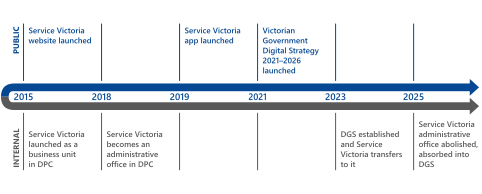
The Service Victoria administrative office we audited in 2021 has since been abolished and absorbed into DGS, as Figure 1 shows. This means DGS is responsible for Service Victoria’s action plan.
DGS has kept the name 'Service Victoria' as a public-facing brand for the government's digital service delivery website and mobile application (app).
Figure 1: Timeline of Service Victoria
Source: VAGO, based on information from DPC and DGS.
Agency roles and responsibilities
Department of Premier and Cabinet
DPC is responsible for developing and leading whole-of-government policies. DPC developed and led the government's A future-ready Victoria – Victorian Government Digital Strategy 2021–2026 until 2023.
DPC was responsible for Service Victoria from its launch in 2015 until its transfer to DGS in 2023.
We made 5 recommendations to DPC in our 2021 report. In 2023, DGS became responsible for the 3 recommendations DPC had not yet reported as complete.
Department of Government Services
DGS was established in January 2023 to bring together government services to improve Victorians' experience of interacting with the government. DGS manages a website and app under the Service Victoria brand.
In 2023, DGS became responsible for A future-ready Victoria – Victorian Government Digital Strategy 2021–2026. The strategy’s key outcomes include providing:
- better, fairer and more accessible services
- a digital-ready public sector
- a thriving digital economy.
What we found
This section focuses on our key findings from this review, which fall into 3 areas:
1. DGS and DPC have made little progress on their action plans for our 2021 recommendations.
2. DGS does not have a clear strategy for its Service Victoria platform or a plan to encourage other agencies to use it for their digital services.
3. DGS does not transparently report on the Service Victoria platform’s costs and benefits, and this makes it impossible to assess how it is truly performing.
The full list of our 2021 audit recommendations, including agency action plans, is available in Appendix D.
Consultation with agencies
When reaching our conclusions, we consulted with the reviewed agencies and considered their views.
You can read their full responses in Appendix A.
Key finding 1: DGS and DPC have made little progress on their action plans for our 2021 recommendations
In our 2021 report Service Victoria – Digital Delivery of Government Services we made 10 recommendations to Service Victoria (now DGS) and DPC. Both agencies accepted the recommendations directed to them and committed to action plans to address them. In 2023, when Service Victoria transferred to DGS, DGS assumed responsibility for 3 of DPC’s 4 actions that were not complete.
However, the agencies have made little progress in implementing their action plans to improve digital service delivery, as our assessment in Figure 2 shows.
Figure 2: Status of the actions that respond to the recommendations from our 2021 audit
| Theme of recommendation and action | Agency | Agency response | Action status | ||
|---|---|---|---|---|---|
| 1 | Develop a stakeholder engagement strategy | DPC | Accepted | Not complete* | |
| 2 | Undertake annual survey to obtain feedback | Service Victoria (DGS) | Accepted | Not complete* | |
| 3 | Revise annual benefits measure | Service Victoria (DGS) | Accepted | Not complete | |
| 4 | Introduce Budget Paper measures and targets | DPC | Accepted | Not complete | |
| 5 | Identify number of government services delivered digitally and require agencies to report on key performance indicators (KPIs) | DPC** | Accepted | Not complete | |
| 6 | Develop a dashboard for KPI reporting by government agencies | DPC** | Accepted | Not complete | |
| 7 | Customer satisfaction performance indicator | DPC** | Accepted | Partially complete | |
| 8 | Review expected benefit of compliance with government regulations | Service Victoria (DGS) | Accepted | Complete | |
| 9 | Review baselines for measuring digital service KPIs | Service Victoria (DGS) | Accepted | Not complete | |
| 10 | Ensure future digital transactions have reliable baselines | Service Victoria (DGS) | Accepted | Not complete | |
Note: *DPC/Service Victoria completed this action, but the work has not continued under DGS.
Note: **Responsibility for this action transferred from DPC to DGS in 2023.
Source: VAGO.
Key finding 2: DGS does not have a clear strategy for the Service Victoria platform or a plan to encourage other agencies to use it for their digital services
One of DGS's objectives is to make it easier for individuals and businesses to engage with the government. However, DGS's current approach to the Service Victoria platform is mostly focused on maintaining the range of services it offers rather than understanding the need for them and expanding them.
DGS and DPC also do not know how many services the government is delivering or how well it is delivering them. This makes it difficult to identify transactions that could be added to the Service Victoria platform to make whole-of-government service delivery more efficient.
We found that:
- DGS's lack of progress addressing our recommendations relates to the lack of clear vision for the Service Victoria platform's future
- DGS does not have a stakeholder engagement strategy to encourage other government agencies to transfer their services to the Service Victoria platform
- DGS and DPC have no way to measure or understand digital service delivery across the whole government
- DGS and DPC have not established reliable, consistent baselines to assess how well government agencies are providing digital services
- DGS does not have a formal mechanism to collect, collate and track feedback from other government agencies.
Key finding 3: DGS does not transparently report on the Service Victoria platform’s costs and benefits, and this makes it impossible to assess how it is truly performing
Although users’ satisfaction with the Service Victoria platform has remained consistently high, DGS does not know if transaction costs have come down since our 2021 report. This is because DPC did not implement the performance measures we recommended and it agreed to. DGS did not adopt the recommended performance measures when it became responsible for Service Victoria.
Reducing the costs associated with government service delivery was a key aim of the Service Victoria platform. Without clear measures the community cannot understand if Service Victoria is achieving the savings government intended it to.
We found that:
- DGS's performance measures cannot show if transaction costs have come down since our 2021 report
- DGS has stopped reporting on whether its initiatives provide the forecast annual financial benefit the original business case promised
- DGS has made mixed progress in updating other performance measures.
2. Delivering and monitoring digital services
DGS does not have a strategy for the future of the Service Victoria platform or a plan to encourage other government agencies to use it for their digital services.
One of DGS's objectives is to make it easier for individuals and businesses to engage with the government. However, DGS's current approach to the Service Victoria platform is mostly focused on maintaining the range of services it offers rather than understanding the need for them and expanding them.
DGS and DPC also do not know how many services the government is delivering or how well it is delivering them. This makes it difficult to identify transactions that could be added to the Service Victoria platform to make whole-of-government service delivery more efficient.
Covered in this section:
- DGS's lack of progress addressing our recommendations relates to the lack of a clear strategy for the platform's future
- DGS does not have a stakeholder engagement strategy to encourage other government agencies to transfer their services to the Service Victoria platform
- DGS and DPC have no way to measure or understand digital service delivery across the whole government
- DGS and DPC have not established reliable, consistent baselines to assess how well government agencies are providing digital services
- DGS does not have a formal mechanism to collect, collate and track feedback from other government agencies.
DGS's lack of progress addressing our recommendations relates to the lack of a clear strategy for the platform's future
No clear strategy for the Service Victoria platform
DGS does not have a clear strategy for the future of the Service Victoria platform, or for increasing uptake of its services. This puts it at a disadvantage when seeking funding for its continued operations or encouraging other agencies to transfer their services to the platform.
In the original 2015 business case for Service Victoria, DPC predicted that close to 100 per cent of Victorian Government transactions would have migrated to the Service Victoria platform by 2020. As of 2026, this has still not happened.
DPC and DGS advice
Between 2020 and 2024, in their advice to the government, DPC and DGS described Service Victoria's future direction in various ways, including:
- delivering end-to-end high-volume transactions for the Victorian public
- delivering modern services designed around people's needs
- as a one-stop-shop for engagement with the government.
However, neither department produced an overall strategy.
DGS priorities
In October 2024, DGS told the government that one of its current delivery priorities was accelerating the uptake and transformation of digital services. Its priority focus would be functions related to:
- vehicle registration and licensing
- worker screening
- grants administration
- consumer affairs
- dispute services
- digital credentials.
In May 2025, DGS submitted an investment framework to the government that included a vision to improve how Victorians and businesses engage with the government and accelerate digital transformation across the public sector. However, the government did not endorse the framework.
Workplans for the Service Victoria platform
DGS has sought government funding over multiple years to maintain, update and expand the Service Victoria platform. However, before 2025, the government had not approved any multiple year funding requests.
Instead, for the 2023–24, 2024–25 and 2025–26 financial years, DGS sought funding for the platform by submitting a workplan to the government outlining the initiatives it would deliver for the year.
In June 2025, DGS sought and secured 3 years of funding for the ‘children's early years’ theme of initiatives. This is the first time that DGS has secured funding for a multiple-year package of work.
The lack of funding certainty has hindered DGS from being able to develop longer-term plans for future initiatives.
DGS does not have a stakeholder engagement strategy to encourage other government agencies to transfer their services to the Service Victoria platform
Action 1
In 2021, we recommended that DPC develop and implement a government agency stakeholder engagement strategy with the aim of increasing agency participation and uptake of Service Victoria's services and reusing existing technology.
DPC accepted the recommendation and committed to implementing action 1.
| Action 1: Develop a stakeholder engagement strategy | ||
|---|---|---|
Not complete  | DPC will consult with key stakeholders as part of the first stage in the development of a government agency stakeholder engagement strategy to increase agency participation and uptake of Service Victoria's identify verification and customer services. The strategy will be reviewed on an annual basis to ensure it remains current and fit-for-purpose. DPC will provide biannual progress reports to the Identity and Access Management Committee, a committee of the Public Sector Administration Committee. DPC will liaise with Service Victoria regarding the outcome of Service Victoria's proposed annual surveys of agencies and adjust the strategy accordingly if required. Timing: July 2021 onwards. | |
Service Victoria engagement strategy
Service Victoria developed and implemented a stakeholder engagement strategy for 2021–22 and 2022–23. Service Victoria's board of management did not endorse the 2023–24 strategy, and it remained in draft.
DGS does not have a stakeholder engagement strategy for the Service Victoria platform now that Service Victoria has merged into it. This also means that DGS does not have a strategy for increasing the uptake of services.
Reporting to VAGO for action 1
In 2022, DPC reported that it had completed action 1 in its submission to our responses to performance engagement recommendations report. In 2025, DGS changed its response for the action from 'completed' to 'not applicable'.
However, as we found during this engagement, the 2023–24 stakeholder strategy was not endorsed, and DGS does not currently have a stakeholder engagement strategy for the Service Victoria platform.
DGS and DPC have no way to measure or understand digital service delivery across the whole government
Actions 5 and 6
Our 2021 report found that DPC and Service Victoria did not know:
- how many transactions take place across the government
- what they cost
- how many transactions are digital or delivered in other ways.
This is because agencies do not report to DPC, DGS or the public on digitisation measures, or the number of services delivered, digitally or otherwise.
Not understanding if and how well agencies are digitally delivering government services makes it harder for the agencies to:
- make data-driven decisions about how to improve their services
- compare data across multiple government services
- be open and transparent to the public about the performance of their services.
Our 2021 report made 2 recommendations to DPC to improve the public's and the government's understanding of delivery of digital services across government.
We recommended that DPC:
- establishes a requirement for departments and agencies delivering digital services to report to the Department of Premier and Cabinet on the key performance indicators outlined in its Measure how content performs – digital guide
- develops a dashboard to report publicly on the performance of agencies delivering digital services against those key performance indicators.
DPC accepted the recommendations in full and committed to implementing actions 5 and 6.
| Action 5: Identify number of government services delivered digitally and require agencies to report on KPIs | ||
|---|---|---|
Not complete | DPC will survey agencies to identify which services are delivered digitally and which are delivered through other channels. Timing: July 2021 onwards DPC will work with those agencies identified as delivering digital services to develop performance measures and reporting timeframes with measurement commencing on 1 July 2023. DPC will report to the Identity and Access Management Committee on agencies' performance against the key performance indicators to the Identity and Access Management Committee on a biannual basis. Timing: January 2022 onwards | |
| Action 6: Develop a dashboard for KPI reporting by government agencies | ||
|---|---|---|
Not complete | DPC will develop a dashboard to report publicly on the performance of agencies delivering digital services against the key performance indicators. Timing: January 2022 onwards | |
Digital delivery of services at a whole-of-government level
Parliament and Victorians still have no way to know if departments and agencies are making more government services available digitally. The public cannot access performance information showing how well agencies perform or if the benefits of delivering services digitally are being realised across the government.
DPC did not survey all agencies as it had committed to. It also did not develop a public dashboard to report to the community on the performance of agencies delivering digital services against the KPIs.
DPC and DGS do not know how many transactions are delivered across the government – digitally or otherwise. This makes it difficult for DGS to identify opportunities to expand the number of services the Service Victoria platform delivers and improve the efficiency of service delivery.
Services have not moved as expected
In 2022, DPC stated that it was no longer necessary to survey agencies or for agencies to report the performance of their digital and non-digital customer channels using consistent performance measures. It said that said agency effort would be better allocated to moving services to Service Victoria's platform.
However, DGS has noted that agencies have not moved most of their services to its Service Victoria platform as it initially expected.
DGS reports its own performance in delivering digital services as part of its annual performance statement. However, this reporting does not show how other departments and agencies are performing when delivering digital services.
Reporting to VAGO for actions 5 and 6
In 2023 and 2024, DGS's submissions to our annual responses to performance engagement recommendations reports said that a publicly available customer satisfaction dashboard for government websites is available through its Single Digital Presence platform. This is not correct.
DGS does not have a publicly available customer satisfaction dashboard. If it did, it would have made how well agencies are providing digital services more transparent.
DGS and DPC have not established reliable, consistent baselines to assess how well government agencies are providing digital services
Actions 9 and 10
DGS cannot effectively drive whole-of-government digital reform initiatives if it does not have strong reporting processes and reliable metrics to assess how well agencies deliver digital services.
Our 2021 audit found that while DPC understood the importance of measuring the performance of digital transaction provision at Service Victoria and across the government, performance reporting was not adequate. We also found that there was no central platform for agencies to report on their performance against DPC's digital standards or clear and reliable benchmarks.
We made 2 recommendations to Service Victoria (now DGS) to:
- review its baselines for key performance measures to ensure they were statistically reliable
- develop processes to ensure that future transactions have reliable baselines.
The department accepted the recommendations in full and committed to actions plans 9 and 10.
| Action 9: Review baselines for measuring digital service KPIs | ||
|---|---|---|
Not complete | Noting the strong dependencies with other recommendations, particularly (3) and (5). The external review will develop a revised KPI/benefit model and process through satisfying recommendation (3) which will inform how Service Victoria and related agencies (re)baseline. Due: June 2021 | |
| Action 10: Ensure future digital transactions have reliable baselines | ||
|---|---|---|
Not complete
| Noting the strong dependencies with other recommendations, particularly (3) and (5). Building on revised practices for recommendation (9) and the new requirement for agencies to make data available to DPC under recommendation (3). Due: December 2021 | |
Developing reliable baselines
There are still no standardised KPIs or baselines for measuring the provision of digital services across the government. This means DGS does not have visibility over the digital services other agencies provide and cannot monitor, benchmark or report on them.
The Victorian Government's Measure how content performs – digital guide gives agencies guidance on and highlights the importance of measuring performance against benchmarks. But neither DGS nor DPC has set standardised baselines or benchmarks for agencies to use. This makes it difficult to compare like-for-like services across the government.
Since our 2021 report, agencies have not transitioned to the Service Victoria platform as the government anticipated. For example, the predicted transition to the Service Victoria platform of high-volume transactions – such as VicRoads registrations and licensing services and land title transactions – has not happened. A lot of agencies have continued providing digital services separately to DGS.
Reporting to VAGO for actions 9 and 10
In 2022, DPC's submission to us for our responses to performance engagement recommendations report said that it had completed its planned work for actions 9 and 10.
In 2023 and 2024, DGS's submissions to us for our responses to performance engagement recommendations report also said Service Victoria had completed these actions. This is not correct as DPC decided not to undertake this work.
DGS changed its reporting in 2025 to say these action plans were no longer applicable. DGS has revised its own measures to be absolute rather than improvements on a baseline.
However, DGS has not set benchmarks and baselines for use across government. It also does not have a publicly available customer satisfaction dashboard for agencies to report on performance.
Had this been available, it would have increased transparency around how well agencies are providing digital services.
DGS does not have a formal mechanism to collect, collate and track feedback from other government agencies
Action 2
Our 2021 report found that Service Victoria did not have a mechanism to collect formal feedback from agencies, such as an annual survey. Instead, it met with agencies before, during and after it had onboarded transactions. This was a missed opportunity for Service Victoria to identify issues from a stakeholder's perspective.
We recommended that Service Victoria introduce an annual survey to track its performance over time. The full recommendation is available in Appendix D.
Service Victoria accepted the recommendation and committed to implementing action 2.
| Action 2: Undertake annual survey to obtain feedback | ||
|---|---|---|
Not complete | Service Victoria will develop and introduce periodic (at least annual) agency surveys. Due: July 2021 | |
Review of agency feedback
DGS does not have a formal mechanism to collect, collate and track feedback from other government agencies. From June 2022 until 2024, Service Victoria ran a twice-yearly stakeholder feedback survey. However, DGS has not run any stakeholder surveys since Service Victoria merged into it.
Although DGS does obtain feedback from its stakeholders during and after on-boarding services to the Service Victoria platform, it does not collate or track feedback across all its projects. DGS is still missing the opportunity to collate issues from the stakeholder's perspective and track how well it engages other agencies over time.
Reporting to VAGO for action 2
Since 2022, Service Victoria has been reporting in its submissions to our responses to performance engagement recommendations reports that it had commissioned a firm to undertake research and run the survey. This is consistent with what we found and addresses the intent of the recommendation we made in our 2021 audit.
In 2025, DGS changed its response for the action from 'completed' to 'not applicable'. However, as we discovered during this engagement, DGS ceased the survey when Service Victoria was absorbed into DGS in January 2025.
3. Costs and benefits of Service Victoria
Although users’ satisfaction with the Service Victoria platform has remained consistently high, DGS does not know if transaction costs have come down since our first audit. This is because DPC did not implement the performance measures we recommended and it agreed to. DGS did not adopt the recommended performance measures when it became responsible for Service Victoria.
Reducing the costs associated with government service delivery was a key aim of the Service Victoria platform. Without clear measures, the community cannot know if Service Victoria is achieving the savings the government intended it to.
Covered in this section:
- DGS's performance measures cannot show if transaction costs have come down since our 2021 report
- DGS has stopped reporting on whether its initiatives provide the forecast annual financial benefit the original business case promised
- DGS has made mixed progress in updating other performance measures.
DGS's performance measures cannot show if transaction costs have come down since our 2021 report
Action 4
In 2021 we recommended that DPC introduces a Victorian Government Budget Paper 3: Service Delivery (BP3) measure and target for Service Victoria's cost of transactions, volume of transactions and the number of services Service Victoria delivers.
This was because we found that Service Victoria's only public reporting measure was customer satisfaction.
DPC accepted the recommendation and committed to implementing action 4.
| Action 4: Introduce Budget Paper measures and targets | ||
|---|---|---|
Not complete | DPC will work with Service Victoria to develop new BP3 measures and targets for Service Victoria's transaction costs, volumes and number of services delivered to be included in the 2022–23 Budget onwards. DPC will report to the Identity and Access Management Committee on Service Victoria's performance against the new BP3 measures and targets on a biannual basis. Timing: July 2021 onwards | |
BP3 measures were different to the action plan
DPC introduced 3 new measures and targets for Service Victoria in the 2022–23 Budget. However, all the measures are different to those in DPC's action plan.
The changes to the recommended BP3 measures obscure Service Victoria's performance. The new measures do not help the public to determine:
- the actual number of services on the Service Victoria platform
- the number of transactions completed
- the cost per transaction.
| DPC implemented the measure … | instead of … | which means … |
|---|---|---|
| average cost per activity | average cost per transaction | there is no public information about the cost of delivering transactions through the Service Victoria platform. |
| volume of activities | volume of transactions | there is no public information about how many transactions are delivered through the Service Victoria platform. |
| number of new services Service Victoria delivers | number of services Service Victoria delivers | there is no easily accessible public information about the total number of services on the Service Victoria platform. We had to manually count the transactions available on the Service Victoria platform. |
DGS did not adopt the recommended performance measures when it became responsible for Service Victoria.
Measuring activities not transactions
Parliament and the public cannot tell if the cost of transactions on the Service Victoria platform have reduced because the new measure does not show that. DPC's decision to measure cost per activity and not per transaction means it is not possible to compare the platform’s current performance to our previous audit.
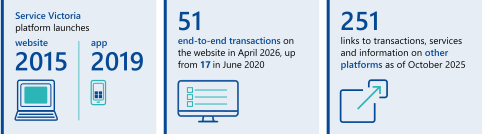
In our 2021 audit, we reported that in June 2020, Service Victoria had 17 end-to-end transactions available on its website. Although DGS does not report on the number of end-to-end transactions on the Service Victoria platform, our analysis found that as at April 2026, there were now 51 end-to-end transactions available on the Service Victoria website.
Understanding the number of transactions is important because transactions are the end point of a service. Counting activities gives an inflated view of Service Victoria's performance as it includes completing a transaction, as well as actions that may not be related to a transaction such as:
- viewing a digital card
- proving identity or reusing a saved identity
- opening a push notification on the Service Victoria mobile app. \
Service Victoria's data shows the platform also provides 251 links to services and information on other websites and platforms as of October 2025.
Non-compliance with government requirements
DGS's measurement of activities is not compliant with the Victorian Government guidance on measuring performance for digital services, Measure how content performs – digital guide.
Under this guide, Victorian Government websites must measure:
- user satisfaction
- value
- discoverability
- completion rate of transactions
- cost per transaction.
By measuring cost of activities not transactions, DGS does not meet the requirements of the guide. Other agencies also cannot compare service provision through their own digital platforms with service provision through the Service Victoria platform.
We have not assessed the other requirements as they were not recommendations from the original engagement.
Measuring customer satisfaction
DPC introduced the measure 'overall satisfaction of customers transacting on the Service Victoria platform' in the 2019–20 Budget. The target has been set at 95 per cent each year. The measure has had some name changes over the years, but the budget papers state that it continues to report on the same activity.
Service Victoria has met or exceeded the 95 per cent target each year, as shown in Figure 3.
Figure 3: Customer satisfaction target and outcome, 2019–20 to 2024–25
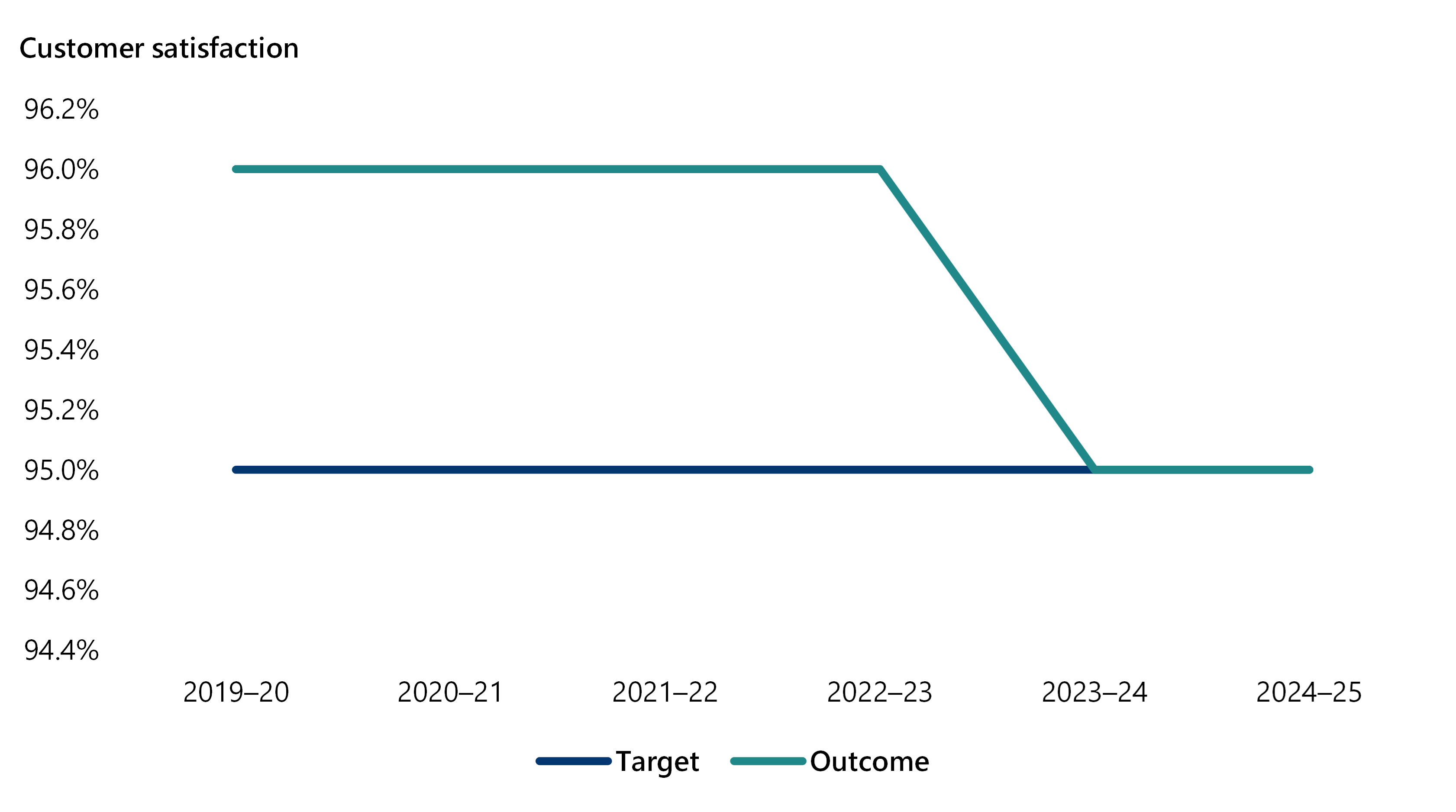
Note: The outcome for 2024–25 is the expected outcome, as the actual outcome was not available when the 2025–26 Budget was published.
Source: VAGO, based on BP3 data.
As we found in 2021, this measure only captures the customer satisfaction of those customers who complete their transaction. Customers who do not complete a transaction are not given the option to provide a customer satisfaction rating.
This means that DGS does not know if the reasons a customer fails to complete a transaction relates to the ease of using its platform.
Reporting to VAGO on action 4
In 2023, when Service Victoria transferred from DPC to DGS, DPC reported this action as complete. Since 2023, DGS has continued to report in its submissions to our responses to performance engagement recommendations reports that DPC introduced new BP3 measures and targets for Service Victoria's transaction costs, transaction volumes and number of services delivered.
This is inaccurate. DPC did not introduce these measures. The measures it introduced were for activity cost and volume, and the number of new services delivered.
DGS has stopped reporting on whether its initiatives provide the forecast annual financial benefit the original business case promised
Action 3
In 2021, we recommended that Service Victoria revises its annual financial benefit measure to ensure that it accurately reflects direct savings for the government and does not include double counting of benefits or include benefits to stakeholders other than the government.
Service Victoria accepted the recommendation and committed to implementing action 3.
| Action 3: Revise annual benefits measure | ||
|---|---|---|
Not complete | Service Victoria has commissioned a review of the benefits measurement methodology, including consideration of this VAGO review. It will recommend revisions to the framework to fully account for and clearly distinguish between the benefits to different beneficiaries and address the root cause of limited data (such as baseline data, comparative performance data within government, monetisation of non-cash benefits). Due: June 2021 | |
New benefits measurement framework
DGS has not implemented a new benefits measurement methodology, despite reporting this action as completed in our annual response to performance engagement recommendations report.
In 2021, Service Victoria commissioned an independent, external review of its benefits measurement methodology. This review found there were shortcomings in Service Victoria's benefit measures, as our 2021 report had highlighted. The review identified the root causes of Service Victoria's flawed methodology and advised Service Victoria to design a new benefits methodology framework. This proposed framework, completed in 2022, was never endorsed by Service Victoria or put to formal use.
DPC's original 2015 business case predicted that Service Victoria would deliver an annual financial benefit of $61 million, growing to between $120 to $150 million per year by 2020 if Service Victoria took on all Victorian Government transactions. Service Victoria has not expanded to include all transactions.
An internal benefits report for 2020–21 showed that Service Victoria had delivered a benefit of $35.7 million for that financial year, $18.6 million below its target.
For 2021–22, Service Victoria used the revised measurement methodology to develop an interim benefits report, which showed it had delivered an annual benefit of $35.5 million. Service Victoria did not compare this result to any target. It did not complete a final benefits report for 2021–22.
DGS has not produced any interim or final benefits measurement reports since 2022. DGS told us it measures the benefits of individual projects. We requested this information but DGS has not provided it.
Reporting to VAGO on action 3
Since 2022, DGS has been reporting in its submissions to our responses to performance engagement recommendations reports that it revised its annual financial benefit measure. We now know this is not correct.
In addition, DGS incorrectly advised the government in a 2023–24 Service Victoria business case that it was using a revised benefits realisation framework and benefits realisation plan. It noted that these documents were reviewed internally and externally and responded to issues raised in our 2021 audit report.
However, we have not seen any evidence that the updated framework is in use or was approved by the DGS executive.
DGS has made mixed progress in updating other performance measures
Action 7
Parliament and the public need to be able to reliably compare service provision by departments and agencies across the Victorian government.
Our 2021 report found that it was difficult to compare Service Victoria's customer satisfaction measures with other agencies. This was because there was no standard customer satisfaction measure used across the government. Each department or agency chose its own customer satisfaction measure.
Service Victoria's own approach was consistent and relied on statistically reliable data. But it only captured feedback from customers who completed their transactions. This meant it potentially excluded customers who did not complete their transaction because they were dissatisfied with the service.
We made one recommendation to DPC to review its digital standards to include a clear key performance indicator for customer satisfaction together with the preferred customer satisfaction measurement approach agencies should use.
DPC accepted the recommendation in full and committed to implementing action 7.
| Action 7: Customer satisfaction performance indicator | ||
|---|---|---|
Partially complete  | DPC will:
Timing: from January 2022 | |
No standardised customer satisfaction measure
These is still no standardised customer satisfaction measure across government departments and agencies.
In 2022, Service Victoria made a change to its own customer service measurement, moving from a 5-point satisfaction scale to a binary 'thumbs up, or thumbs down' measure. But the Service Victoria platform does not use this measure consistently as some of its older services still use the 5-point satisfaction scale.
We asked DGS to provide us the international best practice research it used to justify the change to the new measure. It did not do so.
DGS told us that other departments and agencies adopt its performance measures if they take up its shared services. However, DGS has also acknowledged that agencies have not transitioned to the Service Victoria platform as intended.
DPC and DGS do not know what approaches other agencies use to measure customer satisfaction.
Reporting to VAGO on action 7
Since 2022, Service Victoria has been reporting in its submissions to our responses to performance engagement recommendations reports that it revised its own performance indicator for customer satisfaction for digital services. This is consistent with what we found.
But its action does not address the underlying performance gap because the revised measure is not applied across the government. The public is still not able to reliably compare service provision by departments and agencies.
Action 8
DPC's original 2015 business case said that Service Victoria would increase people's compliance with government regulations and policies because it would make processes simpler, more consistent and more accessible.
Our 2021 audit found that Service Victoria could not show that it had achieved this benefit. This was because Service Victoria's benefit measures did not show how its actions would increase compliance with specific policies and regulations.
We made one recommendation that Service Victoria review its benefits reporting and consider removing the measure about compliance with government policy and regulations.
Service Victoria accepted the recommendation in full and committed to implementing action 8.
| Action 8: Review expected benefit of compliance with government regulations | ||
|---|---|---|
Complete  | Service Victoria has commissioned a review of the benefits measurement methodology. Service Victoria's review will consider VAGO's view that this intended benefit is neither attainable nor linked to the problems in the business case. Due: June 2021 | |
Change to expected benefits measure
Since 2022, Service Victoria has been reporting that this action plan item is complete. This is consistent with what we have found.
In March 2021, Service Victoria commissioned a review of its benefits methodology. It did not implement the new benefits measurement framework, as discussed under action 3 above.
But DGS's 2023–24 and 2025–26 business cases to the government did not include increased compliance with regulations as an intended and measurable reform benefit, as we recommended.
Appendix A: Submissions and comments
Download a PDF copy of Appendix A: Submissions and comments.

Appendix B: Abbreviations, acronyms and glossary
Download a PDF copy of Appendix B: Abbreviations, acronyms and glossary.
Appendix C: Review scope and method
Download a PDF copy of Appendix C: Review scope and method.
Appendix D: Recommendations and actions' status
Download a PDF copy of Appendix D: Recommendations and actions' status.