
Modernising myki
Audit snapshot
Is the myki modernisation project on track to deliver a system that achieves value for money and expected functionality?
Why we did this audit
Myki is the ticketing system for trains, trams and buses in greater Melbourne and parts of regional Victoria. More than 500 million passenger trips are taken each year on Victoria's public transport network. Around one-third of passengers are concession holders.
It is important for the network’s ticketing system to work as expected to avoid disruption and deliver value for money.
In 2023, the Department of Transport and Planning (DTP) contracted a new service provider to:
- operate the existing myki system
- develop a new ticketing system so customers can 'tap-and-go' on a bank card or other device, and verify their concession entitlements online
- expand myki to all remaining regional areas.
We did this audit to assess whether the new system is on track to deliver expected service and functionality within scope, budget and timeframes.
Key background information
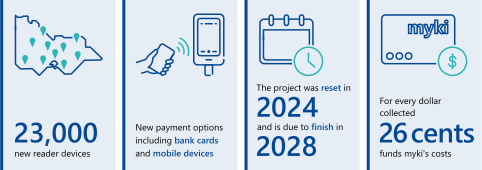
Source: VAGO.
What we concluded
The myki modernisation project is on track to meet its reset timeline. But there are risks in future phases.
DTP delivered an effective strategy and tender process. But it did not resolve known issues before awarding the project contract. This led to early disputes between DTP and the main contractor, which resulted in a contract standstill and project reset. This extended the project’s timeline by 18 months and increased costs by $136.8 million, which is within the original overall cost target agreed by the government.
The project is generally meeting its reset timeline and new reader devices are working as expected. But important parts of the system are due to be delivered in future project phases. These phases are complex and DTP needs to manage them carefully. DTP has not started planning these phases in detail, so it is unclear how it will do this.
The project's overall value for money is uncertain. DTP's benefit management plan does not measure if the new system will deliver its objectives, including reducing the cost of collecting fares over time.
Video presentation
1. Our key findings
What we examined
Our audit followed 3 lines of enquiry:
1. Was the government an informed buyer for the new ticketing approach?
2. Did the tender process for the modernised myki ticketing system support achievement of a value-for-money outcome?
3. Is the rollout of the modernised myki ticketing system being managed effectively?
To answer these questions, we examined 9 entities:
- Department of Premier and Cabinet
- Department of Transport and Planning (DTP)
- Department of Treasury and Finance
- VicTrack
- V/Line
- Conduent Victoria Ticketing System (CVTS) – associated entity
- HCLTech – associated entity
- Metro Trains Melbourne – associated entity
- Yarra Journey Makers, operator of Yarra Trams – associated entity
Identifying what is working well
In our engagements we look for what is working well – not only areas for improvement.
Sharing positive outcomes allows other public agencies to learn from and adopt good practices. This is an important part of our commitment to better public services for Victorians.
Background information
Project timeline
The government's contract with myki's original service provider expired in November 2023. DTP developed a strategy for a new ticketing system, which the government approved in late 2021.
DTP is delivering the modernised system in phases, as Figure 1 shows. It will launch new devices and functions over time, with a period when the old and new systems run together. After the new system is fully operational, DTP will retire the old system.
This approach means that:
- new reader devices on public transport can also read old myki cards
- a working system is always available as the new system is rolled out
- a ‘roll back’ is possible if a new feature does not work as expected.
Figure 1: Timeline for the myki modernisation project
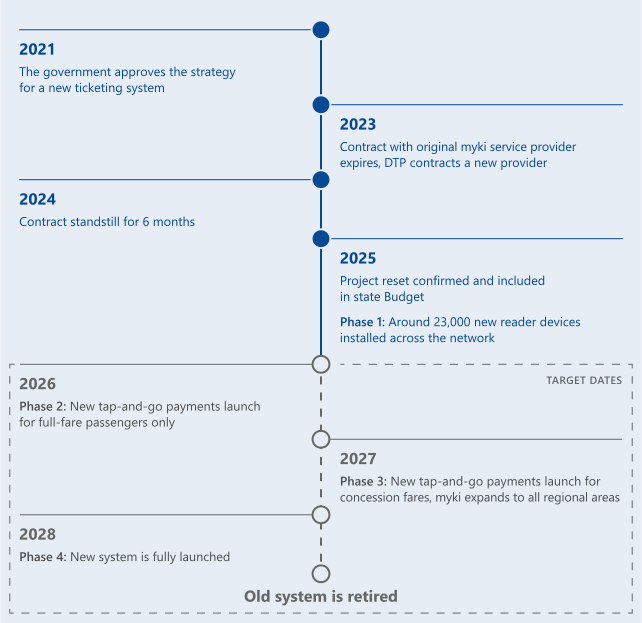
Note: Potential options for phase 4 include introducing QR code payments, Bluetooth technologies and converting old myki card balances into digital ‘travel tokens’ that can be used in the new system. These options are in scope for the project but not yet confirmed.
Source: VAGO, based on data from DTP.
Tap-and-go
Tap-and-go allows passengers to make contactless payments with credit cards, debit cards, mobile phones or other devices. Tap and-go payments on public transport can be anonymous or linked to a registered account (for example, where a passenger is a concession holder).
Card-based to account-based ticketing
The existing myki system uses card-based ticketing. This supports 2 types of payment methods:
- myki cards: reusable plastic smartcards with a microchip to hold and update information such as card balances and periodical fares
- mobile myki: digital smartcards available on Android smartphones.
After reviewing global ticketing technologies, the government chose account-based ticketing for the new system.
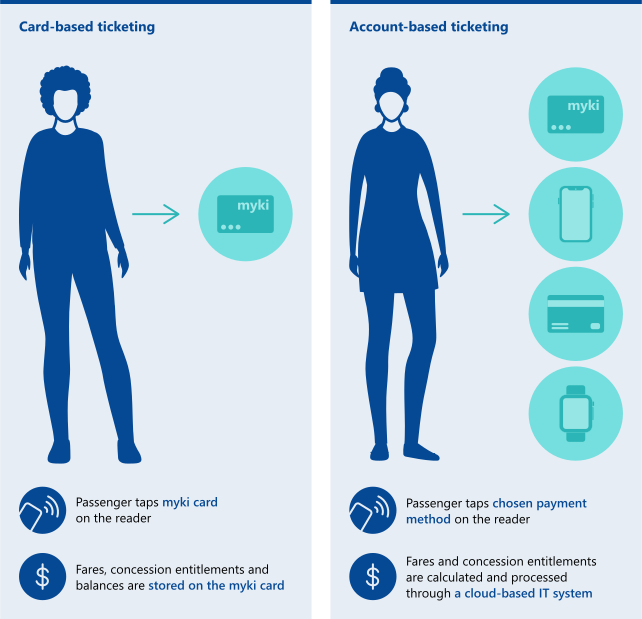
Account-based ticketing is different from myki's current card-based system. As Figure 2 shows, in account-based ticketing, transactions are completed in a cloud-based IT system instead of the microchip in plastic cards. Account based ticketing also allows for more payment options, such as tap-and-go credit or debit cards and virtual cards stored on mobile devices.
Figure 2: Card-based versus account-based systems
Source: VAGO.
Concession entitlements
Concession holders make up around one-third of all public transport passengers. There are nearly 30 types of concession entitlements in Victoria.
In the current system, some concession passengers such as children, pensioners and seniors can buy a concession myki at stations or shops. But many other concession groups, such as students or veterans, must submit paper forms to get a concession myki card.
Passengers must show proof of their concession entitlement (for example a Seniors Card or student card) if requested by public transport staff.
The new system will use new software called the concession entitlement validation platform (the concession platform) to verify and manage concession entitlements. HCLTech, a technology contractor, is developing the concession platform with oversight from DTP.
In early 2026 after we finished our work on this audit, DTP asked HCLTech to pause work on the concession platform. See responses from DTP and HCLTech in Appendix A for more information.
Expanding myki across Victoria
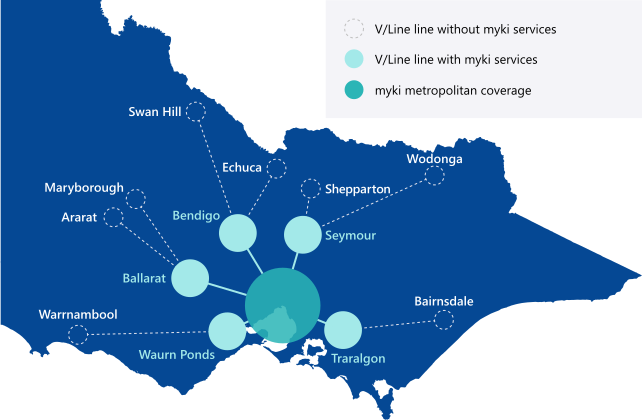
When the government approved the strategy for the new ticketing system, it also decided to expand it to regional areas of Victoria that do not currently use myki. Figure 3 shows the current situation with myki coverage.
This means that after the new system is successfully rolled out, it will replace paper tickets and other payment methods on Victoria’s public transport network, including:
- V/Line's long-distance trains
- V/Line’s regional coaches
- regional town buses.
Figure 3: Myki and non-myki areas across the Victorian transport network
Source: VAGO, based on a DTP graphic.
Roles and responsibilities
There are several entities involved in delivering the new system, as Figure 4 shows.
Figure 4: Roles and responsibilities for delivering the new system
| Entity | Roles and responsibilities |
|---|---|
| DTP | Lead department delivering the myki modernisation project. |
CVTS
| Main contractor to:
|
| HCLTech | Secondary contractor to deliver the concession platform. |
Metro Trains Melbourne Yarra Journey Makers (operator of Yarra Trams) V/Line | Public transport providers responsible for:
|
| VicTrack | Government entity that owns most of Victoria's transport infrastructure including ticketing-related assets. |
| Commonwealth Bank of Australia | Bank responsible for payment transactions in the new account-based ticketing system, including tap-and-go payments. |
| Department of Treasury and Finance and Department of Premier and Cabinet | Departments that provide advice to the government and help oversee the project. They are part of an interdepartmental project steering committee that works closely with DTP. |
Source: VAGO.
Budget to build the new system
In 2024, the capital budget to build the new ticketing system was $544 million. This increased to $680 million in 2025 after the government renegotiated aspects of the contract and commercial arrangements with CVTS. The capital budget component includes the costs to:
- keep some elements of the existing myki system running
- build the new ticketing system
- deliver a banking solution for payments
- build, switch on and maintain the concession platform.
This capital budget does not include:
- operational costs to run the old and new systems (for example, wages)
- costs to develop the ticketing strategy
- costs for advice and support on procurement, legal and commercial matters
- other delivery costs (for example, running a customer support call centre and marketing).
Figure 5 shows the latest disclosed costs for the 3 main contracts to build and operate the new system.
Figure 5: The project’s main contracts and values
| Contract | Contractor | Amount* | Duration |
|---|---|---|---|
| Ticketing (main contract) | CVTS | $1.96 billion | 15 years |
| Banking | Commonwealth Bank of Australia | Not publicly available | The whole-of-government banking and financial services contract expires on 30 September 2028. This contract may get extended or renegotiated in the future. |
| Concession platform | HCLTech | $34 million | 10 years |
Note: *These amounts include the capital costs to build the system and the operational costs to run the system for the duration noted.
Source: VAGO, based on information from Buying for Victoria (updated in May 2025).
Previous audits
VAGO has previously conducted audits about Victoria's public transport ticketing system.
In 2015, our report Operational Effectiveness of the myki Ticketing System looked at whether the myki system was achieving expected outcomes and benefits. We found that myki had experienced significant delays and cost increases that compromised its original business case objectives and benefits. Poor initial planning resulted in myki's original scope and contract being vaguely specified and overly ambitious.
In 2007, our report New Ticketing System Tender looked at the tender process for the first iteration of myki. We found areas where probity management could be improved. This included making sure that probity protocols minimise the risk of actual or perceived conflicts of interest during procurement.
More information
For more information about the scope of this audit and our methods, see Appendix C.
What we found
This section focuses on our key findings, which fall into 4 areas:
1. DTP did not resolve early risks and contract disputes, which caused delays and extra costs.
2. The project is on track based on its new timeline, but upcoming challenges may cause more delays.
3. The project's value for money is unclear.
4. DTP delivered an effective strategy and tender process, but it did not appoint a probity auditor.
The full list of our recommendations, including agency responses, is at the end of this section.
Consultation with agencies
When reaching our conclusions, we consulted with the audited agencies and considered their views. You can read their full responses in Appendix A.
Key finding 1: DTP did not resolve early risks and contract disputes, which caused delays and extra costs
DTP accepted an overly optimistic delivery schedule
Before awarding the project contract, DTP received advice that CVTS's delivery schedule was overly optimistic and did not contain enough detail. Ultimately, the schedule was proven to be unrealistic.
DTP did not address these known issues before signing the contract with CVTS. It instead deferred this work to a later stage, which contributed to disputes between DTP and CVTS.
Disputes led to a contract standstill and a project reset
Early disputes between DTP and CVTS led to a contract standstill and project reset. The reset extended the project’s timeline by 18 months and led to a cost increase of $136.8 million, within the government’s original cost target.
DTP and CVTS did not collaborate to resolve several issues, which included:
- the project’s master schedule
- some subcontracting agreements
- DTP’s delay in delivering critical items to CVTS.
The contract standstill lasted 6 months from mid-June 2024 for negotiations. The negotiation process resulted in DTP and CVTS agreeing to a project reset, which included changes to the project’s management, timeline and cost.
Addressing this finding
To address this finding, we have made one recommendation to DTP and the Department of Treasury and Finance about:
- developing guidance on how to achieve collaborative and dynamic risk-sharing approaches during procurement of high-complexity technical projects.
Key finding 2: The project is on track based on its new timeline, but upcoming challenges may cause more delays
DTP is meeting the new delivery schedule and devices are functioning as expected
At the end of our fieldwork for this audit in November 2025, the project was on track, based on its new timeline. The project reset has resulted in a more logical approach to project delivery. This includes device and software testing, and a staged rollout of the new system by public transport type.
This approach means DTP and CVTS can:
- address any software issues without slowing down the overall device installation
- trial new features on different types of public transport.
The new reader devices can read myki cards, which means the current system can keep operating and is not impacted by the new features' delivery schedule.
DTP does not have a detailed plan to manage future delivery risks
The operational and technical work needed to deliver the new system is complex. There is no time contingency in the new agreed schedule and both DTP and CVTS are aware of this risk.
But DTP has not started planning for future phases in detail, so it is unclear how it will manage this work and address upcoming risks. This future work will need to be progressed over the next 12 to 18 months.
| Work in upcoming phases includes ... | which … |
|---|---|
| delivering the concession platform | needs to verify concession entitlements and link with the new ticketing system. |
| expanding myki coverage | will expand the new system across regional Victoria to all public transport vehicles. |
| delivering the customer portal | is a website and app for passengers to manage their travel accounts and concession entitlements when the new system goes live. |
| passenger communications | will help passengers to understand the new system, including when it will be available and how to use it. |
| ‘card-flipping’ | will convert existing myki smart cards to a digital ‘travel token’ compatible with the new system and migrate any fares-related data previously held on the card to the new system. |
Addressing this finding
To address this finding, we have made 2 recommendations to DTP about:
- working with CVTS, operators and external user groups to develop passenger education initiatives
- formally recording progress against key phase milestones and reporting back to the government.
Key finding 3: The project’s value for money is unclear
Value for money is unclear
DTP’s benefits assessment does not demonstrate value for money for the project’s investment.
A project's 'total cost of ownership' can help assess its value for money. This includes all costs over a project’s lifecycle. Our analysis of DTP's available data estimates that the total cost of ownership for the new system is around $2.8 billion over 15 years.
But value for money for this investment is unclear. DTP's original benefits assessment forecasts a benefit-cost ratio between 1.0 (which means benefits and costs are equal) to 1.48 (which means expected economic benefits should exceed expected costs by a reasonable margin). DTP’s latest analysis from 2023 shows a benefit-cost ratio of 1.45. This is within the forecast range and means the economic benefits expected from the project are moderately positive, compared to costs.
In its benefits assessment, DTP expects the new system to reduce current fare evasion by 35 per cent and reduce concession fraud by 50 per cent. But this analysis uses anecdotal evidence from New South Wales. More relevant and up-to-date Victorian data shows differing rates of fare evasion and concession fraud.
DTP’s benefit management plan is underdeveloped
DTP’s benefit management plan is not well developed. The plan is part of a wider benefits management framework. It includes measures to monitor and evaluate how well investments deliver their intended outcomes.
But the measures in the project’s benefit management plan are not well defined.
DTP has not started tracking or reporting these measures, or updated the benefit management plan since 2023.
Addressing this finding
To address this finding, we have made 2 recommendations to DTP about:
- improving the project’s benefits management framework
- updating its understanding of total cost of ownership and developing a more holistic assessment of the project's longer term economic value for money.
Key finding 4: DTP delivered an effective strategy and tender process, but it did not appoint a probity auditor
DTP used high-quality market research to develop its strategy and advice
DTP led a thorough market research process to understand its options for a new ticketing system. High-quality user research focused on passenger needs and supported its decision-making around technology options.
Using this research and knowledge, DTP and other agencies gave useful advice to help the government to be an informed buyer.
DTP's tender process achieved cost and functionality objectives
DTP ran an iterative and comprehensive tender process. This helped the government achieve its cost and functionality objectives for the project.
DTP maintained competitive tension during the process. This helped reduce some final bid costs for the project, meeting the government's approved cost target.
Working well: DTP delivered an effective strategy and tender process
DTP used high-quality research to develop the project's strategy and support its decision-making. DTP and other agencies gave useful advice to the government.
DTP's tender process was comprehensive and helped achieve the government's functionality and cost objectives.
DTP did not follow government guidance to appoint a probity auditor
Government guidance recommends that entities appoint an independent probity auditor for complex and high-value procurement projects. But DTP did not do this.
Instead, DTP contracted a specialist probity lawyer as a probity advisor for the tender process. The advisor attended all key project and tender evaluation meetings, and actively advised the transactions team on any probity-related issues. The advisor provided a ‘sign-off letter’ indicating compliance against the probity plan, but this differs from a formal audit opinion that an independent probity auditor would give.
Independent probity auditor
A probity auditor reviews an entity's procurement process to assess if it complies with legal, regulatory and ethical standards. Government guidance recommends probity auditors are independent to make sure their opinions are reliable and objective.
A probity advisor is different from a probity auditor. An advisor is part of the project team to offer advice and assistance during the procurement process. An auditor is separate from the project team to allow independent review of the procurement process.
Addressing this finding
To address this finding, we have made one recommendation to DTP and the Department of Treasury and Finance about:
- applying the Buying for Victoria best practice guidance related to the use of probity practitioners.
See the next page for the complete list of our recommendations, including agency responses.
2. Our recommendations
We made 6 recommendations to address our findings. The relevant agencies have accepted the recommendations in full, in part or in principle.
| Agency response(s) | ||||
|---|---|---|---|---|
| Finding: DTP did not resolve early risks and contract disputes, which caused delays and extra costs | ||||
| Department of Transport and Planning and Department of Treasury and Finance | 1
| Use the Department of Treasury and Finance’s infrastructure procurement guidance and the Department of Transport and Planning's experience from infrastructure delivery to develop specific guidance on how to achieve more collaborative and dynamic risk-sharing approaches when procuring high-complexity technical projects (see Section 3).
| Accepted in principle
| |
| Finding: The project is on track based on its new timeline, but ongoing challenges may cause more delays | ||||
Department of Transport and Planning
| 2
| Formally record progress against key phase milestones and report to the government on a minimum quarterly basis:
| Accepted
| |
3
| Work with Conduent Victoria Ticketing System, Metro Trains Melbourne, Yarra Journey Makers, V/Line and any other relevant public transport operators to:
| Accepted
| ||
| Finding: The project’s value for money is unclear | ||||
Department of Transport and Planning
| 4
| Improve the benefits management framework for the myki modernisation project, making sure that:
| Accepted
| |
5
| Use recent and relevant Victorian data to:
| Accepted
| ||
| Finding: DTP delivered an effective strategy and tender process, but it did not appoint a probity auditor | ||||
Department of Transport and Planning and Department of Treasury and Finance
| 6
| Consistent with Buying for Victoria’s Goods and Services guidance, engage a probity advisor and a probity auditor for complex, specialised and high value goods and services procurements (see Section 6).
| Accepted in part by Department of Transport and Planning Accepted in principle by Department of Treasury and Finance
| |
3. Early disputes and project reset
Before it awarded the contract to CVTS, DTP was aware of several project risks. This included the project’s delivery schedule, subcontracting agreements and availability of some original myki software. But DTP did not address these risks before signing the contract.
DTP and CVTS could not resolve issues in a collaborative manner, which led to a 6-month contract standstill period. The negotiations in this period resulted in a project reset, which extended the project’s timeline by 18 months and increased costs by $136.8 million.
Covered in this section:
- DTP did not address risks before awarding the contract
- DTP and CVTS did not collaborate to resolve early issues
- Disputes led to delays and cost increases
DTP did not address risks before awarding the contract
Delivery schedule issues
DTP accepted an overly optimistic delivery schedule from CVTS, which contributed to early contract disputes.
Before awarding the project contract, DTP received expert advice that the project’s expected delivery timeline was 'significantly more ambitious than for comparable implementations elsewhere in Australia and internationally and should be reviewed'.
The advice recommended that DTP:
- redefine the project’s completion date
- seek agreement and approval for revised dates from the government.
In April 2023, DTP's tender evaluation panel selected CVTS as the preferred supplier for the project tender. It noted CVTS’s master schedule needed to be refined. But DTP did not agree revisions with CVTS before awarding the contract.
This meant a draft master schedule was in place when CVTS and DTP signed the contract in May 2023. The contract then required CVTS to:
- revise the master schedule
- submit a final version to DTP.
But shortly after contract signing, disputes began and DTP rejected multiple versions of the revised master schedule.
DTP said CVTS’s revised timeline would cause a 'delay in realising customer benefits'. DTP also claimed that CVTS had performance issues and was slow to respond. It also issued CVTS with contract penalties for failing to meet the original schedule’s timeline.
Transition risks and subcontract disputes
In the early development stage of the project, DTP received advice about potential risks transitioning from the current myki system’s supplier to a new one. This included its subcontractor arrangements and intellectual property.
Many subcontractors were used to deliver and support the original myki system. DTP needed to transfer some of the subcontractors to CVTS, which it outlined in the project contract. DTP also had separate agreements with subcontractors and could exercise its power to support the handover if required.
To transfer the current myki system to CVTS, DTP also needed full access to myki proprietary products and intellectual property. This included some software from old system devices that was needed to run the new myki reader devices. Known as ‘source code’, this was developed as part of the original system.
Source code
Source code is a set of instructions written in a programming language that defines how a computer program should behave.
DTP received advice when developing the strategy that there may be issues with intellectual property rights. The advice recommended DTP review its subcontracting agreements before awarding the contract. Although DTP used its advisors to do a review, the department did not adequately understand and address risks in some of these subcontracting agreements.
This led to disputes between CVTS and DTP about additional costs in the subcontracts after they were transferred to CVTS.
DTP and CVTS did not collaborate to resolve early issues
Dispute management
The disputes between DTP and CVTS caused unplanned legal and commercial advisor costs for both parties. It also led to a loss of trust and project cohesion.
DTP's initial approach to the disputes was adversarial and transactional. It focused on enforcing contractual rights, rather than resolving the underlying reasons for needing to revise the master schedule.
DTP did not collaborate to resolve unforeseen risks and issues, despite sharing some responsibility for delays.
Delay providing source code
During this period, DTP did not fully meet its contract obligations to deliver ‘state-supplied items’.
DTP did not provide CVTS with the old myki system’s reader device source code in a timely way. CVTS could not run the current myki system or deliver new reader devices that would work with the old myki cards without the source code. This is because of the period where the current and new devices would be working side by side.
Partly due to not receiving the source code, CVTS revised master schedule proposal asked to delay milestones in Phase 1 and Phase 2 by an average of 6.5 months.
Disputes led to delays and cost increases
Project reset
The disputes between DTP and CVTS led to a contract standstill and a project reset.
The agreed contract standstill started in June 2024 and:
- suspended contract penalties from DTP to CVTS
- allowed DTP and CVTS to continue critical work while negotiations took place.
This negotiation process lasted around 6 months. During this time, DTP and CVTS agreed to a project reset. This involved amending the project timeline and revising some parts of CVTS’s contract. It also settled CVTS's commercial claims, which are costs it asked DTP to cover for variations and other expenses.
The contract standstill and project reset extended the project’s original timeline by 18 months to the end of 2028. As detailed in the 2025–26 state Budget, the project cost was increased by the government so DTP could settle CVTS's claims and cover other prolongation and project related costs.
To fund this increase, the government authorised DTP to offset these new costs against:
- savings from other DTP projects
- some categories of unclaimed myki card balances and interest from those balances.
Unclaimed myki balances
Unclaimed myki balances are balances on unregistered myki cards that have not been used for more than 5 years. Under the Transport Integration Act 2010, unclaimed balances less than $20 are deposited in the Public Transport Fund. The fund can then be used to provide services to passengers, such as the myki ticketing system.
Unclaimed myki balances typically happen when people leave Victoria, lose their unregistered cards, or stop using public transport. Passengers can claim unused balances on their myki cards, regardless of why they have not used it. If a passenger makes a valid refund request, DTP will reimburse the money.
DTP plans to develop communications to raise awareness that passengers are entitled to claim any unused funds on their old myki cards.
4. Project delivery performance
DTP is delivering the project to meet its reset timeline. CVTS is now on track installing new reader devices. These devices are supported by thorough testing.
Future delivery stages will be more complex, including the processes and technology needed to verify concession fares.
DTP is responsible for delivering several parts of the project that are outside of CVTS’s scope. DTP has not started planning in detail for future project phases, so it is unclear how it will deliver this work and manage risks.
Covered in this section:
- The project is on track but the new schedule does not allow for delays
- DTP has not started planning future delivery phases
- Concession fare validation system has challenges
- New reader devices are being installed and working as expected
The project is on track but the new schedule does not allow for delays
Revised master schedule
The project is on track based on its new timeline and master schedule, which has a more logical flow of tasks.
DTP and CVTS agreed on the new master schedule as part of the project reset. Dated 19 December 2024, the new schedule has a more detailed and logical flow of tasks than the original contract’s master schedule.
This includes a staged testing approach that allows DTP and CVTS to fully test devices and systems before releasing them. This approach helps to reduce risks when rolling out complex technology.
The new master schedule outlines 'ready by' dates, as Figure 6 shows. ‘Ready by’ means DTP and CVTS have fully tested the devices and software, and they are ready to launch. The actual launch dates are subject to the government decision and public announcement.
Figure 6: Key milestones according to the revised master schedule
| Milestone | 'Ready by' date | Status |
|---|---|---|
| Phase 1: myki backwards compatibility | ||
| myki backwards compatibility software is ready to launch on trains | Mid 2025 | Complete |
| myki backwards compatibility software is ready to launch on buses and trams | Late 2025 | Complete |
| Phase 2: Tap-and-go payments (full fare passengers only) | ||
| Tap-and-go payments for full fare train passengers in current myki areas | Late 2025 | Not yet complete |
| Tap-and-go payments for full fare bus and tram passengers in current myki areas | Early 2026 | In progress |
| Phase 3: Tap-and-go payments (concession passengers and non-myki areas) | ||
| Tap-and-go payments for concession passengers on trains, buses and trams, and rollout of the system to all regional areas | Mid 2027 | In progress |
| Phase 4: Full account-based ticketing system and current myki closure | ||
| Card-flipping*, QR code payments and other products, and current myki closure | Late 2027 | Not started |
| Provisional completion | Mid 2028 | Not started |
Note: *Card-flipping is where all myki card balances will be converted into digital ‘travel tokens' and transferred to the new system. Once the cards are flipped, there will be no fare money or travel products processed or stored on the card.
Source: VAGO, based on information from DTP.
No time contingency
While the new master schedule has a more logical approach than the original schedule, it does not include time contingency. This means any delays in early phases are like to affect future phases.
DTP and CVTS know about this risk. They will need to closely monitor project delivery to make sure they are meeting the schedule.
But the delivery of future phases is still uncertain. DTP has not started planning for several critical activities in detail. These activities will mainly occur in Phases 3 and 4, over the next 6–18 months.
DTP has not started planning future delivery phases
Planning for Phase 3 and Phase 4
DTP does not have detailed plans for Phase 3 and Phase 4, so it is not clear how it will manage upcoming tasks and challenges.
Phase 3 will:
- launch the concession platform in phases for different types of concessions
- expand the new system into regional areas that do not currently use myki. The new system will replace paper tickets on:
- some V/Line trains
- V/Line coach services
- regional town buses.
Phase 4 will:
- connect the new system with V/Line’s seat booking system, V/Net, which is 20 years old
- migrate all myki card data and stored values to the new account-based system
- retire the current myki system
- introduce other future payment methods (such as QR codes) and Bluetooth technology.
These phases are due to be ready by mid to late 2027. But they are more technically complex than earlier phases. DTP and CVTS have not started detailed planning for these phases. This includes planning with V/Line to expand the new system to regional areas.
As this work hasn't started, the department cannot be reliably assured that these future phases will be delivered on time and with expected functionality.
Concession fare validation system has challenges
In early 2026 after we finished our work on this audit, DTP asked HCLTech to pause work on the concession platform. See responses from DTP and HCLTech in Appendix A for more information.
Passenger challenges
Phase 3 will deliver tap-and-go payments for concession passengers, who make up at least 30 per cent of public transport passengers.
The new system introduces additional steps for passengers to verify their concession entitlements.
When the concession validation system launches, concession passengers will need to:
- create a ticketing account on a new customer portal, which DTP is developing
- use the customer portal to verify their concession entitlement.
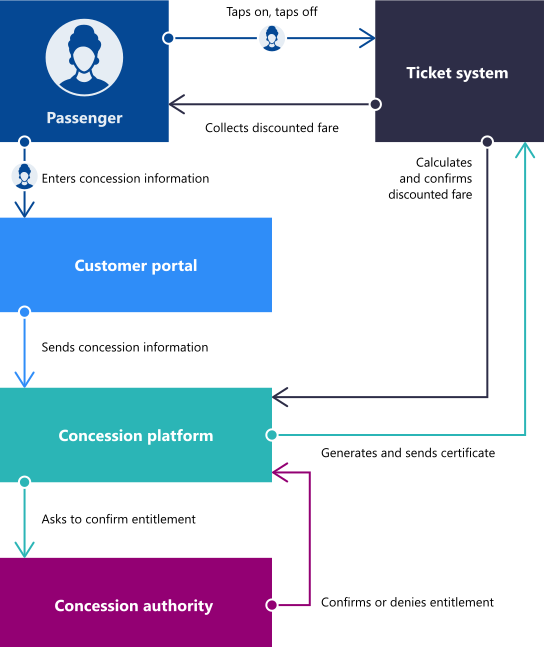
The customer portal will be linked to the concession platform, which then communicates with a Concession Entitlement Management Authority (concession authority) database. This relies on all systems functioning as expected.
Concession authority
A concession authority is an organisation that can verify an individual is entitled to a concession. For example, a university can verify a student’s eligibility or Centrelink can verify pension concessions.
Steep learning curve for concession passengers
A high percentage of regional passengers are concession holders. As Phase 3 will also expand the new system across parts of regional Victoria, passengers currently using paper tickets will also need to switch to tap-and-go payments.
DTP's user research says the technology and process learning curve for concession passengers may be steep and require targeted support.
But DTP has not planned any targeted communications for Phase 3. The evidence is also not clear about whether DTP has formally briefed V/Line on user research that is relevant to regional concession passengers.
The concession platform
HCLTech is delivering a concession platform that will link to the new ticketing system to manage concession entitlements and rates.
DTP is responsible for making sure HCLTech and CVTS work together and achieve a seamless, integrated solution.
The concession platform is an online portal that allows passengers to verify their concession entitlements.
As Figure 7 shows, the platform will verify a passenger's entitlement with the relevant concession authority. It will then communicate with the account-based ticketing system, which will generate a travel concession certificate.
The concession entitlement is stored in the account-based ticketing system and linked to a registered account, so future fares are calculated at the concession rate.
Figure 7: Overview of the concession validation process in the new system
Source: VAGO, based on information from DTP.
Concessions system is the first of its kind
DTP’s external advice and our own research shows that no other jurisdiction worldwide has delivered an automated concession validation system built into an account-based ticketing system.
Because this integration is unprecedented, it increases the risks of unforeseen technical, operational and user-adoption challenges.
DTP, CVTS and HCLTech will need to carefully monitor and manage these risks.
Technical and operational challenges
Setting up the concession platform comes with significant technical and operational challenges.
For the concession platform to automatically verify entitlements, DTP needs to access concession authorities’ databases.
To do this, DTP must sign agreements with each authority to get an application programming interface (API). APIs make it possible for the concession platform and the concession authority’s databases to exchange data with each other.
DTP needs to sign at least 150 agreements with concession authorities and seek details on their APIs. Each concession authority may use different systems and data standards to allow for this.
If the concession authority does not have an API, it can manually verify concession entitlements as passengers request it. But this manual process will require human involvement and will not work in real time. It is not yet clear how many concession authorities will need to use this approach.
This is a significant coordination and technical challenge that DTP needs to manage to make sure it can deliver Phase 3 smoothly.
Privacy challenges
Many Victorians will interact with the new concession platform and customer portal, which introduces privacy and data security challenges.
HCLTech is building the concession platform on third-party software, which is housed on a cloud platform. Passengers’ concessions status and type of concession will be stored on the concession platform.
The concession platform does not store the passenger’s name, date of birth or email address, these are stored in the account-based system when passengers register for an account. The platform will use the customer’s account ID from the new system in the verification process. Because HCLTech will develop, test and manage the concession platform, it is able to access personal data held within the system.
DTP has developed a privacy impact assessment for the project. It says the concession platform will only handle passengers’ personal information when the customer applies for a concession via the customer portal.
DTP has also committed to annual reviews of its privacy impact assessment and plans to develop further assessments before it launches several features of the new system.
DTP is aware that it must report any information security event to the Office of the Victorian Information Commissioner. But DTP has not engaged with the Office of the Victorian Information Commissioner more generally about this wide-scale system.
DTP has outsourced most of the technical work for the new system. But DTP is accountable for privacy and data security aspects of the concession platform, the new system and the customer portal.
State-supplied items and other challenges
DTP is contracted to deliver 55 state-supplied items to CVTS. It must deliver them on time to meet the project timeline. Items include:
- card-based system specifications and source code
- the customer portal (app and website) designed and delivered by DTP
- software interface specifications
- payment service gateway specifications
- banking interface specifications.
DTP also needs to provide planning documents and other data items related to future phases.
As at November 2025, DTP has delivered 23 of the 55 state-supplied items. If any of the remaining items are delayed, CVTS may not be able to deliver the project on time.
During the project reset, DTP and CVTS redefined many required items so that DTP could deliver them with support from its suppliers.
Policy changes for the new system
DTP advises the government on key decisions or changes to legislation needed for it to deliver the project.
As of October 2025, DTP received approval from the Minister for Public and Active Transport for a regional fare structure and rules, as well as a decision from the government on payment of merchant fees (which DTP incurs when processing tap-and-go payments). This timeframe is in line with the master project schedule.
As of December 2025, legislation is in place to:
- recognise digital ‘travel tokens’ and credit cards as valid tickets (which is needed for tap and go functionality)
- allow new devices to be used for authorised officers to check valid tickets
- allow a computer system to verify concessions.
The government is yet to approve decisions on:
- the role of authorised officers, including how they can check digital 'tickets' and concession entitlements
- the role of cash on the network
- locations of myki card vending machines and enhancements of the retailer network.
New reader devices are being installed and working as expected
Delivery to date
DTP and CVTS have efficiently rolled out new card reader devices on train station platforms and gates. This work is nearing completion within existing myki areas.
Reader device rollout on buses is underway. CVTS has technical crews working in various bus depots overnight to install the new devices. This work is due to finish in March 2026.
By the end of September 2025, there was a one-month delay in starting reader device installation on trams. This was because of:
- software and system integration issues
- delays in getting engineering change approvals for the tram fleet.
In late October 2025, DTP resolved these system issues and received engineering approvals from Yarra Trams. CVTS then started installing reader devices on trams.
DTP and CVTS do not expect this delay to impact the delivery of Phase 2. They have created an accelerated installation schedule so they can meet the March 2026 target completion date.
DTP is also working with public transport operators to coordinate passenger communication activities and prepare for the launch of Phase 2.
We cannot provide assurance on the timeliness of Phase 2 delivery. This is because the new device rollout is still underway and the government has not yet approved DTP's plan to trial and launch the phase.
Case study 1: Designing and testing new reader devices
Reader device design and testing gives assurance about functionality
CVTS is currently installing new reader devices across Victoria’s public transport network.
The readers are ‘off-the-shelf’ products. This means they:
- are commercially available without needing to be customised
- have already met a range of international standards as other jurisdictions use them in their transport systems.
DTP engaged with passengers and stakeholders during the new readers’ testing and design process. It used human centered design principles and assessments to do this. DTP documented user feedback well and DTP or CVTS actioned feedback as appropriate.
The Minister for Public and Active Transport’s Accessible Transport Advisory Committee has participated in the project since its procurement stage. The committee has contributed to reviewing user testing outcomes.
DTP and CVTS have run and documented a robust testing regime for the readers’ software and hardware components. This includes different levels of testing and exposure to passengers.
Each phase then progresses to user trials, which are divided into 2 stages:
- closed trials: DTP and CVTS test the devices in controlled, select environments to identify and resolve any issues
- open trials: members of the public use the devices in real-world settings, allowing for feedback and testing under typical operating conditions.
Progression between stages requires formal approval from the Minister for Transport Infrastructure. In the first 28 days of an open trial, DTP and CVTS go into a 'hyper care' period, where they have meetings every morning to:
- report on any issues
- discuss agreed resolutions
- capture this in daily reports.
This structured approach means DTP and CVTS can thoroughly evaluate each technical component before launching it.
Source: VAGO.
5. Benefits and value for money
DTP's benefit management plan for the project is not fully developed. It does not demonstrate value for money and uses some anecdotal data to forecast the project’s expected benefits.
The project’s total cost of ownership is estimated at $2.8 billion over 15 years. The cost of fare collection is estimated at 26 cents per dollar collected.
Overall, value for money for this investment is unclear.
Covered in this section:
DTP's benefits assessment framework is underdeveloped
Expected benefits from the new system
DTP developed a benefits management framework for the project in 2021. This includes:
- an economic benefits assessment, which DTP uses in its benefit-cost analysis for the project
- a benefit management plan, which includes all of the project’s expected (cost and non cost) benefits.
The economic benefits assessment defined 8 benefits for the project across 2 categories that can be quantified.
| The intended … | are ... |
|---|---|
customer benefits
|
|
fares benefits
|
|
DTP has a separate benefit management plan that defines 6 benefits for this project:
- improve customer experience
- reduce operating costs
- support agile decision making
- future proof the solution for new technologies
- attract new customers to the network
- improve transport data analytics.
DTP is required to track these benefits in line with the Department of Treasury and Finance's Gateway Review Process and High Value High Risk Framework requirements. These processes help the government to understand if a project is achieving its intended outcomes.
Using the benefit management plan
DTP is not adequately measuring and managing the project’s benefits.
In its benefits work to date, DTP has not sufficiently engaged with its operational teams that will manage the project over the long term. This has led to these teams not taking ownership of ongoing benefits assessments and relying on the project team and consultants to develop the benefit framework.
The Victorian Government Purchasing Board defines value for money as achieving a balance between a project’s costs and benefits through its lifecycle. But DTP received advice from an expert project assurance team that the benefits listed in its benefit management plan do not demonstrate value for money for the investment.
Reporting on the benefit management plan
DTP drafted the benefit management plan in 2021 and updated it in March 2023.
Since then, DTP has not officially updated it or reported on any measures since the project started.
DTP says it expects to review the benefit management plan and refresh the measures in the next 3 to 6 months as part of delivering Phase 2.
The project’s value for money is unclear
Benefit-cost ratio
DTP’s economic benefits assessment initially estimated the new system would deliver a benefit cost ratio between 1.0 and 1.48.
| A benefit-cost ratio of … | means ... |
|---|---|
| 1.0 | the project’s benefits and costs are equal. |
| 1.48 | the project should deliver positive benefits worth about half more than the costs. |
DTP’s latest assessment from 2023 shows the project’s benefit-cost ratio is at 1.45. This means DTP expects the project to deliver moderately positive net economic benefits over the 15-year life of the project.
Economic assessment data
DTP’s economic benefits assessment outlines the expected costs and benefits of the new system. But the data DTP uses in these calculations is not fit for purpose.
As Figure 8 shows, DTP’s economic benefits assessment forecasts that over 15 years the project will generate:
- $218.50 million in fares benefits
- $137.04 million in customer benefits.
Figure 8: Expected benefits in DTP’s economic benefits assessment (2023)
| Expected benefit | Value ($m) |
|---|---|
| Fares benefits | |
| Uplift in passengers – tourist and local (expected increase of 1%) | 43.99 |
| Reduced fare evasion (expected decrease of 35%) | 102.73 |
| Reduced concession fraud (expected decrease of 50%) | 71.78 |
| Total fares benefits | 218.50 |
| Customer benefits | |
| Time and convenience of not topping-up a myki card | 36.16 |
| Time and convenience of not purchasing a paper ticket | 4.14 |
| Reduced time to process refunds | 9.26 |
| Avoided monetary loss (lost cards) | 87.48 |
| Total customer benefits | 137.04 |
Note: These figures are from the economic benefits assessment's ‘likely’ scenario.
Source: VAGO, based on information from DTP.
DTP used some data and benchmarks from other jurisdictions to calculate these economic benefits.
For example, the economic benefits assessment assumed that the project will reduce fare evasion by 35 per cent and reduce concession fraud by 50 per cent. But it uses fare evasion data and anecdotal evidence from New South Wales. More relevant and recent data from Victoria shows very low fare evasion rates and very limited cases of concession fraud.
It is important that DTP uses relevant and recent data in its economic benefits calculations. This is because economic benefits have a significant impact on the benefit-cost ratio DTP reports to the government.
Total cost of ownership
Our analysis of DTP’s available data shows that the total cost of ownership for the new system is around $2.8 billion in nominal dollars over 15 years. Nominal dollars are not adjusted for forecast future inflation.
Our estimate includes costs related to the project’s:
- strategy development
- tender process
- new software build
- reader device rollout
- oversight and operation of the new system (including all supporting work such as customer support), as well as costs related to keeping the old myki system running while the new system is delivered.
Total cost of ownership
A project’s total cost of ownership is the total of all the expenses an agency pays to deliver a project over its lifecycle, from starting procurement to completing services.
It is more than the cost of a contract as expenses may be incurred beyond the contract term.
Cost of fare collection
A cost of fare collection ratio measures how much a transport provider spends to collect each dollar of fare revenue. It helps to show a ticketing system’s efficiency and value for money over time.
We calculated that the new system’s cost of fare collection is around 26 cents for every one dollar collected from passenger fares.
Because every jurisdiction’s transport network is different, it is difficult to compare global ticketing systems. But in 2021 DTP received advice that, based on other global ticketing implementations, the cost of fare collection for a modern account-based system could be less than 10 cents per dollar collected.
To calculate the myki cost of fare collection, we compared the new system’s estimated total cost of ownership ($2.8 billion) with the actual fare revenue the system collects, as Figure 9 shows.
Figure 9: Cost of fare collection calculations
| Calculation | Total |
|---|---|
| Annual system cost (estimated total cost of ownership divided by 15 years) | $189 million |
| Fare revenue collected in 2024–25 financial year | $736 million |
| Cost of fare collection (annual system cost divided by 2024–25 fare revenue) | 26 cents per dollar |
Note: Figures have been rounded in this calculation.
Source: VAGO.
DTP does not currently monitor or report the cost of fare collection.
Victoria's policy settings about fares and access to public transport can have a direct impact on fare revenue. This has a flow-on effect to the cost of fare collection.
For example, DTP developed its economic benefits assessment before fare caps and exemptions for certain passengers (such as young people or seniors) were introduced in late 2025. DTP has not reviewed how these exemptions affect the project’s fare benefits.
Operating costs versus fare revenue
Victoria's public transport system is heavily subsidised. Our analysis shows that public funding covers about 80 per cent of actual costs.
In the 2024–25 financial year, DTP paid $3.2 billion to bus, tram and train public transport services operators to deliver the system. Passengers paid $736 million in fares. Public transport operators directly received $383 million from fares.
Based on our analysis of available DTP data, we estimate that at an indicative level, around 26 per cent of an $11.40 daily adult fare will go to the cost of running the new myki system. The remaining 74 per cent from fare revenue contributes to the cost of running the overall transport system, as Figure 10 shows.
Figure 10: Indicative explanation of how the public transport system is funded
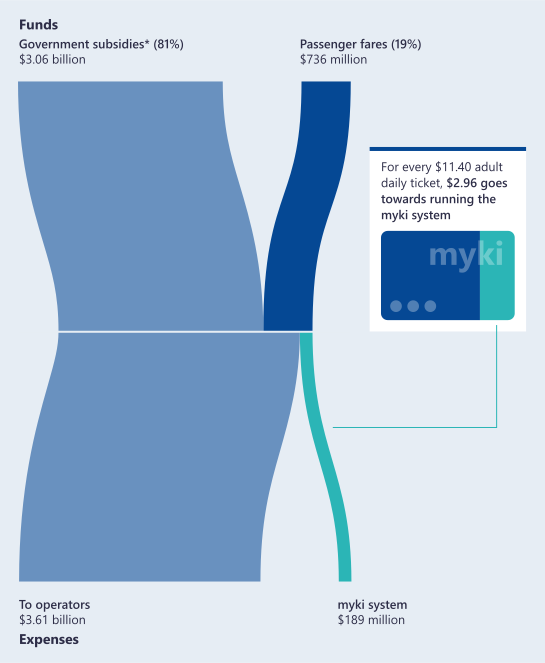
Note: *This includes all funds for operators plus estimated annualised total cost of ownership for the modernised myki system.
Source: VAGO calculations and estimates, using DTP data.
6. Strategy and tender processes
DTP ran a comprehensive market research process to help the government understand options for a new ticketing system. Its tendering process also helped to achieve the government's cost and functionality objectives.
But DTP did not follow government guidelines to appoint an independent probity auditor for the project. Independent probity auditors give assurance that a project’s tender process and outcome comply with legal, regulatory and ethical standards.
Covered in this section:
- DTP developed an effective strategy and understood passenger needs
- DTP's tender process met cost and functionality objectives
- DTP did not appoint a separate probity auditor
DTP developed an effective strategy and understood passenger needs
Market research
DTP’s strategy and procurement plan, which the government approved in late 2021, helped the government to be an informed buyer.
DTP ran a thorough market research process to understand options for a new ticketing system. This included researching other jurisdictions’ systems as reference cases for the project.
It developed its strategy and procurement plan with extensive consultant support and advice. This helped the government to decide which technology to buy and how to engage a supplier.
DTP also ran stakeholder engagement and commissioned market research. This helped DTP to understand the specific needs of passengers from regional areas, as well as those living with disability or experiencing mobility and accessibility challenges.
Understanding ticketing systems
In 2021, DTP hired consultants to help it engage with global ticketing and financial services suppliers. It wanted to understand the market's capacity and capability to deliver public transport ticketing systems.
DTP learned that:
- the market has moved towards 'off-the-shelf' products for its ticketing systems
- transport systems have moved away from using 'transport-only' cards to tap-and-go payments (such as credit cards, mobile phones and smart watches) with examples in Singapore, London and Sydney
- account-based technology is maturing and more suppliers are emerging
- jurisdictions with recent ticketing renewal projects have chosen account-based technology as it delivers more long-term customer benefits and flexibility.
This market research gave DTP confidence that an account-based solution could align with government objectives, market capability and supplier availability.
User research and consultation
DTP consulted with internal stakeholders to check that its strategy aligned with department and government objectives.
This included:
- DTP's accessibility and inclusion team
- DTP’s Chief Accessibility Advocate
- the Minister for Public and Active Transport’s Accessible Transport Advisory Committee.
DTP engaged these stakeholders early in the project to get insights about passengers with accessibility needs.
DTP also commissioned 3 sets of user research to understand:
- current customer experiences for metro and regional myki passengers, and best practice case studies in ticketing
- the specific needs of regional public transport passengers
- needs of public transport passengers living with accessibility and mobility challenges.
Each user research set involved a diverse selection of participants relevant to the research objectives. This included passengers from regional Victoria, concessions holders and people with accessibility needs.
Options offered to the government
Based on government priorities, available technologies, global trends and expert advice, DTP developed 3 options for the new system:
1. keep current system: a 'do minimum' option to continue providing the same services with basic upgrades
2. augment current system: improve the existing myki card technology with new applications or functionality within the limits of the existing reader devices
3. account-based ticketing: a new-build system to introduce tap-and-go payments and move transactions to a cloud-based system away from card-based microchips.
DTP advised the government in June 2021 that account-based ticketing was its preferred solution.
DTP said it preferred this option because it:
- is a modern ticketing solution that aligns with global trends
- provides a better passenger experience and improves data insights
- offers flexibility to provide new payment options
- makes it easier to introduce fare changes and products (as the calculations are managed in a cloud-based IT system).
Case study 2: Mitigating 3G shutdown risks
DTP effectively mitigated key risks from the 3G network shut down
While developing the project strategy, DTP faced a looming technical challenge from the planned 3G mobile network shutdown in 2024 (as announced by telecommunication carriers in 2019).
DTP identified that around 30 per cent of devices on Victoria’s public transport network used 3G and would go offline if they were not replaced.
DTP analysed multiple options to renew these devices. In August 2022, NTT DATA proposed a solution to replace the existing 3G modems and routers with 4G-compatible technology.
DTP approved this approach, which allowed the existing equipment on buses and trams to keep communicating. This upgrade removed the risk of widespread device shutdown as it used existing vehicle antennas to receive a 4G signal.
NTT DATA completed this work during the contract transition to CVTS. This extended the life of the older devices and allowed more time for CVTS to progressively replace them with new readers.
Source: VAGO.
DTP's tender process met cost and functionality objectives
Multi-stage tender process
From late 2021 to May 2023 DTP ran a multi-stage tender process to find a supplier for the new system, as Figure 11 shows.
Figure 11: Tender stages
| Tender stages | Dates |
|---|---|
| Expression of interest | Nov 2021 to Jan 2022 |
| Interactive workshop with shortlisted respondents | Apr 2022 |
| Request for proposal issued to respondents | Aug to Nov 2022 |
| Product demonstration | Jan 2023 |
| Targeted proposal improvement process | Feb 2023 |
| Final tender evaluation | Apr 2023 |
| Final negotiation and contract award | May 2023 |
Source: VAGO, based on information from DTP.
This tender approach gave DTP's evaluation team several opportunities to understand and confirm whether potential suppliers could deliver the new system.
This included DTP running a product demonstration stage where suppliers demonstrated their reader devices in test scenarios. This allowed DTP’s evaluation team to see the potential devices in action to support their assessment.
In late April 2023, DTP selected CVTS as the preferred supplier. Before awarding the contract in May 2023, DTP ran an alignment phase for a few days. During this phase, DTP and CVTS discussed contractual matters identified by the evaluation panel.
This tender process assured DTP that CVTS could deliver a solution that would meet the government's objectives and deliver expected benefits. But as discussed in Section 3, DTP did not resolve some issues prior to awarding the contract, leading to disputes, delays and cost increases.
DTP did not appoint a separate probity auditor
Probity best practice
Buying for Victoria has best practice guidance for complex and high-value procurement of specialised goods and services.
In these circumstances it recommends appointing a separate probity auditor to make sure public entities run a project’s procurement process in line with legal, regulatory and ethical standards.
Probity advisor and probity auditor roles are distinct. Both aim to support integrity in a procurement process. But an advisor works closely with the project team during procurement.
An auditor is separate from the team and provides an independent opinion on whether the procurement process complied with probity principles and rules. A probity auditor should not provide advice on any probity issues that arise during the procurement process.
Probity advisor and probity auditor
DTP did not follow Buying for Victoria’s guidance. It appointed a probity advisor for the project, but not a probity auditor.
DTP developed a probity plan for the project’s procurement. It required all relevant Buying for Victoria guidance to be followed.
But DTP did not appoint a separate probity auditor. Instead, it hired a specialist lawyer as the project's probity advisor.
This probity advisor attended all key meetings and managed potential conflicts of interest and other probity issues throughout the procurement process. Because they gave advice on aspects of the procurement they were not independent and did not perform the same role as a probity auditor.
DTP said it considered its other governance and probity review structures to be sufficient and so did not appoint a probity auditor.
The evidence we saw confirms that DTP adhered to all other procurement process requirements and guidance.
Appendix A: Submissions and comments
Download a PDF copy of Appendix A: Submissions and comments.

Appendix B: Abbreviations, acronyms and glossary
Download a PDF copy of Appendix B: Abbreviations, acronyms and glossary.
Appendix C: Audit scope and method
Download a PDF copy of Appendix C: Audit scope and method.