
Investing in Early Intervention Initiatives
Audit snapshot
Does the implementation of the Early Intervention Investment Framework support the government to make evidence-based funding decisions?
Why we did this audit
Government services provide vital support for Victorians, including people experiencing homelessness, children at risk of entering care, young people in the justice system and people with complex health or mental health needs.
Providing services to people early can help avoid the need for more acute support later. This is known as early intervention.
The Victorian Government funds departments to run early intervention initiatives through its Early Intervention Investment Framework (EIIF). It expects initiatives to improve outcomes for Victorians and save costs in the future by reducing demand for acute services.
Under the EIIF, the government reduces departments’ budgets based on these expected savings. For the EIIF to achieve its goals, the government needs reliable evidence to show that initiatives improve outcomes, reduce service demand and deliver the savings used to make budget reductions.
We did this audit to assess if the Department of Treasury and Finance (DTF) and departments produce this evidence.
Key background information
Source: VAGO.
What we concluded
DTF and departments give the government useful information about EIIF initiatives’ performance. But departments are not always collecting the evidence they need to show if initiatives are reducing service demand, and DTF and departments do not calculate if expected savings are being achieved.
DTF supports EIIF implementation through a consistent approach to assessing proposed initiatives and annual outcomes reporting. But its advice to government could better highlight where expected demand reductions are uncertain, when savings estimates rely on contested assumptions, and outcome measure limitations.
To better support government decision-making about early intervention, the EIIF needs clearer requirements to measure service demand, calculation of actual savings at both initiative and whole-of-framework levels, and better communication of risks and evidence gaps in advice to the government.
Without this, there is a risk that the government will not have enough evidence to know if the EIIF is an effective and sustainable approach to funding early intervention.
1. Our key findings
What we examined
Our audit followed 2 lines of enquiry:
1. Does the Department of Treasury and Finance (DTF) provide and consistently apply Early Intervention Investment Framework (EIIF) guidance and processes to support evidence-based submissions and advice to the government?
2. Is departments’ reporting on EIIF initiatives comprehensive and evidence based?
To answer these questions, we examined:
- DTF
- Department of Education (DE)
- Department of Families, Fairness and Housing (DFFH)
- Department of Health (DH)
- Department of Justice and Community Safety (DJCS).
Identifying what is working well
In our engagements we look for what is working well – not only areas for improvement.
Sharing positive outcomes allows other public agencies to learn from and adopt good practices. This is an important part of our commitment to better public services for Victorians.
Terms used in this report
EIIF initiatives
EIIF initiatives are department programs, or sets of programs, that the government funds through the EIIF.
Savings
Savings are costs for services that the government and departments avoid if an early intervention works, for example, if an early health intervention prevents someone from needing hospital treatment and that results in reduced costs. Savings can be:
- estimated, which are the expected savings based on assumptions about reduced service demand
- actual, which are realised savings based on evidence of reduced service demand and costs.
Budget reductions
Budget reductions are the decreases the government makes to departments' budgets based on estimated savings.
DTF guidance
DTF guidance refers to EIIF guidance documents that DTF produces to help departments design initiatives, create funding submissions and report on their results. DTF updates and reissues this guidance annually.
Background information
About the EIIF
The Victorian Government introduced the EIIF in 2021–22 as a way to fund early intervention initiatives through the annual state Budget.
DTF's Early Intervention Investment Framework: A considered and collaborative approach to support early intervention investment says that the EIIF has 2 main goals, which are to:
- improve outcomes for Victorians
- reduce growth in government spending by lowering demand for acute services.
How the EIIF works
The government expects EIIF initiatives to reduce service demand over time and decrease departments’ future costs. Because of this, when it funds initiatives, it also reduces departments’ budgets.
The EIIF funding model has 2 main parts:
- budget reductions applied to departments, based on estimated savings from reduced service demand
- a portion of estimated savings set aside (known as a 'contingency') to fund future EIIF initiatives.
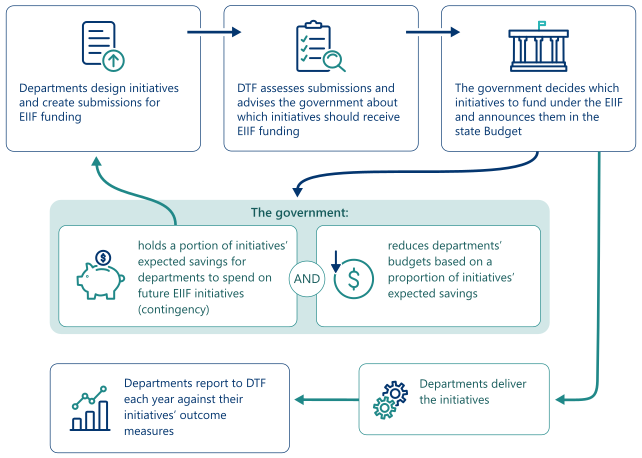
DTF assesses EIIF submissions and provides advice to the government as part of the state Budget process. The government decides which initiatives to fund under the EIIF. Departments' submissions must include:
- outcome measures to track improvements for individuals and the service system
- estimates of savings they expect initiatives to deliver over 10 years by reducing service demand.
This information aims to give the government a clear understanding of how initiatives will support Victorians and reduce the need for acute services, which helps it to make EIIF funding decisions.
Departments must also report on initiatives’ performance over time. This aims to support government decision making by improving the quality of evidence available about initiatives' performance.
Figure 1 gives an overview of the EIIF funding process.
Figure 1: The EIIF funding process
Source: VAGO, based on information from DTF.
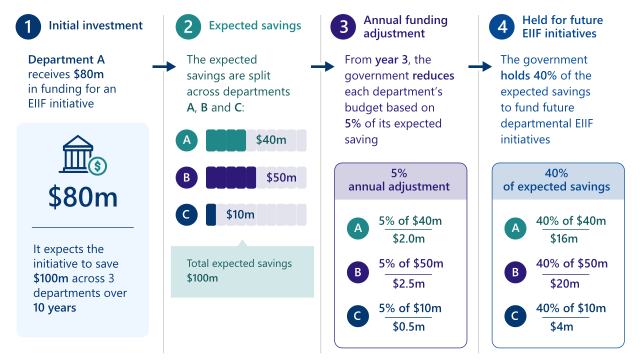
The government reduces department budgets annually, starting from year 3 after the initiative is approved. Reductions are set at 5 per cent of an initiative's 10-year estimated savings and continue indefinitely.
In some cases, departments propose initiatives that are expected to reduce demand in other departments' services. Budget reductions apply to:
- all departments expected to experience lower service demand, even if they are not delivering the initiative
- departments’ overall budgets, rather than specific services where savings are expected. Departments can decide how they manage them.
DTF holds 40 per cent of each initiative’s estimated savings for the contingency, which departments can use to fund future EIIF initiatives (subject to government approval).
Figure 2 illustrates how estimated savings, budget reductions, and contingency for future EIIF initiatives work.
Figure 2: Savings, budget reductions and future funding example
Source: VAGO, based on information from DTF.
DTF's role in the EIIF
DTF developed and coordinates the EIIF. It:
- provides guidance to departments
- assesses departments' EIIF submissions
- advises the government on funding decisions through the state Budget process.
DTF supports the government to make informed decisions about early intervention investment. It reviews departments’ outcomes reporting and advises the government on risks to individual initiative performance and the outcomes of the EIIF as a whole.
The EIIF’s funding impact
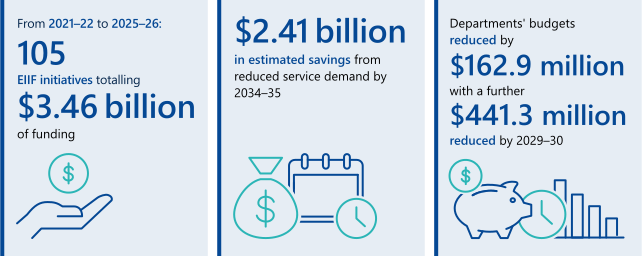
From 2021–22 to 2025–26, the government has funded 105 EIIF initiatives totalling $3.46 billion. This is 3.5 per cent of total funding for new initiatives announced in the state Budget over this period.
Based on these initiatives’ estimated savings, the government has reduced department budgets by $162.9 million. It will reduce budgets by a further $441.3 million by 2029–30 (in addition to budget reductions from any future EIIF initiatives it will fund).
Departments estimate that initiatives funded from 2021–22 to 2025–26 will deliver:
- $2.41 billion in savings over 10 years from reduced service demand
- $1.03 billion over 10 years in other economic benefits, such as reduced costs for individuals or businesses. These benefits do not inform EIIF savings or budget reductions.
Our audited departments, DE, DFFH, DH and DJCS, have received the majority of EIIF funding since it began. Together they account for 95 per cent of total EIIF funding over the period we examined.
For more information about the scope of this audit and our methods, please see Appendix C.
What we found
This section focuses on our key findings, which fall into 3 areas:
1. Departments collect useful evidence about initiatives and DTF monitors performance, but they do not routinely calculate if initiatives deliver estimated savings.
2. DTF has a consistent process to assess proposed initiatives and advise the government, but it could better highlight risks and evidence gaps.
3. Departments’ outcomes reporting is incomplete, but is improving as EIIF initiatives progress.
The full list of our recommendations, including agency responses, is at the end of this section.
Consultation with agencies
When reaching our conclusions, we consulted with the audited agencies and considered their views.
You can read their full responses in Appendix A.
Key finding 1: Departments collect useful evidence about initiatives and DTF monitors performance, but they do not routinely calculate if initiatives deliver estimated savings
For the government to know if the EIIF is working as intended, it needs evidence showing if EIIF initiatives reduce demand for services and lead to savings.
DTF and departments collect and report initiatives’ performance information. But they do not consistently measure changes in service demand or calculate actual savings.
DTF and departments collect useful information, but service demand measurement is inconsistent
Departments collect useful evidence about initiatives and report to DTF on their progress each year. DTF monitors initiatives’ performance using a risk based approach, which identifies initiatives that are not on track to achieve outcome measure targets.
But departments do not consistently measure or report on whether demand for acute services has decreased.
Previous DTF guidance required departments to have outcome measures linked to reductions in service use and estimated savings. But not all funded initiatives have these outcome measures. DTF removed this requirement in its 2026–27 guidance.
Actual savings are not routinely calculated
The government reduces departments’ budgets based on estimated cost savings. Because of this, departments have an incentive to build evidence that shows changes in service demand lead to actual savings.
But in some cases, initiatives’ outcome measures do not directly track demand for the services where savings are expected to occur.
Even where evidence of changes in service demand does exist, DTF and departments do not use this to calculate actual savings. DTF does not:
- require departments to calculate their initiatives’ actual savings
- analyse savings for the EIIF overall.
Budget reductions continue to apply based on estimates
Departments estimate their initiatives’ expected savings when applying for EIIF funding. The government uses these estimates to reduce departments’ budgets and create a funding source for future EIIF initiatives.
But DTF does not routinely reassess budget reductions against initiatives’ outcomes. This means budget reductions continue to reflect initial savings estimates.
DTF has processes to manage these risks. It:
- delays budget reductions until year 3 of the initiative
- reviews departments’ evaluations and annual outcomes reports to identify initiatives that it may need to monitor.
The Treasurer has also invited ministers to request reviews of budget reductions where appropriate.
But these processes do not provide DTF with assurance that actual savings have occurred. Without a process to assess initiatives’ outcomes against their estimated savings, there is a risk that budget reductions continue to apply without evidence that service demand or costs have reduced.
The government has reduced departments’ budgets by $162.9 million from 2021–22 to 2025–26. It will reduce budgets by a further $441.3 million by 2029–30.
As a result, departments can face ongoing annual budget reductions, even if demand and costs do not decrease. Similarly, if initiatives reduce demand more than expected, reductions still reflect estimates instead of actual savings.
Budget reductions often apply to departments that cannot control or verify outcomes
Budget reductions often apply to departments that did not design or deliver the initiatives expected to reduce service demand and costs. For initiatives funded in 2025–26, this represents 54.9 per cent of estimated savings.
In these cases, a department may attribute reduced service demand and savings to another department without having outcome measures to show how demand or costs will decrease in those services.
This means departments and DTF cannot know if these reductions reflect actual system-wide impacts.
Addressing this finding
To address this finding, we made 3 recommendations to DTF about:
- updating its guidance so that outcome measures relate to service demand, and service demand assumptions are tested
- calculating actual savings from EIIF initiatives
- reassessing budget reductions based on actual savings.
We also made one recommendation to DE, DFFH, DH and DJCS about establishing processes to follow DTF's updated guidance.
Key finding 2: DTF has a consistent process to assess proposed initiatives and advise the government, but it could better highlight risks and evidence gaps
For the government to make informed EIIF funding decisions, it needs clear evidence about initiatives’ outcome measures, estimated savings and associated risks.
DTF uses a consistent process to assess proposed EIIF initiatives and advise the government. But the information it provides is not always complete.
DTF has a consistent process to assess EIIF submissions and advise the government
DTF uses documented frameworks to assess initiatives’ outcomes and estimated savings. It also compares initiatives using their expected outcomes and estimated returns on investment.
DTF’s advice to the government includes information about initiatives’ estimated savings, budget reductions and the EIIF contingency. This helps the government to understand the full costs of new initiatives.
There are gaps in how DTF identifies risks and evidence limitations
There are gaps in how DTF identifies modelling risks and limitations in initiatives’ supporting evidence.
Under DTF’s outcomes assessment criteria, initiatives can score well even when key EIIF requirements are missing, such as outcome measures linked to estimated savings, and outcome measure targets and baselines.
When DTF cannot complete a standard assessment of initiatives' proposed outcome measures, it uses default scores. But the scores may not:
- fully reflect the quality or completeness of the initiatives’ supporting evidence
- clearly highlight limitations to the government.
DTF also recommends some initiatives for funding where estimated savings are lower than the proposed funding. It assesses and ranks these initiatives based on return on investment and broader policy factors. But it is not always clear how these initiatives contribute to EIIF’s goal of reducing long-term costs through lower service demand.
This means that government decision-making may not always be supported by complete information about the strength of the evidence, the limitations of assessments or the implications for expected outcomes and savings.
Clearinghouse reviews are limited and DTF does not highlight unresolved issues in its advice
The clearinghouse allows departments to review proposals and raise concerns about savings estimates. This supports cross-government input on proposed EIIF initiatives.
Clearinghouse
DTF’s clearinghouse process provides departments with an opportunity to review other departments’ proposed EIIF initiatives. Departments can look at the estimated savings and outcome measures, and raise concerns before the government makes a funding decision.
But some initiatives do not enter the clearinghouse or are available to review for a limited time. This means issues can remain unresolved.
DTF’s advice to the government does not identify these unresolved issues or their implications for funding decisions. This means the government may approve initiatives and budget reductions without having full visibility of risks.
Guidance does not fully address key modelling risks
During the EIIF submission process, DTF provides modelling tools to departments. But it does not require them to test or show how they manage key modelling risks.
| Risks include ... | which is when ... |
|---|---|
| substitution effects | initiatives reduce demand in one part of the system but increase demand elsewhere. |
| double counting | more than one initiative claims the same avoided service use. This includes where initiatives target the same groups. |
Without clear guidance to manage these risks, departments may overstate their initiatives’ system-wide impacts.
Late EIIF classification can create evidence gaps
Some initiatives funded through the EIIF do not start as EIIF initiatives. Instead, the government decides to bring them into EIIF during the Budget process.
These initiatives may not have complete outcome measures or estimated savings at the time the government makes funding decisions. DTF works with departments after funding to address these gaps.
But DTF’s guidance does not clearly explain how:
- departments should address ongoing evidence gaps
- the government should interpret gaps when making funding decisions.
Addressing this finding
To address this finding, we made one recommendation to DTF about identifying and clearly communicating uncertainty and risk to the government.
We also made one recommendation to DE, DFFH, DH and DJCS about making sure proposed EIIF initiatives are available in the clearinghouse for meaningful review and collaboration.
Key finding 3: Departments’ outcomes reporting is incomplete, but is improving as EIIF initiatives progress
For the government to know if EIIF initiatives are working as intended, departments should report on whether they are improving outcomes and reducing service demand.
Departments’ reporting improves as initiatives progress, and capability and systems develop. But their reporting is not complete or consistent. Some initiatives do not have reported results against their outcome measures, while others have partial or delayed data.
Departments’ outcomes reporting is improving but gaps remain
To accurately measure and report on their initiatives’ impact, departments must have baselines, targets and results for each of their outcome measures. For example, measuring outcomes requires:
- a baseline to understand 'as-is' conditions before an initiative starts
- a target to aim for (such as a 10 per cent reduction)
- results to understand the impact achieved.
Baselines
Baselines are sets of data that describe the current situation. They can be used as fixed reference points to monitor and assess changes against. For example, they can help departments to track service users’ outcomes when an initiative starts.
For initiatives required to report outcome measure results between 2021–22 and 2024–25, reporting is incomplete. We found:
- 46.2 per cent had baselines
- 64.9 per cent had targets
- 56.5 per cent had results.
Only 25.8 per cent had all 3. Departments often have legitimate reasons for not reporting. But these gaps limit the government’s ability to assess if initiatives are achieving expected outcomes or reducing service demand and costs.
As a result, departments’ outcomes reporting does not provide a complete basis to support EIIF performance assessment or funding decisions.
Guidance and data issues have led to inconsistent reporting
It is difficult for departments to set clear baselines for some initiatives, particularly universal initiatives that operate across service systems or entire population groups.
DTF gave departments limited guidance in the early years of the EIIF. But it introduced a standard definition for baselines for 2024–25 reporting. If departments cannot meet the definition, they can report baselines as ‘not applicable’.
This has resulted in a higher proportion of initiatives that do not report a baseline, but DTF expects it will improve reporting over time and comparability across initiatives.
Public reporting on EIIF outcomes
The amount of publicly reported information on EIIF initiatives has increased through successive Budget papers. Budget Paper 3 now includes information on each newly funded initiative. This has improved transparency about what EIIF initiatives aim to achieve and the benefits they are expected to deliver.
But annual outcomes reporting is not public. As the EIIF develops over time, public reporting on initiative outcomes would increase transparency. It would also support a whole-of-framework view of whether EIIF funding decisions and budget reductions are based on evidence of actual performance.
Addressing this finding
To address this finding, we made one recommendation to DTF about publicly reporting EIIF's outcomes.
See the next page for the complete list of our recommendations, including agency responses.
2. Our recommendations
We made 7 recommendations to address our findings. The relevant agencies have accepted the recommendations in full or in principle.
| Agency response | ||||
|---|---|---|---|---|
| Finding: Departments collect useful evidence about initiatives and the Department of Treasury and Finance monitors performance, but they do not routinely calculate if initiatives deliver estimated savings | ||||
Department of Treasury and Finance
| 1
| Update Early Intervention Investment Framework guidance so that:
| Accepted
| |
All audited departments except Department of Treasury and Finance
| 2
| Establish processes to comply with the Department of Treasury and Finance's updated guidance (see sections 3 and 4).
| Accepted in principle by Department of Families, Fairness and Housing Accepted by all other agencies
| |
Department of Treasury and Finance
| 3
| In consultation with departments, establish a process to calculate actual savings using evidence of reduced service demand from outcome measures (see Section 3).
| Accepted
| |
4
| Periodically reassess budget reductions using outcome measure results and, where initiatives do not reduce service demand or costs as estimated, advise the government on appropriate adjustments to budget reductions or funding (see Section 3).
| Accepted in principle
| ||
| Finding: The Department of Treasury and Finance has a consistent process to assess proposed initiatives and advise the government, but it could better highlight risks and evidence gaps | ||||
Department of Treasury and Finance
| 5
| Make sure assessment of Early Intervention Investment Framework submissions and advice to the government identifies key limitations in the supporting evidence. This includes:
| Accepted
| |
All audited departments except Department of Treasury and Finance
| 6
| Make sure proposed Early Intervention Investment Framework initiatives are available in the clearinghouse for the period recommended by the Department of Treasury and Finance, to enable meaningful review and collaboration (see Section 4).
| Accepted in principle by Department of Justice and Community Safety Accepted by all other agencies
| |
| Finding: Departments’ outcomes reporting is incomplete but is improving as Early Intervention Investment Framework initiatives progress | ||||
Department of Treasury and Finance
| 7
| Report Early Intervention Investment Framework outcomes publicly so that service user outcomes, changes in service demand and savings can be assessed over time (see Section 5).
| Accepted in principle
| |
3. Reducing costs through early intervention
Departments report on their initiatives' performance, which DTF tracks. This provides the government with useful information on service user outcomes and emerging risks.
But DTF and departments do not consistently measure changes in demand for the services where savings are expected, and they do not calculate actual savings.
This means the government cannot know if the savings underpinning budget reductions are being achieved.
Covered in this section:
- DTF tracks initiative performance through annual reporting
- Changes in service demand are measured inconsistently
- DTF and departments do not routinely calculate actual savings
- Budget reductions rely on estimates and are not reassessed based on performance
DTF tracks initiative performance through annual reporting
EIIF outcomes reporting
Each year, DTF produces a consolidated outcomes report for all EIIF initiatives. This gives the government useful information on initiatives' performance and service user outcomes.
DTF’s 2024–25 outcomes report includes initiatives’:
- outcome measure results
- performance against targets
- trend information where there is more than one year of data.
A goal of the EIIF is to improve outcomes for Victorians. Where initiatives have outcome measures with targets and results, reporting can show if outcomes are improving over time.
For example, the 2024–25 outcomes report includes case studies of initiatives meeting targets linked to service user outcomes, such as improved school engagement for young people in contact with youth justice, and improved parenting capacity for participating families.
The 2024–25 outcomes report sets out how DTF assesses performance, using ‘met’, ‘partially met’, ‘not met’ and ‘not applicable’ categories. In 2024–25, our audited departments reported targets and results for 214 of 429 outcome measures (49.9 per cent). Of these measures, departments met the targets for 84.6 per cent.
DTF’s annual outcomes reports also show underperformance or where evidence is incomplete, including:
- initiatives that are not yet reporting results
- incomplete outcome measures or targets
- outcome measures aligned with savings that partially met or did not meet their targets
- where further data or evaluation is needed to confirm impacts.
The reports also explain why data is not available, and note that ongoing non reporting limits the ability to assess whether expected impacts are being achieved.
Changes in service demand are measured inconsistently
Measuring service demand
The EIIF aims to reduce demand for government services over time. To assess this, DTF and departments need to track changes in demand for the services where savings are expected.
Departments develop outcome measures for their EIIF initiatives. But they do not consistently have, or report on, measures that capture changes in service demand (known as ’savings outcome measures’). This is important because changes in service demand underpin estimated savings.
Savings outcome measures
Savings outcome measures can help show if initiatives reduce demand for services and save costs. For example, one of DH’s savings outcome measures for its ‘100,000 Lives’ initiative is the ‘number of people with chronic conditions who avoided being admitted to hospital in participating hospitals’.
In 2024–25, most of our audited departments' initiatives had savings outcome measures, but reporting was uneven. Of the 57 initiatives required to report against their outcome measures:
- 47 (82.5 per cent) had at least one savings outcome measure
- 10 (17.5 per cent) had no savings outcome measures, despite having $106.9 million in estimated savings
- 13 (22.8 per cent) had savings outcome measures but no results, despite having $312.8 million in estimated savings
- 11 (19.3 per cent) had only one savings outcome measure (which may be appropriate where savings are low, easily reflected by one measure, or attributed to a single department).
Where savings outcome measures and results are available, they provide useful information about changes in service demand. But where they are missing or not reported, outcomes reporting does not clearly show if service demand is reducing in the services where savings are expected.
For example, the DFFH initiative ‘Investing early where it matters’ has $27.14 million in estimated savings. But DFFH does not report savings outcome measures that directly track if demand has decreased for services where those savings are expected to occur. It instead reports on proxy measures for service use.
DTF told us it is not aware of instances where a lack of savings outcome measures has led to inappropriate budget reductions. But without measures and results, departments and DTF cannot consistently assess if service demand is reducing in line with estimated savings.
Guidance on measuring changes in service demand
DTF guidance says departments should use savings outcome measures to understand changes in demand. But it does not clearly explain how departments should track changes in service demand or set minimum expectations for what should be measured or reported.
DTF guidance has changed over time. Until 2026–27, it required departments to have at least one savings outcome measure. But not all funded initiatives had this. DTF removed this requirement from its 2026–27 guidance.
Instead, DTF’s 2026–27 guidance encourages departments to develop a set of outcome measures that capture service use patterns and directly track large, system-wide savings (for example, savings of more than $20 million). But this is not mandatory. This reduces consistency in how departments measure and report reductions in service demand.
Departments are responsible for developing and reporting outcome measures. DTF assesses their suitability and uses this information to create its advice to the government.
Without consistent expectations for measuring changes in service demand, there is a risk that evidence of reduced service demand is incomplete or uneven across initiatives.
Initiatives with low savings
Some initiatives without savings outcome measures have low estimated savings or expect savings beyond the 10 year modelling period.
DTF told us that savings outcome measures may not add value in these cases. This is because they are unlikely to produce meaningful evidence of reduced service demand or savings, relative to the effort required to develop and track them.
For the initiatives audited departments had to report against in 2024–25, the average savings for initiatives without savings outcome measures was $10.7 million, compared to $25.2 million for all initiatives.
DTF guidance does not clearly say when savings outcome measures are not required, including based on the size or timing of expected savings.
DTF's advice to the government also does not clearly explain where departments have not used savings outcome measures because they are considered low value.
This means there is no consistent basis for the government to distinguish between initiatives where having limited outcome measures is proportionate to expected savings, and initiatives where it reflects evidence gaps.
Even where expected savings are relatively small, they can become material over time because budget reductions are ongoing. This information is also important for assessing whether initiatives should be continued or extended.
Clearer guidance would allow the government to assess if the level of evidence supporting reduced service demand is appropriate across all initiatives.
DTF and departments do not routinely calculate actual savings
Calculating actual savings
The government reduces departments' budgets based on initiatives’ estimated cost savings. This means DTF and departments need to show if and how changes in service demand lead to actual savings over time.
The EIIF funding model relies on estimated savings to support both budget reductions and future investment in early intervention (through the EIIF contingency). There needs to be a clear, consistent approach to calculate whether these savings are being achieved over time.
But DTF and departments do not routinely calculate actual savings. DTF does not require departments to do so and it does not provide a framework to help them do this.
DTF said calculating actual savings for all initiatives is not necessary or efficient, particularly for lower-value or early-stage EIIF initiatives where savings are modest or performance information suggests initiatives are delivering their expected outcomes.
DTF instead uses a risk-based approach to monitor initiatives’ performance through its annual outcomes report.
If it finds risks, it may do detailed analysis and consider if budget reductions are worth exploring with departments. For example, the 2024–25 outcomes report identified 11 higher-risk initiatives across 4 departments with savings outcome measures that only partially met or did not meet their targets. DTF identified these for closer monitoring.
DTF also uses outcomes report data to update its savings modelling for some initiatives.
But there is not a routine process to verify actual savings for individual initiatives or assess the overall savings achieved by the EIIF.
Even where initiatives are mature or expected savings are material, there is no clear process to:
- measure how much service demand has reduced
- apply unit costs to those reductions
- report the dollar value of actual savings achieved.
This limits the government's ability to assess if the estimated savings supporting ongoing budget reductions are being achieved.
Challenges to calculating actual savings
There are genuine challenges to calculating actual savings. Departments told us these include:
- limited data and comparison groups
- overlapping EIIF initiatives affecting the same services
- changing participant groups
- changes in unit costs over time
- no shared, cross government method for calculating savings
- limited capacity to assess changes in service demand.
Calculating actual savings can be even harder for initiatives that are funded through the EIIF but were running before being included in the EIIF.
For example, DFFH told us that:
- some of its initiatives already affected service demand before it received EIIF funding, which makes it hard to isolate impacts from existing service delivery
- it cannot always establish a control group or baseline, or predict who will participate in its initiatives, which limits its ability to track changes in service demand and calculate savings.
Together, these challenges can make it difficult to isolate initiatives’ impacts and translate changes in service demand into savings.
DTF does not provide departments with detailed guidance or minimum standards to help them manage these challenges or explain uncertainty when reporting savings evidence.
Budget reductions rely on estimates and are not reassessed based on performance
Budget reductions based on estimates
Because there is no systemic process to calculate actual savings, budget reductions under the EIIF continue to be based on estimates.
When departments apply for EIIF funding, they estimate the savings they expect to see from less service demand over 10 years. DTF uses these estimates to calculate budget reductions.
Once applied, departments’ budgets are reduced every year with no end date.
The government has reduced department budgets by $162.9 million through the EIIF between 2021–22 and 2025–26, as Figure 3 shows. It will reduce budgets by a further $441.3 million by 2029–30, even though total budgets may increase over time.
Figure 3: EIIF funding, expected savings, contingency and budget reductions by department
| Department | EIIF funding received ($ million) | Expected savings over 10 years ($ million) | Contingency allocated ($ million) | Budget reductions to 2025–26 ($ million) | Further budget reductions by 2029–30 ($ million) |
|---|---|---|---|---|---|
| DE | 654.8 | 11.8 | 4.7 | 0 | 2.3 |
| DFFH | 1,238.4 | 497.1 | 198.8 | 18.1 | 80.3 |
| DH | 826.3 | 1,067.3 | 465.9 | 111.5 | 195.0 |
| DJCS | 658.9 | 850.0 | 340.0 | 33.3 | 163.6 |
| Other | 77.6 | 0 | 0 | 0 | 0 |
| Total | 3,455.9 | 2,426.2 | 1,009.5 | 162.9 | 441.3 |
Note: DJCS includes funding, savings, contingency and budget reductions attributed to Court Services Victoria and Victoria Police. ‘Other’ refers to departments that have received smaller amounts of funding through the EIIF, including the Department of Government Services (DGS), Department of Premier and Cabinet (DPC), Department of Jobs, Skills, Industry and Regions (DJSIR), and Department of Transport and Planning (DTP). We calculated the expected savings using department contingency allocated in each budget. Some totals do not add due to rounding. Totals for expected savings and contingency allocated in other parts of this report may differ from Figure 3 due to general contingency, rounding, adjustments, changing savings assumptions and shifting funding across budget years.
Source: VAGO, based on information from DTF.
Initiatives funded between 2021–22 and 2025–26 will reduce departments’ budgets by $114.5 million each year from 2027–28. As the government funds new EIIF initiatives, this figure will increase.
Budget reductions applied to other entities
Many EIIF budget reductions apply to departments that cannot control or verify outcomes. This happens when an initiative is expected to reduce service demand in another department's services.
DTF’s internal guidance says these cases need closer review of modelling, which informs its advice to the government on estimated savings.
In 2025–26, the government funded 32 EIIF initiatives. These initiatives will result in annual budget reductions of $16.9 million from 2027–28. More than half (54.9 per cent) of these reductions apply to entities that did not design or deliver the initiatives.
For example:
- all funding reductions applied to Court Services Victoria come from other departments' initiatives
- most funding reductions applied to Victoria Police (94.5 per cent) and DJCS (72.2 per cent) come from other departments' initiatives
- more than one-third of funding reductions applied to DH and DFFH (36.3 per cent and 34.0 per cent, respectively) come from other departments’ initiatives.
These entities have limited ability to influence outcomes because they are not delivering the initiatives that have led to their budget reductions.
Outcome measures do not always track the savings applied to other entities’ budgets. Even where they do, DTF and departments do not routinely use them to calculate actual savings, limiting their ability to verify if savings have occurred.
This weakens accountability for the EIIF’s outcomes and increases the risk that budget reductions apply without evidence that service demand has reduced.
Managing uncertainty
DTF has acknowledged the risk that budget reductions may apply before savings are realised or where savings do not fully materialise.
DTF has processes in place to manage this risk. It:
- delays budget reductions until year 3 of the initiative to allow time for benefits to emerge
- applies annual budget reductions at 5 per cent of the initiative’s 10-year estimated savings.
These processes help reduce the risk of inappropriate budget impacts, particularly in the early years of initiatives.
In 2025, the Treasurer invited ministers to request adjustments to their departments’ budget reductions where initiatives are not meeting at least 50 per cent of their expected outcomes. This provides a formal mechanism to reassess budget reductions, which relies on departments and ministers making requests and providing supporting evidence.
To date, DTF has received no requests for budget reduction changes. Departments said limited capacity and complexity can make this difficult.
In one case, a department sought budget changes for initiatives delivered by other departments, but DTF told it only the responsible department could request changes through its Minister. No changes occurred. DTF told us it did not follow up with the responsible department as it is awaiting information from the 2025–26 outcomes report.
Risk of ongoing budget reductions without evidence
These processes have not led to routine reassessment of budget reductions based on measured changes in service demand or actual calculated savings.
As at April 2026, 4 years after EIIF reporting began, DTF has not recommended any changes to budget reductions based on evidence of reduced service demand or actual savings. This means budget reductions continue to apply based on estimated savings. DTF said that:
- more time is needed (at least 3 years of outcomes data) to assess performance trends
- it has not seen evidence of underperformance that would require calculating actual savings
- any underperformance is within the 50 per cent buffer used in its estimated savings modelling.
But because DTF does not require departments to measure reduced service demand or calculate actual savings, there is limited evidence available to support reassessment of budget reductions.
Where DTF has changed budget reductions, the changes reflect individual delivery issues or updates to estimated savings modelling, not a calculation of actual savings. This includes:
- in 2024–25, DTF adjusted budget reductions after DFFH partly delivered an EIIF initiative and redirected funding to another initiative
- for 2026–27, DTF adjusted budget reductions for an initiative after its estimated savings modelling was revised, and adjusted the timing of budget reductions for another initiative.
If this practice continues as the EIIF progresses, budget reductions may continue without clear evidence across the framework that service demand and costs have reduced as estimated.
This could place ongoing budget pressure on departments if savings are not achieved and cannot be verified.
4. Assessing and recommending initiatives
DTF uses a consistent approach to assess EIIF initiatives and advise the government.
But gaps in DTF’s processes, guidance and advice mean that the government does not always have all the evidence it needs to understand the benefits and risks of proposed EIIF initiatives.
Covered in this section:
- DTF has a consistent process to assess initiatives and advise the government
- There are limitations in DTF's assessment process
- DTF’s advice does not always reflect risks and uncertainties
- Initiatives brought into the EIIF late often have evidence gaps
- DTF does not provide a clear definition of early intervention for the EIIF
DTF has a consistent process to assess initiatives and advise the government
How DTF assesses submissions and advises the government
DTF has a consistent process to assess EIIF submissions and advise the government, which it has refined over successive Budgets.
Its process includes:
- assessing outcome measures against initiatives’ intended impacts, evidence and targets
- reviewing initiatives’ estimated savings
- comparing initiatives based on their expected outcomes and estimated returns on investment.
DTF uses this information to give advice to the government.
| DTF gives the government ... | which ... |
|---|---|
| briefs for each EIIF submission | set out DTF’s assessment and funding recommendations. |
| a consolidated EIIF brief | summarises DTF’s advice across initiatives, including expected savings, economic benefits, use of the EIIF contingency and funding reductions. |
| an EIIF impact analysis | compares the relative impacts of EIIF initiatives. |
DTF advice includes the use of the EIIF contingency, alongside standard budget funding. DTF provides clear advice each year on how the EIIF contingency affects departmental budgets.
The government has approved $1.02 billion in EIIF contingency to fund new EIIF initiatives. This supports the EIIF’s aim of shifting investment towards early intervention through an ongoing reinvestment cycle.
DTF monitors initiatives’ performance through annual outcomes reporting. It uses this information to create its advice to the government about new or expanded initiatives.
This shows a consistent approach to assessment, with a focus on continuous improvement and strengthening evidence, measurement and reporting over time.
There are limitations in DTF's assessment process
Issues with DTF’s outcomes assessment
Despite its consistent approach, some aspects of DTF’s assessment process mean that initiatives can score well against the criteria even when key elements are missing.
DTF rates departments’ proposed outcome measures using a zero to 3 scoring scale. Outcome measures above 2.2 are rated as ’high’, which means the initiative is prioritised in funding recommendations.
In its guidance, DTF says initiatives must have outcome measures that show expected savings and have baselines and targets.
But DTF’s assessment scale treats these as weighted factors, not as minimum requirements. This means initiatives can receive high ratings without meeting the EIIF’s requirements.
| DTF’s assessment approach means an initiative with no ... | can score up to ... | This means the initiative can score well without showing … |
|---|---|---|
| outcome measures linked to savings | 2.8 out of 3. | how it reduces service demand and costs over time. |
| targets and baselines | 2.6 out of 3. | its starting point or planned impact. |
outcome measures linked to savings and no targets and baseline
| 2.4 out of 3.
|
|
As a result, an initiative can score highly on DTF’s outcomes assessment without fully showing how it will measure its impact on service users and demand over time.
Initiatives where funding is higher than savings
DTF has recommended some initiatives where the estimated 10-year savings are lower than the recommended funding.
In 2025–26, DTF gave estimated return on investment information to the government for 23 initiative components (which are sub-parts of initiatives). Of these, 11 components (47.8 per cent) had a return on investment below one, which means 10-year savings are lower than funding levels.
When we applied the same approach to DTF's 2024–25 estimated return on investment information provided to the government, we found 18 of 27 initiatives (66.7 per cent) had a return on investment below one.
DTF told us the government has not set a minimum return on investment or estimated savings threshold for EIIF initiatives. It said its funding recommendations can consider broader factors such as policy merit, system reform benefits or budget capacity. This reflects that some EIIF initiatives are expected to deliver benefits beyond direct cost savings.
DTF assesses initiatives using expected outcomes and estimated return on investment. It ranks submissions based on their relative impact and broader policy considerations as part of its advice to the government. DTF also publishes funding and estimated savings publicly in Budget papers.
These practices support transparency about EIIF initiatives’ expected benefits. But where estimated savings are lower than funding, it is not always clear how these initiatives contribute to the EIIF's goal of reducing long-term spending through lower demand.
Clearer articulation of how DTF weighs broader benefits against lower estimated savings would help the government understand how funding recommendations align with the EIIF’s objectives.
DTF’s advice does not always reflect risks and uncertainties
Advice about initiative risk and uncertainty
We reviewed 16 initiatives sent to DTF for assessment between 2023–24 and 2025–26. DTF advised the government on estimated savings in 11 cases and outcome measures in 10 cases.
Where DTF advised the government, it accurately reported the savings estimates, value-for-money information and results of its assessment ratings processes.
But DTF’s advice did not consistently show where evidence was weak, incomplete or contested. It did not explain:
- when it relied on default ratings rather than a standard outcomes assessment
- clearinghouse limitations
- unresolved modelling risks.
Default assessment ratings
DTF uses default assessment ratings when it cannot do a standard outcomes assessment. This happens when the government adds initiatives into the EIIF late in the Budget process.
In these cases, DTF can apply a default 'medium' rating to avoid using a 'low' rating, instead of completing a standard assessment.
Of the 16 initiative assessments we reviewed, DTF communicated an assessment rating to the government for 10 of these initiatives.
In 3 of these 10 cases, DTF reported a default medium rating for initiatives added to the EIIF late in the Budget process. This is despite it either assessing the initiative as low, or not completing a standard assessment, as Figure 4 shows.
This approach can result in advice that does not fully reflect DTF’s underlying assessment or the absence of an assessment.
Figure 4: How default 'medium' ratings can misrepresent evidence
| EIIF initiative | DTF assessment | Advice to the government |
|---|---|---|
| Late-entry initiative A | Low | Medium (in the EIIF impact analysis) |
| Late-entry initiative B | No assessment completed | Medium (in the submission brief) and low (in the consolidated brief) |
| Late-entry initiative C | Low | Medium (in the EIIF impact analysis) |
Source: VAGO, based on information from DTF.
Outcomes assessment ratings are a key part of DTF’s advice to the government. When DTF applies default ratings without explanation, the government cannot clearly see where evidence is limited or missing.
As a result, the government could approve EIIF initiatives and apply budget reductions without a clear view of the limitations of the supporting evidence or the risks it is accepting.
Clearinghouse supports engagement
DTF has set up a clearinghouse process that allows departments to review other departments’ proposed EIIF initiatives, including their estimated savings, and raise concerns before DTF provides advice to the government.
DTF runs several clearinghouse rounds each year. It ran 4 in 2025–26.
Working well: DTF supports cross-government engagement
DTF introduced the clearinghouse in 2024–25 to strengthen coordination across departments and improve the evidence base for EIIF initiatives. It does this by facilitating and encouraging engagement between departments.
This supports a system wide view of initiatives’ impacts and encourages earlier identification of risks and assumptions in estimated savings. When used well, the clearinghouse can improve the quality of savings estimates.
Clearinghouse limitations
There are limitations in how the clearinghouse currently operates, which reduce its effectiveness in testing initiatives’ estimated savings. We also found gaps in how DTF advises the government on unresolved clearinghouse issues.
Initiatives can be available in the clearinghouse for only a short period, which may limit how well departments can test an initiative’s impact on their budgets.
DTF’s guidance describes the clearinghouse as a 2-week review process. But it does not set a minimum review period. It also relies on departments to submit their estimated savings on time, which does not always happen.
Some initiatives do not enter the clearinghouse at all.
In our review of 16 initiatives submitted to DTF, none met the 2-week period. Instead:
- 5 initiatives (31.3 per cent) did not enter the clearinghouse. In 3 of those cases, DTF developed the estimated savings during Budget discussions, so departments could not review them
- 11 initiatives (68.8 per cent) spent an average of 8 days in the clearinghouse, with review periods ranging from one to 12 days.
DTF expects departments to make genuine efforts to resolve issues. In 2024–25 and 2025–26, departments resolved 63 of 115 queries (54.8 per cent) through the clearinghouse, across 39 initiatives. This includes 49 resolved queries related to estimated savings.
As a result, departments revised savings estimates for 19 initiatives. But material issues can remain unresolved within the available time, as Case study 1 shows.
As part of its advice to the government, DTF considers clearinghouse feedback to inform its view on departments' estimated savings modelling.
But DTF's advice does not report unresolved clearinghouse issues or explain their potential impact on funding decisions. As a result, the government may not have full visibility of uncertain or contested savings estimates when making these decisions.
Case study 1: Unresolved savings concerns
How departments raise issues through the clearinghouse and how unresolved concerns can be included in DTF’s advice
During the clearinghouse review of DFFH's EIIF initiative, 'Supporting Victoria’s response to family violence', affected departments raised concerns about savings estimates attributed to them.
The modelling was available for 5 days, which was the full length of that clearinghouse round. Four agencies gave 7 items of feedback, including 6 on DFFH’s savings estimates.
DFFH amended its modelling in response to one of these queries, which affected savings attributed to DJCS and Victoria Police.
DFFH could not resolve the other concerns in the time available and kept its original modelling. For example, Court Services Victoria requested evidence for $12.7 million in savings attributed to it because it could not confirm DFFH’s estimate. DFFH and Court Services Victoria could not reach an agreement and DFFH did not change the modelling.
DTF supported this approach. DTF's advice to the government did not explain the disagreement or its implications, despite the issue being unresolved. Based on DTF’s advice, the government approved the initiative and reduced entities’ budgets.
Source: VAGO.
Unresolved modelling risks
Departments' modelling of estimated savings may not always reflect system-wide savings.
DTF guidance notes key modelling risks, which Figure 5 shows.
Figure 5: Key modelling risks and their impacts
| Risk | What it means | How this can impact savings estimates |
|---|---|---|
| Substitution | Demand falls in one service but rises in another. | Savings may reflect shifted, not reduced, demand. |
| Double counting | More than one initiative claims the same avoided service use. This includes where initiatives target the same groups. | Savings may overlap and be overstated across the service system. |
Source: VAGO.
DTF does not require departments to test these issues when they calculate their initiatives’ estimated savings. This means that the estimated savings may not fully reflect initiatives’ system wide impacts and may overstate any reduction in service demand.
For example, DTF guidance tells departments to exclude substitution effects from their estimated savings. This allows departments to show lower demand in one service without recognising higher demand elsewhere.
DTF does not require departments to test for double counting or overlapping cohorts, or adjust estimates where these occur. Departments must identify and resolve these issues themselves. This is often done through the clearinghouse. But issues may remain unresolved and are not currently reported in DTF's advice to the government.
This means savings estimates can reach the government without clear evidence that they represent system-wide savings.
DTF's shadow modelling
DTF uses shadow modelling to test departments’ savings estimates where risks are higher, such as when they are high value, uncertain, contested, or create significant estimated savings for other departments.
Shadow modelling
Shadow modelling is a practice DTF uses to remodel a proposed initiative’s impacts to test or adjust departments’ modelling for their estimated savings.
Shadow modelling helps DTF to test departments’ assumptions, evidence and impacts before it advises the government. It also allows DTF to focus its effort where risk is highest.
But DTF does not consistently document how it applies shadow modelling. Records do not always show:
- why it used or did not use shadow modelling
- what risks it found
- what testing it did
- how it resolved differences between its testing and departmental estimates
- any impacts on its funding advice.
Of the 16 EIIF initiatives we reviewed, DTF told us it considered shadow modelling for 6 initiatives and decided it was not needed.
DTF did not document the reasons why it made these decisions or any tests it performed. This reduces transparency over how DTF has tested higher-risk estimates and the extent to which these tests have informed its advice to the government.
DTF acknowledged it could better document how it makes decisions about shadow modelling.
Initiatives brought into the EIIF late often have evidence gaps
Late-entry initiatives
DTF provides funding advice on initiatives that the government includes in the EIIF late in the Budget process.
At this stage, DTF has limited opportunity to engage with departments before preparing its advice. This leaves little or no time for departments to develop outcome measures, baselines, targets and savings estimates.
This means late-entry initiatives can go ahead with incomplete evidence, as Case study 2 shows.
Case study 2: Incomplete outcome measures
Initiatives have been approved without complete evidence or agreed outcome measures
In the 2024–25 Budget, the government reclassified the DE initiative 'Student health and wellbeing' (comprising the Primary School Nursing Program) as an EIIF initiative.
Outcome measures developed during the Budget process were later revised to one output measure following discussions between DTF and DE.
Similarly, in the 2024–25 Budget, the government reclassified 5 DJCS programs as an EIIF initiative, called 'Funding for critical lapsing programs in the corrections system'. Outcome measures that DTF developed during the Budget process did not align with the initiative’s design.
DTF acknowledged this and agreed to list all outcome measures for these initiatives as ‘to be developed’ in DTF’s 2023–24 outcomes report. While outcome measures were included in DTF’s 2024–25 outcomes report, there were no agreed measures at the time the initiative was funded.
Source: VAGO.
In 2024–25, DTF presented 27 initiatives for consideration under the EIIF, including 11 initiatives that the government added late in the process. At the time DTF gave its advice:
- 2 of these initiatives did not have savings estimates
- 7 did not have an outcomes assessment.
DTF advised the government that these gaps would be addressed after Budget decisions.
These gaps were not evident in 2025–26, when DTF's consolidated brief to the government did not show equivalent evidence gaps.
DTF told us that in 2024–25, it assessed each initiative and identified if late-entry initiatives could meet the EIIF’s objectives. Because of timing constraints, it also said that it would finalise outcome measures, baselines and targets with departments ahead of annual reporting for that year. This reflects the practical limits of developing EIIF specific evidence late in the Budget process.
But DTF guidance does not clearly explain how:
- departments should address evidence gaps, particularly if developing outcome measures or savings estimates is difficult
- it advises the government about funding implications if evidence gaps remain over time.
This means the government may fund some EIIF initiatives without a complete view of whether they meet EIIF requirements, particularly their expected impacts on service demand and savings.
DTF does not provide a clear definition of early intervention for the EIIF
No clear definition of early intervention
DTF guidance distinguishes the EIIF from standard Budget bids through process requirements, rather than a clear definition of early intervention.
Instead of applying a consistent definition, DTF and departments assess whether initiatives align with the EIIF based on whether they:
- meet the EIIF’s requirements to include outcome measures and savings estimates
- respond to illustrative examples and prompting questions about initiatives in DTF’s guidance
- reflect departments’ judgement about whether an initiative represents early intervention.
This means that initiatives can meet EIIF process requirements, but vary significantly in how they intervene early or how directly they link to reducing future service demand.
For example, some DFFH family violence initiatives funded through EIIF support people through crisis response, like case management and supported emergency accommodation. Their outcome measures focus on immediate response, like the time taken to reach safety and reductions in incidents after the intervention.
While this may satisfy EIIF process requirements, it is not always clear if these initiatives align with a preventative or early-intervention approach focused on reducing future service demand.
Without clearer guidance or a shared definition of early intervention, there may be uncertainty about what type of initiatives departments should identify as suitable for the EIIF. This can reduce consistency in initiative design and alignment with the EIIF’s requirements, including its goal of reducing long-term spending on acute services.
5. Reporting on initiatives
Outcomes reporting for the EIIF is improving. But there are gaps in reported results, targets and baselines.
This means that DTF and departments do not yet have all the evidence they need to show outcomes for Victorians or changes in service demand for all EIIF initiatives.
Covered in this section:
- Annual reporting supports evidence-based decision-making
- Despite improvements, reporting gaps remain
- Data issues limit consistent reporting
- Public reporting on EIIF initiatives supports transparency
Annual reporting supports evidence-based decision-making
Outcomes reporting improves over time
DTF’s annual outcomes report gives the government useful information about initiatives’ performance and their emerging impacts.
Departments report against their initiatives’ outcome measures. The quality of this information improves as initiatives mature. It can take time for departments to start delivering initiatives and collecting outcomes data.
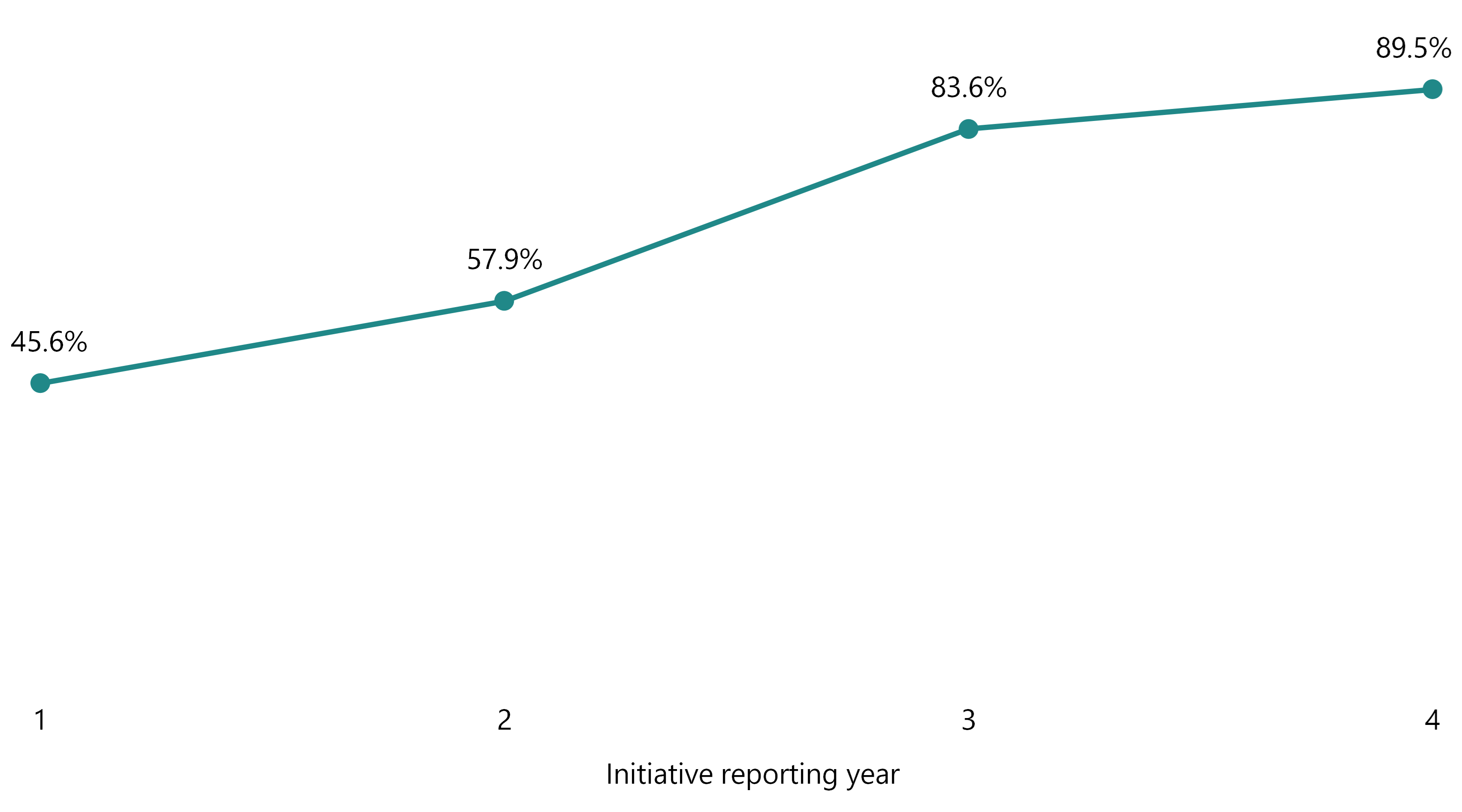
As Figure 6 shows, outcome result reporting rates improve from 45.6 per cent in year one of an initiative to 89.5 per cent by year 4, as data for long-term measures becomes available.
Figure 6: Combined outcome measure result reporting by initiative reporting year
Note: Only includes audited departments.
Source: VAGO, based on DTF’s annual outcomes reports.
In 2024–25, our audited departments had targets and results for 214 outcome measures. Departments met the targets for 181 of these measures (84.6 per cent). This shows that, where data is reported, many initiatives are performing as expected.
Outcomes reporting is evidence-based
Departments’ reported results are generally supported by underlying data, which strengthens confidence in the information used for DTF oversight and government decision-making.
Working well: Outcomes reporting uses reliable data
Our review of 16 initiatives and 73 outcome measures from the 2024-25 reporting cycle had 60 reported results. We found that all of them were traceable to original data sources.
Departments validated 48 results (80.0 per cent). Departments could not fully validate results in the remaining 12 cases (20.0 per cent) because other agencies supplied some or all of the data.
In 19 cases, DH explained how its results link to underlying data and how they were validated. But it did not provide supporting evidence, so we could not independently verify these.
Overall, this shows that outcomes reporting is generally supported by underlying data. Where departments include baselines and targets, they also use relevant evidence to support them. This improves consistency and reliability of reported outcomes and supports evidence-based assessment over time.
Using outcomes reporting to assess performance
DTF has a consistent process to assess departments’ EIIF initiative outcomes reporting and advise the government on whether initiatives are working as intended.
This strengthens evidence based decision making by helping the government identify:
- initiatives that are performing well
- emerging risks
- areas where evidence is still developing.
Working well: DTF uses annual outcomes reporting to inform decision making
We reviewed a selection of 8 EIIF initiatives covering 43 outcome measures. DTF correctly applied its documented process to assess the initiatives' performance in all cases. This includes accurately assessing results against targets and trends over time.
We also reviewed 4 EIIF submissions where DTF used the results from existing EIIF initiatives to inform its advice to the government on new or expanded funding. DTF accurately reflected those results in its advice, which shows that DTF actively uses outcomes reporting to support government decision-making.
But the conclusions that DTF and the government can draw from this assessment are limited by gaps in reported results, targets, and baselines.
While DTF uses outcomes reporting to inform its advice to the government, these gaps mean the government cannot rely on this information to:
- provide a complete picture of reduced service demand
- reassess budget reductions based on changes in service use.
Despite improvements, reporting gaps remain
Gaps in outcomes reporting
Gaps in results, baselines and targets mean that the government does not have a complete view of whether initiatives are improving outcomes and reducing service demand in line with the EIIF’s goals.
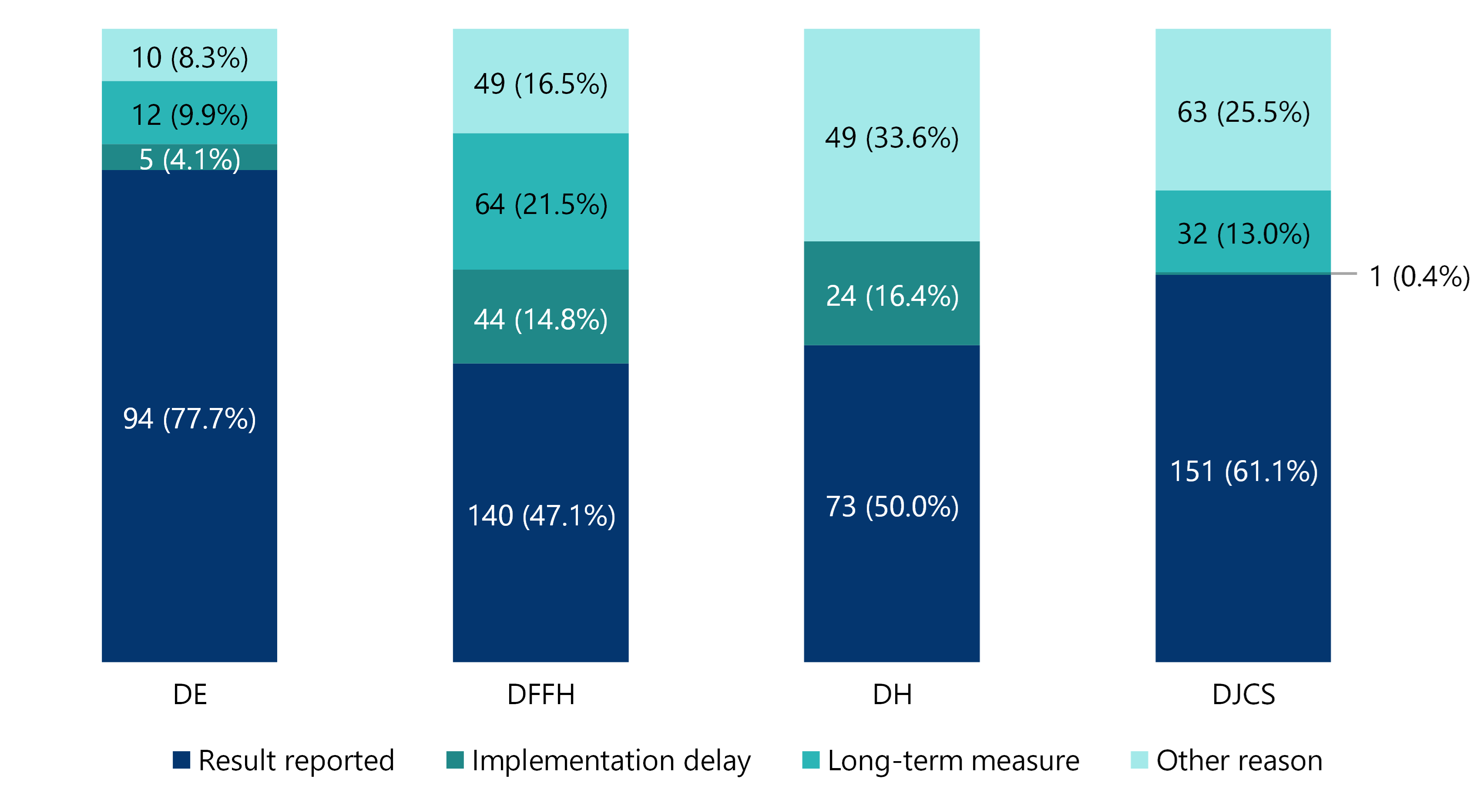
Across 4 reporting cycles, our audited departments have reported results for 458 of 811 outcome measures (56.5 per cent), as Figure 7 shows.
There are often valid reasons for non-reporting. Of the 353 outcome measures without results:
- 108 (30.6 per cent) tracked long-term outcomes that departments cannot measure every year
- 74 (21.0 per cent) related to implementation delays that prevented outcome measurement.
But departments also gave other reasons, such as data collection or process delays, for 171 measures without results (48.4 per cent), which is 21.1 per cent of all 811 outcome measures. This reduces the completeness of evidence available for oversight and comparison across initiatives.
Figure 7: Number and proportion of outcome measure results reported by status and reason
Note: Only includes audited departments. Some totals do not add up to 100 due to rounding.
Source: VAGO, based on DTF’s annual outcomes reports
When departments report outcome results, they do not always reflect complete information. For example, in the 'Specialist forensic mental health services' initiative, DH told us it used health and justice data, but that it could not identify all the initiatives’ participants.
This means its reported outcome results only cover 25.7 per cent of the initiatives’ target group, limiting how confidently the government can interpret results or assess changes in service demand for this cohort.
DTF and departments also use qualitative updates, such as implementation reports, to report on initiatives’ progress. This information is useful, particularly on an individual initiative level. But it does not replace complete and consistent outcome results or help to measure initiatives’ impact on service demand. This also limits its usefulness for assessing the overall achievements of the EIIF as a framework.
Gaps in baseline reporting
Baselines show ‘as-is’ conditions before an initiative starts and are essential for measuring changes over time. Without baselines, departments and the government cannot reliably interpret reported outcomes.
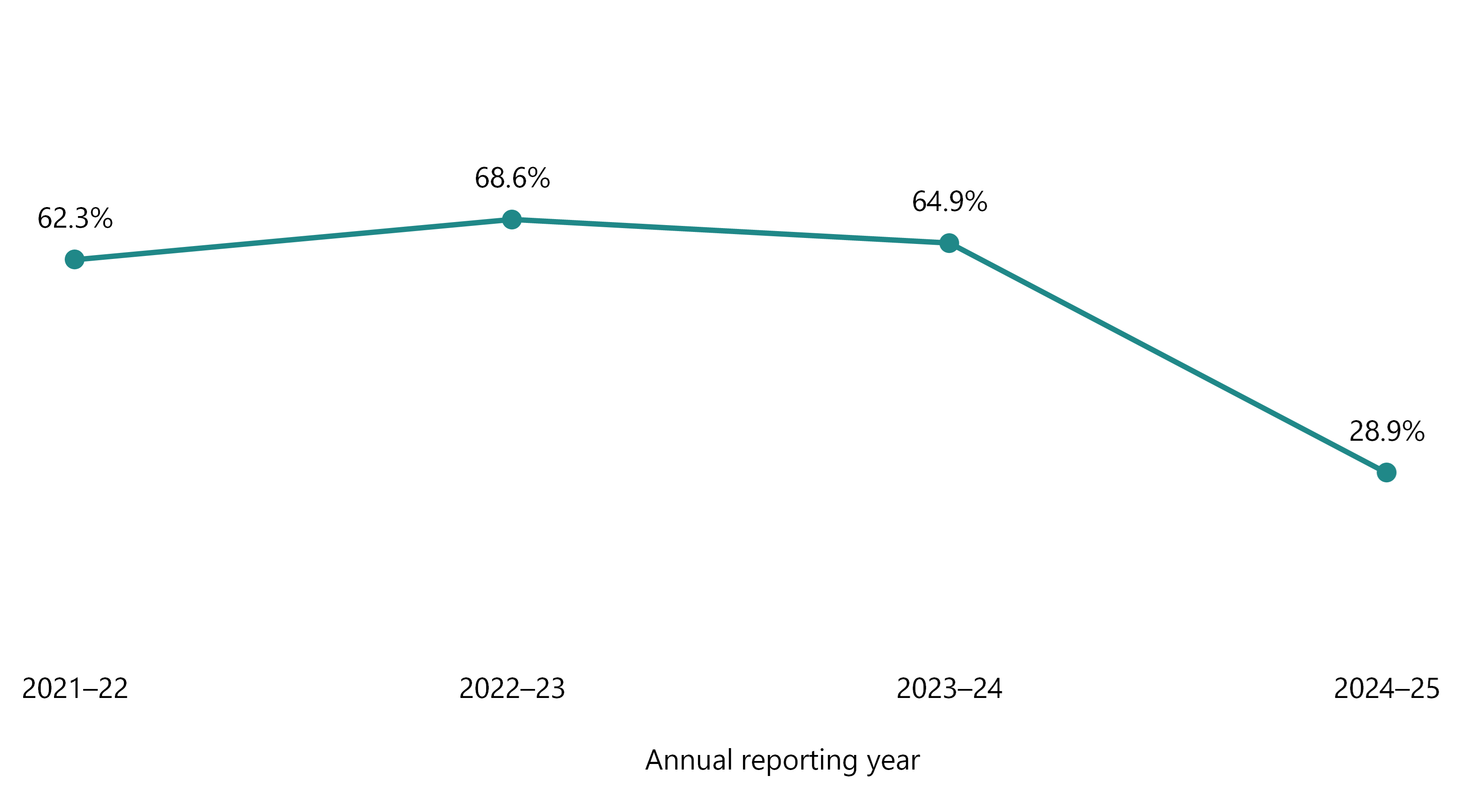
Across 4 reporting cycles, our audited departments reported baselines for 375 of 811 outcome measures (46.2 per cent). As Figure 8 shows, departments’ baseline reporting was steady between 2021–22 and 2023–24, but fell in 2024–25.
Figure 8: Outcome measure baseline reporting by annual outcomes report year
Note: Only includes audited departments.
Source: VAGO, based on DTF’s annual outcomes reports.
The decrease in 2024–25 aligns with DTF updating its definition of a baseline. Earlier DTF guidance required departments to include baselines in their reporting, but it did not define them clearly and allowed departments to use historical or representative data.
From 2024–25, DTF required baselines to show outcomes without the initiative. If departments cannot do this, they appropriately report baselines as ‘not applicable’.
As a result, some:
- new initiatives could not set baselines
- existing initiatives withdrew previously reported baselines that no longer met the definition and reported these as not applicable.
We reviewed a selection of 16 initiatives and 73 related outcome measures reported in 2024–25. Departments did not report baselines for 48 outcome measures (65.8 per cent).
Of these, departments told us they did not report baselines for 38 measures (79.2 per cent) because they could not align with DTF's updated baseline definition.
Fewer reported baselines reduce departments and DTF’s ability to measure changes over time. This means reported results cannot always help to inform DTF and the government’s current and future assessments of initiatives and department funding.
Gaps in target reporting
Targets show if initiatives are performing as expected. They help DTF and the government interpret reported results and understand if outcomes show meaningful change over time.
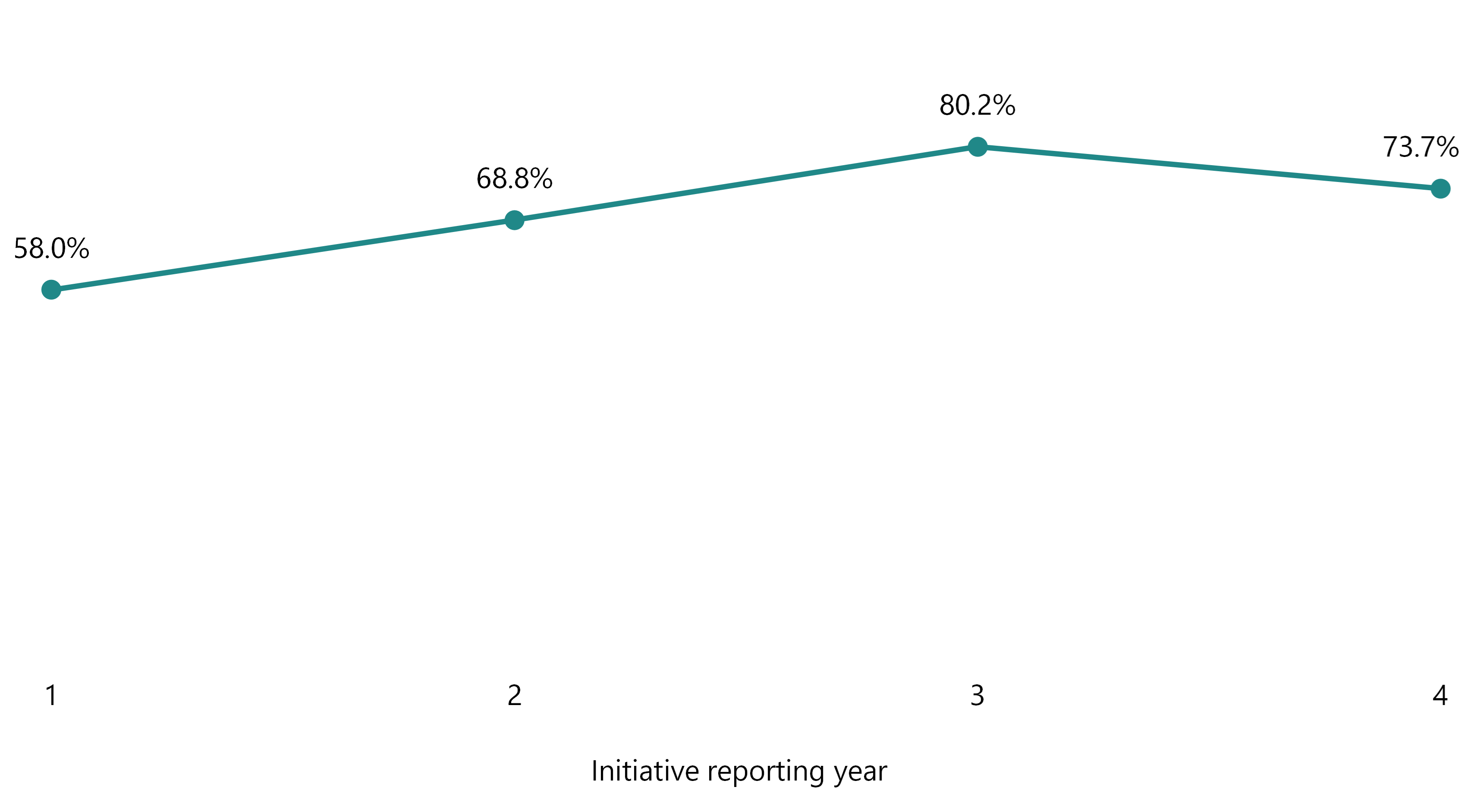
Across 4 reporting cycles, audited departments reported targets for 526 of 811 outcome measures (64.9 per cent). Target reporting generally improves as initiatives mature, as Figure 9 shows.
Figure 9: Combined outcome measure target reporting by initiative reporting year
Note: Only includes audited departments.
Source: VAGO, based on DTF’s annual outcomes reports.
Despite improvements over time, missing targets can still limit DTF’s ability to assess initiatives’ performance consistently across the EIIF.
In our review of 16 initiatives and 73 related outcome measures reported to DTF in 2024–25, departments did not report targets for 28 outcome measures (38.4 per cent).
| We found ... | did not report targets for … | because ... |
|---|---|---|
| DE | 3 measures | the measures tracked long-term impacts, or lacked timely data or suitable comparison groups. |
| DFFH | 4 measures | it was still developing a methodology to measure these outcomes. |
| DH | 18 measures | of data limitations, or because it removed targets that were no longer relevant or used alternative monitoring approaches. DH told us these reasons but did not provide supporting evidence. |
| DJCS | 3 measures | it deferred them while it waited for a program evaluation to start, which is scheduled for 2026–27. |
Some of these reasons reflect real measurement challenges, especially for complex or long-term outcomes where targets may not apply every year.
But where targets are not set, it is harder for DTF and the government to assess if reported outcomes show progress towards reducing service demand as intended. This means they have a limited view of the EIIF’s effectiveness.
Reporting challenges for universal initiatives
Some evidence gaps reflect the design of EIIF initiatives, rather than shortcomings in delivery or effort by departments.
Targeted initiatives with clearly defined participants make it easier to compare outcomes before and after an intervention.
But universal or system wide initiatives apply to whole populations and individual participants cannot be identified. This means departments cannot easily establish what would have happened without the initiative or compare against other cohorts.
For example, the ’Respectful Relationships for children and youth’ initiative aims to reach all students. DE cannot measure what would happen without the initiative, even though DTF’s guidance says this comparison is key to baseline setting.
As a result, outcomes reporting for universal initiatives often focuses on participation or delivery activity, rather than changes in demand for other services.
While this information is valuable for monitoring implementation, it does not provide evidence of long term impact or reduced service use. This means it is not always clear how these initiatives contribute to the EIIF’s goal of reducing service demand and costs over time.
Guidance gaps contribute to incomplete evidence
DTF’s guidance does not always help departments set baselines to show reductions in service demand, including for existing, universal or system wide initiatives.
DTF defines a baseline as what would happen without the initiative. But when departments cannot set such a baseline, DTF guidance does not clearly set out how they could:
- use proxy cohorts to assess changes in demand
- use population level data to test their savings assumptions
- reflect uncertainty in their reporting where they cannot directly measure demand reduction.
DTF’s 2026–27 guidance acknowledges that baselines may not always be possible and suggests that departments use external data to build comparisons. Clearer examples in the guidance would improve consistency and strengthen evidence when departments cannot set baselines.
Without clearer guidance, departments often use other measures, such as service uptake or delivery milestones. These measures track how well an initiative is being delivered, but do not show if they improve outcomes or reduce service demand, as Case study 3 shows.
Some departments use internal tools to establish baselines or negotiate changes with DTF. This helps initiatives to progress, but makes it harder for the government to compare initiatives and assess EIIF initiatives’ performance overall.
DTF’s annual outcomes report also recognises that more detailed data analysis (through program evaluations) can provide deeper insight into service demand and system-level impacts. But this approach is not yet applied consistently across EIIF initiatives and is not integrated into routine reporting.
Case study 3: Insufficient outcome measures
Outcome measures that cannot show long-term impact or reduced service demand
For its ’Early intervention and diversion’ and ’Responding to demand for Child Protection and Family Services’ initiatives, DFFH reported outcome measures such as whether families were engaged with services and if practitioners saw progress towards parenting or behaviour goals.
DFFH does not have baselines for these measures because, in the absence of the program, the services would not otherwise be delivered.
DFFH reported activity based measures for other EIIF initiatives, such as the ’Victorian State Disability Plan’. These measures count activity, such as the amount of assistance provided to help people with disability access healthcare. DFFH reported these measures without baselines because it could not estimate outcomes for people who would not otherwise receive these services without the program.
Some of these measures help DFFH track service delivery, but they are not sufficient on their own to support a meaningful assessment of long term impact or reduced service demand.
DTF guidance does not offer clear alternatives to design baselines in these types of cases.
Source: VAGO.
Data issues limit consistent reporting
Lagged data and alternative reporting approaches
As EIIF initiatives mature and reporting improves, data related challenges still affect the consistency and comparability of reported results across initiatives and over time.
Departments often rely on data that lags behind the reporting year. While this can be unavoidable, inconsistent use of lagged data reduces the relevance and comparability of reported results.
DTF guidance requires departments to report lagged data in the year they collect it, not the year the data refers to. But we found examples of departments not doing this:
- DFFH reported lagged data for its ’Tackling rough sleeping’ initiative and updated earlier results when new data became available.
- DJCS reported the same data for its ’Women's custodial health services’ initiative across multiple years because the data was collected through a survey that is completed only once every 2 years.
If departments cannot report outcome measure results or targets, they sometimes use proxy measures, interim tracking or related outcome measures to understand performance. These approaches can support internal management. But they do not:
- meet the EIIF’s reporting requirements
- show changes in service demand
- support the calculation of actual savings.
Inconsistent reporting practices makes it harder for DTF and the government to compare initiative performance or assess if they are delivering their expected outcomes and savings.
Difficulties maintaining baselines and targets
Even where departments set baselines and targets, they cannot always report them consistently over time. Changes to data systems, measurement methods or external conditions can break year to-year comparison.
For example, changes to the National Assessment Program – Literacy and Numeracy measurement scale in 2023 meant that DE could no longer use its previously reported baselines.
DE instead set up new measures aligned to the revised measurement scale, which could not have baselines that aligned with DTF's definition.
Departments said that participant groups can change for reasons outside their control, including population shifts or broader service system trends. If targets are set against a moving baseline, it becomes harder to see if changes are caused by an initiative’s performance or external factors.
To reflect uncertainty, some departments use ranges in their reporting. In 2024–25, DTF updated its reporting templates and required departments to use single values. This change makes it difficult for departments to compare results over time. Departments manage these issues through explanatory notes or by revising their outcome measures.
But even where departments report outcomes, these issues mean that baselines and targets do not always provide a reliable basis for assessing performance over time, including reductions in service demand or progress towards expected savings.
Public reporting on EIIF initiatives supports transparency
Public reporting supports transparency
Over recent budgets, the government has increased the amount of information publicly reported on EIIF initiatives through Budget papers.
Budget Paper 3 now includes information for each newly funded EIIF initiative. It includes:
- initiative objectives
- total funding
- estimated financial and economic benefits
- key impact areas
- expected participant cohort size.
These changes have improved transparency about what EIIF initiatives aim to achieve and the benefits they are expected to deliver.
But departments and DTF’s annual outcomes reporting is not public. This limits visibility of whether initiatives are delivering outcomes and reducing service demand in practice. It also limits transparency about the performance and impact of the EIIF as a whole, including whether it is achieving its intended outcomes and reducing service demand across the system.
As the EIIF progresses, public reporting of outcomes would help increase transparency and show whether funding decisions and associated budget reductions are supported by evidence of performance.
Appendix A: Submissions and comments
Download a PDF copy of Appendix A: Submissions and comments.

Appendix B: Acronyms and glossary
Download a PDF copy of Appendix B: Acronyms and glossary.
Appendix C: Audit scope and method
Download a PDF copy of Appendix C: Audit scope and method.
Appendix D: Funded EIIF initiatives
Download a PDF copy of Appendix D: Funded EIIF initiatives.