
Timely Payments Performance
Audit Snapshot
Does the government pay its suppliers on time?
Why we did this review
When suppliers do business with Victorian Government agencies, they expect to be paid on time. Paying supplier invoices on time is important for helping businesses manage their cash flow. It also helps to maintain the government's reputation as a reliable business partner.
In 2021, the state government amended the 2004 Victorian Government Fair Payment Policy (the Policy). The Policy applies to 39 agencies, including all government departments. Under the amendment, these agencies must pay invoices for contracts under $3 million within 10 business days. This was to help manage COVID-19 pandemic impacts by providing cashflow certainty.
We did this review to see if agencies are paying on time, and if publicly reported information about payment timeliness is accurate and transparent.
Key background information
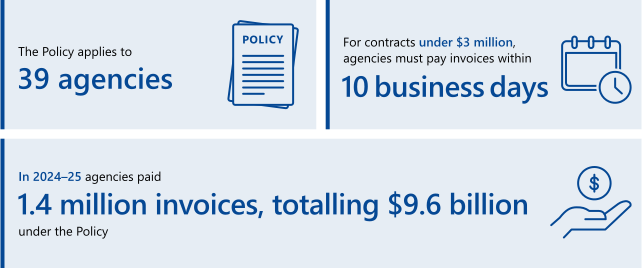
Source: VAGO, based on the Department of Jobs, Skills, Industry and Regions' data and data sent by agencies.
What we concluded
Agencies under the Policy reported collectively that they paid 81.5 per cent of relevant invoices on time in 2024–25. But publicly reported data on payment timeliness is not complete or accurate. We also found opportunities for some agencies to improve their payment processes.
We examined 6 agencies in detail and found differences in:
- the way each agency processes invoices
- starting points they use to measure payment timeliness
- transaction types they include in their reporting.
We found these differences come from different applications and interpretations of the Policy, and limitations in agencies' accounts payable systems and internal processes.
We also found that the Department of Jobs, Skills, Industry and Regions and the Victorian Small Business Commission do not check the data agencies provide to ensure publicly reported data is complete and accurate.
We made 9 recommendations to ensure agencies are capturing accurate, consistent and comparable data.
Data dashboard
View the dashboard full screen
Dashboard data
Our invoice payment timeliness fact sheet
This fact sheet outlines how we manage invoices and pays our suppliers. Paying supplier invoices on time is important to help businesses manage their cashflow. It also helps us maintain our reputation as a reliable business partner.

Download a PDF copy of the fact sheet
1. Our key findings
What we examined
Our review followed 2 lines of inquiry:
1. Does the government pay its private sector suppliers according to contracted or otherwise agreed payment terms?
2. Is the data agencies provide to the Department of Jobs, Skills, Industry and Regions (DJSIR), and published by the Victorian Small Business Commission (VSBC) about their invoices, timeframes and compliance rates reliable and do entities fairly present performance publicly?
To answer these questions, we examined 6 agencies in detail:
- Country Fire Authority (CFA)
- Department of Families, Fairness and Housing (DFFH)
- Department of Health (DH)
- Department of Justice and Community Safety (DJCS)
- DJSIR
- Museums Victoria (MV).
We examined the VSBC and its role with the Policy. We also examined another 6 agencies and included their data in our dashboard. These agencies are not part of the detailed examination in this report:
- Department of Education (DE)
- Department of Energy, Environment and Climate Action (DEECA)
- Department of Government Services (DGS)
- Department of Premier and Cabinet (DPC)
- Department of Transport and Planning (DTP)
- Department of Treasury and Finance (DTF).
We use ‘agencies’ in this report to refer to both government departments and other government agencies under the Policy. This limited assurance review excludes grant payments, as well as inter-government and intra-government payments.
Background information
The Policy
DJSIR develops and oversees the Policy. The VSBC publishes performance results in its annual reports. The amended Policy does not apply to all government agencies. It only applies to 39 agencies, which includes all government departments.
The Policy sets out that agencies should include and follow fair payments clauses in contracts under $3 million. This includes:
- requiring invoices to be paid within 10 business days
- applying penalty interest for late payments if initiated by a supplier
- requiring suppliers to notify agencies when a payment is late to receive penalty interest
- suspending the 10 business day payment terms if there is a dispute.
Penalty interest
Agencies have to pay penalty interest on invoices not paid within 10 business days, at the supplier’s initiation. Penalty interest only applies to late payments from 1 April 2021.
10 business days payment terms
- The 10 business day period starts from the date a correct and complete invoice is received.
- Payment terms do not apply to an incorrect, incomplete or disputed invoice.
- An invoice must also be received by the relevant agency (i.e. the address and recipient details must be correct) for the payment terms to apply.
While the Policy requires invoices to be paid within 10 business days, performance reporting is measured against 14 calendar days.
Victorian Government agencies’ payments to suppliers
In 2024–25, the 39 agencies paid 1.99 million invoices totalling $51.0 billion. Efficient payment systems and processes are critical to manage this volume and value of invoice payments.
Timely payments according to agreed terms are essential for:
- supplier cash flow and business sustainability
- maintaining the government's reputation as a reliable business partner.
The payment terms for individual invoices depend on the contract value. Under the Policy, when an invoice is for a contract up to $3 million, the payment period is 10 business days. For contracts worth $3 million or more, the payment term is 30 days (unless agreed otherwise).
| In 2024–25 agencies paid … | invoices to the value of … | under … |
|---|---|---|
| 1,387,800 | $9.6 billion | the Policy. |
| 603,686 | $41.4 billion | agreed payment terms. |
Source: VAGO, based on DJSIR’s data and data sent by agencies.
What we found
This section focuses on our key findings, which fall into 3 areas:
1. Agencies report mostly paying in line with the Policy, but publicly reported data is not complete or accurate.
2. Payment timeliness is measured differently across agencies, making it difficult to compare performance.
3. Agencies aim to pay suppliers on time, but internal processes and systems have limitations.
The full list of our recommendations, including agency responses, is at the end of this section.
Consultation with agencies
When reaching our conclusions, we consulted with the reviewed agencies and considered their views.
You can read their full responses in Appendix A.
Key finding 1: Agencies report they mostly pay in line with the Policy, but reporting is not complete or accurate
Agencies report that they mostly pay suppliers in line with the Policy
Agencies under the Policy are required to pay invoices for contracts worth under $3 million within 10 business days (which is calculated as 14 calendar days). Overall, in 2024–25, agencies collectively reported that:
- they paid 81.5 per cent of invoices in line with the Policy
- it took an average of 10.8 calendar days to pay invoices.
The average days to pay is different to what is reported by the VSBC. This is because DJSIR calculates its overall average as a simple average by adding up each agency's aggregated results and dividing by the number of applicable agencies. This has been done across all reporting years. To provide a more faithful representation of overall performance, we recommend that DJSIR use a weighted average using the total number of invoices. This accounts for agencies with more invoices. In addition, when preparing our dashboard, some agencies told us that their data was incorrect and provided updated data.
Of the 39 applicable agencies, 29 agencies reported that it took them less than 14 calendar days on average to pay invoices for contracts valued at under $3 million in 2024–25.
This data is presented in our accompanying dashboard and includes data from 2021–22 to 2024–25.
DJSIR and the VSBC do not check the data agencies give them
DJSIR collects payment timeliness data and gives this to the VSBC to include in their annual report. But DJSIR:
- only collects aggregated data from agencies
- relies on what agencies report to DJSIR
- does not know how agencies calculate payment timeliness
- does not verify or check data reported by agencies.
DJSIR told us that agencies are responsible for ensuring they provide complete and accurate data, and that it does not have access to agencies' financial systems to check this data.
We tried to replicate the data reported to DJSIR for the agencies we looked at in detail. We were not able to replicate this data as it was not clear how these agencies identified which data was reportable.
As part of this review, we also produced a dashboard showing agencies’ payment timeliness. When we asked agencies to verify the data they provided to DJSIR, some told us that the data collected and reported by DJSIR was incorrect upon review. For example, agencies have told us that:
- due to system limitations, they used the date on an invoice as the starting point for calculating 10 business days instead of the invoice received date, which would have the effect of understating their performance
- they included more invoices than required in the data because their systems could not identify which invoices were for contracts under $3 million. This obscures actual performance.
We also found issues in the data collected by DJSIR and reported by the VSBC.
| There is no data reported for ... | for … |
|---|---|
| penalty interest accrued in 2024–25. However, these agencies reported no penalty interest accrued. This was incorrectly recorded by DJSIR as a blank space.
|
| Monash Health | 2021–22. Monash Health provided this data, but DJSIR did not record this data and provide it to the VSBC. |
| State Trustees | 2021–22 and 2023–24. |
Key finding 2: The agencies we looked at in detail measure payment timeliness differently, making it difficult to compare performance
As part of this review, we looked at 6 agencies in detail to see how they pay their suppliers and report their performance.
Agencies measure timeliness differently due to different applications and interpretations of the Policy
The Policy requires applicable invoices to be paid within 10 business days from the receipt of a correct and complete invoice. But:
- the Policy does not define ‘receipt’ and ‘correct and complete invoice’
- agencies have different starting points for their payment timeliness reporting.
As shown in Figure 1, CFA and MV measure and report payment timeliness differently from the other agencies we looked at.
Figure 1: Invoice payment timeliness for agencies we looked at in detail
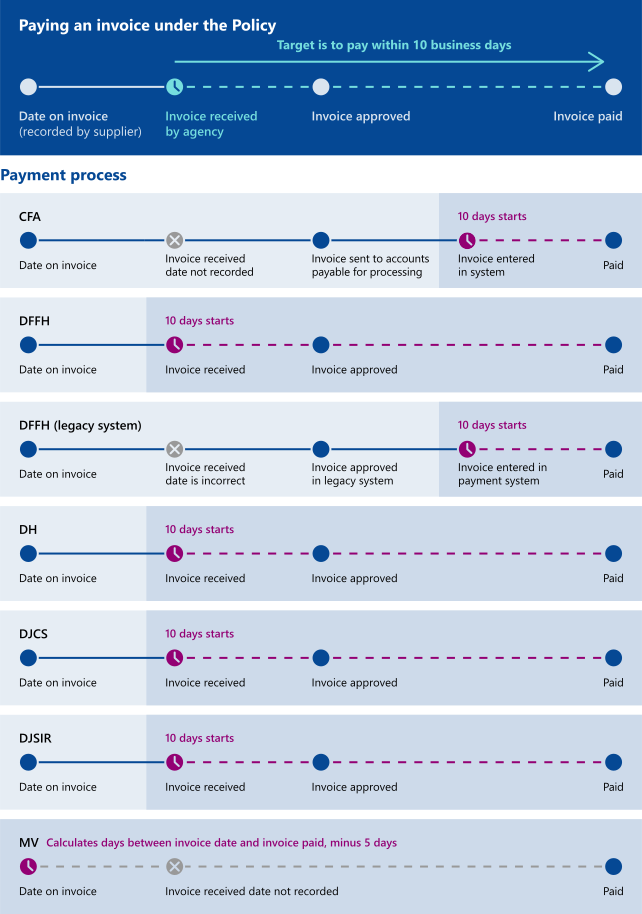
Source: VAGO, based on agency information.
Figure 2 shows how payment timeliness is calculated for MV, CFA and DFFH.
Figure 2: How payment timeliness is calculated for MV, CFA and DFFH
| Agency | Payment timeliness measurement | Outcome |
|---|---|---|
MV
|
| Reported payment times are inaccurate.
|
CFA
| Looking at the time between:
|
|
DFFH
| Looking at the time between when an invoice is received and when an invoice is paid. For invoices processed in its legacy systems, the time an invoice is received is incorrectly showing as when the invoice is approved.
| The payment timeliness reported for invoices processed in its legacy systems is incorrect and under reported. DFFH told us that this accounts for up to 71 per cent of DFFH's transactions.
|
Note: *MV told us that its system cannot record when an invoice is received. To account for the time between the date on an invoice and when an invoice is received, MV does a 5-day adjustment. This 5-day adjustment is also completed to reflect the time it takes to match an invoice to a purchase order and goods received. †This is the time between the invoice date and when an invoice is entered by the accounts payable team. This analysis is for all invoices. There may be a delay between the date on the invoice and when an invoice is received by the agency. There may also be a delay between when an invoice is sent to the accounts payable team and when it is entered.
Source: VAGO.
Some agencies do not collect all required data
Some of the agencies we looked at did not collect all the data required for reporting. For example:
- MV and CFA do not collect data on when a correct and complete invoice is received
- DFFH told us that for most of its invoices, the invoice received date is incorrectly recorded as the date the invoice is entered in its finance system (this is detailed above).
Agencies we looked at in detail report different transactions
The 6 agencies we looked at in detail record and exclude different transactions for their reporting. The Policy is not clear on what transactions should be included.
Figure 3: Transactions included in policy reporting for CFA, MV, DJSIR, DJCS, DH and DFFH
| Agency | Standard supplier invoices | International transactions | Credit card transactions | Payments made to a government agency | Grants |
|---|---|---|---|---|---|
| CFA | ✔ | ✔ | ✔ | ✔ | ✔ |
| MV | ✔ | ✔ | ✖ | ✔ | – |
| DJSIR | ✔ | ✖ | ✖ | ✔ | ✖ |
| DJCS | ✔ | ✖ | ✖ | ✔ | ✔ |
| DH | ✔ | ✔ | ✖ | ✖ | ✖ |
| DFFH | ✔ | ✖ | ✖ | ✖ | ✖ |
Note: DJCS also excludes employee reimbursements and non-supplier manual payments. DH and DFFH exclude client transactions. MV told us that it paid no grants. This is shown as "–".
Source: VAGO.
Key finding 3: The agencies we looked at in detail aim to pay suppliers on time, but their internal processes and systems have limitations
The agencies we looked at in detail demonstrate a commitment to pay on time
All agencies we looked at have changed their internal policies, procedures and contract templates to reflect the Policy requirements. As shown in Figure 4, 4 of the 6 agencies we looked at in detail reported that it took less than 14 calendar days to pay invoices.
Figure 4: Number of calendar days agencies reported they took to pay invoices for contracts under $3 million
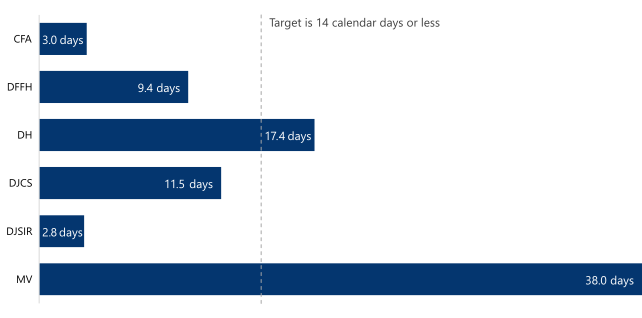
Source: VAGO, based on information from DJSIR.
DJSIR, DH, DFFH and DJCS have also changed their payment systems to meet the requirements of the Policy. Their systems automatically apply a fixed 10-day payment time for all approved invoices. This makes them more likely to pay invoices with contract value over $3 million early, unless adjusted manually.
MV manually applies a 14 calendar day payment term to all invoices. CFA records the agreed supplier payment terms but processes payments as soon as the invoice has been approved and entered to the payment system.
Automated payment systems can help agencies pay on time
The agencies we looked at have different automation levels. DJSIR has the highest automation in its accounts payable function, while MV has the lowest.
At DJSIR:
- invoices are automatically scanned and uploaded into the finance system, which checks that invoices are complete
- invoices are then matched to a purchase order automatically for single-line purchase orders and manually for multi-line purchase orders
- payment is then made automatically.
In contrast, at MV:
- invoices are manually entered into the system
- invoices are manually matched to a purchase order and goods received
- payment is made after automatic batching.
In 2024–25:
- DJSIR reported a 98 per cent compliance rate, taking 2.84 days to pay invoices on average.
- MV reported a 22 per cent compliance rate, taking 38 days to pay invoices on average.
MV told us it has had workforce capacity issues, and its reliance on manual processing has affected its compliance rate.
The significant difference in payment timeliness demonstrates that automated payment systems can help agencies pay on time and comply with the Policy.
Agencies with regional or decentralised payment processes have less visibility over invoice processing
Of the 6 agencies we looked at in detail, DFFH, DH and CFA have a regional and decentralised payment process.
In these agencies, financial delegates in regional offices or business units (for example, CFA's West Region) receive, assess and approve invoices. In CFA, a financial delegate sends invoices to the central accounts payable team for payment once the invoice is confirmed correct and complete.
Accounts payable teams in these agencies have less visibility over payment timeliness. This is because these agencies do not collect data on how long invoice processing takes at the regional or business unit level. For example, these agencies do not know:
- the number of invoices being processed by a regional office or business unit at any one time
- if an invoice is being disputed by the agency
- how long an invoice has been with a regional office or business unit
- the reason for any delays to processing an invoice.
This makes it difficult for agencies to oversee payment timeliness and follow up on invoices that have been delayed.
Addressing these findings
We made 9 recommendations to agencies about ensuring the data they capture is accurate, consistent and comparable.
See Section 2 for the complete list of our recommendations, including agency responses.
2. Our recommendations
We made 9 recommendations to address our findings. The relevant agencies have accepted 7 recommendations and 2 recommendations in principle.
| Agency response(s) | ||||
|---|---|---|---|---|
| Finding: Agencies report they mostly pay in line with the Policy, but publicly available data is not complete or accurate | ||||
Department of Jobs, Skills, Industry and Regions
| 1
| Implement processes to ensure:
| Accepted
| |
Department of Jobs, Skills, Industry and Regions
| 2
| Develop guidance materials and update reporting templates so that agencies need to:
Share and communicate guidance and updated templates to agencies (see Sections 3 and 4).
| Accepted
| |
| Finding: The agencies we looked at in detail measure payment timeliness differently, making it difficult to compare performance | ||||
Department of Jobs, Skills, Industry and Regions
| 3
| Develop guidance materials and update reporting templates to:
Share and communicate guidance and updated templates to agencies (see Section 4).
| Accepted
| |
Department of Jobs, Skills, Industry and Regions
| 4
| Find out how agencies calculate payment timeliness data and:
| Accepted
| |
Victorian Small Business Commission
| 5
| Include an explanation or note in the published data if an agency uses a date other than 'invoice received' to calculate its results (see Section 4).
| Accepted
| |
Museums Victoria
| 6
| Identify ways to automate its accounts payable systems, including the capture of a correct and complete invoice (see Section 4).
| Accepted in principle
| |
Country Fire Authority
| 7
| Implement processes to identify when a correct and complete invoice is received (see Section 4).
| Accepted in principle
| |
Department of Families, Fairness and Housing
| 8
| Explore options to enable the invoice received date to be more accurately reported on for invoices processed in legacy systems (see Section 4).
| Accepted
| |
| Finding: The agencies we looked at in detail aim to pay suppliers on time, but their internal processes and systems have limitations | ||||
Department of Jobs, Skills, Industry and Regions
| 9
| Develop guidance materials so that agencies identify:
| Accepted
| |
3. Reporting on payment timeliness
In 2021, the state amended the Policy. It requires agencies to pay invoices with a contract value up to $3 million in 10 business days.
In 2024–25, agencies reported collectively that they paid 81.5 per cent of invoices on time. On average, it took 10.8 calendar days to pay invoices.
But payment timeliness data collected by DJSIR and published by the VSBC is not checked. We found gaps in the collected data. Agencies also told us, on review, that some of the collected and published data is incorrect.
Covered in this section:
- The Policy
- Agencies report they mostly pay suppliers in line with the Policy
- Published data is not checked
The Policy
Policy requirements
In 2021, the Victorian Government amended the Policy. Agencies covered by the Policy must:
- pay invoices with a contract value of under $3 million in 10 business days
- pay penalty interest on invoices that are not made within 10 business days (at the supplier’s initiation)
- include fair payment clauses in contracts under $3 million.
For more information, see Section 1.
Data collected under the Policy
DJSIR collects the following data from agencies under the Policy:
| For ... | DJSIR collects the ... |
|---|---|
all invoices
|
|
invoices with a contract value of under $3 million
|
|
The Policy and template used to collect this data does not require agencies to attest that the data they provide is complete and accurate. DJSIR gives this data to the VSBC to publish in its annual report. The VSBC's 2024–25 annual report shows payment timeliness by agency. But in previous years, the VSBC only published aggregated data and did not identify each agency's performance.
Agencies report they mostly pay suppliers in line with the Policy
Invoices paid
In 2024–25, agencies covered by the Policy paid 1,991,486 invoices. About 70 per cent of these fell under the Policy's requirement to be paid within 10 business days.
| Applicable agencies paid ... | with a combined value of … |
|---|---|
| 1,991,486 invoices | $51.0 billion. |
| 1,387,800 invoices under the Policy's 10 business day terms | $9.6 billion. |
Overall data
Agencies under the Policy are required to pay invoices for contracts worth under $3 million within 10 business days. To account for weekends, DJSIR assesses agency compliance against 14 calendar days. Overall, in 2024–25, agencies collectively reported that:
- they paid 81.5 per cent of invoices in line with the Policy
- it took 10.8 calendar days on average to pay invoices for contracts under $3 million (see note in Figure 5).
Of the 39 applicable agencies, 29 agencies reported that it took them less than 14 calendar days on average to pay invoices for contracts valued at under $3 million in 2024–25.
Figure 5 shows payment timeliness data from 2021–22 to 2024–25. This data is also included in our dashboard.
Figure 5: Overall compliance with the Policy
| 2021–22 | 2022–23 | 2023–24 | 2024–25 | |
|---|---|---|---|---|
| Percentage of invoices paid on time | 68.2% | 70.2% | 83.3% | 81.5% |
| Average number of calendar days to pay | 18.2 | 19.4 | 12.4 | 10.8 |
Note: The average days to pay is different to the number reported by the VSBC. This is because DJSIR calculates its overall average as a simple average by adding up each agency's aggregated results and dividing by the number of applicable agencies. This has been done across all reporting years. To provide a more faithful representation of overall performance, we recommend that DJSIR use a weighted average using the total number of invoices. This accounts for agencies with more invoices. In addition, when preparing our dashboard, some agencies told us that their data was incorrect and provided updated data.
Source: VAGO.
Published data is not checked
Data collection
DJSIR is responsible for monitoring performance against the Policy and coordinating the annual performance reporting process. To do this, DJSIR requests information from agencies on how quickly they are paying invoices. This includes data on:
- the number and value of invoices paid
- the amount of penalty interest paid due to late payments
- the average number of days taken by the agency to pay an invoice
- the number of invoices paid within 14 calendar days (10 business days).
Agencies provide this information to DJSIR by completing a standardised template. DJSIR consolidates this information in a spreadsheet that is provided to the VSBC for publication in its annual report.
Published data
DJSIR only collects aggregated data from agencies and does not ask for:
- the underlying source data
- how payment timeliness is calculated.
DJSIR relies on the total figures that agencies report, and both DJSIR and the VSBC do not check the data's accuracy or how it is calculated.
DJSIR told us that agencies are responsible for ensuring they provide complete and accurate data, and that it does not have access to agencies' financial systems to check this data.
Incorrect data
As part of this review, we asked agencies to verify the data they provided to DJSIR. Some agencies told us that, on review, some data collected and reported by DJSIR was not accurate. For example, agencies have told us that:
- they used the date on an invoice as the invoice received date
- they could not identify which invoices were for contracts under $3 million.
Issues in data reported
We found issues in the data that was collected by DJSIR and published by the VSBC.
| There is no data reported for ... | for ... |
|---|---|
| penalty interest accrued in 2024–25. However, these agencies reported no penalty interest accrued. This was incorrectly recorded by DJSIR as a blank space. |
| Monash Health | 2021–22. Monash Health provided this data, but DJSIR did not record this data and provide it to the VSBC. |
| State Trustees | 2021–22 and 2023–24. |
4. How agencies calculate timeliness
We looked at 6 agencies in detail to see how they record and report their payment timeliness data. We found that agencies apply and interpret the Policy differently. This makes it difficult to compare agencies’ performance.
Covered in this section:
- How suppliers expect to be paid
- Agencies measure payment timeliness differently
- Some agencies do not collect all data required
- Agencies we looked at in detail report different transactions
How suppliers expect to be paid
Suppliers' expectations
When a supplier sends an invoice to an agency, they expect to be paid promptly.
But different agencies have different business processes, which can impact the length of time it takes in practice to pay invoices.
Figure 6: Invoice payment process under the Policy
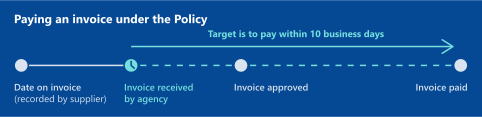
Source: VAGO.
Agencies measure payment timeliness differently
Policy interpretations
The Policy requires applicable invoices to be paid within 10 business days from the receipt of a correct and complete invoice.
But the Policy does not define 'receipt' and 'correct and complete'.
| The term … | could mean ... |
|---|---|
receipt
| when:
|
correct and complete invoice
|
|
Figures 1 and 7 show the differences in how agencies measure payment timelines for the agencies we looked at in detail.
Figure 7: How agencies we looked at in detail measure payment timeliness
| Agency | Timeliness measure | Invoice receipt |
|---|---|---|
DJSIR
| Looking at the time between:
| When an invoice:
|
DJCS
| When an invoice:
| |
DH
| When an invoice is ok to pay. This means:
| |
DFFH
| When an invoice is ok to pay. This means:
But for invoices processed in DFFH's legacy systems, payment timeliness is counted from when an invoice is approved and entered into the main accounts payable system. DFFH has told us that this may account for up to 71 per cent of its transactions.* This means that the payment timeliness reported for invoices processed in its legacy systems is incorrect and under-reported. | |
CFA
| Looking at the time between:
| This excludes the time:
|
MV
| 1. Looking at the time between the invoice date and when an invoice is paid. 2. Subtracting 5 business days from this difference. | Not applicable.
|
Note: *DFFH told us this excludes time for invoices processed in its legacy systems, which are mainly used for managing housing. This means that the payment timeliness reported for invoices processed in its legacy systems is incorrect and under-reported.
Source: VAGO.
Case study 1: CFA invoice processing
How CFA processes invoices
Invoices sent to CFA are generally received by a financial delegate in a regional offices or business unit (for example, its West Region office). The financial delegate then assesses:
- if the invoice is complete and accurate
- if the goods or services have been received.
This period includes time spent clarifying or disputing an invoice. A financial delegate will then send an invoice to the central accounts payable team once it has been approved. The central accounts payable team does not have visibility of these invoices before they are sent to them. The central accounts payable team then enters an invoice into the payment system. It may take several days before the accounts payable team receives an invoice from the regional office or business unit before entering it into the system.
In 2024–25, it took an average of 29.6 days from the invoice date to when an invoice was entered into the system by the accounts payable team (that is, after it has been assessed as complete and correct and ok to pay and send to the accounts payable team).
The time between an invoice date and when an invoice is assessed as complete and correct and approved by payment may be due to factors outside the agency's control. For example, where an invoice is dated incorrectly.
Note: There can be a lag between when an invoice is assessed as complete and correct and ok to pay and when an invoice is sent to the accounts payable team. This analysis is for all invoices paid and excludes values less than zero.
Source: VAGO.
Disputed invoices
The Policy's payment terms do not apply to invoices under dispute. The agencies we looked at deal with, and report on, disputed invoices differently. This means that the way these agencies calculate payment timeliness for disputed invoices is different. For example:
- DJSIR staff put a hold on invoices in dispute, which stops the time used to calculate invoice payment timeliness. If the invoice is not cancelled, the original date the invoice is received is used to calculate payment timeliness.
- DH staff handle disputed invoices differently, depending on business units. Some staff enter an invoice into the accounts payable system after a dispute has been resolved, other staff enter an invoice that is in dispute into the accounts payable system and place a hold on the invoice. This means that staff either enter the date an invoice is resolved or the original date an invoice is received. This date is then used to calculate payment timeliness.
- generally, CFA staff deal with and resolve disputed invoices at a regional level. Once an invoice is resolved, staff send this invoice to the central accounts payable team, which then enters the invoice into its accounts payable system. As discussed above, this date is used to calculate payment timeliness.
Some agencies do not collect all data required
Required data
The Policy requires agencies to measure and report on payment timeliness, calculating from the date of receipt of a correct and complete invoice to the date an invoice is paid.
Some of the agencies we looked at did not collect all the payment data the Policy requires. For example, MV and CFA do not collect data on when a correct and complete invoice is received:
- MV has told us that this information is not available in its system
- CFA records when an invoice is entered into its system by the accounts payable team. This is after a financial delegate has assessed an invoice as correct and complete and ok to pay. But there might be delay in when an invoice is assessed, when an invoice is sent and when an invoice is entered. This means that this date captured may not always be accurate.
DFFH captures when a correct and complete invoice is received. But DFFH told us that for invoices processed in its legacy systems, the time an invoice is received is incorrectly showing as when the invoice is approved. DFFH has told us that this accounts for up to 71 per cent of DFFH's transactions.
This has meant that agencies collect different data and makes it difficult to compare performance across agencies.
Agencies we looked at in detail report different transactions
Reported transactions
The Policy was established to support small businesses. According to the Australian Bureau of Statistics, small businesses are defined as businesses employing less than 20 people. These make up approximately 98 per cent of businesses in Victoria.
However, the Policy is not clear on what transactions should be included or whether only payments to small businesses are covered. As shown in Figure 3, the agencies we looked at record and exclude different transactions for their reporting. These differences make it difficult to compare the performance of these agencies.
5. How agencies pay invoices
We looked at 6 agencies in detail to see how they process and pay invoices. This section contains case studies which look at the business practices that support agencies to pay their invoices on time.
Covered in this section:
- Agencies show a commitment to pay on time
- Automated payment systems can help agencies pay on time
- Agencies with regional or decentralised payment processes have less visibility over invoices
Agencies show a commitment to pay on time
Internal policies, procedures and templates
Most agencies we looked at in detail have changed their policies, procedures and templates to reflect the requirements of the Policy. As shown in Figure 8:
- all agencies we looked at have changed their internal policies, procedures and templates to reflect the requirements of the Policy
- not all contracts we reviewed contained all of the Policy clauses required.
Figure 8: Alignment of internal policies, procedures and templates to the Policy for the agencies we looked at
| Agency | Policies and procedures | Contract templates | Contract review |
|---|---|---|---|
| DJSIR |  Partially compliant: internal policy has inconsistent information and states that:
|  Compliant: relevant contract templates contain a 30-day payment term. During our review, DJSIR updated these templates to reflect the Policy requirements. |  Non-compliant: 8 of 8 contracts reviewed did not contain all of the Policy clauses required.* |
| DFFH | Compliant: all elements of the Policy included in internal policies and procedures. | Compliant: all elements of the Policy in relevant contract templates. | Partially compliant: 2 of 3 contracts reviewed had all of the Policy clauses required. |
| DH | Compliant: all elements of the Policy included in internal policies and procedures. | Compliant: all elements of the Policy in relevant contract templates. | Compliant: all contracts reviewed had all of the Policy clauses required. |
| DJCS | Compliant: all elements of the Policy included in internal policies and procedures. | Compliant: all elements of the Policy in relevant contract templates. | Compliant: all contracts reviewed had all of the Policy clauses required. |
| MV | Compliant: all elements of the Policy included in internal policies and procedures. | Compliant: all elements of the Policy in relevant contract templates. | Compliant: all contracts reviewed had all of the Policy clauses required. |
| CFA | Partially compliant: internal policy and procedure states that staff must follow the Policy. But these documents do not detail what these requirements are. | Compliant: all elements of the Policy in relevant contract templates. | Partially compliant: 6 of 7 contracts reviewed had all of the Policy clauses required. |
Note: During our review, DJSIR had non-compliant contract templates. These templates contained a 30-day payment term. DJSIR later fixed these templates.
Source: VAGO.
Payment system changes
Agencies we looked at took different approaches to help them pay invoices in line with the Policy. As shown in Figure 9, all agencies have made changes to their payment system or processes to meet the Policy requirements. In particular:
- DJSIR processes all approved invoices immediately, regardless of agreed payment terms
- CFA records the agreed supplier payment terms but pays invoices as soon as an invoice is assessed and approved
- DH, DFFH and MV apply the same payment term for invoices for contracts over $3 million. This means that invoices may be paid early. DJCS adjust invoice payments to match the agreed payment terms. This means that invoices are likely paid on time.
Figure 9: How agencies we looked at arrange invoice payment time
| Agency | Applied payment term for Policy invoices | Applied payment term for non-Policy invoices | Payment timeliness for Policy invoices | Payment timelines for non-Policy invoices* |
|---|---|---|---|---|
| DJSIR | Immediate automatic daily payment run | Immediate automatic daily payment run | Early | Early |
| CFA† | As soon as an invoice is assessed and approved | As soon as an invoice is assessed and approved | Early | Early |
| DJCS | Automatic payment in 10 calendar days | Adjusted manually when required | On time | On time |
| DH | Automatic payment in 10 business days | Adjusted manually if the payment term is less than 10 business days | On time | Early |
| DFFH | Automatic payment in 10 business days | Adjusted manually if the payment term is less than 10 business days | On time | Early |
| MV | Scheduled for payment in 14 calendar days | Adjusted manually if the payment term is in less than 14 calendar days | On time | Early |
Note: *This is if invoices are approved in a timely manner. †CFA advised that it has transitioned to a new financial system in June 2025. The new system has a higher automation level and captures additional information, including the date written on invoices, goods received date and invoice date.
Source: VAGO.
Automated payment systems can help agencies pay on time
Systems used to pay invoices
The agencies we looked at have different levels of automation. Of the agencies we looked at, DJSIR’s system was the most automated. MV’s system was the least.
Working well: DJSIR’s payment systems are highly automated
In DJSIR, an invoice is automatically processed if the invoice has a purchase order number. The system then checks if the invoice:
- is correctly addressed to DJSIR with the right ABN
- is GST compliant
- has the correct purchase order number.
Once this is done the system automatically matches the invoice to a purchase order for single-line purchase orders. But this is done manually for multi-line purchase orders. The system then sends a request to approve the invoice to the relevant contact in DJSIR. The system additionally sends automated reminders if an invoice has not been actioned. Once approved, the invoice is automatically scheduled for payment.
DJSIR has automation in all of its invoice payment steps. In contrast, most of these steps are performed manually at MV. In 2024–25:
- DJSIR reported that it took 2.8 days to pay relevant invoices and had a 98 per cent compliance rate
- MV reported that it took 38 days to pay relevant invoices and had a 22 per cent compliance rate. MV has told us that it has had workforce capacity issues, and that this has affected its compliance rate.
As discussed in Section 4, these agencies report payment timeliness differently. But the large difference in timeliness demonstrates automated payment systems can help agencies pay on time.
Agencies with regional or decentralised payment processes have less visibility over invoices
Invoice visibility
DFFH, DH and CFA have a regional and decentralised payment process. In these agencies, financial delegates in regional offices or business units (for example, CFA's West Region) receive, assess and approve invoices. In CFA, financial delegates send invoices to the central accounts payable team once the invoice is confirmed correct and complete.
These agencies do not have visibility of how regional offices or business units are processing invoices. For example, these agencies do not know:
- the number of invoices being processed by a regional office or business unit at any one time
- if an invoice is being disputed by the agency
- how long an invoice has been with a regional office or business unit
- the reason for any delays to processing an invoice.
Case study 2: DJCS and DJSIR invoice oversight
DJCS and DJSIR have more oversight over their invoices
DJCS and DJSIR have a more central payment process compared to DFFH, DH and CFA. At DJCS and DJSIR, the accounts payable team and system generally receive invoices before the relevant financial delegate’s approval.
This allows for DJSIR and DJCS to oversee all invoices, including disputed invoices, and to follow up on invoices that are pending approval. For example:
- DJSIR told us that automated emails are sent to financial delegates if approvals are not completed and that the accounts payable team sends weekly unapproved invoice reports if invoices are not approved
- at DJCS, the accounts payable team sends weekly emails for unapproved invoices.
Source: VAGO.
Appendix A: Submissions and comments
Download a PDF copy of Appendix A: Submissions and comments.
Appendix B: Abbreviations, acronyms and glossary
Download a PDF copy of Appendix B: Abbreviations, acronyms and glossary.
Appendix C: Review scope and method
Download a PDF copy of Appendix C: Review scope and method.
Appendix D: Agencies under the Policy
Download a PDF copy of Appendix D: Agencies under the Policy.
Appendix E: Policy performance data
Download a PDF copy of Appendix E: Policy performance data.